
Table of Contents
Table of Contents
Searches for continuous compliance evidence streaming usually come from teams that are past the spreadsheet phase of governance. The company already runs critical workloads on event streams. Security, finance, data platform, and application teams already need proof that controls are working. The problem is that audit evidence still arrives as screenshots, tickets, exported logs, weekly reviews, and after-the-fact attestations.
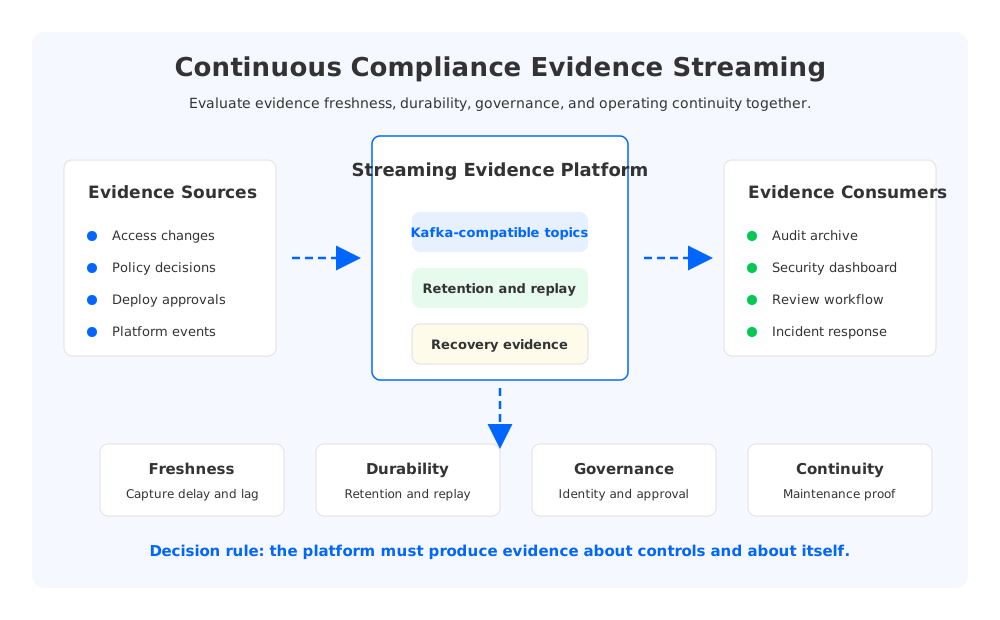
Streaming platforms change the evidence model because they can carry the operational record while the business process is still happening. A control event can be produced when an ACL changes. A configuration drift signal can be captured when infrastructure changes. A data quality result, schema change, deployment approval, or access review outcome can be retained as an ordered event rather than reconstructed later. That is the promise behind continuous compliance evidence streaming.
The harder question is whether the platform that carries the evidence is itself trustworthy enough to be part of the control environment. A Kafka-compatible streaming platform can provide durable topics, ordered partitions, consumer groups, offsets, transactions, and ecosystem integration. Those primitives do not automatically solve retention cost, tenant isolation, access governance, deployment boundaries, or recovery evidence. The architecture has to make those properties observable.
1Why Continuous Evidence Belongs in the Stream
Compliance evidence is often treated as a reporting layer above production systems. That works when controls change slowly and auditors only need periodic samples. It breaks down when infrastructure is elastic, permissions are managed by automation, and data moves across many services. In that environment, useful evidence is not a quarterly snapshot. It is the history of who changed what, which policy evaluated the change, what data moved, and whether the platform stayed inside its operating constraints.
A streaming architecture fits this shape because evidence has the same core properties as event data:
- Time order matters. A policy approval after a data export is different from an approval before the export.
- Replay matters. Auditors, incident responders, and data owners may need to rebuild the sequence from a known offset.
- Fan-out matters. The same evidence event may feed dashboards, SIEM tools, data catalogs, workflow systems, and long-term archives.
- Retention matters. Some evidence needs short operational visibility; some needs durable retention for formal review.
- Integrity matters. The platform must show that evidence was not silently lost, skipped, or overwritten.
Kafka is frequently used for this kind of fan-out because producers and consumers can remain decoupled. Apache Kafka documentation describes records, topics, partitions, consumers, offsets, and transactions as core concepts for streaming applications. In a compliance evidence pipeline, those primitives define the chain of custody for the evidence itself.
The first design rule is to separate the evidence stream from the reporting experience. Dashboards can change. The underlying evidence topics should remain durable, queryable, and governed. A report answers one question at one point in time. An evidence stream preserves the facts needed to answer many questions later.
2The Production Constraints Behind the Search
The search intent behind continuous compliance evidence streaming is rarely about a single tool. It is about a production constraint that has become visible. The platform team may be asked to prove that access changes are captured within minutes. Data engineering may need lineage events for every pipeline deployment. SREs may need to show that broker maintenance did not interrupt evidence collection. The CTO may need sensitive data to stay inside the company's cloud account.
Those requirements expose several constraints that traditional Kafka deployments often make expensive:
| Constraint | What the compliance team asks for | What the platform team must prove |
|---|---|---|
| Evidence freshness | Control events are captured close to the action | Producer latency, ingest availability, and consumer lag stay inside defined SLOs |
| Evidence durability | Evidence is retained and replayable | Topic retention, replication, storage recovery, and deletion policy are observable |
| Access accountability | Changes to users, ACLs, topics, and services are traceable | Admin operations, IAM paths, and audit logs map to stable identities |
| Operating continuity | Maintenance does not create blind spots | Broker replacement, scaling, and upgrades preserve produce and consume paths |
| Deployment boundary | Data remains under the expected cloud and network controls | VPC, private connectivity, object storage ownership, and support access are documented |
The last row is easy to underestimate. Compliance evidence is not only about records in the topic. It is also about where the platform runs, who can operate it, how logs are exported, how encryption keys are managed, and how emergency access is approved. Managed service, BYOC, and self-managed software models can all be valid choices, but they create different evidence trails.
This is why a streaming compliance architecture should be evaluated as a control system, not as a message bus with audit logs attached. The platform has to produce evidence about business controls and itself.
3Architecture Patterns Teams Usually Compare
Most teams compare three patterns before they settle on a compliance evidence platform.
The first pattern is application-owned evidence capture. Each application emits audit events into Kafka topics, often with schemas that reflect the local domain. This is flexible and close to the source, but evidence quality depends on every application team following the same rules. It can also leave platform-level events, such as topic creation, ACL changes, and broker maintenance, outside the application domain.
The second pattern is centralized governance collection. Infrastructure logs, IAM events, CI/CD approvals, data catalog changes, and platform metrics flow into a common pipeline. This gives security and governance teams a consistent view, but it can become a bottleneck if treated as a batch log sink rather than a real-time evidence stream.
The third pattern is streaming control-plane evidence. Evidence events are modeled as first-class streams with schemas, producer ownership, consumer ownership, retention classes, dead-letter handling, and replay procedures. The goal is not to put every audit artifact into Kafka forever. It is to make the stream canonical for evidence that benefits from ordering, fan-out, and timely processing.
These patterns often coexist. Application teams emit domain evidence. Platform teams emit infrastructure and policy evidence. Governance teams consume, enrich, and archive the combined stream. Risk appears when the Kafka platform is stateful in ways that make retention, scaling, and recovery hard to prove.
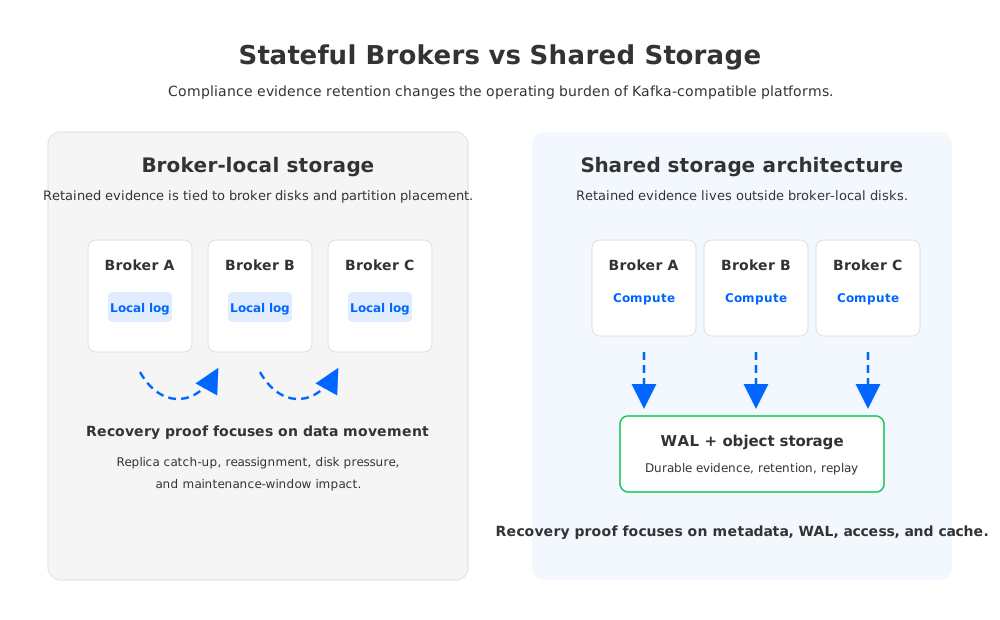
Apache Kafka's classic Shared Nothing architecture stores partition replicas on broker-local disks. Replication and ISR behavior are central to Kafka durability, but broker-local storage also couples retained data to broker capacity, partition placement, and recovery operations. For evidence streams, that coupling shows up in practical questions: Can we retain evidence without over-provisioning broker disks? Can we replace a broker without a long data movement event? Can we prove the pipeline stayed available during infrastructure maintenance?
Tiered Storage changes part of that equation by moving older log segments to remote storage while brokers continue to manage the active local log. It can help long-retention topics, especially when historical replay is less frequent than current ingest. It does not remove the need to reason about active log recovery, remote log metadata, and scaling behavior.
Shared Storage architecture goes further by moving durable stream data out of broker-local disks and into shared storage, usually object storage with a write-ahead layer for performance and recovery. That does not remove governance work. It changes the evidence the platform must collect: object storage access, WAL health, metadata consistency, cache behavior, private network paths, and cloud IAM become first-class control evidence.
4A Vendor-Neutral Evaluation Checklist
The right question is not "Which Kafka service has compliance features?" It is "Can this architecture produce the evidence we would rely on during an audit, incident, or customer review?"
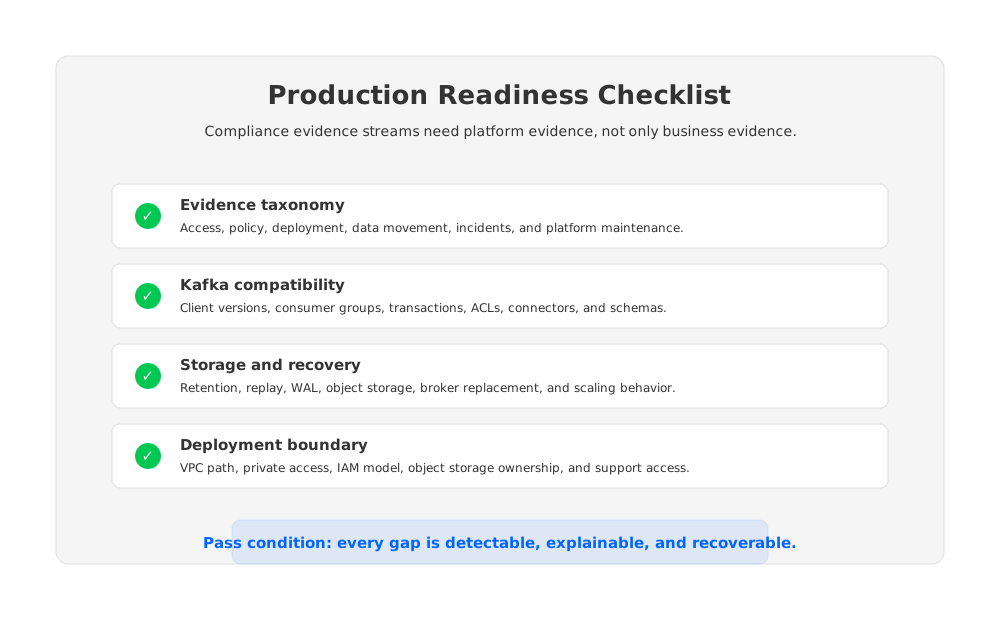
Start with the evidence model:
- Event taxonomy. Define evidence event types for access changes, policy decisions, configuration changes, data movement, deployment approvals, incidents, and platform maintenance.
- Schema governance. Give evidence topics stable schemas and versioning rules so downstream systems can trust the event shape.
- Producer accountability. Every evidence event should have an owning system, identity context, timestamp source, and validation path.
- Consumer accountability. Dashboards, archives, alerting systems, and review workflows should commit offsets and expose lag.
- Retention classes. Separate operational evidence from formal review evidence so short-lived signals do not crowd out long-retention records.
Then test the platform under production-shaped pressure. A compliance evidence pipeline that only works when traffic is low is not a control. Run broker maintenance, scaling, credential rotation, schema changes, and consumer replay while the evidence workload is active. Measure producer errors, request latency, consumer lag, topic availability, and archive completeness.
Governance teams should also insist on negative evidence. The platform should expose missing producers, schema validation failures, failed deliveries, replay gaps, denied access attempts, and delayed consumers. Controls are more credible when failure modes are visible.
A continuous evidence platform is useful only if it can explain both what happened and why a gap would have been detected.
Finally, validate the deployment boundary. If the organization needs customer-controlled infrastructure, verify where brokers, control planes, observability collectors, object storage, encryption keys, and support paths live. If the organization uses private connectivity such as AWS PrivateLink or cloud-native private endpoints, capture that network path as part of the evidence model.
5Where AutoMQ Changes the Operating Model
After the neutral evaluation, AutoMQ becomes relevant for teams that need Kafka compatibility but do not want retained evidence data tied to broker-local disks. AutoMQ is a Kafka-compatible, cloud-native streaming platform built around Shared Storage architecture. Its documentation describes preserving Kafka protocol compatibility while replacing Kafka's native log storage with S3Stream, a shared streaming storage layer backed by WAL storage and S3-compatible object storage.
That difference matters because evidence topics tend to combine steady ingest, long retention, fan-out, and strict recovery expectations. In a broker-local model, longer retention increases the amount of data bound to broker storage and partition placement. In a shared-storage model, brokers still handle compute responsibilities, caching, metadata, leadership, and client traffic, but durable retained data is not owned by a specific broker disk.
The operating model changes in four ways:
- Retention planning becomes less tied to broker disks. Teams can evaluate retained evidence data against object storage policy, lifecycle, and access controls rather than sizing every broker for the retained log footprint.
- Broker replacement becomes easier to evidence. The test shifts from rebuilding large local replicas toward proving WAL safety, metadata correctness, object-store access, and cache warm-up.
- Elasticity becomes part of the control story. Scaling capacity no longer needs to imply large partition data movement, which helps teams prove continuity during maintenance and traffic spikes.
- BYOC boundaries become inspectable. In AutoMQ BYOC environments, public documentation describes deployment into customer cloud infrastructure, with data plane systems in the user's network environment. That can be relevant when compliance requirements emphasize data isolation and customer-controlled resources.
This does not make architecture review optional. A Shared Storage architecture must be tested under the evidence workload. Platform teams should validate Kafka client behavior, ACL and identity integration, transaction usage where applicable, consumer group recovery, object storage permissions, WAL behavior, metadata scale, and private network routing.
The value of AutoMQ in this context is narrower than "shared storage is always preferable." When Kafka-compatible semantics matter, evidence retention is growing, cloud operating cost matters, and broker-local state makes recovery evidence harder to produce, a shared-storage design deserves evaluation.
6Decision Table for Platform Teams
Use the following table to choose the next step before starting a proof of concept.
| Situation | Likely next step | Evidence to collect |
|---|---|---|
| Evidence is still collected through tickets and exports | Standardize evidence event taxonomy and topic ownership | Event schema, producer identity, timestamp source, and consumer commitments |
| Kafka already carries evidence but retention is expensive | Evaluate retention classes and remote or shared storage options | Retained bytes by topic, replay frequency, deletion policy, and archive path |
| Broker maintenance creates evidence blind spots | Test replacement and scaling under evidence workload | Produce errors, consumer lag, controller stability, and archive completeness |
| Compliance requires customer-controlled infrastructure | Compare self-managed, BYOC, and managed deployment boundaries | VPC path, IAM model, object storage ownership, support access, and logs |
| Application compatibility is the main risk | Prioritize Kafka compatibility tests before storage migration | Client versions, transactions, consumer groups, connectors, ACLs, and schemas |
The strongest designs are usually boring to operate. Evidence events arrive continuously, consumers can replay from known offsets, failed producers are visible, retention policy is explicit, and platform maintenance produces its own audit trail. That gives compliance teams something better than a report: a living record.
For teams evaluating Kafka-compatible Shared Storage architecture, AutoMQ's architecture overview and GitHub project are starting points. A proof of concept should pick two or three evidence topics, define the recovery evidence you would show an auditor, and test maintenance and replay together.
7References
- Apache Kafka Documentation
- AutoMQ Architecture Overview
- AutoMQ Compatibility with Apache Kafka
- AutoMQ S3Stream S3 Storage
- AutoMQ BYOC Environment Overview
- AWS PrivateLink Documentation
8FAQ
8.1What is continuous compliance evidence streaming?
Continuous compliance evidence streaming is the practice of capturing control evidence as ordered events while business and platform operations happen. Instead of reconstructing evidence from periodic exports, teams produce events for access changes, policy decisions, deployment approvals, data movement, quality checks, and platform maintenance.
8.2Why use Kafka for compliance evidence?
Kafka-compatible platforms provide durable topics, ordered partitions, replay through offsets, consumer groups, and broad ecosystem integration. Those capabilities are useful when evidence must be distributed to dashboards, archives, alerting systems, and review workflows without coupling every producer to every consumer.
8.3Is a streaming platform enough for audit readiness?
No. The platform is one part of the control system. Teams still need event taxonomy, schema governance, access controls, retention policy, archive procedures, monitoring, ownership, and review workflows. The streaming platform should make those controls easier to prove, not replace them.
8.4How does Shared Storage architecture help evidence pipelines?
Shared Storage architecture moves durable stream data away from broker-local disks. For evidence pipelines with long retention and strict continuity requirements, that can reduce the amount of retained data tied to broker replacement, scaling, and partition movement. Teams still need to validate WAL behavior, object storage access, metadata correctness, and cache warm-up.
8.5When should AutoMQ be evaluated?
Evaluate AutoMQ when Kafka compatibility is required and the evidence platform is constrained by broker-local storage, retention cost, scaling windows, recovery evidence, or customer-controlled deployment boundaries. The proof should use real evidence topics and include maintenance, replay, access-control, and failure-mode tests.


