
Table of Contents
Table of Contents
Someone searching for schema migration sequencing kafka is usually past the whiteboard phase. The team already knows a schema change has to land near a Kafka migration, a cluster upgrade, or a move to a Kafka-compatible platform. The hard part is no longer whether Avro, Protobuf, or JSON Schema can express the next version. The hard part is knowing which application contract breaks if a producer, registry subject, topic, offset, connector, or downstream table moves in the wrong order.
That is why a contract dependency map is more useful than a generic migration checklist. A checklist tells you to verify schemas, consumers, offsets, security, and rollback. A dependency map shows which of those checks must happen before another team can safely change behavior. The difference matters during a cutover window, when "the schema is compatible" is not enough if the consumer group starts from the wrong Offset or a sink connector writes duplicate rows.
The practical thesis is simple: schema migration sequencing in Kafka should be planned as a graph of contracts, not as a linear list of deployment steps. Once that graph is visible, platform architecture becomes easier to evaluate because each choice can be judged by how it reduces contract coupling, data movement, and rollback ambiguity.
1Why schema sequencing becomes a contract problem
Kafka lets teams evolve independently because Producers and Consumers share a durable log instead of direct request paths. That independence disappears during migration if the shared contract is treated as only a schema-registry entry. A Record carries a key, value, timestamp, headers, Partition, Offset, and ordering position. The Producer owns serialization and key choice. The Broker preserves the log. The Consumer owns deserialization, committed progress, and side effects in systems Kafka does not control.
Those responsibilities form a contract chain. The chain is usually stable enough that nobody names it, which is exactly why migrations expose it. The next schema version may be backward-compatible, but the target cluster may have a different Topic name, different Partition count, missing ACL, different registry subject naming, or incomplete Consumer group progress. Each mismatch moves the failure from "schema validation" into production behavior.
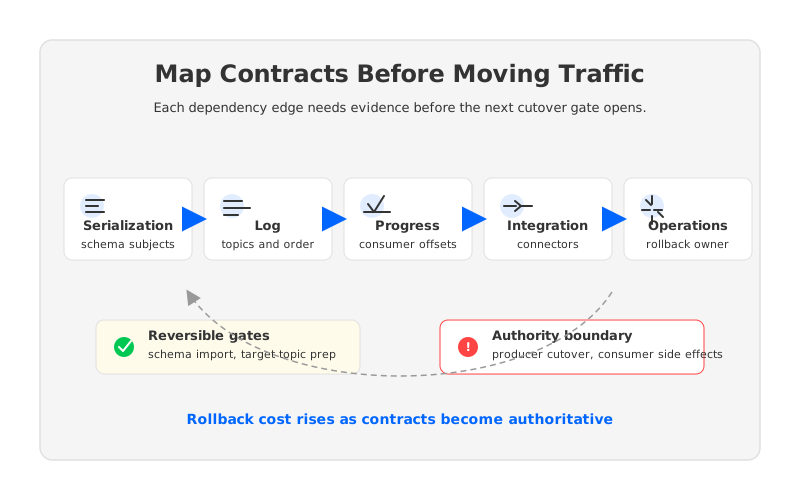
The clean way to start is to map five contract surfaces before any cutover step:
- Serialization contract: schema subjects, compatibility mode, serializer configuration, schema IDs, and ownership of schema publication.
- Log contract: Topic names, Partition count, key distribution, ordering assumptions, retention, compaction, and headers.
- Progress contract: Consumer group IDs, committed Offsets, replay boundaries, transactional markers, and idempotency behavior downstream.
- Integration contract: Kafka Connect workers, source and sink connectors, schema converters, dead-letter topics, and external write targets.
- Operational contract: access control, network path, observability, capacity, rollback owner, and incident decision rights.
The order above is conceptual, not procedural. Teams can prepare several surfaces in parallel, but they should not promote a later surface while an earlier one is still ambiguous. A Consumer cutover is unsafe if the log contract is unsettled. A producer cutover is unsafe if rollback would create two authoritative write paths without a reconciliation rule.
2The graph shows where rollback gets expensive
Rollback is often described as if it were a button. In Kafka migrations, rollback is a boundary in the dependency graph. Before a Producer starts writing to the target path, rollback may be a configuration change. After some Consumers have read from the target and written side effects, rollback becomes a data reconciliation problem. After a connector has delivered records into a warehouse or database, replay may be safe for Kafka and unsafe for the destination.
That is why the map should label each edge with the cost of reversing it. Some edges are low-friction: importing a schema subject into a target registry can be undone if no application depends on it. Some edges are medium-cost: moving a Producer can be reversed if the source path still accepts writes and the target records have not become authoritative. Some edges are expensive: moving Consumers that write non-idempotent side effects forces the team to reason about duplicates, gaps, and downstream state.
The dependency map also prevents a common planning error: treating replication success as contract success. MirrorMaker2, Kafka Connect, or a platform-specific migration tool can move records, but copied bytes do not prove that a Consumer can deserialize, resume, and produce the same business effect. The contract test has to include the client behavior and the external state touched by the client.
| Dependency edge | Reversible until | Evidence to collect | Failure if skipped |
|---|---|---|---|
| Schema subject to Producer | Producers publish records using the new serializer | Representative records encode and decode under expected subject naming | Records arrive with schema IDs or subjects Consumers do not resolve |
| Topic to Consumer group | Consumers commit progress on the target path | Committed Offsets map to readable target records | Consumers replay too much, skip records, or duplicate side effects |
| Connector to destination | Sink writes become visible to downstream systems | Destination idempotency and dead-letter behavior are tested | Kafka rollback succeeds while the database or lake table stays inconsistent |
| Producer path to rollback path | Target writes become authoritative | Source retention, target retention, and write ownership are documented | Both clusters contain valid-looking but divergent event histories |
This table is deliberately operational. It gives migration owners a way to say "not yet" without sounding like they are blocking progress. The gate is not personal preference. The gate is missing evidence for a dependency edge.
3Stateful brokers add a second dependency graph
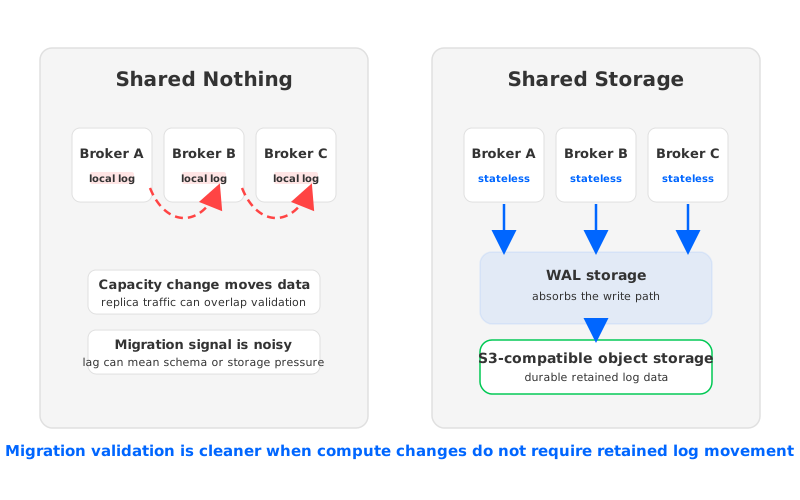
Traditional Kafka adds another graph under the application contract graph: the placement of log data on Broker-local storage. In the Shared Nothing architecture, each Broker owns local replicas for assigned Partitions, and durability is maintained through replication among Brokers. That model is reliable and familiar, but it means cluster operations often involve moving log data across machines.
During a schema-sensitive migration, this storage graph competes with the contract graph. The platform team may need extra capacity for replication, validation reads, Consumer catch-up, or rollback retention. Adding or replacing Brokers can trigger reassignment work. Reassignment competes for disk and network resources with the same traffic the migration is trying to validate. A schema issue and a capacity issue can then look similar because both appear as lag, fetch latency, or decode errors at the application edge.
Tiered Storage changes part of that equation by offloading older log segments to object storage. It can be useful for long retention, but it does not make active Brokers stateless. Hot data, leadership, local storage pressure, and operational changes still need planning. For schema migration sequencing, the distinction is important because the migration team needs confidence in active cutover behavior, not only in long-term retention economics.
The architectural question is therefore sharper than "which tool moves the records?" A serious evaluation asks whether the target platform reduces the amount of state that must move while contracts are being validated. Less data movement does not remove schema risk, but it makes the risk easier to observe because fewer unrelated storage operations are happening at the same time.
4Evaluate platforms against the dependency map
Once the contract map exists, platform evaluation becomes less abstract. You can stop comparing broad labels such as managed, self-managed, cloud-native, or Kafka-compatible, and start asking how each option behaves at the exact dependency edges in your migration. This is also where teams avoid a false sense of safety. Kafka API compatibility is necessary, but it is not the same as proving every client, connector, transaction pattern, and Consumer group workflow used by the estate.
Use the dependency map to run an architecture review with these questions:
- Compatibility: Do the Producers, Consumers, admin clients, Kafka Connect jobs, transactional Producers, and schema tooling behave the same way on the target path?
- Offset continuity: Can each Consumer group resume at a known boundary, and can the team test that boundary before final promotion?
- Elastic capacity: Can the target absorb replication, validation, producer cutover, and Consumer catch-up without turning the test window into a storage rebalance window?
- Governance: Are schema publication rights, ACLs, network access, audit logs, and deployment ownership inside the same boundary expected by security teams?
- Rollback: Which step makes target writes authoritative, and what exact state must be reset if the team moves back?
- Observability: Can operators separate schema decode errors from lag, throttling, connector failures, and downstream write failures?
The order of these questions is intentional. Compatibility and Offsets protect the application contract. Capacity and governance protect the platform boundary. Rollback and observability protect the people on call when the plan meets production.
5Where AutoMQ fits after the neutral review
After the dependency map has made the risks explicit, AutoMQ is relevant as a Kafka-compatible streaming platform built around Shared Storage architecture. AutoMQ keeps the Kafka API and protocol surface while replacing Broker-local persistent storage with S3Stream, WAL (Write-Ahead Log) storage, and S3-compatible object storage. In practical terms, AutoMQ Brokers are stateless, while durable data lives in shared storage.
That architectural boundary changes the migration operating model. When target capacity has to grow for validation or Consumer catch-up, the team is scaling compute instead of moving retained log data from one Broker disk to another. When a Broker is replaced, recovery is less about reconstructing local data and more about metadata, WAL recovery, and shared storage access. The schema contract still has to be mapped, but platform changes create less unrelated data motion during the period when the team is trying to measure contract safety.
AutoMQ Kafka Linking is relevant to the same dependency map because migration often depends on topic data synchronization, Offset alignment, and staged cutover. It does not make schema governance automatic. It gives the platform team a cleaner way to separate the gates: replicate records, validate reads, move Producers, test Consumer groups, and promote the target when the contract evidence is strong enough.
AutoMQ BYOC also matters when the operational contract includes cloud-account ownership and VPC boundaries. In BYOC, the control plane and data plane run in the customer's cloud environment rather than forcing Kafka traffic through a vendor-owned data plane. That does not replace a security review, but it gives architecture and security teams a concrete boundary to inspect when they map ACLs, network paths, observability, and rollback responsibilities.
6A readiness scorecard for the cutover meeting
The final cutover meeting should not ask whether the migration plan looks complete. It should ask whether the dependency map has no red edges left. A red edge means a contract dependency is still unknown or irreversible without a named repair plan. Yellow means the edge is known but needs an operator decision during cutover. Green means the evidence exists and the reversal rule is written down.
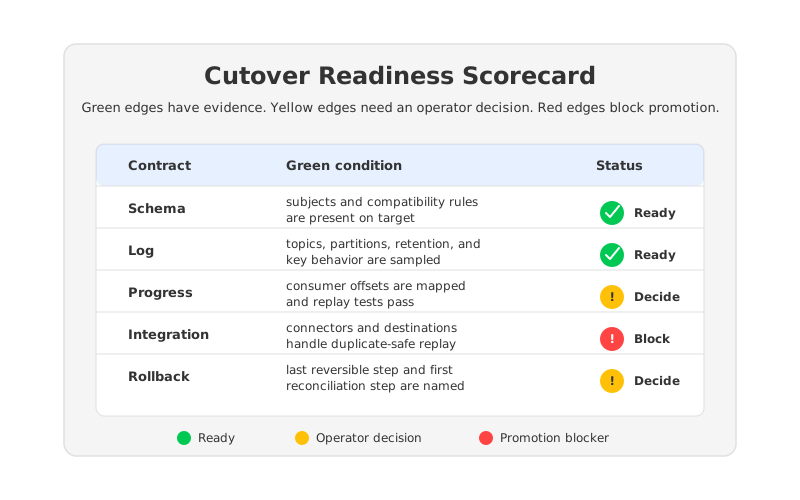
Use the scorecard to keep the discussion concrete:
| Area | Green condition | Owner |
|---|---|---|
| Schema contract | All active subjects, compatibility modes, and serializer configs are present on the target path. | Schema platform or data governance |
| Log contract | Topic names, Partitions, retention, compaction, and key behavior are validated against production samples. | Kafka platform team |
| Progress contract | Consumer group Offsets are synchronized or mapped, and replay tests pass for representative groups. | Application owners and SRE |
| Integration contract | Connectors, converters, DLQs, and destination idempotency are tested without production side effects. | Data integration team |
| Rollback contract | The last reversible step and the first reconciliation step are named in the runbook. | Migration lead |
| Observability contract | Lag, event age, decode errors, connector status, and downstream write errors are visible during the window. | SRE |
The scorecard is intentionally boring. It turns a high-stakes migration into a set of named contracts, owners, and evidence. That is the point. Kafka migrations fail less often when the team resists dramatic cutovers and keeps asking which contract changed, who owns it, and whether rollback still means rollback.
If your team is mapping schema dependencies, Offset continuity, and rollback boundaries before a Kafka migration, use the same map to evaluate whether Broker-local storage is adding risk during the cutover. For workloads where Shared Storage architecture and stateless Brokers could reduce migration coupling, evaluate AutoMQ with your own topics and runbook.
7References
- Apache Kafka documentation
- Apache Kafka consumer configuration
- Apache Kafka message delivery semantics
- Apache Kafka Connect documentation
- Apache Kafka cross-cluster data mirroring
- AutoMQ architecture overview
- AutoMQ compatibility with Apache Kafka
- AutoMQ migration guide
- AWS PrivateLink documentation
- Amazon S3 data durability documentation
8FAQ
8.1What is schema migration sequencing in Kafka?
Schema migration sequencing in Kafka is the order in which teams change schemas, Producers, Topics, Consumer groups, connectors, and rollback paths. The goal is to keep records readable and Consumer progress safe while the authoritative streaming path changes.
8.2What is a contract dependency map?
A contract dependency map is a graph of the application and platform assumptions that must hold during migration. It connects schema subjects, serializers, Topics, Offsets, Consumers, connectors, downstream systems, observability, and rollback boundaries.
8.3Why is schema compatibility not enough for Kafka migration?
Schema compatibility proves that one version can be read under a defined rule. A migration also has to preserve Topic mapping, Partition ordering, Consumer group progress, access control, connector behavior, and downstream side effects.
8.4Should Producers or Consumers move first?
Producers often move before Consumers because that controls where post-cutover records are written while old Consumers can continue reading from the source. The right sequence still depends on rollback design, replication state, and whether downstream systems can tolerate duplicates.
8.5How does Shared Storage architecture help migration planning?
Shared Storage architecture reduces the coupling between Broker lifecycle and retained log data. For migration teams, that can make capacity changes and Broker replacement less dependent on moving local replicas while schema and Offset contracts are being validated.


