
Table of Contents
Table of Contents
Teams searching for compliance evidence streams kafka usually have a problem that is more specific than “we need Kafka.” They need a durable path for audit events, access records, policy changes, transaction outcomes, operational logs, and system state transitions. Those records must be queryable later, but they also have to survive the boring parts of production: retention growth, bursty writes, network boundaries, deployment approvals, incident recovery, and cost review.
That is where the architecture decision becomes awkward. Kafka is good at ordering records, retaining logs, and feeding multiple consumers from the same topic. Regulated operations add a second question: can the platform prove that evidence was produced, retained, moved, replayed, and governed without creating a new operational risk of its own? The answer depends less on a single Kafka feature and more on the storage, replication, access, migration, and observability model around the cluster.
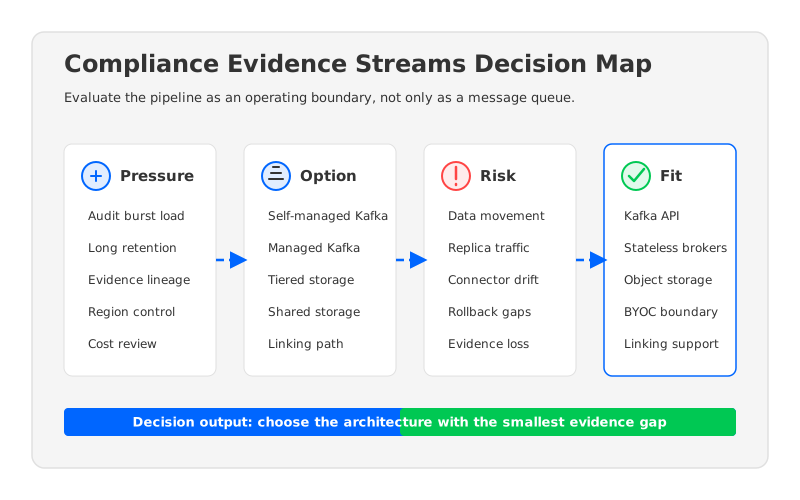
The useful way to evaluate a compliance evidence pipeline is to treat it as an operating boundary. A payment system, identity service, policy engine, or control-plane component may all write events into the same streaming backbone, but each one has a different audit owner. The platform team has to keep Kafka clients working while giving security, compliance, and FinOps teams enough evidence to trust the pipeline.
1Why Teams Search for compliance evidence streams kafka
The search phrase sounds narrow, but the underlying need is broad. Security teams want evidence of who did what and when. Compliance architects want retention rules and access boundaries that match their control framework. Platform owners want a Kafka-compatible architecture that does not force every audit requirement into a custom connector, side database, or manual export job.
Kafka fits the first layer of the problem because topics provide ordered logs, consumer groups let different systems process the same stream independently, and offsets make replay a first-class operational concept. Kafka Connect and MirrorMaker-style replication patterns can also help move data between systems or clusters when the compliance boundary spans regions or accounts. Those are strong building blocks, not a complete control system.
The gap appears when evidence data stops being small. Compliance streams are often quiet and then spike during incident response, reconciliation, control checks, or regulatory reporting. Retention can stretch beyond the hot operational window because the record is valuable after normal application traces have aged out.
There are four signs that the pipeline has crossed from “Kafka topic” into “regulated operating system”:
- The evidence stream has multiple readers with different responsibilities: fraud analytics, SIEM, compliance reporting, internal audit, customer support, and incident response.
- Retention is governed by policy rather than application convenience, so storage growth cannot be handled by deleting old segments early.
- Access control and network placement matter as much as throughput because evidence may include security or customer-sensitive metadata.
- Migration and rollback plans must preserve both data and interpretation, including offsets, schemas, connector state, and replay windows.
Once those conditions hold, the architecture should be evaluated under failure and audit pressure, not only under benchmark traffic.
2The Production Constraint Behind the Problem
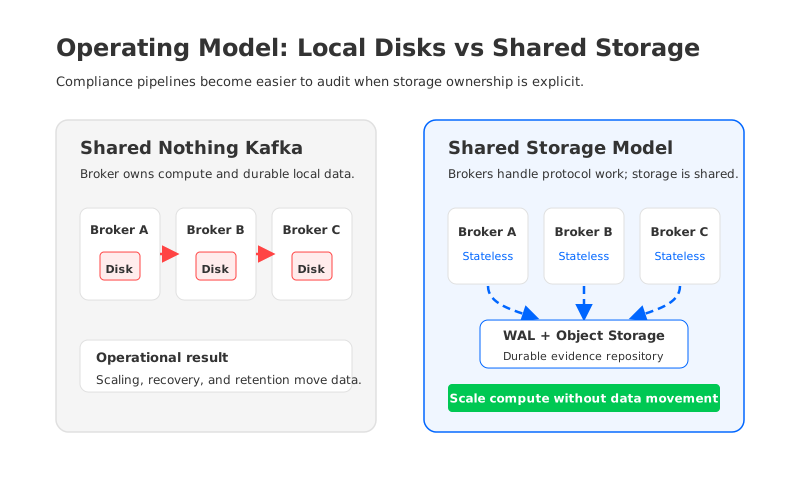
Traditional Kafka’s shared-nothing model keeps data local to brokers and uses replication to maintain availability. That design is proven and widely understood. It also means that brokers are not only serving the Kafka protocol; they are the owners of durable local log segments. When a cluster scales, rebalances, recovers a broker, or changes partition placement, the operating model often includes moving data between brokers.
For ordinary application topics, that trade-off may be acceptable. For compliance evidence streams, it creates a harder governance surface. Broker-local storage ties retention, recovery, and capacity planning to the lifecycle of compute nodes. Replica traffic and catch-up reads become part of the cost model. Partition movement becomes part of the change-management record.
The hidden issue is not that Kafka replication is wrong. Kafka was designed around a log abstraction where brokers own partitions and followers replicate from leaders. The issue is that regulated evidence pipelines often want the opposite operating property: compute should be replaceable, while durable evidence should have an explicit storage boundary with clear ownership, retention, and access controls.
That distinction affects cost as well as governance. A compliance stream with long retention can spend more money on stored historical data than on active write throughput. In a multi-AZ cloud deployment, replica placement and reader location can also affect network transfer. Exact numbers depend on cloud, region, instance family, storage class, and traffic pattern, so review them with current provider pricing. The architectural point is stable: when durability is bound tightly to brokers, scaling compute and retaining history are harder to reason about independently.
Connectors add another boundary. Many evidence pipelines use Kafka Connect to ingest database changes, cloud events, SIEM records, or application logs, then sink them into data lakes or audit stores. The connector layer standardizes integration work, but it also introduces state, offsets, credentials, retries, and schema assumptions. A regulated platform has to decide who owns that state during incident response and migration.
3Architecture Options and Trade-Offs
Most teams choose among a few patterns. They may keep a self-managed Kafka cluster and harden it with stricter ACLs, longer retention, automation, and observability. They may use a managed Kafka service while accepting the service’s deployment boundaries. They may enable tiered storage so older log segments move to object storage while hot data remains broker-centric. Or they may choose a Kafka-compatible architecture that separates compute from storage more directly.
The right answer depends on the control objective. A short-lived operational audit stream with modest retention may not need a new architecture. A cross-region evidence stream that feeds several regulated consumers probably does. The evaluation should make the trade-offs explicit.
| Evaluation area | Question to ask | Why it matters for evidence streams |
|---|---|---|
| Compatibility | Do existing Kafka producers, consumers, offsets, transactions, and Connect jobs behave as expected? | Evidence pipelines should not require application rewrites during a governance project. |
| Durability boundary | Where does durable evidence live, and who controls that storage? | Auditors care about retention, access, and recovery ownership. |
| Scaling model | Does adding compute require moving historical data? | Audit bursts should not trigger risky data movement. |
| Cost model | Are retention, replica traffic, catch-up reads, and cross-zone transfer visible? | FinOps needs a defensible model before retention grows. |
| Security model | Can identity, ACLs, encryption, and network boundaries be mapped to existing controls? | Evidence data often contains sensitive operational context. |
| Migration path | Can the team dual-run, compare outputs, and roll back without losing interpretation? | The pipeline itself may become audit-critical before migration is complete. |
Tiered storage deserves a careful look because it is often confused with a fully shared-storage operating model. Kafka tiered storage moves older log segments to remote storage while keeping the Kafka broker model intact. That can help retention economics and reduce pressure on local disks, but it does not automatically make brokers stateless. Hot data, leadership, partition ownership, and recovery still need to be understood in Kafka terms.
A shared-storage model changes a different part of the system. The broker remains responsible for Kafka protocol work, but durable stream storage is moved into a shared storage layer, typically backed by object storage and a write-ahead-log path. That architecture makes compute and storage easier to scale independently. It also makes the evidence boundary easier to discuss: brokers can be replaced or resized without treating their local disks as the long-term record.
This is not a free pass. Shared storage has to handle latency, write durability, metadata correctness, and recovery carefully. The design review should ask how the write path works, how reads behave during catch-up, what happens during broker failure, how metadata is protected, and whether Kafka clients remain compatible.
4Evaluation Checklist for Platform Teams
A useful compliance evidence streams Kafka checklist should combine architecture and operations. It should not stop at “does it support encryption?” or “can we set retention?” The harder question is whether the team can prove the pipeline is still correct after scaling, migration, or incident response.
Start with compatibility because migration risk often hides there. Producers may depend on idempotence, transactions, batching, compression, headers, and client configuration defaults. Consumers may depend on group coordination, offset reset behavior, lag monitoring, and replay semantics. Connectors may depend on task assignment, internal topics, schema integration, and error handling. A platform can be Kafka-compatible in broad terms and still require validation for the client behaviors that carry evidence.
Then model the cost and retention boundary. Separate hot write throughput, historical storage, replica traffic, catch-up reads, connector tasks, and cross-zone or cross-region movement. These numbers do not need to be perfect in the first pass, but they need owners. If the security team mandates longer retention, the platform team should know where the cost lands.
Security and governance come next. The minimum review should cover authentication, authorization, encryption in transit, encryption at rest, private networking, identity boundaries, admin access, audit logs for platform changes, and emergency access procedures. Evidence pipelines are often built to satisfy controls, but the streaming platform itself becomes part of the control environment. That means broker configuration changes, topic deletion, ACL updates, connector credential rotation, and consumer offset resets may all need an evidence trail.
Migration planning should be treated as part of readiness, not a deployment afterthought. A strong plan lists topics, producers, consumers, connectors, schemas, ACLs, quotas, retention settings, and monitoring alerts. It also has a dual-run window where teams compare event counts, lag, error rates, downstream materializations, and recovery behavior.
5How AutoMQ Changes the Operating Model
The neutral framework above leads to a specific architectural requirement: keep Kafka semantics familiar while reducing the coupling between brokers and durable evidence storage. AutoMQ fits that category as a Kafka-compatible, cloud-native streaming platform built around shared storage and stateless brokers. Its design keeps the Kafka API surface familiar while moving storage responsibility away from broker-local disks and toward object-storage-backed stream storage.
For regulated operations, the important shift is not a marketing label. It is the operating model. If brokers are stateless, scaling compute is less likely to become a data movement project. If durable stream data is stored in object storage, retention planning can be discussed with the same governance vocabulary teams already use for cloud storage: bucket policy, encryption, access boundary, region, lifecycle, and cost ownership. If the platform supports Kafka-compatible clients, teams can evaluate the migration as an infrastructure change instead of a broad application rewrite.
AutoMQ’s shared-storage architecture also changes the cross-AZ discussion. Traditional Kafka deployments often replicate data between brokers across zones to achieve availability. AutoMQ’s architecture is designed to reduce inter-zone data movement by using object storage as the durable storage layer and routing clients with zone awareness. The exact savings depend on workload and cloud placement, so the responsible review is still to model traffic with your own data. The practical difference is that cross-zone traffic becomes a design variable, not an unavoidable side effect of broker-local replication.
Customer-controlled deployment boundaries matter here. In regulated environments, teams often need the data plane to live inside their own cloud account, VPC, Kubernetes environment, or approved network path. AutoMQ BYOC and software deployment options are relevant because they let architects discuss Kafka compatibility, storage ownership, access control, and operations without forcing all evidence through a vendor-controlled runtime boundary.
The migration story still needs discipline. AutoMQ can be evaluated with existing Kafka clients, MirrorMaker-style migration patterns, topic-level validation, and observability checks. A compliance evidence pipeline should move only when dual-run results show that producers, consumers, offsets, retention, security controls, and recovery behavior remain within risk tolerance.
6A Practical Readiness Scorecard
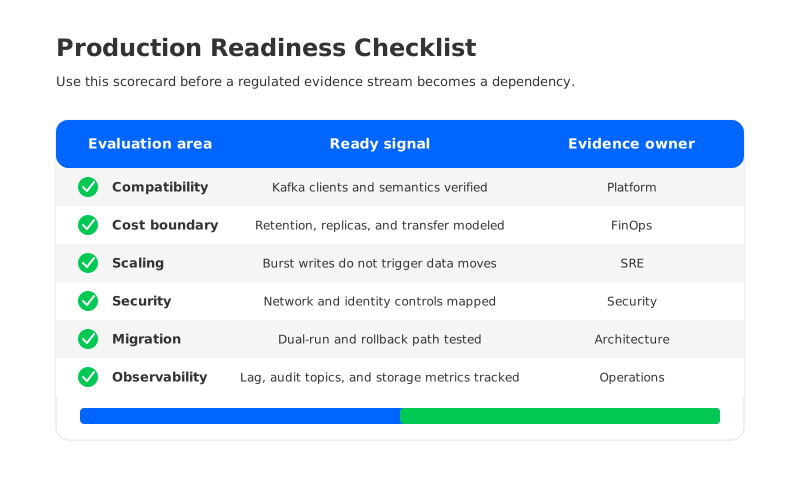
Before choosing any platform, give each area a simple rating: green for validated, yellow for partially validated, red for unknown or unowned. A red item does not mean the architecture is wrong; it means the team has not produced enough evidence to depend on it.
- Compatibility is green only when representative producers, consumers, transactions, Connect jobs, and replay workflows have been tested against the target platform.
- Cost is green only when retention, replication or storage, network transfer, connector compute, and observability overhead are modeled with current pricing assumptions.
- Security is green only when authentication, authorization, encryption, private networking, admin access, and audit logging are mapped to named owners.
- Migration is green only when dual-run, cutover, rollback, and downstream reconciliation have been exercised in a non-production environment that resembles production.
- Observability is green only when lag, throughput, error rates, storage growth, connector health, and platform changes are visible to the teams that will respond to incidents.
The goal is to avoid the common failure mode where a Kafka topic becomes a compliance dependency before anyone has agreed who owns storage, migration, or evidence quality.
If you are evaluating a Kafka-compatible architecture for regulated evidence streams, AutoMQ’s shared-storage model is worth testing against your own control requirements. Start with the architecture overview and migration materials, then validate one representative evidence topic end to end: producer behavior, retention, consumer replay, connector output, access control, and rollback. A specific AutoMQ starting point is available in the AutoMQ overview.
7References
- Apache Kafka documentation: https://kafka.apache.org/documentation/
- Apache Kafka Connect documentation: https://kafka.apache.org/documentation/#connect
- Apache Kafka design notes on replication and availability: https://kafka.apache.org/documentation/#design_ha
- KIP-405: Kafka Tiered Storage: https://cwiki.apache.org/confluence/display/KAFKA/KIP-405%3A+Kafka+Tiered+Storage
- AutoMQ overview: https://docs.automq.com/automq/what-is-automq/overview?utm_source=blog&utm_medium=reference&utm_campaign=aivk-0083
- AutoMQ shared storage architecture: https://docs.automq.com/automq/architecture/overview?utm_source=blog&utm_medium=reference&utm_campaign=aivk-0083
- AutoMQ compatibility with Apache Kafka: https://docs.automq.com/automq/what-is-automq/compatibility-with-apache-kafka?utm_source=blog&utm_medium=reference&utm_campaign=aivk-0083
- AutoMQ inter-zone traffic overview: https://docs.automq.com/automq/eliminate-inter-zone-traffics/overview?utm_source=blog&utm_medium=reference&utm_campaign=aivk-0083
- AutoMQ migration overview: https://docs.automq.com/automq/migration/overview?utm_source=blog&utm_medium=reference&utm_campaign=aivk-0083
8FAQ
8.1Is Kafka a good fit for compliance evidence streams?
Kafka can be a strong foundation because it provides ordered records, retention, replay through offsets, and independent consumers. The platform still needs a governance layer around storage ownership, access control, retention policy, migration, and observability.
8.2Is tiered storage the same as shared storage?
No. Tiered storage moves older log segments to remote storage, which can help with long retention. A shared-storage operating model goes further by reducing the broker’s ownership of durable data, making compute and storage easier to scale independently.
8.3What should be tested before migrating an evidence stream?
Test producer behavior, consumer groups, offsets, transactions if used, Kafka Connect jobs, schemas, ACLs, retention settings, lag monitoring, downstream reconciliation, and rollback. The migration is ready only when the team can explain both the data path and the control path.
8.4Where does AutoMQ fit in this architecture review?
AutoMQ is relevant after the team has decided that Kafka compatibility, shared storage, stateless brokers, and customer-controlled deployment boundaries match the control objective. It should be evaluated with representative workloads and the same readiness scorecard used for any regulated platform.


