
Table of Contents
Table of Contents
Teams searching for customer owned control plane kafka usually have a real production question in mind. They are not trying to define a fashionable deployment label. They are asking whether a Kafka-compatible streaming platform can satisfy the same scrutiny applied to databases, identity systems, payment systems, and other regulated infrastructure: where does the control plane run, what does it know, what can it do, and what happens when the boundary is stressed.
That question matters because Kafka is rarely a neutral pipe inside regulated environments. It carries event sourcing records, payment events, fraud signals, operational telemetry, customer activity, change data capture, and AI pipeline context. Even when the message payloads stay inside a private network, the surrounding artifacts can still reveal business behavior. Topic names, schema subjects, Consumer group names, connector configurations, offsets, metrics, logs, support bundles, and audit trails all deserve a placement decision.
The useful way to evaluate the problem is not to ask whether a product says BYOC, private, dedicated, or managed. Those words can describe very different architectures. The useful question is more concrete: can your platform team draw the control plane, data plane, metadata, telemetry, storage, support access, and migration paths on one page, then prove each boundary with configuration and operational tests?
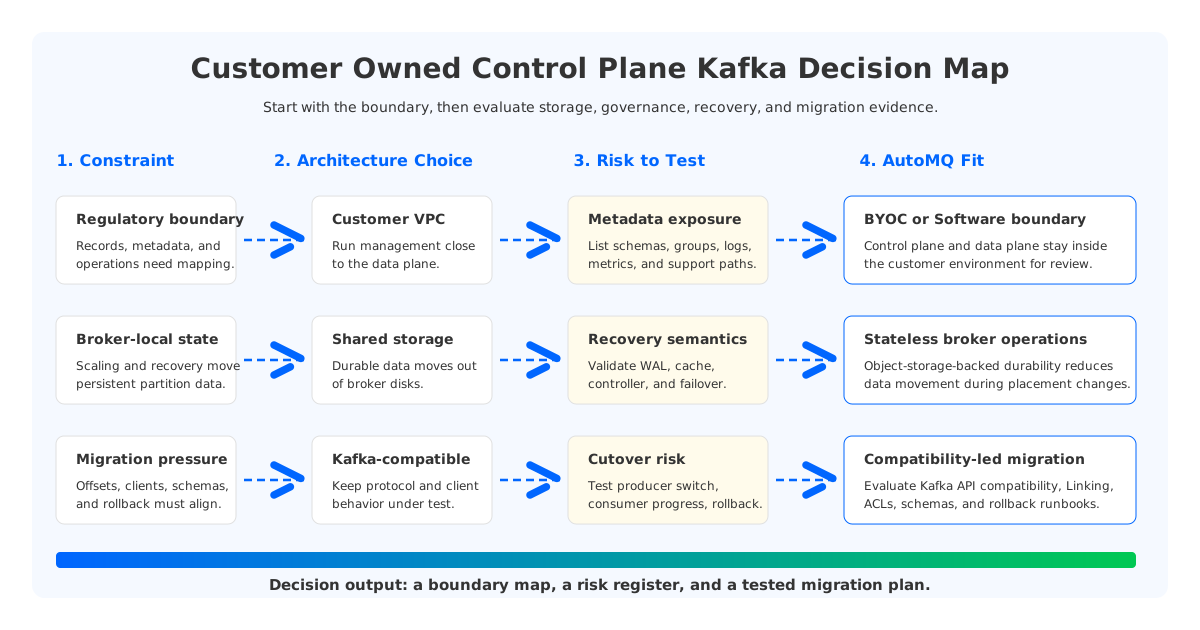
1Why Teams Search for customer owned control plane kafka
The search starts when a managed streaming conversation meets a governance review. A SaaS-style Kafka service may be operationally attractive because someone else runs upgrades, broker replacement, capacity planning, and incident response. A self-managed Kafka cluster may satisfy account ownership, but it leaves the platform team with storage planning, partition reassignment, broker upgrades, security patching, and recovery drills. A customer owned control plane Kafka model sits between those extremes only if the implementation makes the ownership boundary precise.
Regulated teams usually care about four categories of control. The first is data residency: where records, schemas, offsets, and retained logs live. The second is administrative authority: which identity can create topics, alter ACLs, scale clusters, or change listener configuration. The third is operational evidence: which logs, metrics, audit events, and support artifacts are exported. The fourth is failure behavior: whether the platform keeps serving clients when a management endpoint, support tunnel, cloud permission, or telemetry route is unavailable.
Apache Kafka already has its own cluster-level control concepts. KRaft metadata, controllers, topic metadata, partition leadership, Consumer group coordination, and transaction state are part of the Kafka system itself, as described in the Apache Kafka documentation. Product control planes are different. They handle lifecycle operations, deployment automation, user management, observability, connector management, upgrades, and policy workflows. Mixing those two meanings creates confusion during architecture review, so the diagram should name both.
Once that distinction is clear, the evaluation becomes less ideological. A platform can be managed and still run inside the customer's account. A platform can keep payload data local while sending operational metadata elsewhere. A self-managed system can keep every byte inside the account while still creating unacceptable risk through weak automation and poorly audited access. Placement is not a slogan. It is a set of system behaviors.
2The Production Constraint Behind the Problem
Traditional Kafka was built around a Shared Nothing architecture. Each broker owns local storage, and durability comes from replicated partition logs across brokers. That design is proven and well understood, but it turns broker placement into a storage placement problem. When a broker fails, a disk fills, a node pool is resized, or partitions need to move, the platform team has to reason about where durable bytes live and how much data movement the operation will create.
The regulated version of that problem is sharper. A security team can approve a VPC, a subnet, a KMS key, and an IAM role, but Kafka operations still have to move through broker-local state. Partition reassignment can transfer large volumes of replicated log data. Rebalancing can create network pressure across Availability Zones. Capacity changes may require extra headroom because the cluster is moving data while serving traffic. The result is not only an operations concern. It affects change windows, audit evidence, incident recovery, and cost predictability.
Tiered Storage helps with long retention by moving older log segments to remote storage, but it does not fully remove the broker-local operating model. The active log still depends on broker storage, and leadership, local disk pressure, and reassignment behavior remain important. For a governance team, that means Tiered Storage should be evaluated as one useful storage feature, not as a complete answer to control plane placement or broker statelessness.
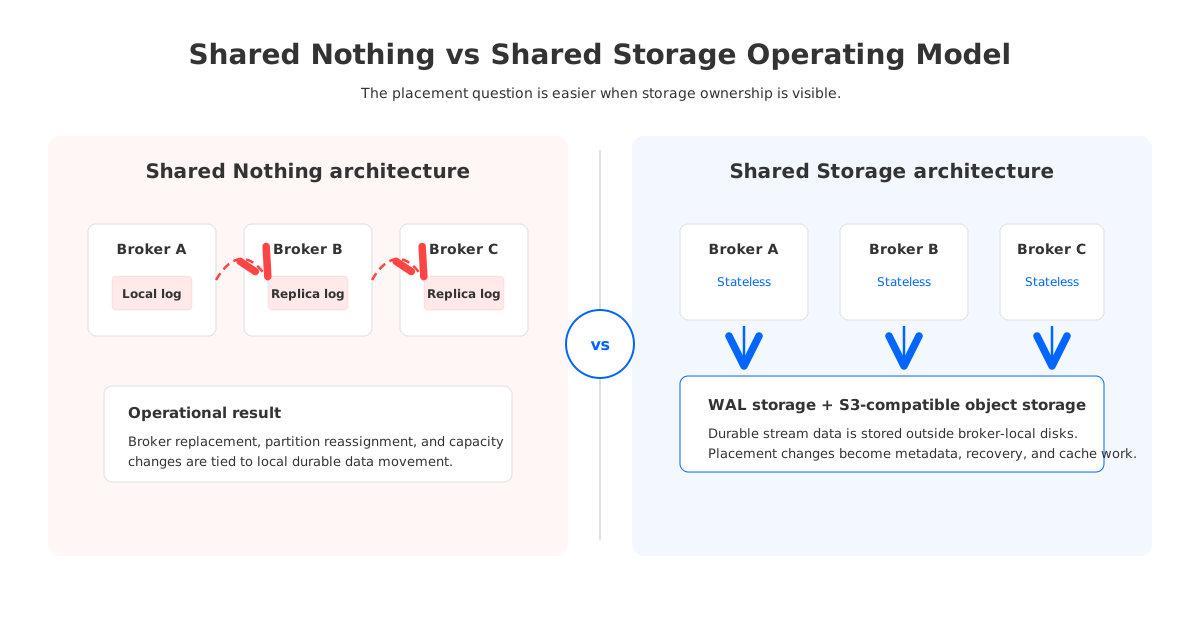
This is where the architecture question becomes practical. If broker-local disks remain the primary durable layer, the control plane must orchestrate around data movement. If durable stream data is moved into a shared storage layer, the control plane can treat brokers more like replaceable compute. That shift does not eliminate correctness work. The platform still needs controller metadata, fencing, WAL recovery, cache behavior, observability, and clear failure semantics. It does change what must move when the platform changes placement.
3Architecture Options and Trade-Offs
A serious evaluation should compare deployment models by boundary, not by product category. The same phrase can hide different answers to the questions that matter in production. Draw the platform as a set of planes and paths, then ask who owns each one.
| Model | What the team gains | What the team must verify |
|---|---|---|
| Fully hosted managed Kafka | Operational burden moves to the provider. Procurement and application teams may move faster. | Data plane location, metadata retention, network path, support access, service limits, and exit path. |
| Self-managed Kafka | Maximum direct control over account, network, disks, and operations. | Staffing, upgrade discipline, partition reassignment risk, incident response, and long-term cost ownership. |
| BYOC Kafka | Customer-owned infrastructure with a managed operating layer. | Exact control plane placement, cloud permissions, telemetry scope, support model, and vendor dependency under failure. |
| Software in private environments | Strongest environment ownership for private data centers or isolated deployments. | Upgrade ownership, storage dependency, support workflow, and operational maturity. |
The table is intentionally unsatisfying if you want a universal winner. Regulated platforms do not get a universal winner. They get a risk model. A fraud analytics cluster with strict data residency, heavy replay, and long retention has different pressure than an internal telemetry cluster with short retention and tolerant consumers. A platform used by stream processing jobs with transactions and strict offset handling has different migration risk than a notification pipeline that can tolerate replay from a checkpoint.
Kafka compatibility belongs in this part of the review because it limits migration blast radius. Compatibility is not only whether producers can connect. It includes client behavior, ACLs, Consumer group semantics, offsets, transactions, Connect workers, Schema Registry workflows, and operational tooling. If a proposed platform changes too much of that surface, the control plane placement may look attractive while the migration creates a different kind of governance risk.
Cost also belongs here, but not as a headline promise. Regulated teams should separate raw cloud infrastructure cost from operational cost. Broker-local storage, cross-zone replication, over-provisioned capacity, support labor, and migration windows all create cost. So do control plane dependencies, private connectivity, observability export, and support processes. A useful cost model shows which cost moves from one layer to another, not only whether a line item is lower.
4Evaluation Checklist for Platform Teams
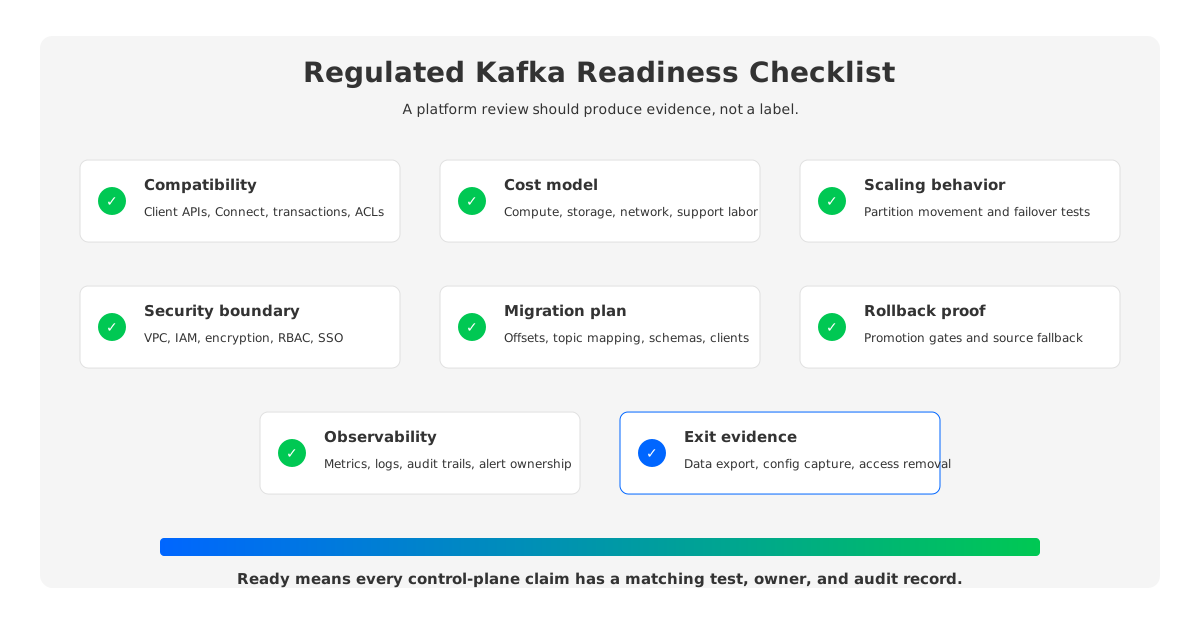
The checklist should be written before vendor demos and proof-of-concept work. Otherwise the proof of concept tends to test the happy path: produce a record, consume a record, create a topic, and show a dashboard. That proves the platform can function. It does not prove that the architecture is acceptable for regulated production.
Use the checklist as a readiness record:
- Boundary map. Document where the product control plane, Kafka controllers, brokers, object storage, WAL storage, schema services, connectors, metrics, logs, and support tools run. Mark which components live in the customer account, which live in a provider environment, and which cross the boundary.
- Permission inventory. List every cloud role, Kubernetes permission, Kafka ACL, service account, secret, KMS key, bucket policy, and network route required for normal operations and emergency support. Separate read-only observability access from write-capable administrative access.
- Metadata classification. Treat metadata as data with lower but real sensitivity. Topic names, schema names, Consumer group names, offset movement, error logs, and connector configuration can expose business activity.
- Failure drills. Test blocked management connectivity, revoked cloud permission, failed broker replacement, object storage access errors, schema service outage, and support access denial. Record whether Kafka clients keep working and which operations stop.
- Migration and rollback proof. Validate producer cutover, Consumer group progress, offset handling, schema compatibility, ACL mapping, and source-cluster fallback. A migration plan without rollback proof is not a production plan.
- Audit and exit evidence. Confirm where audit logs are stored, how long they are retained, who can alter them, how support sessions are approved, and how data, configuration, and access are removed at termination.
This is also the right moment to define data contracts. Kafka data contracts are not only schema compatibility rules. They are agreements about topic ownership, schema evolution, retention, access, replay expectations, and downstream impact. A customer owned control plane Kafka architecture should make those agreements easier to govern because the policy plane, audit plane, and data plane can be reviewed together. If the architecture scatters those artifacts across unrelated systems, the platform team should treat that as operational debt.
5How AutoMQ Changes the Operating Model
After the neutral review, the architecture requirement becomes clearer: regulated teams want Kafka compatibility, customer-controlled deployment boundaries, and an operating model that does not make every placement change a broker-local storage project. AutoMQ fits that category as a Kafka-compatible, cloud-native streaming platform built around Shared Storage architecture and stateless brokers.
The key design shift is storage ownership. AutoMQ keeps the Kafka protocol and core Kafka concepts visible to clients while replacing the broker-local log storage layer with S3Stream, WAL storage, data caching, and S3-compatible object storage. The AutoMQ architecture overview describes AutoMQ as compatible with Apache Kafka and designed around object-storage-backed shared storage. The practical effect for platform teams is that durable stream data is not tied to a broker's local disk as the long-lived source of truth.
For regulated deployments, the product boundary matters as much as the storage layer. AutoMQ BYOC is designed for customer cloud environments, and AutoMQ Software is designed for private environments. In those models, the platform team can evaluate the control plane, data plane, object storage, networking, identity, observability, and support access inside the customer's deployment boundary rather than treating them as an opaque external service. That does not remove diligence. It gives the diligence team a sharper set of artifacts to inspect.
AutoMQ's Kafka compatibility also matters during migration. The Kafka compatibility documentation is the place to start when checking client behavior and ecosystem fit. For commercial migrations, Kafka Linking is relevant when teams need to preserve offsets and reduce cutover disruption, but it should still be tested against the actual source cluster, authentication mode, schema workflow, client versions, and rollback plan.
The strongest reason to evaluate AutoMQ in this search path is not that every regulated workload should use the same platform. It is that the architecture separates two decisions that traditional Kafka often blends together. One decision is where management authority, policy, audit, and support workflows belong. The other is where durable stream data lives and how brokers recover. When those decisions are separated, platform teams can make a more precise placement choice.
If your next review starts with the same uncomfortable question, where does the control plane really live, turn it into a boundary map and a failure drill before you compare product labels. For teams evaluating a Kafka-compatible platform with customer-controlled deployment boundaries, start an AutoMQ BYOC architecture review with that evidence model in hand.
6FAQ
6.1What does customer owned control plane Kafka mean?
It means the lifecycle management layer for Kafka-compatible streaming runs under the customer's infrastructure boundary or under a customer-controlled operating model. The exact meaning depends on the platform. A good review should identify where the control plane runs, what metadata it stores, which permissions it has, and whether it can affect the data plane.
6.2Is a customer owned control plane the same as self-managed Kafka?
No. Self-managed Kafka usually means the customer operates the entire cluster and its automation. A customer owned control plane model can still include vendor software, managed operations, support workflows, and lifecycle automation, but the control plane placement and permissions are designed for customer-controlled environments.
6.3Does keeping the control plane in the customer environment guarantee compliance?
No. Compliance depends on policies, implementation, evidence, and operations. Placement helps, but the team still has to validate IAM, network routes, encryption, audit logs, telemetry, support access, data retention, schema governance, and incident response.
6.4Why does Shared Storage architecture matter for control plane placement?
Shared Storage architecture changes what the control plane has to orchestrate during scaling, failover, and reassignment. When brokers are less tied to local persistent data, placement changes depend more on metadata, leadership, WAL recovery, and cache behavior than on copying durable partition logs between broker disks.
6.5Where should AutoMQ enter a regulated Kafka evaluation?
AutoMQ should enter after the team has defined its boundary map and evaluation checklist. It is relevant when the team wants Kafka-compatible APIs, customer-controlled deployment boundaries through AutoMQ BYOC or AutoMQ Software, and an operating model based on stateless brokers with object-storage-backed durability.


