
Table of Contents
Table of Contents
Teams usually search for real time elt governance kafka after their pipeline has become part of the business control plane. The first version may have been a practical path from operational databases into Kafka, then into a warehouse, lakehouse, search index, or stream processor. Over time, the same path starts carrying audit events, customer state, billing changes, fraud signals, and product analytics. At that point, the question is no longer whether Kafka can move data in real time. The question is whether the ELT delivery path can be governed without slowing every team that depends on it.
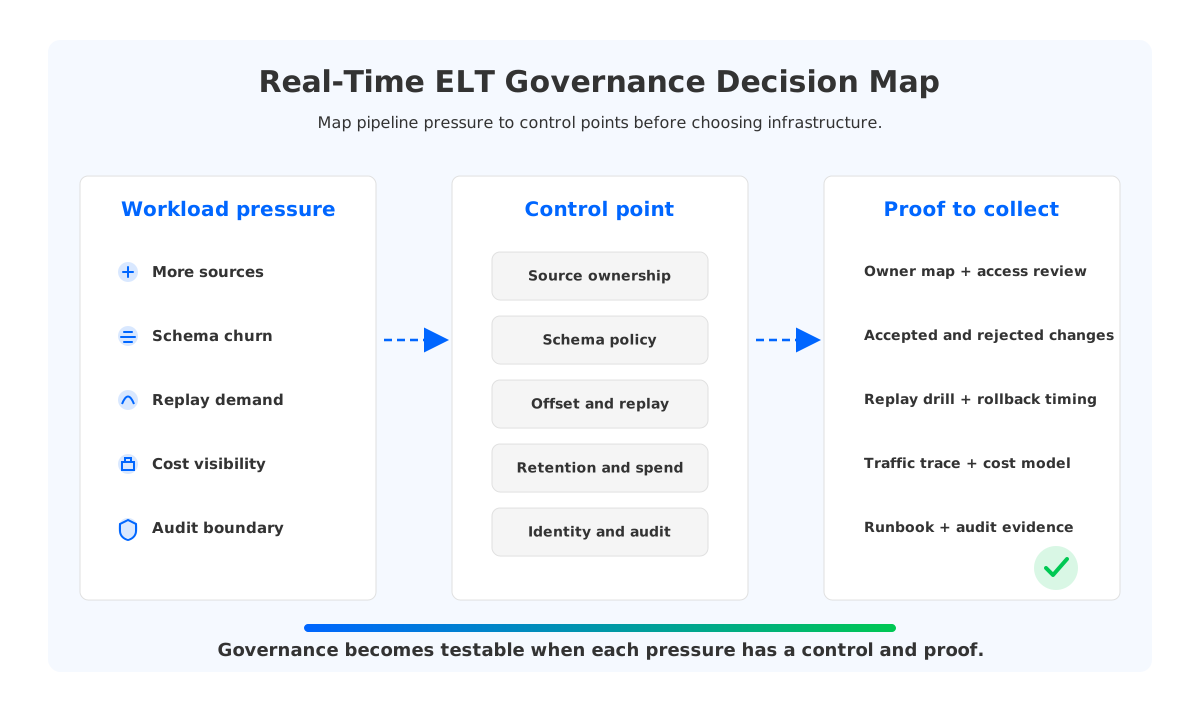
Governance in this setting is often misunderstood. It is not a committee sitting above Kafka Connect, Flink, object storage, and warehouse loaders. It is a set of technical control points that make the pipeline explainable under pressure: what schema was accepted, which connector wrote a record, which offset was processed, where replay is allowed, who can change credentials, how long retained data stays available, and how the platform behaves when a broker, connector worker, sink, or cloud zone fails. A governed ELT system is not slower by default. It is a system where the failure modes have names and owners.
1Why teams search for real time elt governance kafka
The search phrase is awkward because the problem crosses team boundaries. Data integration teams care about source capture, schema evolution, connector retries, and sink-side idempotency. Kafka platform teams care about partition count, broker capacity, retention, consumer groups, and cross-zone traffic. Data governance teams care about access, lineage, masking, audit evidence, and rollback. FinOps cares because real-time pipelines often turn into always-on infrastructure with high retention and uneven traffic patterns.
Those concerns collide in the same place: the Kafka log becomes the delivery contract. A source connector writes change events into topics. Stream processors enrich, filter, or aggregate those events. Sink connectors deliver them to systems that were not designed around Kafka offsets. When a downstream table is wrong, the recovery path may involve pausing tasks, rewinding consumer offsets, replaying retained records, patching schemas, and proving that no unauthorized data moved across a boundary.
The governance problem is not that Kafka lacks primitives. Kafka has consumer groups, committed offsets, transactions, Connect workers, ACLs, and retention policies. The difficulty is that each primitive solves one slice of the operating model. Real-time ELT needs those slices to line up across source systems, Kafka topics, stream processors, sink systems, access controls, and cloud infrastructure.
2The integration constraint behind the pipeline
Batch ELT hides many mistakes behind the next scheduled run. Real-time ELT does not have that luxury. A bad schema can reach a warehouse before a human reads the deployment note. A connector credential rotation can stop ingestion while source data keeps changing. A sink outage can create lag that looks harmless until retention is too short for a clean replay. These are not exotic failures; they are the normal shape of a real-time integration platform that has grown beyond a few pipelines.
The control points should therefore be attached to behaviors, not tools. A useful platform design asks what must be true when records enter, move through, and leave Kafka:
- Ingress control: Every source path needs schema rules, ownership, authentication, and a way to quarantine malformed or unauthorized records without blocking unrelated streams.
- State control: Consumer group offsets, connector offsets, processor checkpoints, and sink write positions need a shared recovery story. If those states disagree, replay becomes guesswork.
- Retention control: Retention must cover operational replay windows, compliance requirements, and sink recovery time. Short retention lowers storage pressure but can turn a sink outage into data loss.
- Change control: Connector configs, ACLs, topic settings, schema compatibility, and worker placement need review boundaries because each change can alter delivery semantics.
- Exit control: Sink writes need idempotency, deduplication, or transactional boundaries that match the destination system. Kafka can preserve order within partitions, but the sink still decides how duplicates and retries appear to users.
This framing keeps the platform discussion honest. If a team says its ELT delivery is governed, it should be able to show where these controls live, who owns them, and how they are tested before a production cutover.
3Connector, schema, replay, and stream processing trade-offs
Kafka-centric ELT is attractive because it decouples source systems from downstream consumers. That decoupling is real, but it is not free. The platform has to decide where transformation belongs, where schema contracts are enforced, and which systems are allowed to replay historical records. A source connector that publishes raw database changes gives consumers flexibility, but it also pushes data quality and masking obligations downstream. A stream processor that publishes curated topics reduces downstream complexity, but it introduces checkpoint state and deployment risk in the middle of the path.
Kafka Connect is often the first place teams feel this trade-off. Connect can run source and sink connectors in a distributed worker group, store connector configuration, and track offsets in internal topics. That model is powerful because workers can rebalance tasks and continue after failures. It also means the platform must govern the worker runtime itself: plugin versions, secret providers, network routes, task parallelism, dead-letter queues, and access to internal topics.
Schema governance has a similar shape. Enforcing compatibility at the producer boundary catches breaking changes early, but it requires every producer and connector path to participate. Enforcing it inside a stream processor can make lineage clearer for curated topics, but raw events may still exist upstream. Enforcing it only at the warehouse sink is late; by then the record has already consumed Kafka capacity and may have reached other consumers.
Replay is where these choices become visible. Kafka's offset model lets consumers resume from a committed position, and retained topics allow consumers to reprocess older records. That is the foundation for many recovery patterns. In governed ELT, however, replay must be authorized and bounded. Replaying a topic can rewrite a table, duplicate external side effects, or re-expose records that should have been masked. The platform needs runbooks that say which topics are replayable, which sinks are idempotent, which consumer groups may be reset, and which approvals are required.
4Evaluation checklist for data platform teams
A neutral evaluation should start before product names enter the room. The question is not "Which Kafka service has the longest feature list?" The question is "Which operating model gives this team enough control over delivery, cost, and recovery without forcing application rewrites?" For real-time ELT, that usually means testing the following gates with representative pipelines rather than reading a feature matrix.
| Control point | What to evaluate | Evidence to collect |
|---|---|---|
| Kafka compatibility | Producers, consumers, Connect, stream processors, auth, and monitoring tools | Client versions, protocol behavior, ACL coverage, representative test results |
| Connector operations | Worker placement, plugin lifecycle, task scaling, secrets, and internal topics | Restart tests, failed-task handling, secret rotation, offset recovery runbook |
| Schema and data contracts | Compatibility policy, raw and curated topic boundaries, dead-letter handling | Schema change tests, rejected-message handling, owner mapping |
| Replay and rollback | Consumer group reset, retained data, sink idempotency, migration rollback | Replay drill, duplicate-handling proof, rollback timing |
| Cloud cost and elasticity | Broker capacity, storage retention, cross-zone traffic, scaling time | Cost model, traffic trace, scaling test, retention forecast |
| Governance boundary | Network placement, IAM, audit logs, data residency, operational ownership | Architecture diagram, access review, audit evidence, incident handoff |
The table matters because it separates compatibility from governance. A Kafka-compatible platform can reduce application rewrite risk, but compatibility alone does not prove that connector state, schema enforcement, replay, and cloud boundaries are governed. A managed connector offering can reduce operational work, but it still needs to fit the organization's network, identity, and audit model. A storage architecture can reduce data movement, but it still has to meet latency, durability, and retention requirements for the actual workload.
5How AutoMQ changes the operating model
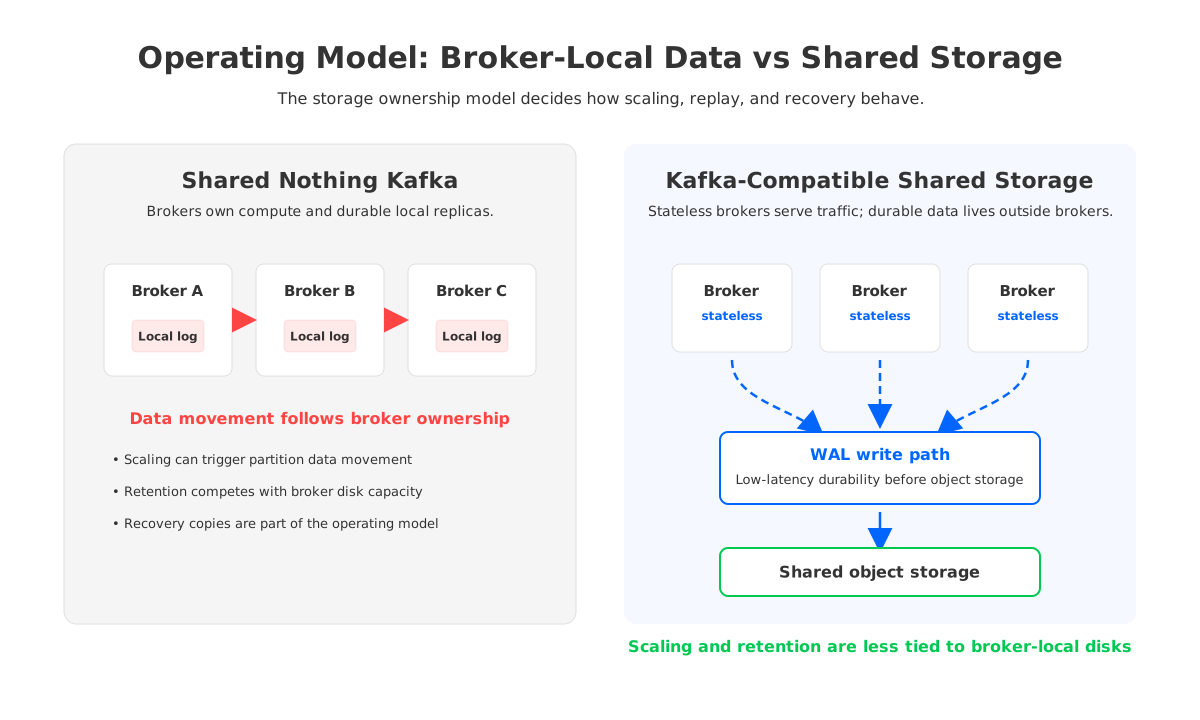
Once the evaluation is framed around control points, the storage model becomes a first-order question. Traditional Kafka follows a Shared Nothing architecture: brokers own local storage, serve protocol traffic, and replicate partitions to other brokers. That design is proven, but it couples durable data to broker-local capacity. Scaling, recovery, partition reassignment, and multi-zone cost all inherit that coupling.
AutoMQ is a Kafka-compatible cloud-native streaming platform that takes a different path: it keeps the Kafka protocol surface while moving durable stream storage into shared object storage with stateless brokers and a WAL-based write path. For governed ELT, the interesting part is not a generic claim that the platform is easier to operate. The important change is that retained data is no longer owned by one broker's local disk. Broker replacement, capacity changes, and retained-data growth become less tied to large data-copy operations.
That distinction affects real-time ELT in practical ways. Long retention becomes easier to discuss as a governance requirement instead of a broker-disk reservation problem. Connector-heavy workloads can be evaluated against traffic and task behavior rather than against a fixed storage footprint. Multi-zone deployments can be modeled with less broker-to-broker replica movement in supported topologies. When the data plane runs inside a customer-controlled environment, as in AutoMQ BYOC, platform teams can keep network, object storage, IAM, and audit boundaries aligned with their existing cloud controls.
There are still questions to prove. WAL choice affects latency and durability characteristics. Client and server version compatibility should be tested with the actual producers, consumers, Connect workers, and stream processors in scope. Zero cross-AZ traffic claims depend on documented topology and routing conditions, not on a slogan. A governed evaluation should include these constraints in the scorecard rather than treating architecture as a shortcut around validation.
6A readiness scorecard you can use
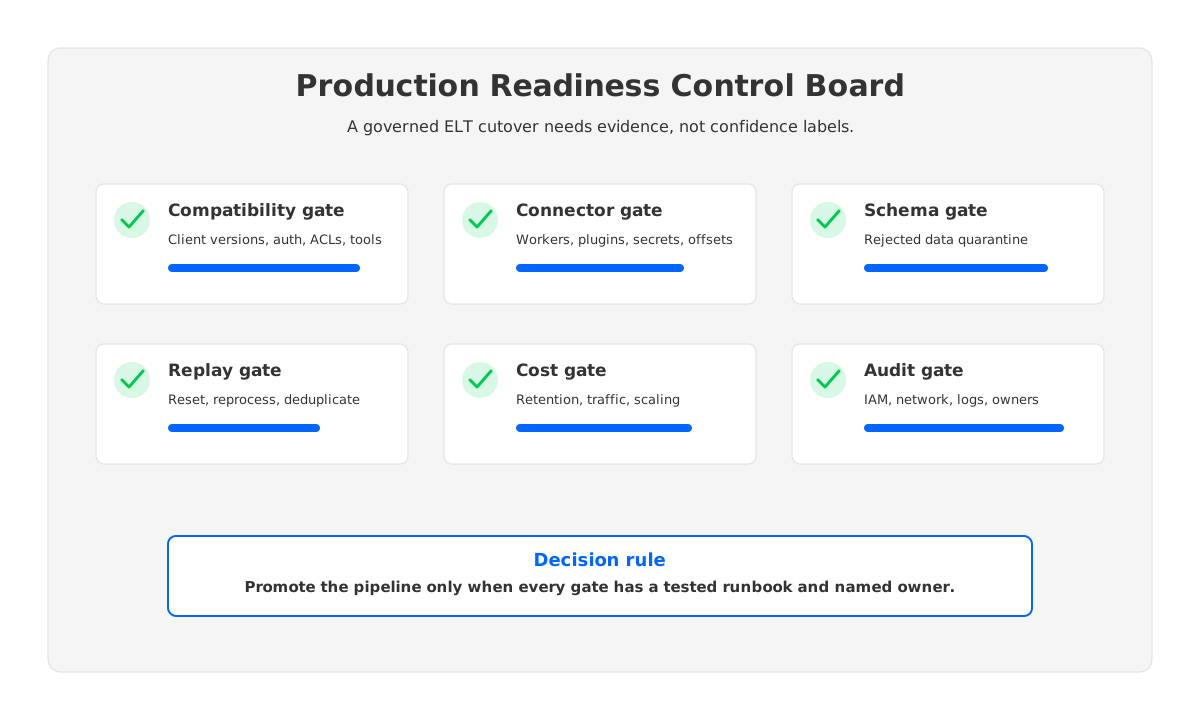
A scorecard is useful when it forces a decision. For each pipeline class, pick one representative source, one transformation path, and one sink. Then run the same test sequence against the current platform and any target platform: deploy, rotate credentials, introduce a compatible schema change, reject an incompatible schema change, stop the sink, recover from lag, replay a bounded window, reset a consumer group, replace a worker, replace a broker, and roll back the cutover plan.
The score should not be a vague green/yellow/red label. Use evidence that an operator can trust during an incident:
- Pass: The behavior is automated or documented, tested with the representative workload, and owned by a named team.
- Conditional pass: The behavior works under stated limits, such as specific client versions, connector plugins, WAL types, cloud regions, or topology constraints.
- Fail: The behavior depends on manual interpretation, unknown sink semantics, unsupported versions, missing retention, or an untested rollback path.
This is where governed ELT becomes measurable. The scorecard tells you which controls are strong enough for production, which ones need engineering work, and which ones belong in the migration plan rather than the steady-state runbook. It also prevents the common failure where teams validate throughput and latency while leaving replay, schema rejection, connector offsets, and rollback to the final week.
7Closing the control loop
The reason teams search for real time elt governance kafka is that their data movement path has become too important to run on assumptions. Kafka can provide the durable log, the integration ecosystem can move data, and stream processors can transform it in flight. Governance is the work of turning those moving parts into a system where changes, failures, replays, and costs are explainable.
If your next platform decision includes Kafka-compatible real-time ELT, use the control points above as the evaluation plan. Start with one high-value pipeline, prove the compatibility and recovery gates, and model the storage and network costs before expanding the scope. To test a Kafka-compatible Shared Storage architecture in your own cloud boundary, start from the AutoMQ console entry point and run the readiness scorecard against a representative connector path.
8References
- Apache Kafka Documentation
- Apache Kafka Connect Documentation
- Apache Kafka Design Documentation
- Apache Kafka Compatibility Notes
- Snowflake Connector for Kafka
- AutoMQ Architecture and FAQ
- AutoMQ BYOC Overview
- AutoMQ Cross-AZ Traffic Optimization
- AutoMQ Managed Kafka Connector
9FAQ
9.1Is real-time ELT governance mainly a schema registry problem?
No. Schema compatibility is one control point, but governed ELT also includes connector ownership, offset recovery, sink idempotency, retention, replay authorization, credentials, network placement, audit logs, and rollback. A schema registry can prevent one class of breaking change; it does not govern the full delivery path by itself.
9.2Does Kafka compatibility remove migration risk?
Kafka compatibility reduces application rewrite pressure, especially for producers, consumers, Kafka Connect, and common ecosystem tools. Migration risk remains in version support, authentication, internal topics, connector plugins, offset behavior, sink semantics, observability, and rollback. Treat compatibility as something to prove with representative workloads.
9.3How long should Kafka retention be for governed ELT?
Retention should be based on the longest recovery window the business needs, not only on broker storage cost. Include sink outage recovery, replay approvals, late-arriving records, compliance needs, and migration rollback. If retention is too short, the platform may have throughput capacity but still lack a safe recovery path.
9.4Where should transformations happen in real-time ELT?
Raw capture topics are useful when multiple teams need flexibility, while curated topics reduce downstream complexity and make contracts clearer. The right boundary depends on ownership, masking requirements, replay policy, and sink behavior. Many teams use both: raw topics for durable capture and curated topics for governed consumption.
9.5When should AutoMQ be evaluated for governed ELT delivery?
Evaluate AutoMQ when the platform decision is not only about connector count, but also about Kafka compatibility, long retention, cloud cost, elastic capacity, broker replacement, customer-controlled deployment boundaries, and multi-zone traffic. It is most relevant when the storage and recovery model has become part of the governance problem.


