
Table of Contents
Table of Contents
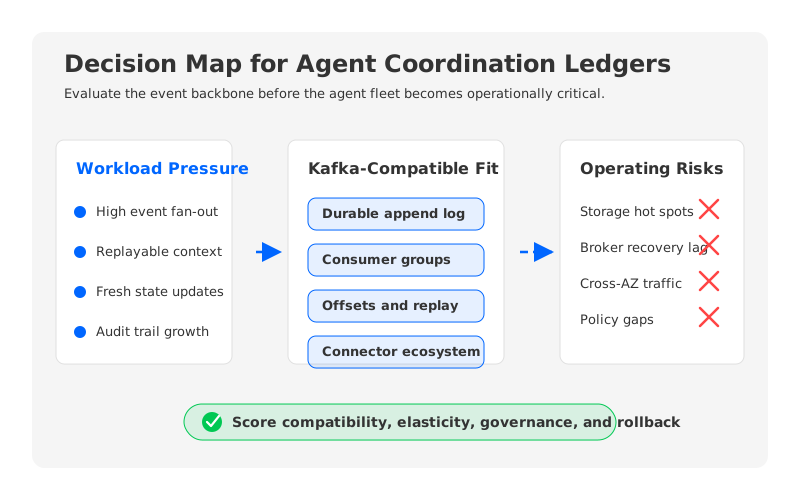
The first production problem in a large AI agent fleet is not usually the model. It is coordination. One agent decomposes a task, another calls a tool, a third validates the result, a supervisor agent changes the plan, and an evaluation service later needs to explain why the chain made a decision. When teams search for multi agent coordination events kafka, they are usually past the demo stage. They are deciding whether agent activity should become a durable, replayable event stream instead of a pile of transient traces, database rows, and application logs.
That shift matters because a coordination stream is more than telemetry. It carries task state, tool-call intent, guardrail decisions, prompt versions, retrieval context, human approvals, error recovery, and consumer progress. If the stream loses events, reorders important transitions, or becomes too expensive to retain, the agent platform loses the ability to debug and govern its own behavior. Kafka-style event streaming is attractive because it gives platform teams a familiar append log, consumer groups, offsets, replay, and a mature connector ecosystem. The hard question is whether the infrastructure model behind that Kafka-compatible API can keep up with the operational shape of agent fleets.
1Why teams search for multi agent coordination events kafka
Multi-agent systems turn coordination into a data problem. A single request can produce dozens of intermediate decisions, and those decisions are often consumed by different systems at different speeds. The application needs the next action immediately. The safety system may evaluate the event asynchronously. A data science team may replay the conversation later to improve routing. A compliance team may ask for the evidence trail after an incident. These are not the same consumer, and they should not be forced into the same database transaction boundary.
Kafka’s model maps cleanly to this pattern. Producers append events to topics, consumers read independently, consumer groups coordinate work, and offsets give each consumer a durable position in the log. For AI agent fleets, that means the event backbone can separate agent execution from evaluation, audit, monitoring, and data lake ingestion. It also means the platform team can add downstream consumers without changing the agent runtime every time another stakeholder asks for the same data.
The useful mental model is a coordination ledger. A ledger does not decide what the agent should do. It records the facts that other systems need in order to decide, verify, replay, or explain. In an enterprise setting, the ledger captures several event classes:
- Task lifecycle events. These describe plan creation, task decomposition, assignment, completion, failure, retries, and handoff between agents.
- Context events. These record retrieval results, memory updates, prompt templates, policy inputs, and any state that changes the agent’s next decision.
- Tool and action events. These capture external calls, parameters, side effects, approval gates, and returned evidence.
- Governance events. These include guardrail checks, policy denials, human review, escalation, and post-run evaluation.
Treating those events as a shared append log is cleaner than scattering them across service-specific stores. It also raises the bar for the streaming platform because the stream may trigger customer-facing actions, financial workflows, security responses, or regulated operational decisions.
2The freshness and governance problem behind AI event streams
Agent coordination has an awkward mix of requirements. Some consumers need fresh events within tight latency budgets, while others care more about long retention and complete replay. A supervisor agent may need the latest tool result before choosing the next step. A batch evaluation job may read the same events hours later. A governance system may need to prove that a denial happened before a tool call. A data lake sink may persist the same stream for model improvement, auditing, and incident review.
This mix is where the word “ledger” becomes useful. A log that only serves immediate dispatch is not enough; a ledger has to preserve sequence, context, and ownership boundaries. The platform team needs to answer which service wrote the event, which identity authorized it, which consumer processed it, which agent version emitted it, and whether a later correction was appended rather than hidden by an in-place update.
The hidden pressure comes from volume and retention. Agent events are verbose because they carry context. They also fan out because each event is valuable to runtime orchestration, observability, policy enforcement, feature extraction, model evaluation, and data lake ingestion. If the platform is built around broker-local disks, those requirements translate into capacity planning, replication traffic, partition reassignment, and recovery work.
Governance makes the problem less forgiving. A platform team can tolerate a dashboard that misses a few debug spans; it cannot tolerate a coordination ledger that drops approval events or makes replay unreliable. Retention, encryption, access control, network isolation, and consumer lag monitoring become part of the agent architecture.
3Architecture options for durable, replayable AI context
There are several ways to persist multi-agent coordination events. A relational database gives transactional updates and simple queries, but it struggles when many independent consumers need ordered replay. A tracing system is excellent for observability, but traces are not usually designed as a durable coordination substrate with consumer offsets. Kafka-compatible streaming sits in the middle: append-only durability, ordered partitions, independent consumers, replay, and broad integration options.
The platform choice is not only about Kafka as a protocol. It is also about how the platform stores data, scales brokers, moves partitions, and handles failure. Traditional Kafka uses a Shared Nothing architecture: brokers own local log segments, and replication protects data by writing copies across brokers. That design is proven and deeply understood, but it couples compute capacity to broker-local storage. When an agent workload grows or the cluster is resized, data movement becomes part of recovery and balancing.
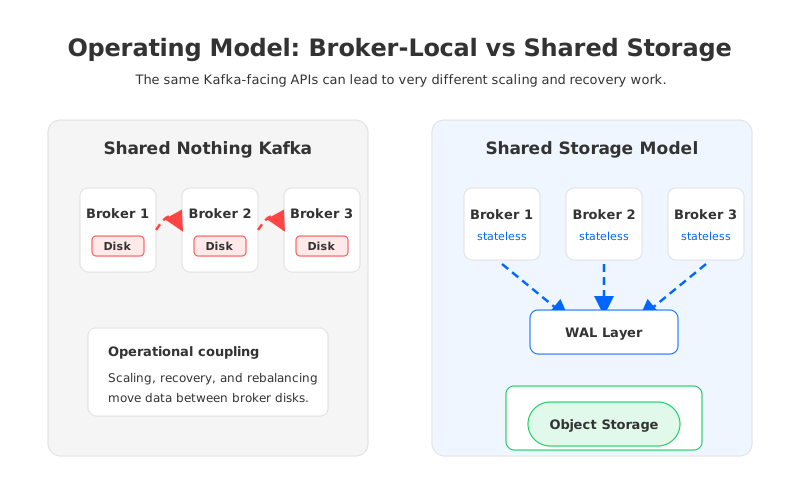
For coordination ledgers, this coupling appears in practical ways. The pressure is operational, not abstract:
- Broker-local storage drives capacity buffers. Teams reserve disk for retention and bursty context growth, even when compute demand is not growing at the same rate.
- Rebalancing competes with production traffic. Partition movement and replica catch-up can consume network and disk bandwidth while agents are still emitting coordination events.
- Cross-zone replication can become a cost and latency concern. Multi-AZ durability is important, but application-level replication across zones can create cloud network traffic that has to be budgeted and monitored.
- Recovery time becomes a platform dependency. If agent coordination topics are large, broker replacement and replica catch-up affect how fast the platform returns to a healthy operating state.
Cloud-native streaming architectures try to change that operating model by separating compute from durable storage. Instead of treating each broker’s disk as the long-term source of truth, they use shared storage, often object storage, for durable data while brokers serve Kafka-compatible reads and writes. Write-ahead logging, caching, metadata, and failure handling still matter, but compute and retention can be evaluated as separate dimensions.
4Evaluation checklist for platform teams
Before choosing a platform for AI coordination events, start with the shape of the ledger rather than the brand of the broker. The design review should ask what has to be true after the agent fleet is in production and multiple teams depend on the event stream.
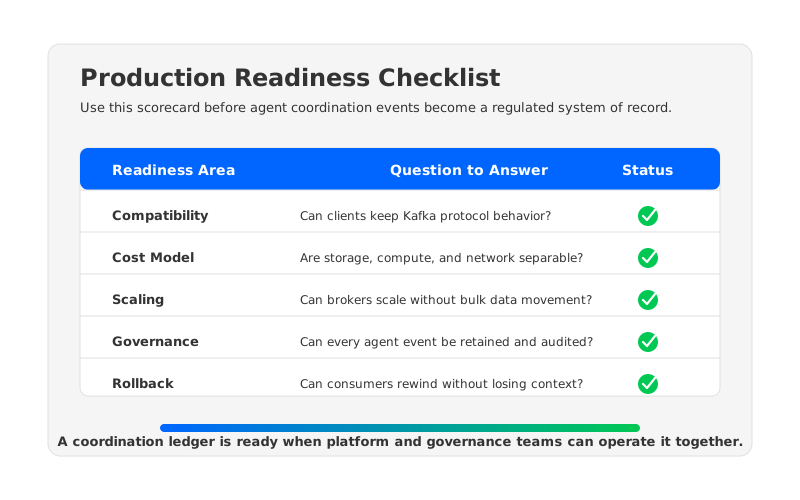
Use a scorecard that covers architecture, operations, and governance together. A useful scorecard forces platform, AI, and governance owners into the same review:
| Evaluation area | Question to ask | Why it matters for agent fleets |
|---|---|---|
| Kafka compatibility | Can existing Kafka clients, schemas, ACL patterns, and connectors keep working? | Agent platforms often integrate with existing data systems rather than greenfield pipelines. |
| Elasticity | Can broker capacity change without bulk data movement becoming the main event? | Agent traffic can be bursty when workflows, evaluations, or batch replays spike. |
| Cost model | Can compute, storage, and network costs be reasoned about independently? | Coordination events are verbose, retained, and consumed by many downstream systems. |
| Governance | Can events be retained, encrypted, attributed, and replayed under clear access boundaries? | The stream may become evidence for regulated decisions and incident review. |
| Migration risk | Can producers, consumers, offsets, and rollback paths be tested before cutover? | A coordination ledger is hard to replace once many agents depend on it. |
| Observability | Can teams see lag, throughput, storage growth, broker health, and cross-zone traffic? | Operational symptoms need to be visible before they affect agent decisions. |
This checklist avoids a common mistake: designing the ledger only for the agent runtime team. Runtime teams care about fresh coordination. Data teams care about replay and lake ingestion. Security teams care about identity boundaries. SREs care about recovery, lag, and capacity. Finance teams care about retention and network growth.
Topic design should reflect the same discipline. A coordination ledger is easier to govern when event types, partition keys, and retention policies are explicit. Task-level events may partition by workflow or conversation. Tool-call events may need stronger ordering around a specific task. Evaluation events may tolerate different latency and retention. The goal is not to force all agent activity into one topic; it is to make the event model durable enough that downstream systems can trust it.
5How AutoMQ changes the operating model
Once the evaluation frame is clear, a cloud-native Kafka-compatible platform becomes relevant for a specific reason: the agent fleet needs Kafka semantics without inheriting every broker-local storage trade-off. AutoMQ is a Kafka-compatible streaming platform built around Shared Storage architecture and stateless brokers. It keeps the Kafka-facing API model while moving durable stream storage into cloud object storage with a write-ahead log layer designed for low-latency writes.
That architectural distinction matters for coordination ledgers because storage and compute needs often move at different speeds. Retention may grow as governance requirements expand, while broker compute may only need to scale during traffic bursts or replay-heavy evaluation windows. In a Shared Nothing cluster, those changes are tied to broker-local disks and partition movement. In AutoMQ’s model, brokers can be treated more like serving nodes over shared durable storage.
The practical benefits show up in several places. Stateless brokers reduce the amount of broker-local state that has to be rebuilt after a node change. Shared object storage gives the platform a durable storage layer with cloud-native capacity characteristics. Independent compute and storage scaling makes it easier to retain coordination history without over-provisioning broker disks. AutoMQ’s documentation also describes approaches for eliminating inter-zone traffic, which is relevant when multi-AZ Kafka replication becomes part of the cost model.
This is not a reason to skip design review. A coordination ledger still needs schemas, ACLs, topic naming, consumer lag alerts, dead-letter handling, and rollback plans. It also needs a migration plan if the team already runs Kafka. The narrower point is that Shared Storage changes the operating constraints that usually make large Kafka retention and elasticity painful.
AutoMQ fits when the team wants to preserve the Kafka integration surface while reducing the coupling between brokers and storage. AI platforms rarely get to choose every surrounding system. Compatibility lowers migration friction; the storage architecture determines whether retention or scaling changes become data movement projects.
6Migration and readiness scorecard
A production rollout should prove the ledger before it carries critical agent actions. Start with a narrow set of coordination topics, connect the most important consumers, and test replay under realistic traffic. The goal is to discover where schema evolution, consumer lag, access policy, and retention decisions break down.
A pragmatic readiness sequence looks like this. Each step should be tested with real producers and consumers:
- Define the event contract. Name the task, context, tool, governance, and evaluation events that must be append-only and replayable.
- Choose partition keys deliberately. Preserve ordering where agent state transitions depend on it, and avoid keys that create hot partitions during popular workflows.
- Test consumer independence. Run runtime, evaluation, audit, and lake-ingestion consumers at different speeds to verify offset management and replay behavior.
- Model retention and network cost. Estimate event size, fan-out, retention, and cross-zone traffic before the platform becomes difficult to move.
- Exercise rollback. Validate producer cutover, consumer offset recovery, topic-level rollback, and the path back to the previous system.
- Instrument operations. Monitor broker health, throughput, storage growth, consumer lag, failed writes, connector status, and policy-denied events.
The scorecard should be owned jointly by the AI platform team and the streaming platform team. If only the AI team owns it, the design may ignore Kafka operations. If only the infrastructure team owns it, the design may miss why certain events must be ordered, replayable, or retained.
For teams evaluating Kafka-compatible infrastructure for this pattern, AutoMQ is worth a closer look after the workload and governance requirements are clear. Compare your ledger design against AutoMQ’s Kafka compatibility and Shared Storage architecture documentation, then run a proof of concept with real producer and consumer behavior. You can start from the verified AutoMQ documentation here: AutoMQ Kafka compatibility.
7References
- Apache Kafka documentation: Use cases, APIs, configuration, and operations
- Apache Kafka documentation: Message delivery semantics
- Apache Kafka documentation: KRaft mode operations
- Apache Kafka documentation: Kafka Connect
- AWS documentation: Amazon S3 User Guide
- AWS documentation: What is AWS PrivateLink?
- AutoMQ documentation: Compatibility with Apache Kafka
- AutoMQ documentation: Architecture overview
- AutoMQ documentation: S3Stream Shared Streaming Storage
- AutoMQ documentation: Eliminate inter-zone traffic
- AutoMQ documentation: Migrating from Apache Kafka to AutoMQ
8FAQ
8.1Is Kafka a good fit for multi-agent coordination events?
Kafka-compatible streaming is a strong fit when events need durable append-only storage, independent consumers, replay, offsets, and integration with existing stream processing or data lake systems. The deciding factor is whether downstream systems need to reconstruct what happened after the original agent action is complete.
8.2Should all agent events go into one topic?
Usually no. Production ledgers benefit from separating task lifecycle, context, tool-call, governance, and evaluation events when they have different ordering, retention, access, or consumer requirements.
8.3What makes coordination events different from observability traces?
Traces explain execution paths, while coordination events often become part of the application’s durable state and governance record. A trace can help debug why an agent was slow. A coordination event may prove which tool was called, which approval was granted, or which policy denied an action.
8.4Where does AutoMQ fit in this architecture?
AutoMQ fits when the team wants Kafka-compatible APIs with a cloud-native operating model based on Shared Storage and stateless brokers. Teams should still validate schemas, ACLs, topic design, migration steps, and rollback behavior.
8.5What should be tested before production?
Test producer cutover, consumer offset behavior, replay from retained history, schema evolution, access control, failed writes, connector recovery, consumer lag alerts, and rollback to the previous path. Use realistic event sizes and fan-out, and include runtime, data, governance, and SRE stakeholders.


