
Table of Contents
Table of Contents
Teams usually search for low latency enrichment join kafka after an enrichment path has already become important. A stream processor joins live events with customer profiles, device metadata, account limits, pricing tables, fraud lists, inventory state, or feature-store outputs, and the first dashboard looks promising. Then the production questions start to hurt: how fresh is the reference data, how far can the source topics replay, what happens during a rebalance, and who owns the cost when the join needs more retention than the original Kafka cluster was sized for?
The tempting answer is to tune the processor. Increase parallelism, cache the lookup table, compact the reference topic, or move the join into a faster state backend. Those can be correct moves, but they are not the whole architecture. A low-latency enrichment join sits on a chain of commitments: Kafka offsets, processor checkpoints, reference-data versions, schema rules, storage retention, and rollback boundaries. The practical thesis is this: the join is only as fast as its slowest state boundary, and only as reliable as the replay window behind it.
1Why Teams Search for low latency enrichment join kafka
The search intent is rarely academic. A platform team has a Kafka-based event pipeline that already serves operational consumers, and another team wants enriched events with the same freshness expectations. The application team sees latency. The SRE team sees consumer lag and restart behavior. The data governance team sees personally identifiable information copied into a wider topic. The FinOps team sees broker storage, cross-Availability Zone (AZ) traffic, object storage requests, and processor compute turning into one blended bill.
That is why the phrase "low latency" can be misleading. The relevant latency is broader than the time between a source record arriving and an enriched record being produced. It also includes the time required to refresh reference data, recover processor state, replay from a known offset, and prove that a bad enrichment can be rolled back without guessing. Apache Kafka gives teams a durable ordered log, offsets, consumer groups, transactions, Kafka Connect, and an ecosystem that many stream processors already understand. The enrichment architecture decides whether those primitives remain visible during incidents.
A production review should start with a few uncomfortable questions:
- If the reference table changes while processors are restarting, which version is used for replay?
- If the output topic contains enriched PII, do its access controls match the combined data shape or the old source topic?
- If Kafka retention expires before the processor catches up, can the team rebuild the enriched stream from another durable source?
- If the platform scales brokers during a traffic spike, does the join see a normal capacity event or a state-recovery incident?
These questions move the discussion away from a single latency benchmark. They also prevent a common mistake: treating Kafka as a pipe between source and processor while the processor is treated as the primary stateful component. In production, Kafka is still the recovery ledger. The more valuable the enriched stream becomes, the more carefully the log, storage, and ownership model must be designed.
2The Production Constraint Behind the Problem
Traditional Kafka deployments use a Shared Nothing architecture. Each broker manages local storage, and partitions are replicated across brokers for durability and availability. This architecture is mature and well understood, but it turns long replay windows, partition movement, and multi-AZ deployment into broker-local capacity work. When enrichment joins become central to customer-facing decisions, those operational details stop being background plumbing.
Consider what an enrichment join asks the platform to do. The live event topic needs enough retention to replay after a processor bug, a bad deployment, or a failed downstream write. The reference data needs a versioning model that can be reconstructed during replay. The output topic often needs stronger governance than either input topic because it combines fields that were previously separate. Each of those requirements is reasonable. Together, they raise the cost and latency budget of the Kafka cluster underneath the processor.
The hardest constraint is that the system has more than one clock. Producers continue writing while a processor restarts. Reference data may update while an old source event is replayed. Consumer group rebalances can move work while checkpoints are being restored. Broker scaling can require partition reassignment and replica movement in a Shared Nothing architecture. None of these events is unusual by itself, but the join experiences them as one end-to-end path.
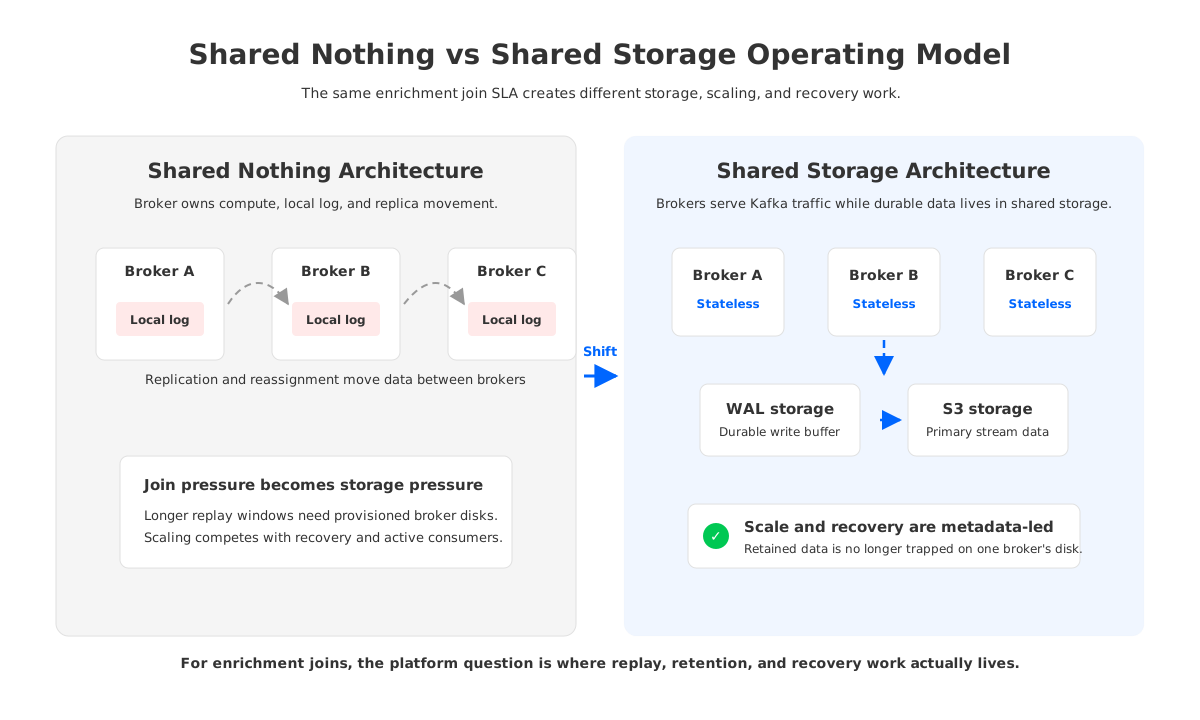
There is also a cloud cost angle that shows up late if no one models it. Broker-local disks or cloud volumes must be provisioned for the recovery window before the incident occurs. Multi-AZ Kafka deployments can generate cross-AZ data transfer through replication and client traffic, depending on placement and configuration. Private networking, object storage API requests, processor compute, and observability pipelines add their own line items. A fast join that works only when the cluster is overprovisioned is not a production architecture; it is a latency result without a cost model.
3Architecture Options and Trade-Offs
There is no single correct way to build a low-latency enrichment join on Kafka. The correct choice depends on how much state the join owns, how often reference data changes, how strict the output governance is, and how much operational independence the platform team wants.
| Option | Where the hard state lives | Good fit | Main trade-off |
|---|---|---|---|
| Kafka Streams join | Local state stores, changelog topics, Kafka offsets | Application-owned stream processing with Kafka-native semantics | App teams must operate state restore, standby strategy, and output governance |
| Flink enrichment job | Flink state, checkpoints, Kafka offsets, reference sources | Large state, complex joins, event-time logic, and richer processing controls | More moving parts in checkpoint, savepoint, upgrade, and backfill workflows |
| Kafka Connect plus lookup service | Connector offsets plus an external service or cache | Lightweight enrichment at integration boundaries | Cache freshness and service availability become part of the stream SLA |
| Custom processor | Application state, Kafka offsets, external stores, and domain logic | Strict domain control or unusual consistency requirements | Teams own idempotency, replay, and rollback discipline themselves |
This table is deliberately neutral. Kafka Streams is often a strong fit when the team wants Kafka-native processing and can operate changelog-backed state. Flink is often stronger when the enrichment logic needs complex state management, event-time behavior, or controlled backfills. A lookup service can keep the stream path light, but it moves freshness and availability into another runtime dependency. A custom processor can be justified, but only when the team accepts that it is building its own recovery contract.
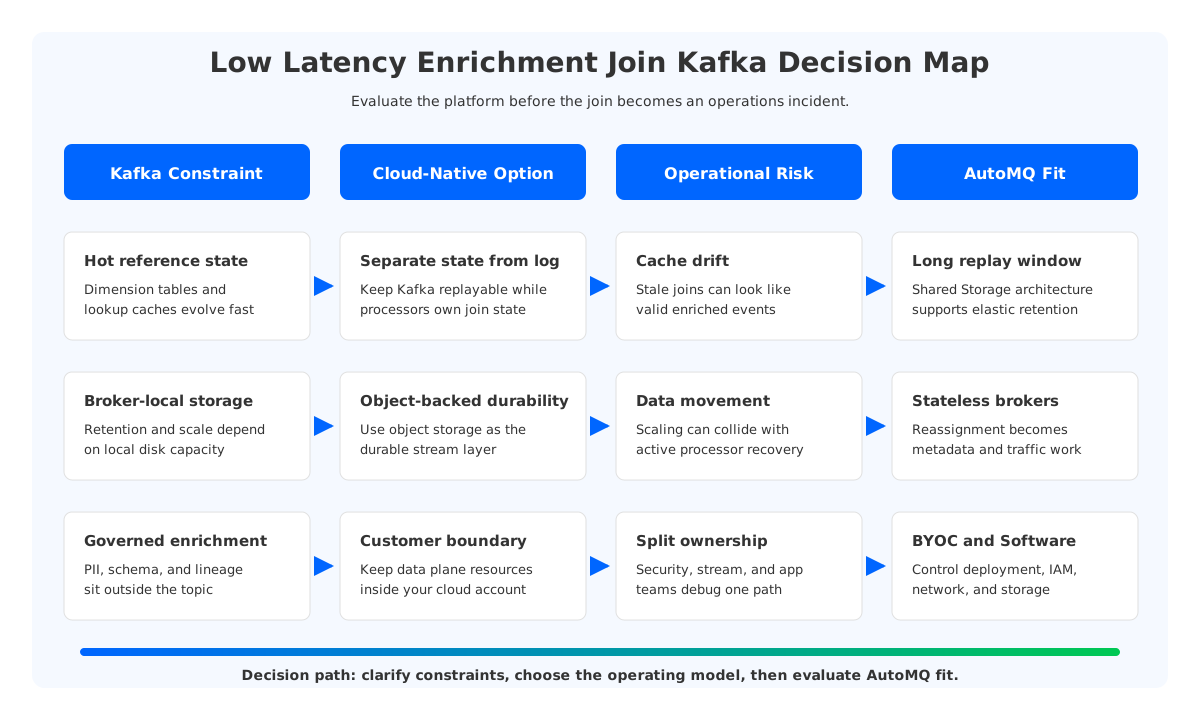
The useful evaluation unit is the state boundary, not the framework name. For each option, write down the source offset considered safe, the reference version used for replay, the processor checkpoint considered restorable, the output record considered visible, and the rollback point considered acceptable. If those boundaries are implicit, the first production incident will define them under pressure.
4Evaluation Checklist for Platform Teams
Before choosing or migrating a Kafka-compatible streaming platform, platform teams should evaluate the operating model underneath the join. A processor can hide architectural debt for a while, especially when traffic is stable and reference data is small. The debt becomes visible when replay, retention, scaling, and security all need to work at the same time.
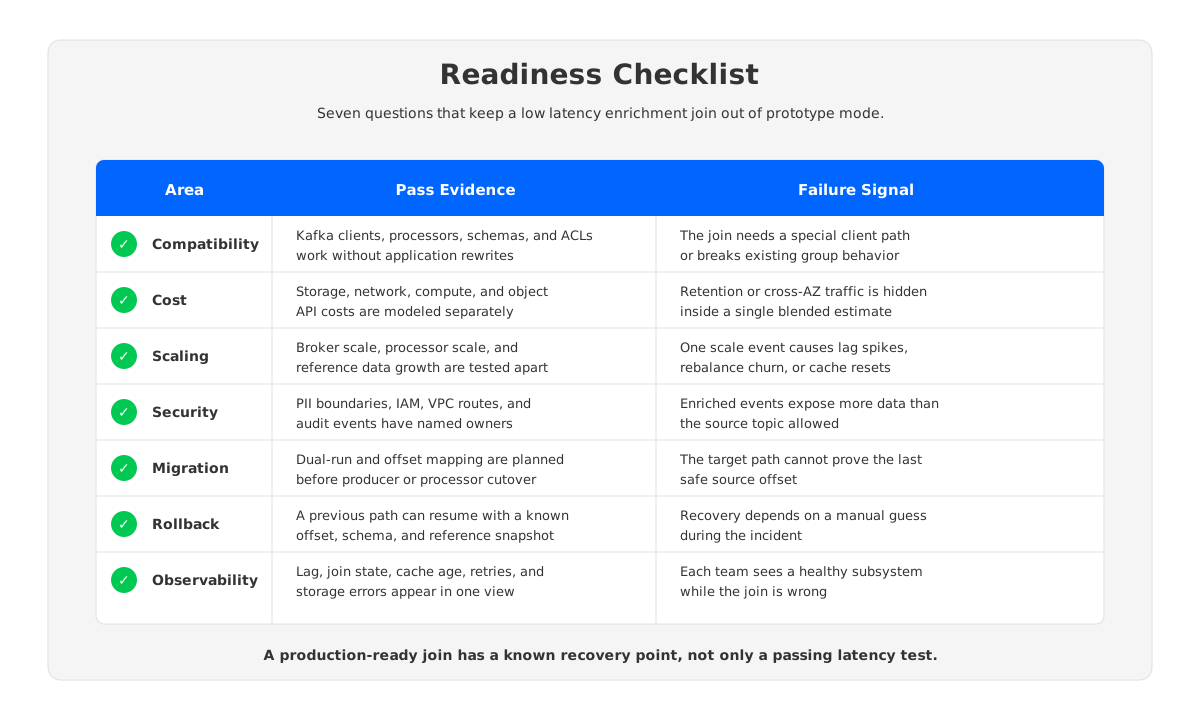
Use this checklist as a design review rather than a vendor scorecard:
The checklist has a useful side effect: it gives each team a clear boundary. Application teams can own join logic and output semantics. Platform teams can own Kafka-compatible infrastructure, retention, scaling, and migration. Security teams can own access boundaries. SREs can own the incident runbook. Without that separation, enrichment incidents become meetings about whose dashboard is more correct.
5How AutoMQ Changes the Operating Model
Once the neutral evaluation framework is clear, the storage architecture underneath Kafka becomes a first-order decision. AutoMQ is a Kafka-compatible streaming platform that keeps Kafka APIs and ecosystem semantics while replacing broker-local persistent storage with a Shared Storage architecture. The important point for enrichment joins is not that the processor gets a magic shortcut. It is that replay, retention, broker replacement, and scaling no longer have to be centered on broker-local durable data.
AutoMQ uses S3Stream as its stream storage layer. Persistent stream data is written through WAL (Write-Ahead Log) storage for durable write buffering and recovery, then stored in S3-compatible object storage as the primary storage layer. Brokers continue to serve Kafka protocol traffic, own partition leadership, and integrate with the Kafka ecosystem, but they are stateless brokers rather than long-lived owners of local partition data. That changes the shape of operational work: scaling and reassignment become metadata and traffic-management work instead of large broker-to-broker data movement.
For low-latency enrichment joins, that shift helps in three practical ways. First, retention for replay can be planned around shared object-storage-backed durability rather than the ceiling of broker-local disks. Second, broker replacement or scale-out is less likely to collide with processor recovery because retained log data is not trapped on a specific broker. Third, customer-controlled deployment models such as AutoMQ BYOC and AutoMQ Software can keep the data plane, object storage, network boundaries, IAM, and governance controls inside the customer's environment.
AutoMQ also matters when the join is part of a larger data platform path. Kafka Linking can support migration planning where offset continuity and consumer progress matter. Self-Balancing helps keep broker traffic distribution from becoming a manual partition-placement project. Table Topic can be relevant when enriched streams are also intended for Apache Iceberg tables. These capabilities do not remove the need for design review; they change what the review can focus on. Instead of spending most of the energy on broker storage movement, the team can focus on state contracts, data governance, processor behavior, and rollback evidence.
There are still trade-offs. WAL type, object storage behavior, cloud region, network layout, processor framework, and workload shape all affect latency and cost. AutoMQ Open Source uses S3 WAL, while AutoMQ commercial editions support additional WAL storage options for workloads with different latency requirements. The right conclusion is not "all joins should move to one platform." The right conclusion is that an enrichment join deserves a Kafka-compatible foundation where retention, scaling, and recovery are explicit parts of the operating model.
6A Practical Readiness Scorecard
Before putting an enrichment join into the production path, create a short scorecard that the on-call team can actually use. The artifact does not need to be long, but it needs to prove that latency, cost, and recovery were designed together.
| Area | Production question | Pass evidence |
|---|---|---|
| Source log | Can we replay from the last known safe offset? | Retention policy, lag alert, and replay test are documented |
| Reference state | Can replay use the correct reference version? | Reference snapshots, changelog topics, or versioned lookup data are retained |
| Processor state | Can a restart restore without stale or duplicate output? | Checkpoint, changelog, or state-restore test covers crash scenarios |
| Output governance | Does the enriched topic match the sensitivity of combined data? | ACLs, schemas, retention, and audit logs have named owners |
| Platform scaling | Can brokers scale while processors recover? | Scale test covers reassignment, lag, catch-up reads, and state restore |
| Migration | Can we cut over without guessing offsets? | Dual-run, offset mapping, rollback, and consumer switch steps are verified |
The scorecard turns a search query into an engineering decision. If the join is a small convenience path, a familiar processor and a moderate retention window may be enough. If the join drives customer decisions, fraud controls, personalization, or financial limits, the Kafka-compatible platform underneath it deserves the same scrutiny as the processing framework. A production-ready enrichment join has a known recovery point, not merely a passing latency test.
7FAQ
7.1What is a low-latency enrichment join in Kafka?
A low-latency enrichment join combines live Kafka events with reference data, such as customer profiles, device metadata, pricing data, or fraud lists, and produces enriched events quickly enough for operational use. The hard part is keeping the reference state, source offsets, processor checkpoints, output governance, and rollback path consistent.
7.2Should I use Kafka Streams or Flink for enrichment joins?
Kafka Streams is often a good fit for Kafka-native application processing with changelog-backed state. Flink is often a better fit for larger state, event-time logic, controlled backfills, and complex processing workflows. The right choice depends less on the framework name and more on how the team handles replay, checkpointing, reference-data freshness, and output governance.
7.3Why does broker storage architecture matter for join latency?
Broker storage architecture affects retention, replay, catch-up reads, partition movement, and scaling. In a Shared Nothing architecture, retained log data is tied to broker-local storage. In a Shared Storage architecture, durable stream data lives in shared object storage, which changes how teams plan recovery and elasticity.
7.4Does AutoMQ replace the stream processor?
No. AutoMQ is a Kafka-compatible streaming platform, not a replacement for Kafka Streams, Flink, or application-specific processing logic. It changes the Kafka storage and operating model under the processor, which can make retention, scaling, recovery, and migration easier to reason about.
7.5Where should AutoMQ enter the evaluation?
AutoMQ should enter after the team has defined compatibility, cost, elasticity, governance, recovery, and migration requirements. It is most relevant when teams want Kafka-compatible APIs with stateless brokers, Shared Storage architecture, customer-controlled deployment boundaries, and an operating model that separates durable stream data from broker-local disks.
If your enrichment join is moving from prototype to production, use the checklist above as the design review. When the source log needs Kafka-compatible semantics with cloud-native elasticity, explore AutoMQ through the product workspace: start with AutoMQ.
8References
- Apache Kafka documentation
- Apache Kafka Connect documentation
- Apache Kafka KRaft documentation
- Apache Kafka Tiered Storage documentation
- Apache Kafka Streams documentation
- AWS data transfer pricing
- AutoMQ Shared Storage architecture
- AutoMQ compatibility with Apache Kafka
- AutoMQ WAL storage
- AutoMQ Kafka Linking overview
- AutoMQ Table Topic overview
- AutoMQ cross-AZ traffic optimization


