
Table of Contents
Table of Contents
Teams usually search for near real time analytics feed kafka when a dashboard, model feature, fraud rule, or lakehouse table has outgrown its first pipeline. The early version looked reasonable: publish operational events to Kafka, run a stream processor or connector, and make the data visible to analysts within minutes. Then the feed becomes part of business operations. More consumers subscribe, retention gets extended, backfills become routine, and the platform team discovers that "near-real-time" is not one latency target. It is a chain of storage, recovery, governance, and cost decisions.
The tricky part is that analytics feeds sit between two cultures. Application teams care about event order, offsets, retries, and customer impact. Analytics teams care about freshness, completeness, schema evolution, and query availability. Platform teams have to keep both sides honest while paying for brokers, storage, network paths, observability, and on-call time. The useful thesis is this: a near-real-time analytics feed is production-ready only when the replay window, read fan-out, and ownership model are designed together.
1Why Teams Search for near real time analytics feed kafka
The search intent is practical, not academic. A team already has Kafka in the critical path and wants to turn event streams into continuously updated analytics outputs. That output may be a materialized feature stream for machine learning, a fraud monitoring feed, a customer activity table, an operational BI dataset, or a stream-to-lakehouse path. The team is not asking whether Kafka can move events; it is asking whether Kafka can keep the feed fresh without turning retention, recovery, and scaling into a permanent capacity project.
A production review should force the hidden assumptions into the open:
- Which Kafka offsets define the last safe point if a downstream table write fails?
- How much retention is needed for routine backfill, incident replay, and audit review?
- Which consumers are allowed to read the feed, and does that change when fields are joined or denormalized?
- Can the platform scale brokers while processors and analytics consumers are also catching up?
- If the feed lands in Apache Iceberg or another table format, who owns schema compatibility across the stream and the table?
These questions move the conversation beyond a single p99 latency number. Apache Kafka gives teams durable ordered logs, offsets, consumer groups, transactions, Kafka Connect, Kafka Streams, and KRaft-based metadata management. Those primitives are useful because they make recovery and consumption explicit. The architecture around the feed decides whether those primitives remain visible when the feed becomes a shared data product.
2The Production Constraint Behind the Problem
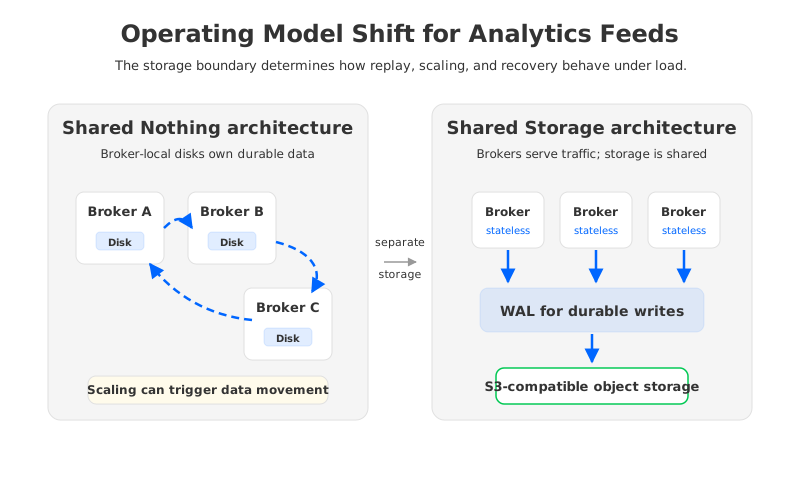
Traditional Kafka deployments use a Shared Nothing architecture. Each broker manages local persistent storage, partitions are assigned to brokers, and replicas are copied across brokers for durability and availability. This model is proven and widely understood, but it ties the cost of long retention and the mechanics of scaling to broker-local storage. When an analytics feed needs a longer replay window than the original operational topic, that difference has to be paid for before the incident that needs the replay occurs.
The constraint becomes sharper in cloud deployments. Broker disks or cloud volumes must be sized for peak retention, hot partitions, and safety margin. Multi-Availability Zone (AZ) deployments can introduce cross-AZ traffic through replication and client placement. Kafka Tiered Storage can offload older log segments to object storage, which is useful for some retention-heavy workloads, but it still keeps the active write path and local tier in the broker operating model. For an analytics feed with bursty reads, long backfills, and multiple consumers, the team still has to ask what happens when hot reads, catch-up reads, partition movement, and processor recovery overlap.
The hard operational moment is usually not steady state. It is the day after a schema bug, a failed connector deployment, a broken table commit, or a downstream query outage. Producers kept writing while the analytics path was degraded. Some consumers continued reading, others fell behind, and the table or dashboard may contain partial output. At that point, the feed needs a clear recovery ledger. If the log has enough retention, offsets are known, and downstream writes can be replayed safely, the incident is a controlled repair. If any of those conditions are missing, the team reconstructs truth from dashboards and cloud bills.
Cost and latency are tied together in that repair story. More retention can protect replay but increases storage exposure. More replicas can protect availability but increase network and storage work in Shared Nothing Kafka. More consumers can improve data access but create read fan-out and lag isolation problems. More aggressive table commits can improve freshness but increase metadata pressure on the lakehouse side. The architecture is not deciding whether latency or cost matters more; it is deciding where the trade-off is visible and who can operate it.
3Architecture Options and Trade-Offs
Near-real-time analytics feeds usually fall into a few patterns. The names matter less than the state boundary each pattern creates.
| Pattern | Where the hard state lives | Good fit | Main trade-off |
|---|---|---|---|
| Stream processor to analytics topic | Kafka offsets, processor checkpoints, output topic | Derived metrics, feature feeds, live monitoring | Processor recovery and output governance must be designed together |
| Kafka Connect to warehouse or lakehouse | Connector offsets, sink retry state, target table state | Operational events entering analytics systems | Target commits and connector retries can define real freshness |
| Stream-to-table pipeline | Kafka log, table catalog, object storage, table snapshots | Apache Iceberg or lakehouse-first analytics | Stream schema and table schema need one ownership model |
| Dual path: operational stream plus batch backfill | Kafka for freshness, object storage or warehouse for rebuild | Large reprocessing jobs and audit workloads | Two sources of truth can drift without strict reconciliation |
Kafka Streams, Flink, Kafka Connect, and custom services can all be reasonable choices. Kafka Streams keeps processing close to Kafka-native semantics and changelog-backed state. Flink is often stronger when the feed needs complex event-time logic, large state, or controlled backfills. Kafka Connect can be the right operational boundary when the main job is reliable ingestion into an analytics system. A custom service can be justified when the domain logic is unusual, but it also means the team owns idempotency, replay, and rollback discipline.
The useful evaluation unit is the feed contract. A feed contract says what source offsets are included, what schema version is valid, what lateness is tolerated, what downstream target is authoritative, what access policy applies, and how replay is performed. Without that contract, teams tend to improve the component they own. The processor team tunes parallelism, the data team tunes table compaction, the platform team adds broker capacity, and the SRE team adds alerts. Each move may help, but none of them proves the feed can recover.
4Evaluation Checklist for Platform Teams
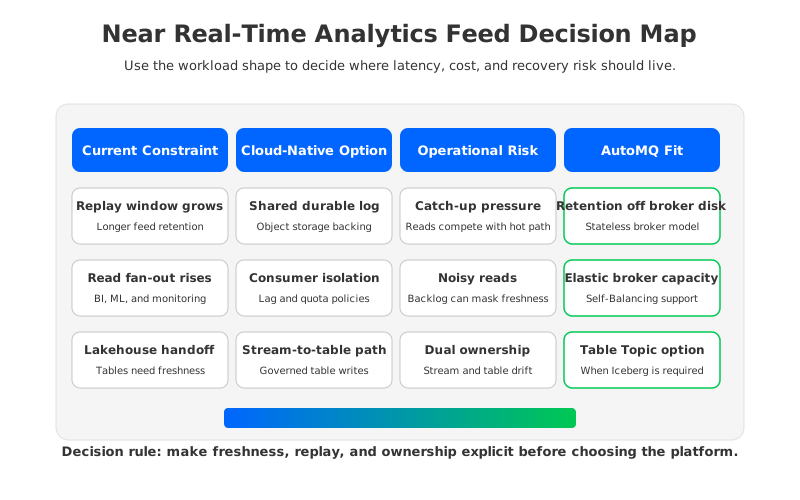
Before choosing a Kafka-compatible streaming platform or changing the analytics feed architecture, platform teams should evaluate the operating model underneath the pipeline. The checklist should be specific enough to drive a design review, not so broad that every platform scores itself as "mostly done."
The checklist separates responsibilities. Application teams can own event semantics and source compatibility. Data teams can own table shape, freshness, and query behavior. Platform teams can own Kafka-compatible infrastructure, scaling, and retention. Security teams can own access boundaries. SREs can own the recovery runbook. When those boundaries are missing, the analytics feed becomes a shared dependency with no single recovery owner.
5How AutoMQ Changes the Operating Model
Once the evaluation framework is clear, the storage architecture underneath Kafka becomes a first-order decision. AutoMQ is a Kafka-compatible streaming platform that preserves Kafka APIs and ecosystem behavior while replacing broker-local persistent storage with a Shared Storage architecture. The point is not that analytics consumers receive a shortcut around processing. The point is that replay, retention, broker replacement, and elastic capacity no longer have to be centered on durable data stored on a particular broker.
AutoMQ uses S3Stream as its streaming storage layer. Writes pass through WAL (Write-Ahead Log) storage for durable buffering and recovery, and persistent stream data is stored in S3-compatible object storage as the primary storage layer. Brokers still handle Kafka protocol traffic, partition leadership, caching, and scheduling, but they are stateless brokers rather than long-lived owners of local partition data. That changes the operating model: scaling and reassignment become metadata and traffic-management work instead of large broker-to-broker data movement.
For near-real-time analytics feeds, the shift helps in three practical areas. First, longer replay windows can be planned around shared object-storage-backed durability instead of broker-local disk ceilings. Second, catch-up reads and broker replacement can be reasoned about separately because retained data is not trapped on the failed or overloaded broker. Third, customer-controlled deployment models such as AutoMQ BYOC and AutoMQ Software can keep the data plane, object storage, network paths, IAM, and governance boundaries inside the customer's environment.
AutoMQ also intersects with analytics handoff patterns. Kafka Linking can support migration planning where offset continuity and consumer progress matter. Self-Balancing helps avoid manual partition-placement work as traffic changes. Table Topic can be relevant when a stream should continuously feed Apache Iceberg tables without creating a separate ETL pipeline for every analytics path. These capabilities should enter the conversation after the team has defined the feed contract; otherwise, product features become a substitute for architecture review.
There are still trade-offs. WAL type, object storage behavior, cloud region, table format, query engine, connector framework, and workload shape all affect latency and cost. AutoMQ Open Source uses S3 WAL, while AutoMQ commercial editions support additional WAL storage options for workloads with different latency requirements. The right conclusion is not that every analytics feed should use the same platform. The right conclusion is that a feed with long retention, high read fan-out, and strict recovery requirements deserves a Kafka-compatible foundation where storage, elasticity, and governance are explicit design variables.
6A Practical Readiness Scorecard
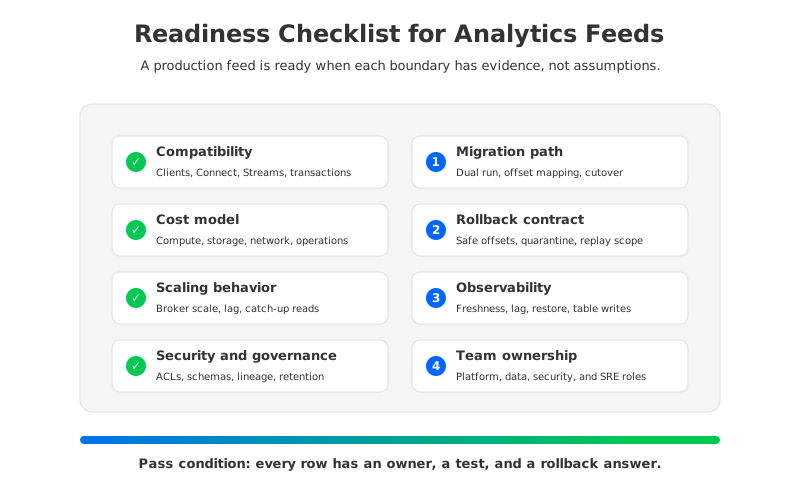
Before a near-real-time analytics feed becomes a dependency for dashboards, models, or operational decisions, give it a readiness scorecard. The scorecard should be short enough for an architecture review and concrete enough for the on-call engineer who receives the alert.
| Area | Production question | Pass evidence |
|---|---|---|
| Source log | Can we replay from the last known safe offset? | Retention policy, lag alert, and replay test are documented |
| Feed freshness | Do we measure source event time to usable analytics output? | Freshness SLO includes processor, connector, and table delay |
| Schema and table contract | Can stream and table schemas evolve without breaking consumers? | Compatibility rules, owners, and rollback steps are named |
| Read fan-out | Can analytics consumers catch up without harming operational traffic? | Quotas, isolation, and catch-up-read tests are documented |
| Platform scaling | Can brokers scale while processors and connectors recover? | Scale test covers reassignment, lag, and historical reads |
| Governance | Does the output data product have the right access boundary? | ACLs, encryption, lineage, retention, and audit logs are verified |
| Migration | Can we cut over without guessing offsets? | Dual-run, offset mapping, rollback, and consumer switch steps are tested |
The scorecard turns a search query into an engineering decision. A small internal feed may need a familiar processor, a clear retention rule, and basic lag monitoring. A feed that drives fraud analysis, personalization, operational BI, or regulatory reporting needs a stronger contract because the cost of stale or incomplete output is higher than the cost of the pipeline itself. That is the real trade-off: paying for enough architecture up front so the platform can repair itself when the feed matters.
7FAQ
7.1What does near real time analytics feed kafka mean in practice?
It usually means using Kafka or a Kafka-compatible platform to move operational events into analytics outputs with low enough delay for dashboards, models, monitoring, or lakehouse tables. The real requirement should be stated as a freshness SLO from source event time to usable output, not as a vague "near-real-time" label.
7.2Is Kafka enough for near-real-time analytics feeds?
Kafka provides the durable log, offsets, consumer groups, transactions, and ecosystem integrations that many feeds need. The production question is whether the surrounding architecture has enough retention, replay control, governance, scaling behavior, and observability for the feed's business role.
7.3How is this different from batch ingestion?
Batch ingestion usually optimizes for completeness over a scheduled window. A near-real-time feed optimizes for continuous freshness while still preserving replay and correctness. That makes consumer lag, connector retry behavior, table commit delay, and schema compatibility part of the production design.
7.4Does Shared Storage architecture remove the need for stream processors?
No. Stream processors, connectors, and table writers still own transformation, enrichment, routing, and target writes. Shared Storage architecture changes the Kafka storage and operating model underneath them, especially around retention, broker replacement, scaling, and recovery.
7.5Where should AutoMQ enter the evaluation?
AutoMQ should enter after the team has defined compatibility, cost, elasticity, governance, failure recovery, and migration requirements. It is most relevant when teams want Kafka-compatible APIs with stateless brokers, Shared Storage architecture, customer-controlled deployment boundaries, and a clearer operating model for long-retention or replay-heavy analytics feeds.
If your analytics feed is becoming a shared dependency, start by writing the scorecard above for one real topic. When the source log needs Kafka-compatible semantics with cloud-native elasticity, explore AutoMQ through the product workspace: start with AutoMQ.
8References
- Apache Kafka documentation
- Apache Kafka Connect documentation
- Apache Kafka KRaft documentation
- Apache Kafka Tiered Storage documentation
- Apache Kafka Streams documentation
- AWS data transfer pricing
- AWS PrivateLink pricing
- AutoMQ Shared Storage architecture
- AutoMQ compatibility with Apache Kafka
- AutoMQ WAL storage
- AutoMQ Kafka Linking overview
- AutoMQ Table Topic overview
- AutoMQ cross-AZ traffic optimization


