
Table of Contents
Table of Contents
Teams search for streaming transformations scale kafka when a working pipeline starts behaving like shared infrastructure. A transformation that once enriched one event stream now feeds operational dashboards, fraud features, lakehouse tables, search indexes, and downstream services that expect fresh derived data. The first version was about writing code. The production version is about keeping latency, replay, cost, ownership, and rollback under control while the number of consumers keeps growing.
That pressure changes the meaning of “scale.” It is not enough to ask whether a stream processing job can handle the current records per second. Platform teams have to ask what happens when the job falls behind, when a schema change needs a replay, when a downstream sink is unavailable, when a Consumer group is reset, or when a high-volume backfill runs during live traffic. The real architecture question is this: can Kafka remain the durable coordination layer for transformations without making every broker a larger storage and recovery problem?
1Why teams search for streaming transformations scale kafka
The search intent is usually practical. A team already runs Apache Kafka as the event backbone, and transformation workloads have moved from experiments into production contracts. Some transformations are stateless: filtering, routing, masking, format conversion, and light enrichment. Others are stateful: joins, windows, aggregations, deduplication, sessionization, or feature computation. The processing framework may be Apache Flink, Kafka Streams, Spark Structured Streaming, Kafka Connect Single Message Transforms, a custom service, or a managed SQL layer, but the stress lands on the same Kafka foundation.
Kafka gives those workloads a powerful contract. Producers write records to Topics. Partitions preserve order within a keying model. Consumers track progress by Offset. Consumer groups divide work across instances. Transactions and idempotent producers can protect write behavior for supported workloads. Kafka Connect and stream processors integrate with the ecosystem around that log. None of this removes the harder production question: how much retained history, read bandwidth, and operational recovery capacity does the transformation estate need?
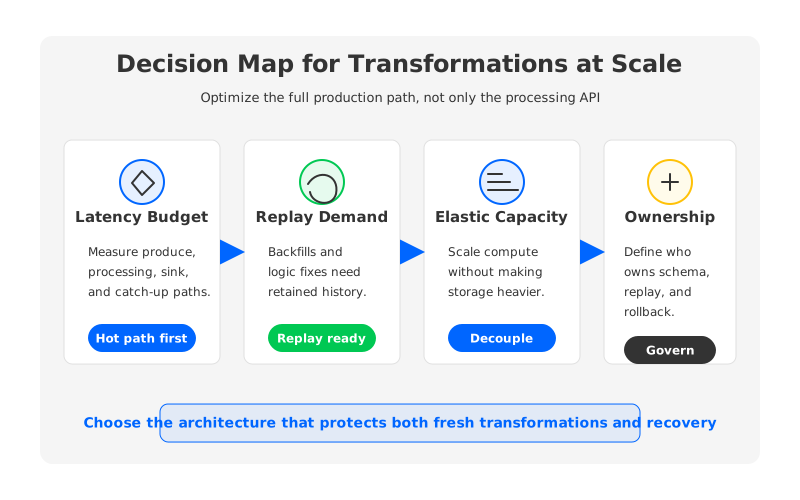
The answer is rarely visible in a single benchmark. A clean latency test measures the hot path: producer to broker, broker to processor, processor to sink. Production transformations also need the cold path: historical reads, catch-up consumers, replay after bad logic, state rebuild, and migration rollback. A platform that looks fast during steady ingest can struggle when a week of retained data has to be replayed for a corrected transformation. The costs show up as storage, network movement, larger brokers, slower recovery, and the human work required to coordinate the incident.
2The production constraint behind the problem
Traditional Kafka runs as a Shared Nothing architecture. Each broker manages its own local storage, and replication spreads partition copies across other brokers for durability and availability. This model is proven and well understood, especially for clusters where storage growth, replay volume, and topology changes remain predictable. It also couples compute and durable data ownership in a way that becomes uncomfortable when transformations multiply.
The coupling appears first in retention. Transformation teams often ask for longer topic retention because replay is the practical insurance policy for bad code, late data, sink failures, and revised business logic. Longer retention helps recovery, but in a broker-local storage model it also increases the data each broker fleet must carry. More retained bytes can mean larger disks or volumes, more careful partition balancing, and more pressure during broker replacement.
The second pressure is catch-up behavior. A transformation that falls behind does not consume the same way a tailing service consumes. It may scan older segments, compete with fresh consumers, and pull data at a rate designed to restore freshness. If several downstream jobs run backfills at once, the Kafka cluster is no longer serving a simple real-time stream; it is serving a mix of hot traffic and recovery traffic. That mix has different latency and cost characteristics.
The third pressure is cloud topology. Multi-Availability Zone Kafka deployments are common because production systems need fault isolation. Replication, client placement, and sink placement can create recurring inter-zone data movement. Cloud providers publish data transfer pricing, and the exact number depends on region, service, and path. The architectural point is not a universal dollar figure. It is that transformation scale can turn network placement into a standing cost driver rather than an incident detail.
These constraints do not mean Kafka is the wrong base for transformations. They mean the storage model under Kafka participates in every transformation decision. When the durable log is the source of replay, governance, and recovery, storage architecture is part of the transformation architecture.
3Architecture options and trade-offs
A neutral evaluation starts by separating four layers that often get mixed into one diagram. The first layer is the Kafka contract: Topics, Partitions, Offsets, Consumer groups, transactions, ACLs, and client compatibility. The second layer is the transformation runtime: Flink, Kafka Streams, Kafka Connect, Spark, or services. The third layer is the sink: another Kafka Topic, a table format, a serving store, a search system, or an operational database. The fourth layer is the streaming platform storage architecture.
That separation prevents a common mistake: choosing a processing API while ignoring the replay substrate. A team may correctly choose Flink for event-time windows and keyed state, but Flink still depends on Kafka history for source replay. A team may choose Kafka Connect for standardized movement, but connector recovery still depends on offsets, sink idempotency, and retained data. A team may write directly to Apache Iceberg for analytics, but the source log still determines how far back a table can be repaired.
| Evaluation area | What to test | Why it matters at scale |
|---|---|---|
| Compatibility | Producers, consumers, transactions, Connect, stream processors, ACLs, and metrics | A transformation failure often appears as offset drift or state inconsistency, not as a clean API error |
| Latency budget | Produce latency, processing delay, sink commit time, and catch-up reads | The user-facing SLO includes the whole path, not the broker write alone |
| Retention and replay | Rebuild volume, reset procedures, and historical read behavior | Replay is the recovery plan for bad logic and downstream corruption |
| Cost model | Storage, compute, network, object requests, observability, and operations | Transformation scale creates cost across multiple infrastructure lines |
| Ownership | Schema, transformation logic, rollback, and access boundaries | Derived data often carries business meaning and compliance requirements |
The table is deliberately broader than a tool comparison. Processing engines solve different classes of computation, while Kafka-compatible platforms solve the log and infrastructure contract around those engines. The team should choose both layers intentionally.
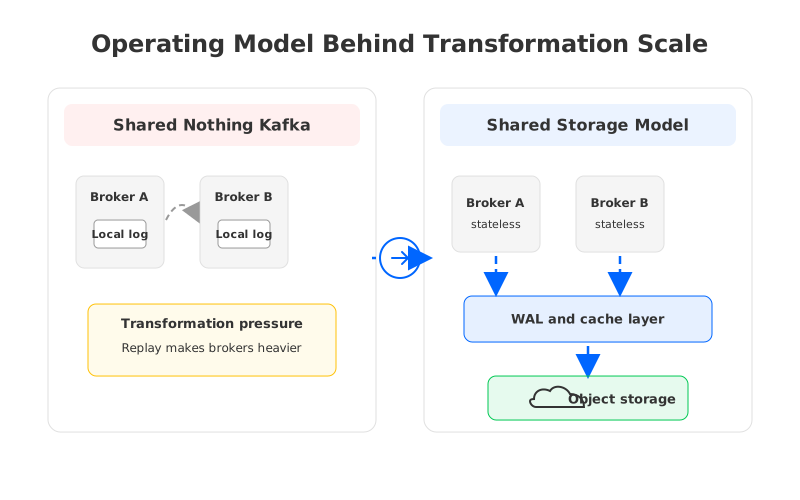
Tiered Storage deserves a specific mention because it is often evaluated for long-retention transformation workloads. Apache Kafka Tiered Storage offloads older log segments to remote storage while retaining the Kafka broker model for active data. That can help retention economics and recovery for many deployments. It does not make broker compute fully independent from durable log ownership. A Shared Storage architecture goes further by moving persistent stream data out of broker-local disks, which changes how teams reason about broker replacement, retained history, and catch-up reads.
4Evaluation checklist for platform teams
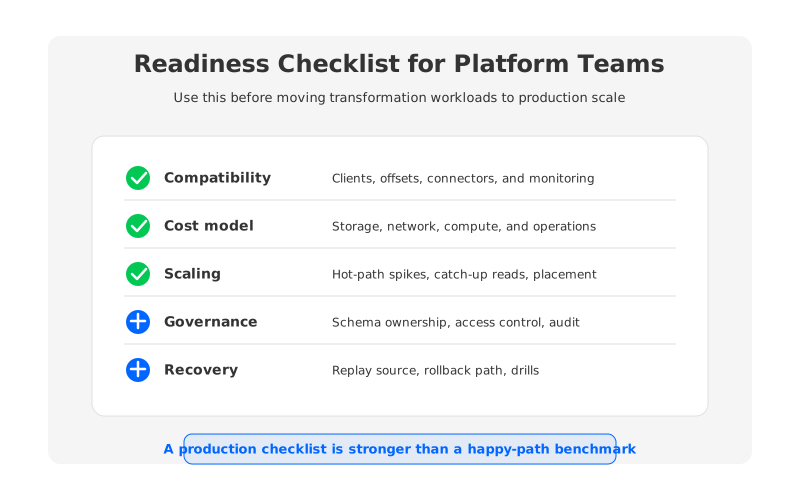
Before changing the platform under transformation workloads, run a production readiness review that includes happy-path performance and failure behavior. The checklist should use representative traffic, not a toy Topic. Include one high-throughput Topic, one long-retention Topic, one stateful transformation, one connector or table sink, one replay drill, and one rollback drill.
Start with latency. Define the freshness SLO from source event to useful derived output. A broker write may be fast while the sink commit path is slow, or while a processor checkpoint delays visibility. Measure the hot path during steady traffic and again while a catch-up consumer is active. If the latency budget collapses during replay, the platform has a recovery problem disguised as a performance problem.
Then model cost by path. Separate the cost of ingesting fresh records from the cost of retaining history and replaying it. For each path, identify broker compute, storage, network transfer, object storage requests, monitoring, and human operations. Avoid comparing platforms with a single “per GB” number unless the model includes retention, fan-out, and catch-up behavior. Streaming transformations are most expensive when something has to be corrected under time pressure.
Governance should be explicit. Transformations encode business rules: fraud thresholds, entitlement logic, privacy filters, customer segmentation, inventory projections, or billing state. Treat those rules as production data products. The platform review should answer who approves schema changes, who can reset a Consumer group, who owns a backfill, who reviews access, and which logs prove what happened.
Migration deserves the same discipline. A Kafka-compatible target reduces application rewrite risk, but it does not remove migration work. Validate Offset continuity, client configuration, authentication, network paths, connector behavior, stream processing state, and rollback procedures. A useful migration test is not “can one producer write?” It is “can a critical transformation recover after cutover without losing its source of truth?”
5How AutoMQ changes the operating model
After the neutral evaluation, one architectural question becomes hard to avoid: does the team need Kafka compatibility, or does it specifically need broker-local durable storage? Many transformation estates need the Kafka API and ecosystem because existing producers, consumers, Flink jobs, Kafka Connect pipelines, dashboards, and runbooks already depend on Kafka behavior. Fewer workloads require the operational side effect that retained data lives on broker-attached disks.
AutoMQ fits this category as a Kafka-compatible cloud-native streaming platform built around Shared Storage architecture. It keeps Kafka protocol and API compatibility while using S3Stream, WAL storage, S3-compatible object storage, data caching, and stateless brokers to separate broker compute from persistent stream data. The goal is not to change how a Flink job defines a window or how a Consumer group commits offsets. The goal is to change the infrastructure behavior underneath the log.
For transformation workloads, this changes several day-to-day trade-offs. Longer retention no longer has to make every broker a larger storage appliance. Broker replacement and scaling are less tied to copying retained partition data between nodes. Catch-up reads can be understood through cache, WAL, and object storage behavior rather than only as local disk pressure. The transformation runtime still needs good job design, checkpoint discipline, sink idempotency, and schema governance, but the Kafka-compatible substrate is less constrained by broker-local data ownership.
The WAL choice still matters. AutoMQ Open Source uses S3 WAL, which is operationally simple and fits workloads that can accept the latency profile of object-storage-backed writes. AutoMQ commercial editions can use WAL options such as Regional EBS WAL or NFS WAL for lower-latency production paths, depending on cloud environment and durability requirements. That distinction is important for transformation platforms because the right answer depends on the latency budget, replay volume, and deployment boundary.
Deployment boundary is another reason platform teams evaluate this model. AutoMQ BYOC runs the control plane and data plane in the customer cloud environment, while AutoMQ Software targets private data center environments. For transformations over regulated or sensitive event streams, the infrastructure ownership model can be part of the decision. The stream platform is not only routing records; it holds the recovery path for derived business state.
AutoMQ also has adjacent capabilities that matter when transformations feed analytical tables. Table Topic is designed to write streaming data into Apache Iceberg tables from Kafka-compatible topics. It does not replace Flink for complex stateful computation, and it should not be treated as a universal sink. It is relevant when a team wants a governed table output path closer to the streaming platform boundary, where Topics, schema, scaling, and observability are already managed.
The practical proof of concept should be direct. Pick a transformation that the business notices when it is wrong. Run it against representative traffic. Trigger a backfill. Reset a Consumer group. Replace broker capacity. Validate a sink outage recovery. Measure latency during the replay, not after the cluster is calm. If shared storage changes the worst recovery hour rather than only the steady-state benchmark, the architecture is solving the problem that made the team search in the first place.
6FAQ
6.1What does streaming transformations scale kafka mean in production?
It means running transformation workloads over Kafka-backed event streams while preserving latency, replay, cost control, governance, and recovery behavior under production traffic. The issue is broader than processing throughput because transformations depend on retained Kafka history, offsets, state recovery, and downstream sink behavior.
6.2Should Kafka perform transformations directly?
Kafka is best treated as the durable event log and coordination layer. Some lightweight transformations can happen through Kafka Connect or Kafka Streams, while complex stateful computation often belongs in Flink or another processing engine. The key is to keep the source log reliable enough for replay, recovery, and governance.
6.3How do latency and cost conflict in streaming transformations?
Low latency favors hot data, efficient writes, local cache, and short critical paths. Cost control often favors longer retention in lower-cost storage, fewer oversized brokers, and less unnecessary network movement. At scale, the architecture has to support both fresh processing and recovery reads without letting one path starve the other.
6.4Does Tiered Storage solve transformation scale?
Tiered Storage can help with long-retention Kafka workloads by moving older segments to remote storage. It is not the same as Shared Storage architecture. Tiered Storage keeps the broker-local operating model for active data, while Shared Storage architecture separates durable stream data from broker-local ownership more directly.
6.5Where does AutoMQ fit with Flink and Kafka Connect?
AutoMQ fits below the transformation runtime as a Kafka-compatible shared-storage streaming platform. Flink, Kafka Connect, Kafka Streams, and other tools can remain responsible for transformation logic, while AutoMQ changes how the durable Kafka-compatible log is stored, scaled, and recovered.
The original search starts with transformations, but the durable decision is about recovery ownership. If Kafka-compatible streaming is the source of truth for derived data, the storage architecture deserves the same scrutiny as the processing framework. To evaluate that model in your own environment, start with the AutoMQ deployment path.
7References
- Apache Kafka documentation
- Apache Kafka Streams documentation
- Apache Kafka Tiered Storage documentation
- Apache Flink stateful stream processing documentation
- Apache Flink checkpoints documentation
- Apache Iceberg Flink writes documentation
- AutoMQ architecture overview
- AutoMQ compatibility with Apache Kafka
- AutoMQ WAL storage
- AutoMQ Table Topic overview
- AWS data transfer pricing


