
Table of Contents
Table of Contents
Teams searching for iot edge synchronization kafka are usually past the proof-of-concept stage. The hard question is not whether edge devices can publish events into Apache Kafka. It is whether the platform can keep device data moving when sites are offline, bandwidth is uneven, topics grow faster than planned, and cloud bills start reflecting every architectural shortcut.
IoT edge synchronization is uncomfortable because the edge rarely behaves like a clean data-center workload. Gateways buffer telemetry during a network outage. Devices reconnect in bursts. Plant, fleet, retail, or energy sites may have different retention rules, security boundaries, and data freshness targets. The central platform has to accept this uneven traffic while preserving the Kafka contracts that application teams already depend on: Topic, Partition, Offset, Consumer group, ordering within a partition, and predictable client behavior.
The main trade-off is therefore not "edge or cloud." It is how much storage coupling, replication work, and operational risk you are willing to carry in the Kafka layer while edge synchronization keeps stressing the system. A production architecture should make that trade-off explicit before the team chooses a managed service, self-managed Kafka, a replication-first pattern, or a Kafka-compatible platform built around shared object storage.
1Why Teams Search for iot edge synchronization kafka
The search phrase looks narrow, but it usually hides several decisions. An architect wants to know whether Kafka can serve as the synchronization backbone between gateways and regional or central processing. A platform team wants to know how to size brokers when some locations are quiet for hours and then replay a backlog. An SRE wants to know what happens to Consumer lag, failed connectors, and offset commits when a site comes back online.
Those questions are practical, not academic. Kafka works well when the workload is append-heavy, ordered by key, and consumed by independent services. IoT synchronization often fits that shape: device telemetry, command acknowledgments, firmware events, anomaly signals, and local aggregate updates can all be modeled as records in ordered partitions. Kafka Connect can move data between external systems and Kafka, while Kafka clients give application teams a familiar API surface.
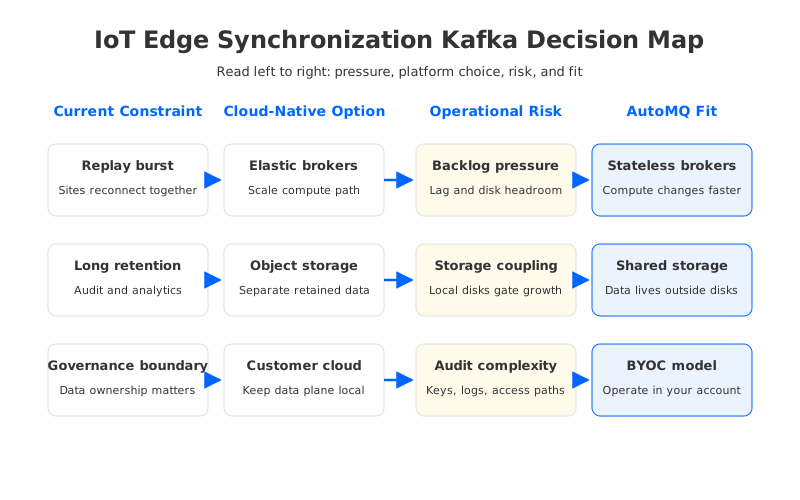
The friction appears when synchronization becomes a reliability problem. Edge backlogs do not arrive politely. A regional site might retry traffic while another site is doing a planned replay. Some consumers read hot data for alerting, while others perform catch-up reads for analytics or reconciliation. If the platform treats each spike as a broker-local storage event, the operational cost of "being reliable" grows with every edge location.
2The Production Constraint Behind the Problem
Traditional Kafka uses a Shared Nothing architecture. Each broker owns local storage, and each partition replica is placed on broker disks. Kafka replication through ISR (In-Sync Replicas) gives durability and availability inside the cluster, and that model has served many workloads well. It also means storage, compute, and traffic are tied together at the broker level.
That coupling matters for IoT synchronization because reliability work becomes data movement work. If the platform needs more capacity, teams may have to add brokers and rebalance partitions. If a broker fails, replicas and leaders have to absorb the load. If retention grows, local disk or attached volume planning becomes part of the application capacity model. If the cluster spans Availability Zones, replication and client routing can create cross-zone network charges depending on the cloud design.
The result is a familiar pattern: teams provision for the worst burst, then spend the rest of the month paying for headroom that may be idle. They keep larger disks because backlogs are hard to predict. They limit retention because broker storage is not elastic enough. They schedule reassignments during quieter windows because moving partition data can compete with real traffic. None of these choices is wrong by itself. Together, they make edge synchronization feel harder than the data model suggests.
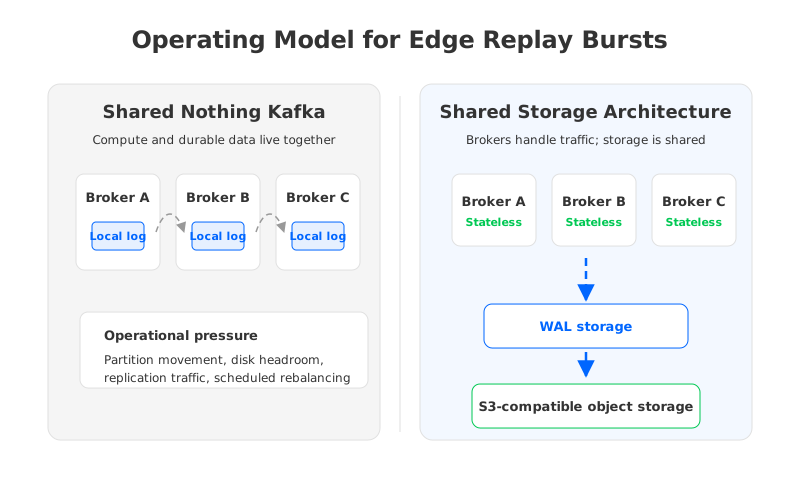
Tiered Storage changes part of this equation by moving older Kafka log segments to remote storage. It can help retention economics, especially when historical reads are less frequent than hot reads. But it does not automatically remove the broker-local primary log from the center of the operating model. For edge synchronization, the question is whether the platform only needs a retention tier, or whether it needs a different relationship between broker compute and durable storage.
3Architecture Options and Trade-Offs
IoT edge synchronization usually lands in one of four patterns. The right choice depends on site autonomy, cloud boundaries, retention, and how much migration risk the team can accept.
| Option | Where it fits | Main constraint |
|---|---|---|
| Local Kafka per site | Sites need strong local autonomy and can operate without the cloud for long periods. | Many clusters create governance, upgrade, and observability work. |
| Central Kafka with edge gateways | Edge gateways buffer locally, then publish to a central Kafka cluster. | Central brokers must absorb reconnect bursts and backlog replay. |
| Regional aggregation | Regional Kafka clusters absorb local traffic before forwarding to a central platform. | Replication, offset mapping, and failover policy become platform responsibilities. |
| Kafka-compatible shared storage | Teams want Kafka client behavior with a storage model less tied to broker disks. | The team must validate latency, WAL type, cloud storage, and operational boundaries. |
This table is useful because it moves the discussion away from vendor labels and toward failure modes. If a factory gateway is offline for hours, the issue is local buffering and replay order. If a regional link is saturated, the issue is routing and backpressure. If central Kafka is full, the issue is broker storage, partition placement, and retention. Different layers own different risks.
Kafka compatibility is the first filter. The platform should preserve client behavior that application teams already use, including producer retries, Consumer group coordination, offset commits, transactions where needed, Kafka Connect integration, and KRaft-based cluster metadata in Kafka versions that use it. A platform that changes storage but breaks the client contract may reduce one kind of operational work while creating another.
Cost is the second filter, and it needs to be split into components. Compute cost is the broker fleet. Storage cost is the retained log and any local or remote storage behind it. Network cost includes producer traffic, consumer traffic, replication traffic, inter-zone traffic, PrivateLink or similar connectivity, and data leaving a region or cloud boundary. For IoT, the network line can be especially sensitive because edge traffic is geographically distributed and often passes through private connectivity paths.
Reliability is the third filter. The platform needs a clear answer for broker loss, zone loss, storage service interruption, connector failure, and delayed consumers. It also needs a recovery path that does not depend on perfect timing. A synchronization system should assume delayed data, duplicate retries, and replay. Kafka gives teams offset-based consumption and ordered partitions, but the platform still has to make storage recovery and capacity recovery boring.
4Evaluation Checklist for Platform Teams
Before choosing an architecture, write down the workload contract in operational terms. A checklist is more useful than a reference diagram because each item turns into a test or an owner.
Start with compatibility. Which Kafka client versions are in use? Are producers idempotent? Do any workloads rely on transactions? Which connectors are required? How are schemas governed? Which Consumer groups are allowed to lag, and which ones are tied to alerting or control loops? These questions determine whether migration is mostly a platform change or an application change.
Then map the cost shape. Separate the steady stream from reconnect bursts and replay. Measure write throughput, read fan-out, retention, catch-up read volume, private connectivity, and cross-zone or cross-region paths. Avoid a single "Kafka cost" number. IoT synchronization has different cost drivers during normal collection, site recovery, regional failover, and analytics backfill.
Security and governance deserve the same treatment. Edge data may include operational telemetry, location data, customer identifiers, or regulated industrial signals. The platform choice should specify where data is stored, which cloud account owns the storage, how keys are managed, how audit logs are collected, and whether the control path is separated from the data path.
The final checklist item is rollback. A migration plan that can only move forward is not a plan; it is a bet. For Kafka workloads, rollback means understanding topic mapping, offset continuity, consumer progress, producer routing, connector configuration, and the point at which the old cluster is no longer a valid recovery target.
5How AutoMQ Changes the Operating Model
After that neutral evaluation, AutoMQ becomes relevant as an architecture option. AutoMQ is a Kafka-compatible, cloud-native streaming platform that keeps Kafka protocol behavior while replacing broker-local log storage with Shared Storage architecture on object storage. The design goal is not to make edge synchronization a different application pattern. It is to change the platform work created by storage growth, broker replacement, and uneven traffic.
In AutoMQ, brokers are stateless brokers in the storage sense: persistent data is not bound to local broker disks. S3Stream writes records through WAL (Write-Ahead Log) storage and stores durable data in S3-compatible object storage. WAL storage acts as a write and recovery buffer, while object storage is the primary durable storage layer. That distinction matters for IoT because bursts and retention growth no longer have to turn every broker operation into a local-disk planning exercise.
Shared Storage architecture also changes scaling and recovery discussions. In a broker-local model, adding or removing brokers is closely tied to partition data movement. In AutoMQ, partition reassignment is more about metadata, leadership, and traffic ownership because data is already in shared storage. Self-Balancing can redistribute traffic pressure across brokers, and customer-controlled deployment models such as AutoMQ BYOC keep the control plane and data plane inside the customer's cloud environment.
This does not remove the need for workload testing. Teams still need to validate latency targets against the selected WAL type, object storage behavior, private networking, connector load, and consumer catch-up patterns. AutoMQ Open Source uses S3 WAL, while AutoMQ commercial editions can use additional WAL storage options depending on deployment requirements. For an IoT team, that means the architecture decision should include the edge replay profile, not only the average ingest profile.
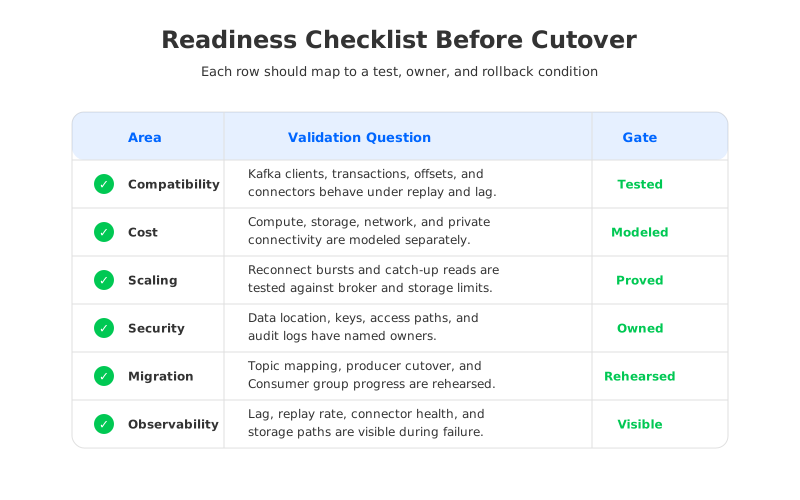
AutoMQ Kafka Linking can also be part of the migration conversation when teams need to move existing Kafka workloads. The practical migration risk is not only copying records. It is preserving offsets, Consumer group progress, and producer cutover behavior well enough that application teams can switch without rewriting their mental model. For edge synchronization, where delayed data and replay are normal, offset continuity is a first-class migration requirement.
The architectural takeaway is narrow but important. If your IoT edge synchronization problem is mainly about device protocol translation, local gateway code, or command semantics, solve that at the edge. If the problem is that Kafka storage, retention, broker replacement, and cross-zone traffic are turning synchronization into a capacity treadmill, evaluate whether Shared Storage architecture gives you a cleaner operating model while keeping the Kafka API surface.
6FAQ
6.1Is Kafka a good fit for IoT edge synchronization?
Kafka is a good fit when edge events can be modeled as ordered records, grouped by keys such as device, site, asset, or tenant. It is less complete by itself when the main problem is device management, command delivery, or intermittent local control. Most production designs pair Kafka with edge buffering, identity, schema governance, and a clear retry policy.
6.2Should every edge site run its own Kafka cluster?
Not always. A local cluster can help when sites need long offline autonomy, but it adds upgrade, security, monitoring, and replication work. Many teams prefer gateway buffering plus regional or central Kafka when site autonomy requirements are limited. The decision should be based on offline duration, local processing needs, and operational ownership.
6.3How should teams compare Tiered Storage and Shared Storage architecture?
Tiered Storage can reduce pressure from long retention by moving older log data to remote storage. Shared Storage architecture changes the primary storage model so broker compute is less tied to durable data placement. For edge synchronization, compare them using replay bursts, broker replacement, retention growth, and consumer catch-up behavior.
6.4Where does AutoMQ fit in an IoT edge synchronization Kafka plan?
AutoMQ fits when teams want Kafka compatibility but need a cloud-native operating model for storage, scaling, and broker recovery. It should be tested against real edge traffic patterns: reconnect bursts, delayed consumers, connector throughput, private network paths, and rollback requirements.
7Closing Checklist
Use this final scorecard before committing to an architecture:
| Area | Question to answer |
|---|---|
| Compatibility | Can existing producers, consumers, transactions, offsets, and connectors move without application rewrites? |
| Cost | Are compute, storage, network, private connectivity, and replay costs modeled separately? |
| Reliability | What happens during broker loss, site reconnect, zone failure, and delayed consumer recovery? |
| Governance | Where does data live, who owns the cloud account, and how are keys and audit logs managed? |
| Migration | Can the team test cutover, offset continuity, and rollback before production traffic moves? |
The phrase iot edge synchronization kafka starts as a search query, but it becomes an operating-model decision. If broker-local storage is the part that keeps turning edge reliability into capacity planning, test a Kafka-compatible shared-storage path with the same workload that makes the current platform uncomfortable. To evaluate AutoMQ in a customer-controlled environment, start with AutoMQ BYOC and run the replay, retention, and recovery tests that matter for your edge estate.
8References
- Apache Kafka Documentation
- Apache Kafka KRaft Documentation
- Apache Kafka Tiered Storage Documentation
- Apache Kafka Connect Documentation
- AutoMQ Architecture Overview
- AutoMQ S3Stream Shared Streaming Storage
- AutoMQ WAL Storage
- AutoMQ Kafka Compatibility
- AutoMQ Kafka Migration Overview
- AWS Data Transfer Pricing
- AWS PrivateLink Pricing
- Amazon S3 Pricing


