
Table of Contents
Table of Contents
A search for manufacturing quality signals kafka rarely starts as a streaming-platform exercise. It usually starts with a production problem: inspection events arrive late, a defect trace needs replay, an MES workflow needs fresher context, or analytics needs the same line-level signal without another path into plant systems. Apache Kafka becomes attractive because it gives teams durable event ingestion, consumer fan-out, offsets, replay, and Kafka Connect.
The hard part begins after the first topics work. Quality signals do not behave like one clean event stream. Vision inspection, PLC-derived state, historian exports, machine alarms, operator actions, batch genealogy, and rework events all have different latency, retention, governance, and burst patterns. A platform that looks reliable for a pilot can become expensive or fragile when the same stream must serve containment, traceability, maintenance, analytics, and audit consumers. The real decision is not whether Kafka can carry manufacturing quality events; it is which Kafka-compatible operating model can keep quality data reliable without turning every plant expansion into a storage and rebalancing project.
1Why Teams Search for Manufacturing Quality Signals Kafka
Manufacturing quality systems sit between operational technology and enterprise data platforms. The plant floor cares about line continuity and containment speed. Data engineering cares about schema, replay, integration, and lakehouse ingestion. SRE and platform teams care about recovery time, broker utilization, cross-zone traffic, and whether the same cluster can survive the next line, plant, or region. Kafka is often the shared language among these groups because producers and consumers can move independently while offsets preserve a durable read position.
That shared language does not remove the boundary problem. A camera station may emit bursts during inspection windows. A traceability pipeline may retain event history for recalls, warranty analysis, or batch investigations. A quality analytics team may replay months of events after changing a feature model. Plant integration may want Kafka Connect, while the platform team wants existing libraries and operational tools to keep working.
Those needs create a useful first filter:
- Inspection and containment need predictable ingestion, clear consumer lag visibility, and failure behavior that does not hide bad parts behind delayed events.
- Traceability needs retention and replay economics that do not force every retained byte onto broker-local volumes.
- Maintenance and process analytics need multiple consumers to read the same history without starving hot write paths.
- Governance needs a crisp answer for where data, credentials, logs, metrics, and control actions live.
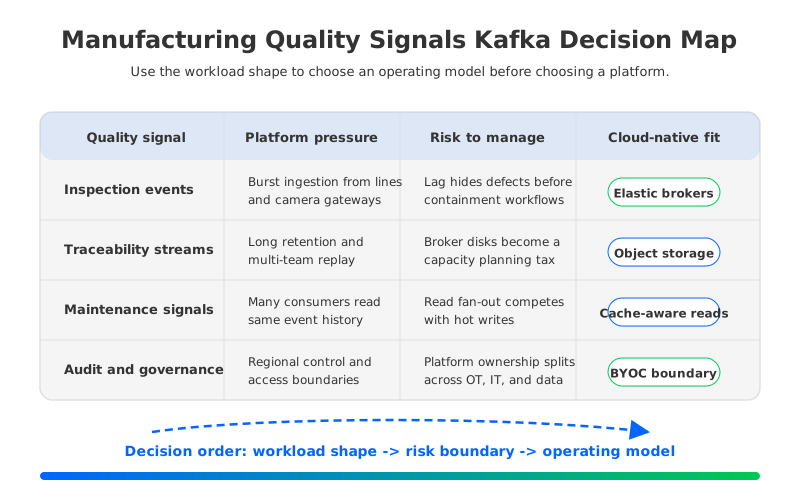
The decision map is intentionally about workload shape before vendor choice. If the workload is mostly short-lived alerts, the design pressure is different from long-retention genealogy streams. If the data must stay inside a customer-controlled cloud account or private environment, deployment boundaries matter as much as feature lists. If the plant and enterprise teams share the same stream, ownership and observability become platform requirements instead of nice-to-have items.
2The Production Constraint Behind the Problem
Traditional Kafka follows a Shared Nothing architecture. Each broker owns local storage for the partitions assigned to it, and Kafka uses replication between brokers to keep partition data available. This model is well understood, battle-tested, and still a strong fit for many deployments. The trade-off is that storage, compute, and operational ownership become tightly coupled. When a broker is added, removed, replaced, or rebalanced, the cluster has to move partition data or replica responsibilities across brokers.
That coupling matters in manufacturing because quality signals have uneven growth. One plant may add another inspection station and double a specific topic's write rate. A compliance requirement may extend retention for a small group of genealogy topics. A maintenance team may add consumers that replay history during model retraining. In a broker-local storage model, these changes often become capacity planning questions: which brokers have disk, which partitions should move, how long will reassignment take, and what happens to hot producers while the cluster catches up?
Cross-Availability Zone design adds another layer. Production Kafka clusters often spread replicas across fault domains to protect availability. In cloud deployments, that can introduce data transfer charges, endpoint charges, or network-path complexity depending on provider and topology. The architecture point is stable: broker-to-broker replication has a different network cost profile from a design that writes durable data to shared storage and moves broker ownership separately from retained bytes.
This is where manufacturing teams sometimes misread the problem. They treat Kafka reliability as a replication-factor setting, then discover that the real constraints are recovery operations, retained-data movement, read fan-out, and cost predictability. A quality stream can be correctly replicated and still be operationally expensive if every growth event requires scheduled broker storage changes.
3Architecture Options and Trade-Offs
A practical platform review should compare operating models, not product names. For manufacturing quality signals, four options usually appear.
| Architecture option | Where it fits | Trade-off to test |
|---|---|---|
| Self-managed Kafka on local or cloud block storage | Teams with strong Kafka operations skills and clear capacity patterns | Broker storage, partition movement, and recovery procedures remain the team's responsibility |
| Managed Kafka service | Teams that want fewer broker-management tasks | Cost transparency, networking, retention economics, and operational boundaries vary by provider |
| Kafka with Tiered Storage | Workloads where older data can move to remote storage while brokers keep hot data locally | It reduces some local storage pressure, but brokers still keep an active local tier and operational coupling remains |
| Kafka-compatible Shared Storage architecture | Teams that want Kafka APIs while separating compute from durable stream storage | Teams must validate WAL choice, object storage behavior, observability, and migration path |
Apache Kafka's own documentation is the right baseline for application semantics: topics, partitions, offsets, consumer groups, transactions, KRaft, and Kafka Connect all shape how applications behave. A platform that breaks those expectations creates migration risk even if the storage layer looks attractive. Client compatibility is not a checkbox for manufacturing systems; it protects the applications that already know how to produce inspection events, commit offsets, retry idempotently, and consume from a specific position after a fault.
The storage question is separate. Tiered Storage can help when older segments should move away from local disks, and it is a meaningful Kafka feature for long-retention topics. But it does not make brokers stateless. The broker still owns the active local log, metadata, leadership, and operational paths that decide how scaling and failure handling behave. If the goal is to reduce retained-data movement during scaling or recovery, the team needs to evaluate whether the architecture separates compute from storage at the core write path or only offloads older data.
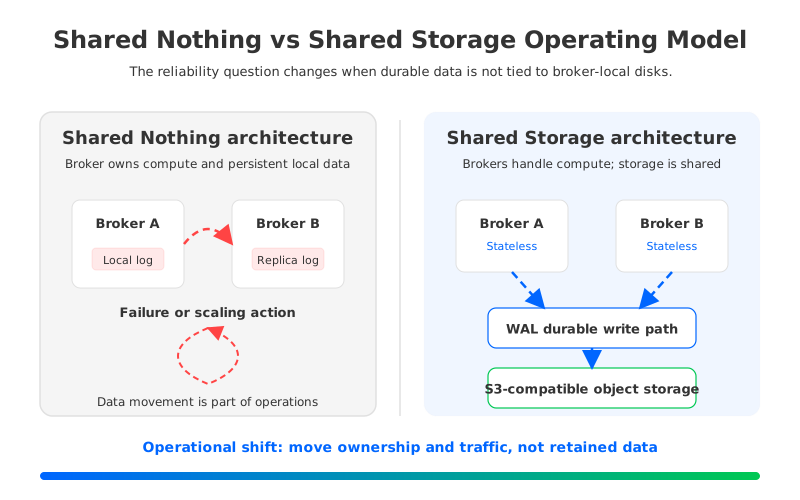
The comparison is not a claim that one model wins every workload. Shared Nothing architecture is familiar and direct. Shared Storage architecture changes the failure and scaling problem by making durable data reachable outside the broker that last served the partition. The platform review should ask whether that change helps the specific quality-signal workload enough to justify the operational shift.
4Evaluation Checklist for Platform Teams
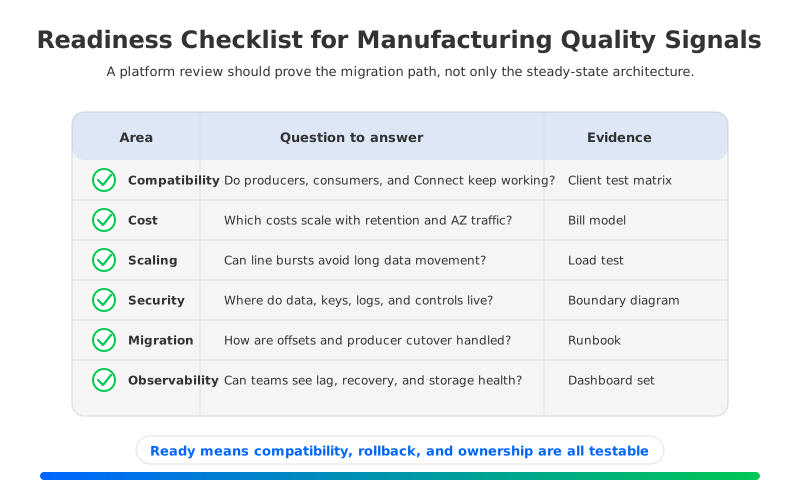
The cleanest way to evaluate manufacturing quality signals on Kafka is to turn the architecture debate into a readiness review. The platform team should define a representative workload, then test it against compatibility, cost, elasticity, governance, recovery, and migration criteria. The review should include both steady state and operational events, because many Kafka problems show up during rebalancing, failover, replay, or consumer catch-up rather than during normal ingest.
Start with compatibility. Confirm the producer libraries, consumer group behavior, offset commits, authentication, transactions if used, Kafka Connect connectors, observability tools, and deployment automation that matter to the plant and enterprise teams. Do not assume that "Kafka-compatible" means every operational tool behaves the same way under load or during cutover. Build a client test matrix and keep it as part of the migration runbook.
Then model cost by driver instead of by monthly total. Manufacturing teams should separate compute, storage, retained data, replication traffic, cross-zone traffic, private connectivity, object storage requests, data egress, monitoring, and support. This decomposition prevents a common mistake: optimizing broker count while missing that retention or network paths dominate the bill. It also makes cloud-provider price changes easier to review because each cost line has a named driver.
The reliability review should cover these questions:
- Can producers continue writing during a broker failure or scaling event without hidden data movement becoming the bottleneck?
- Can consumers resume from known offsets after failover, migration, or rollback?
- Can the team observe consumer lag, broker health, storage health, connector status, WAL behavior if applicable, and object storage errors from one operational view?
- Can plant, platform, and security teams explain where customer data, credentials, audit logs, and control actions live?
- Can the migration be rehearsed with topic configuration, ACLs, offsets, and rollback steps before production cutover?
5How AutoMQ Changes the Operating Model
After that neutral review, AutoMQ enters the discussion as a Kafka-compatible streaming platform built around Shared Storage architecture. AutoMQ keeps the Kafka protocol and client ecosystem while moving durable stream storage away from broker-local disks and into S3-compatible object storage. Brokers become stateless compute nodes for request handling, leadership, caching, and routing; durable data is written through a WAL (Write-Ahead Log) path and then stored in object storage.
For manufacturing quality signals, that architectural change targets the operational constraints discussed earlier. If retained data is not tied to a specific broker's local disk, scaling and recovery can focus on leadership, ownership, and traffic distribution rather than copying large retained logs between brokers. If object storage carries the durable history, long-retention traceability streams can be evaluated with object-storage economics instead of requiring every retained byte to sit on broker volumes. If brokers are stateless, platform teams can reason about compute elasticity and storage growth as separate concerns.
This does not remove the need for engineering judgment. AutoMQ Open Source uses S3 WAL, which fits latency-tolerant scenarios better than low-latency production loops. AutoMQ commercial editions, including AutoMQ BYOC and AutoMQ Software, support additional WAL options that are designed for lower-latency workloads. A manufacturing platform should therefore choose the WAL type, deployment model, and storage backend based on the actual signal class: inspection containment, traceability, maintenance analytics, or lakehouse ingestion.
The deployment boundary can matter as much as the storage layer. In AutoMQ BYOC, the control plane and data plane run inside the customer's cloud account and VPC, which helps teams keep data, networking, and infrastructure under their own boundary. AutoMQ Software addresses private data center or IDC deployments where the customer operates the environment. For regulated manufacturing, supplier-quality programs, or plants with strict regional requirements, this boundary should be part of the architecture review rather than an afterthought.
6A Migration Scorecard for Quality Signals
A useful scorecard has a few plain gates:
- Green: client behavior is verified, rollback is documented, dashboards cover lag and storage, and cost drivers are understood.
- Yellow: the workload is compatible, but retention, network path, or cutover ownership needs another test.
- Red: offset continuity, failure behavior, security boundary, or plant ownership is unclear.
Return to the original search: manufacturing quality signals kafka. The answer is not a single cluster diagram. It is a decision process that starts with how quality signals behave, then chooses an operating model that keeps reliability and cost understandable as plants, consumers, and retention requirements grow.
If you are evaluating a Kafka-compatible platform for manufacturing quality data, use the checklist above against one real topic family and one real rollback plan. To discuss how AutoMQ BYOC or AutoMQ Software would map to that workload, start with the AutoMQ team here: plan a Kafka-compatible streaming architecture.
7FAQ
7.1Is Kafka a good fit for manufacturing quality signals?
Kafka is a good fit when quality data needs durable ingestion, replay, fan-out to multiple consumers, and integration with analytics or operational workflows. It should not replace PLC control logic, safety systems, SCADA, historians, MES, or device protocols. In most manufacturing architectures, Kafka sits above or beside those systems as the durable event backbone.
7.2What makes quality signals different from ordinary telemetry?
Quality signals often carry production decisions, batch context, genealogy, inspection outcomes, and audit value. That combination creates stronger requirements for retention, replay, access control, and recovery. A telemetry topic can often tolerate gaps in historical replay; a traceability stream may not.
7.3Does Tiered Storage solve the cost problem for manufacturing Kafka?
Tiered Storage can reduce pressure from older data on broker-local disks, and it is worth evaluating for long-retention topics. It does not make brokers stateless, and it does not remove every scaling or recovery operation tied to the active local log. Teams should test whether it solves their specific retention and reassignment pressure.
7.4When should AutoMQ be evaluated?
Evaluate AutoMQ when the platform requirement is Kafka-compatible streaming with separation of compute and storage, customer-controlled deployment boundaries, elastic broker operations, and lower operational coupling between retention and broker capacity. The evaluation should include client compatibility, WAL choice, object storage behavior, observability, and migration rehearsal.
7.5What should a proof of concept include?
A proof of concept should include a representative topic family, real producer and consumer clients, Kafka Connect if connectors are part of the system, a retention and replay test, a broker failure test, a scaling event, an observability dashboard, and a rollback runbook. The goal is to test operations, not only throughput.
8References
- Apache Kafka documentation
- Apache Kafka Connect documentation
- AutoMQ architecture overview
- AutoMQ compatibility with Apache Kafka
- AutoMQ WAL storage
- AutoMQ Continuous Self-Balancing
- AutoMQ Kafka Linking migration overview
- AutoMQ Table Topic overview
- AWS EC2 On-Demand pricing: data transfer notes
- AWS PrivateLink pricing
- Amazon S3 pricing


