
Table of Contents
Table of Contents
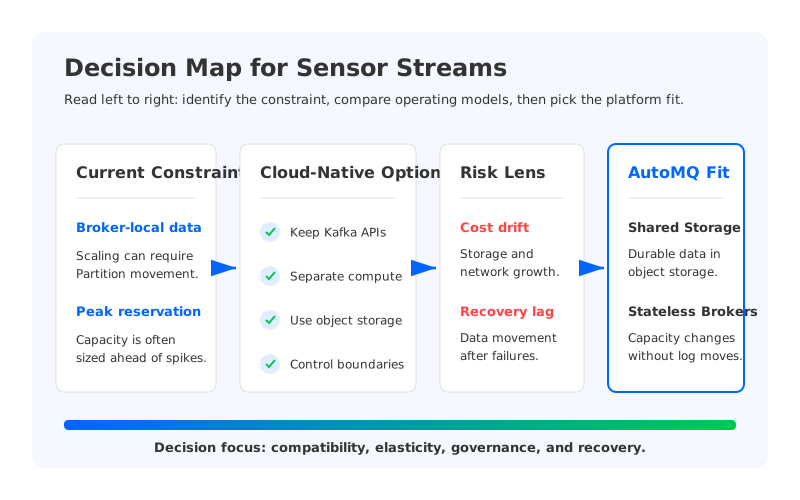
Searches for smart city sensor streams kafka usually start after the pilot stops looking like a pilot. A traffic team adds more cameras. Utilities add water-pressure telemetry. Transit systems add fare gates, vehicle positions, and station sensors. The streaming layer that worked for one department becomes shared infrastructure for a city-scale operating model, and the hard question changes from "Can Kafka ingest this?" to "Can the platform stay reliable without turning every growth step into a storage, network, and operations project?"
Smart city data is awkward for traditional capacity planning because it is both steady and bursty. Sensors produce a baseline all day, but storms, road closures, public events, emergency response, and batch firmware reconnects can shift traffic within minutes. Some streams can tolerate seconds of delay. Others feed signal priority, fleet dispatch, public safety dashboards, or grid-control alerts where lost records and long recovery windows are not acceptable. A production design has to respect those differences without creating a separate streaming cluster for every agency, vendor, and retention policy.
That is why the useful discussion is not "Kafka or not Kafka." Apache Kafka gives teams a proven model for Topics, Partitions, Offsets, Consumer groups, Connect pipelines, transactions, and a large client ecosystem. The harder design question is where the cost and reliability boundaries sit when Kafka becomes the shared nervous system for city operations. The answer depends less on the number of sensors than on storage ownership, data movement, fault recovery, and the team's ability to change capacity without moving large amounts of broker-local state.
1Why Teams Search for smart city sensor streams kafka
A smart city streaming platform usually begins as an integration problem. MQTT devices, HTTP gateways, camera analytics, mobility applications, and work-order systems all need a place to publish and subscribe to events. Kafka is a natural fit because it separates producers from consumers, preserves ordered records within Partitions, and lets independent teams read at their own pace through Consumer groups. Kafka Connect also gives platform teams a familiar way to move data between streaming topics and external systems such as databases, object storage, analytics engines, and search indexes.
The search intent becomes more specific once the platform carries operational data, not only analytics data. A traffic-light stream might have short retention and strict alerting. Parking occupancy may need medium retention and wide fan-out to mobile applications. Environmental sensors may feed batch analytics, public dashboards, and compliance reporting. The same Kafka-compatible platform has to support different durability, replay, access-control, and observability expectations without forcing every application team to understand broker placement.
The pattern to watch is fan-out. One sensor event rarely has one consumer. A vehicle-position update may feed passenger arrival predictions, operations dashboards, historical analytics, and incident detection. Each additional Consumer group adds read pressure, lag monitoring, and failure modes. If the platform team treats every new consumer as "free," it eventually discovers the bill in broker CPU, network transfer, storage retention, and recovery complexity.
2The Production Constraint Behind the Problem
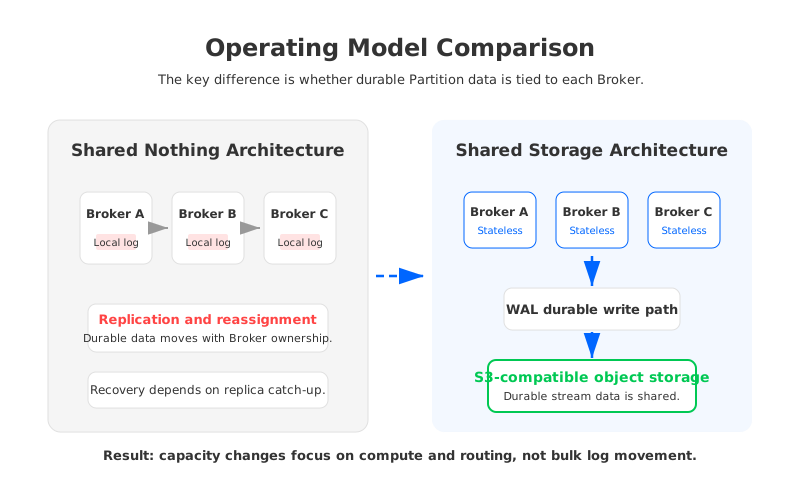
Traditional Kafka uses a Shared Nothing architecture: each Broker owns local storage for the Partitions assigned to it, and reliability comes from replication across Brokers. That design is coherent and battle-tested. It also means data placement is an operational fact, not a detail hidden below the platform. When a Broker runs hot, a disk fills, or a cluster needs more capacity, the platform may need Partition reassignment and data movement before the new shape is useful.
Smart city workloads amplify this constraint because the event sources are geographically and administratively distributed. The producers may sit in roadside cabinets, stations, substations, vendor networks, or edge gateways. The consumers may run in separate municipal departments or contractor-managed environments. A single cluster can end up serving write-heavy telemetry, read-heavy dashboards, delayed batch consumers, and long-retention audit streams at the same time.
In a broker-local storage model, those mixed workloads create four pressure points:
- Capacity is provisioned ahead of demand. Teams usually reserve disk and Broker headroom for peak incidents, seasonal events, and retention changes. The unused part still costs money.
- Rebalancing moves data, not only traffic. Adding Brokers can help, but the cluster must move Partition data before the relief is complete.
- Replication consumes network capacity. Multi-AZ deployment improves availability, but replication and client placement can create chargeable cross-zone traffic, depending on the cloud and topology.
- Recovery is tied to local state. A failed Broker is not only a lost compute node. It may also trigger leadership changes, replica catch-up, and operational decisions about how much lag the platform can tolerate.
None of these points means Kafka is wrong for the job. They mean the architecture has a cost shape. City-scale sensor streaming makes that shape visible because the platform grows through many small additions, not one clean annual capacity event.
3Architecture Options and Trade-Offs
The first option is a conventional Kafka cluster with careful topic design, rack awareness, retention controls, and well-run operations. This is often the right starting point when the team already has Kafka expertise and the workload has stable throughput. The trade-off is that the operations team owns the full storage lifecycle: disk sizing, replication overhead, Partition movement, and failure recovery. For a city platform with many agencies sharing one backbone, that ownership can become a bottleneck.
The second option is managed Kafka from a cloud provider or a hosted streaming service. It can reduce infrastructure tasks and standardize upgrades, monitoring, and security integration. The trade-off is boundary control. Some city workloads have strict requirements around cloud accounts, network paths, procurement, region selection, or data residency. A managed service may be attractive for speed, but the team still needs to model cross-zone traffic, PrivateLink or endpoint charges, retention cost, and the operational limits of the service tier.
The third option is Kafka-compatible streaming with a Shared Storage architecture. In this model, Brokers keep Kafka protocol and compute responsibilities while durable data lives in shared object storage and a WAL (Write-Ahead Log) path handles low-latency persistence. The important change is operational: scaling compute no longer implies moving all durable Partition data between Brokers. Broker replacement, traffic balancing, and capacity changes become closer to metadata and routing actions.
That architectural split does not remove engineering trade-offs. Object storage behaves differently from local disks. A design still needs a WAL strategy, cache behavior, read-path planning, and clear failure semantics. The payoff is that the platform team can reason about compute and storage separately, which matters when sensor volume, retention, and read fan-out grow at different speeds.
4Evaluation Checklist for Platform Teams
A good platform review starts with the boring questions because those are the questions that decide production outcomes. The table below is a practical way to compare Kafka-compatible options before a smart city program commits to one operating model.
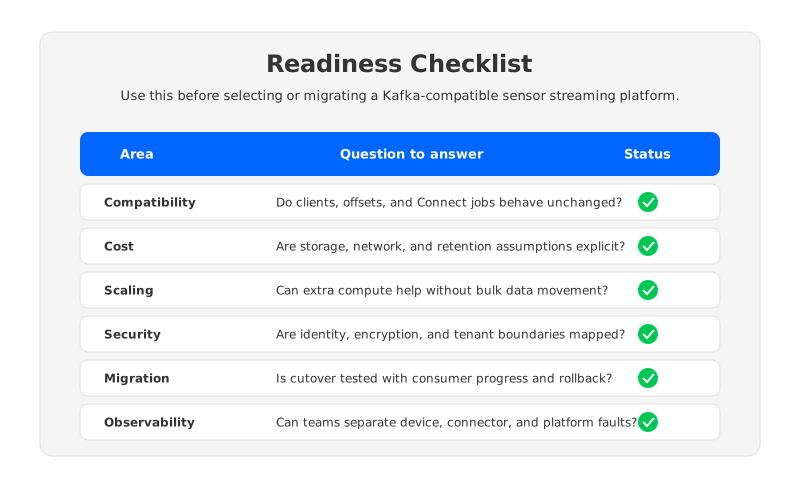
| Decision area | What to check | Why it matters for sensor streams |
|---|---|---|
| Compatibility | Kafka client behavior, admin APIs, Consumer group offsets, transactions, Connect support | Existing ingestion gateways and analytics jobs should not need rewrites during platform migration. |
| Storage model | Broker-local storage, Tiered Storage, or Shared Storage architecture | This determines how scaling, retention, and recovery behave under growth. |
| Network path | AZ placement, cross-zone transfer, private endpoints, gateway routing | Sensor platforms often fan out to many internal and partner systems. Network cost can grow quietly. |
| Elasticity | How quickly new compute capacity helps live traffic | Incident spikes and event surges need capacity changes that do not wait on large data movement. |
| Governance | Identity, ACLs, encryption, audit, tenant boundaries | Public-sector systems need clear ownership and access boundaries across departments. |
| Migration | Offset continuity, dual-write or replication plan, rollback path | A streaming platform migration fails when consumers lose progress or rollback is improvised. |
| Observability | Lag, broker health, storage path, object-store errors, connector status | Sensor failures and platform failures look similar unless the metrics separate them. |
This checklist should be applied per stream class, not only per cluster. Traffic control, public dashboards, maintenance analytics, and compliance archives do not have the same tolerance for latency, replay, or data loss. A platform that can express those differences with Topics, retention, access controls, and routing policy will age better than one that hides them in tribal knowledge.
5How AutoMQ Changes the Operating Model
Once the evaluation points to storage and data movement as the main constraint, AutoMQ becomes relevant as a Kafka-compatible, cloud-native streaming platform built around Shared Storage architecture. It keeps Kafka protocol compatibility for clients and ecosystem tools, while moving durable stream storage away from broker-local disks and into S3-compatible object storage through S3Stream. AutoMQ Brokers are stateless in the sense that durable Partition data is not bound to their local disks.
For a smart city sensor platform, that changes the day-two operating model in three practical ways. First, scaling compute is no longer the same project as reshuffling durable data. If an incident creates a temporary spike in vehicle-position updates or camera-derived events, adding Broker capacity can focus on serving live traffic instead of waiting for large local log copies. Second, storage retention can grow with object storage economics and lifecycle controls rather than with pre-provisioned Broker disks. Third, failure recovery can treat a Broker more like replaceable compute because the durable data remains in shared storage.
The WAL layer is the part that makes this architecture credible for streaming rather than only archival storage. AutoMQ uses WAL storage as a durable write path before data is organized into S3 storage. Different deployments can choose different WAL types, such as S3 WAL, Regional EBS WAL, or NFS WAL, depending on latency, durability, and environment needs. That choice should be explicit in any production review because roadside telemetry, transit operations, and compliance analytics may not share the same latency target.
AutoMQ BYOC is also relevant for city and public infrastructure teams that need customer-controlled deployment boundaries. In a BYOC deployment, the control plane and data plane run in the customer's cloud environment, and the streaming data path stays within that environment. That does not remove the need for security review, IAM design, network controls, and audit processes. It does give platform owners a way to keep Kafka-compatible operations inside their own account and VPC boundaries while using a cloud-native storage model.
The migration story should be handled with the same discipline. Kafka compatibility lowers the application-change burden, but it does not make migration a checkbox. Teams still need to inventory clients, validate Consumer group offset behavior, test Connect pipelines, define cutover windows, and rehearse rollback. AutoMQ provides migration tooling and Kafka Linking capabilities for controlled movement, but the platform team should still treat consumer progress as a first-class migration object.
6A Readiness Scorecard You Can Use
Before choosing a platform, score each stream class from 1 to 5 across six dimensions: compatibility risk, storage growth, read fan-out, recovery target, governance sensitivity, and migration complexity. A low score means the current Kafka setup is likely manageable. A high score means the team should spend more time on architecture, not only on instance sizing.
The useful part is not the total score. It is the disagreement. If the data engineering team rates storage growth as a 2 while the operations team rates it as a 5, that gap probably hides a retention assumption. If the security team rates governance as a 5 while application teams rate it as a 2, access boundaries are not yet explicit. Smart city platforms span enough departments that these mismatches are normal. Finding them early is less disruptive than finding them during a storm response or a public event.
Use the scorecard to decide the next action:
- Keep a conventional Kafka model when throughput is stable, the team has strong Kafka operations experience, and retention growth is predictable.
- Use managed Kafka when reducing infrastructure ownership matters more than deep control over network, account, and storage boundaries.
- Evaluate Shared Storage architecture when scaling, recovery, and storage cost are being limited by broker-local state and data movement.
- Test AutoMQ when Kafka compatibility, customer-controlled deployment, and object-storage-backed durability are all requirements in the same project.
The point is to make the trade-off visible. A city sensor stream is not valuable because it enters Kafka. It is valuable when many teams can trust the stream during ordinary days and abnormal days, without turning the platform into a permanent capacity-migration exercise.
If your team is evaluating a Kafka-compatible foundation for smart city sensor streams, review the AutoMQ architecture and run a focused proof of concept around your highest-risk stream class: start with AutoMQ.
7FAQ
7.1Is Kafka a good fit for smart city sensor streams?
Kafka is a strong fit when teams need durable event streams, multiple independent consumers, replay, and integration with existing stream-processing or data-platform tools. The production question is how the chosen Kafka-compatible platform handles storage growth, recovery, network traffic, and governance.
7.2Should every sensor stream use the same retention policy?
No. Operational telemetry, public dashboards, analytics, and compliance records usually need different retention windows. The platform should make those policies explicit at the Topic and governance layer instead of hiding them in one cluster-wide assumption.
7.3Does Shared Storage architecture replace Kafka Tiered Storage?
They solve different problems. Tiered Storage moves older Kafka data to remote storage while Brokers still own recent local logs. Shared Storage architecture makes shared object storage the primary durable layer, with Brokers acting more like stateless compute nodes.
7.4What should be tested before migrating smart city Kafka workloads?
Test client compatibility, Consumer group offset handling, producer retry behavior, transaction use, Connect pipelines, observability, rollback, and network paths. The migration plan should prove that consumers can keep or intentionally reset progress.
7.5Where does AutoMQ fit in the decision?
AutoMQ fits when a team wants Kafka-compatible APIs, customer-controlled deployment boundaries, Shared Storage architecture, stateless Brokers, and object-storage-backed durability. It should be evaluated after the team has mapped workload classes and operating constraints.


