
Table of Contents
Table of Contents
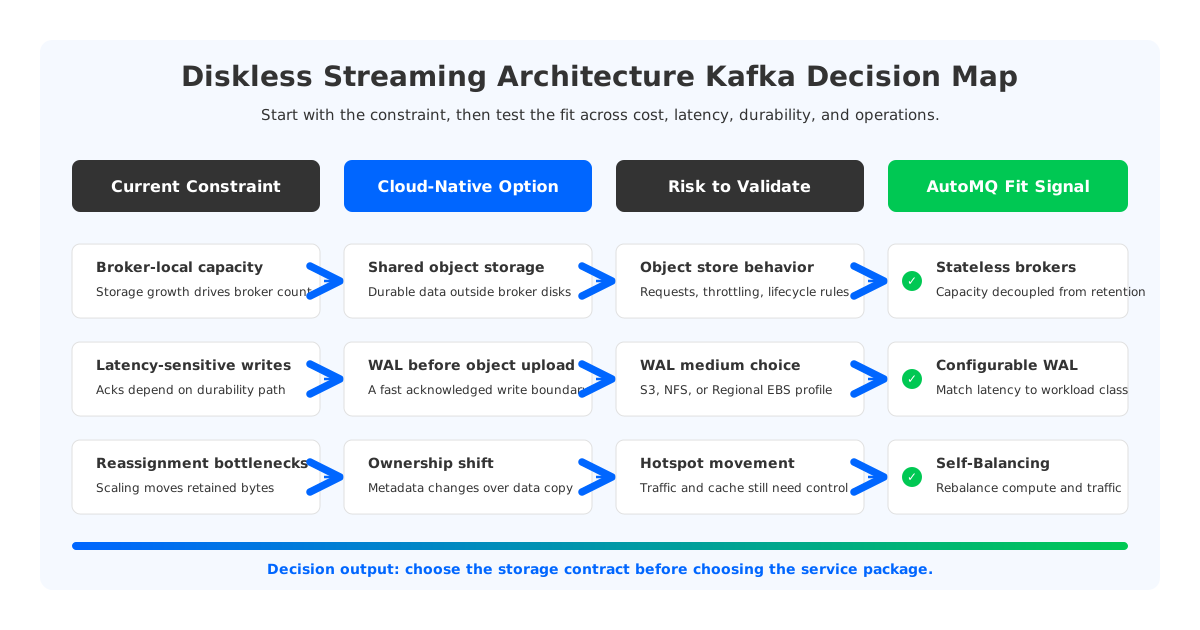
Teams usually search for diskless streaming architecture kafka after a familiar Kafka decision stops looking familiar. A cluster that was acceptable at 20TB of retention becomes awkward at 200TB. A rare rebalance becomes weekly capacity work. A cloud bill starts showing storage growth, request patterns, and cross-Availability Zone (AZ) movement as separate design questions.
The search phrase sounds like a product category, but the real question is architectural: can a Kafka-compatible platform keep the Kafka API and operating semantics while removing broker-local disks as the primary durable home of stream data? If yes, which trade-off moves from the broker fleet into storage, network, metadata, and migration planning?
Kafka is not only a queue with a storage directory. It is a contract between producers, consumers, offsets, partitions, transactions, consumer groups, and operations. A diskless design that breaks that contract creates a rewrite project, while one that hides a weak durability path creates production risk. Evaluate cost, latency, and durability together.
1Why Teams Search for diskless streaming architecture kafka
The first reason is usually cost, but cost is rarely one thing. Traditional Kafka ties retained bytes, broker count, local storage, replica traffic, and recovery operations into the same system. If a topic needs more retention, the cluster may need more disk, more brokers, and reassignment. When partitions move, production brokers spend bandwidth and I/O copying data that is not business traffic.
Cloud infrastructure makes that coupling visible. Local SSD, block storage, object storage, private endpoints, cross-AZ traffic, and operational labor have different pricing models and failure boundaries. Architecture decides which meters are touched by producer traffic, replay, replication, backup, scaling, and retention.
The second reason is elasticity. Kafka can scale, but the traditional path is shaped by partition data belonging to brokers. Adding capacity is a data placement operation, not only scheduling. Removing capacity is more sensitive because production data has to leave the broker first. Many SRE teams respond by overprovisioning, scheduling maintenance windows, and avoiding scale-in.
The third reason is recovery. When a broker fails in Shared Nothing architecture, the cluster must reason about replicas, leader election, under-replicated partitions, throttles, disk pressure, and replacement nodes. Kafka's replication model is proven, but it makes broker-local storage part of the failure domain. Diskless architecture asks whether a failed broker can be treated more like lost compute than lost data.
2The Production Constraint Behind the Problem
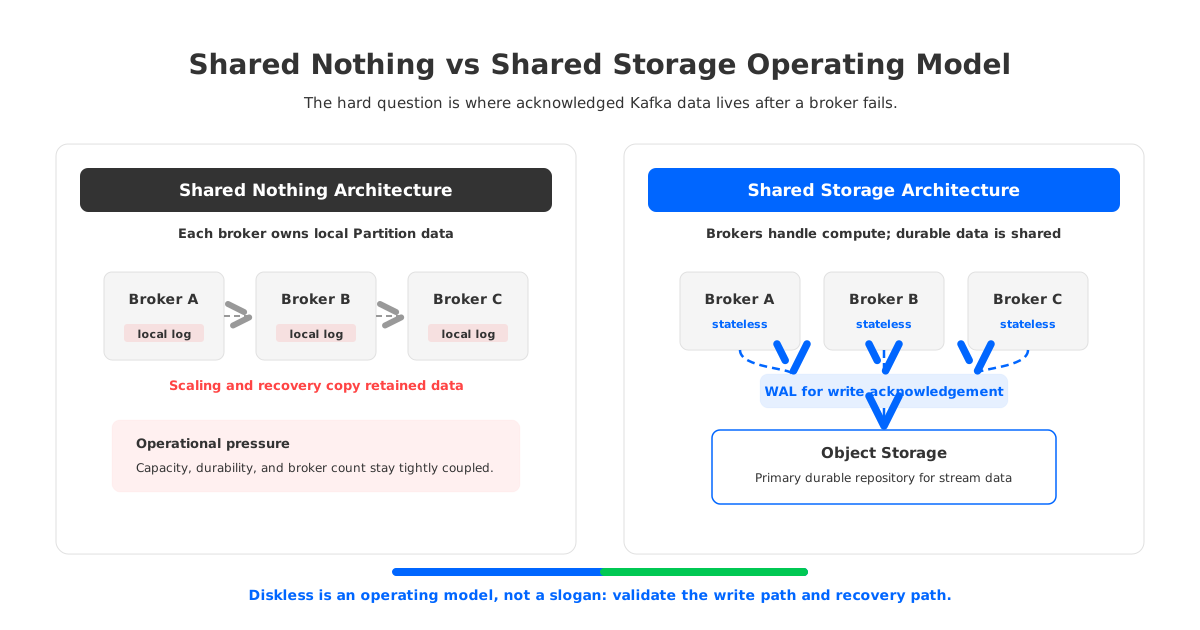
Traditional Kafka uses a Shared Nothing architecture. Each broker manages local log directories, and each partition has replicas placed across brokers. This fits Kafka's original design: records append to logs, consumers track offsets, and replication factor protects availability and durability.
The constraint appears when cloud operations make local ownership expensive to change. A partition is not an abstract scheduling unit when retained data sits on broker-local storage. It is a data asset that must be copied, caught up, throttled, monitored, and verified.
The consequences show up in several places:
- Capacity planning becomes storage planning. When retention grows faster than throughput, teams may add brokers for disk headroom rather than CPU or network demand.
- Reassignment becomes production work. Moving partitions consumes the same cluster resources needed to serve clients, so teams throttle movement and accept longer operational windows.
- Cross-AZ design needs scrutiny. Replicas and client paths can create inter-zone traffic, depending on placement, routing, and cloud provider pricing rules.
- Failure recovery carries data-placement state. Replacing a broker is not complete until the cluster has restored safe placement and replication conditions.
Traditional Kafka is not wrong. The issue is that storage growth and elasticity become broker operations. A diskless architecture is valuable only if it changes that conversion without weakening Kafka compatibility or durability semantics.
3Architecture Options and Trade-Offs
There are several ways to reduce broker-local storage pressure, and they are not equivalent. Apache Kafka Tiered Storage moves eligible log segments to remote storage while local disks continue to serve the active log. That can help long retention and replay economics, especially when historical reads are less frequent than tail reads. It does not fully remove broker-local durable state from the hot write path.
A stronger diskless model changes the primary storage contract. Brokers still speak Kafka protocol, coordinate leadership, process produce and fetch requests, and preserve client behavior. Durable stream data is stored in a shared storage layer rather than owned by each broker's disk. The broker may still use cache or temporary storage, but long-lived bytes are not trapped inside broker lifecycle.
The write path deserves the most attention. Object storage is durable and cost-effective for retained data, but Kafka producers expect acknowledgements with ordered appends and clear durability boundaries. A production diskless design needs a WAL (Write-Ahead Log) or equivalent mechanism that absorbs writes, defines the acknowledgement boundary, and recovers data if a broker fails before upload.
The read path has a different trade-off. Kafka workloads often mix tailing reads with catch-up reads. A diskless architecture needs caching, prefetching, and workload-aware fetch behavior so historical reads do not turn every lag event into an object storage request storm.
The evaluation matrix should compare designs across seven dimensions:
| Dimension | What to ask | Why it matters |
|---|---|---|
| Compatibility | Do existing clients, transactions, consumer groups, offsets, Kafka Connect, and Kafka Streams work without rewrites? | The Kafka API is the application contract. Losing it changes project scope. |
| Cost model | Which costs move to object storage, requests, private endpoints, data transfer, and compute? | Lower storage cost can be offset by request or network patterns if the model is incomplete. |
| Latency | Where does the producer acknowledgement happen, and how are tail reads served? | Diskless does not remove latency physics; it changes the path that must be optimized. |
| Durability | What survives broker loss, zone loss, and object storage or WAL disruption? | The design must define the exact point where acknowledged data is recoverable. |
| Elasticity | Does scaling require copying retained partition data between brokers? | The answer determines whether scale-in is a normal operation or a maintenance event. |
| Governance | Where do control plane metadata, customer data, credentials, and audit logs live? | Regulated teams need deployment boundaries that match policy, not vendor diagrams. |
| Migration | Can topics, offsets, and producers move with a rollback plan? | Architecture value is irrelevant if adoption requires a risky cutover. |
This matrix keeps the discussion honest. Tiered storage may be enough for long retention on broker disks. A fully diskless design becomes more compelling when the pain is repeated reassignment, scale-in hesitation, recovery complexity, or storage growth that keeps forcing broker fleet decisions.
4Evaluation Checklist for Platform Teams
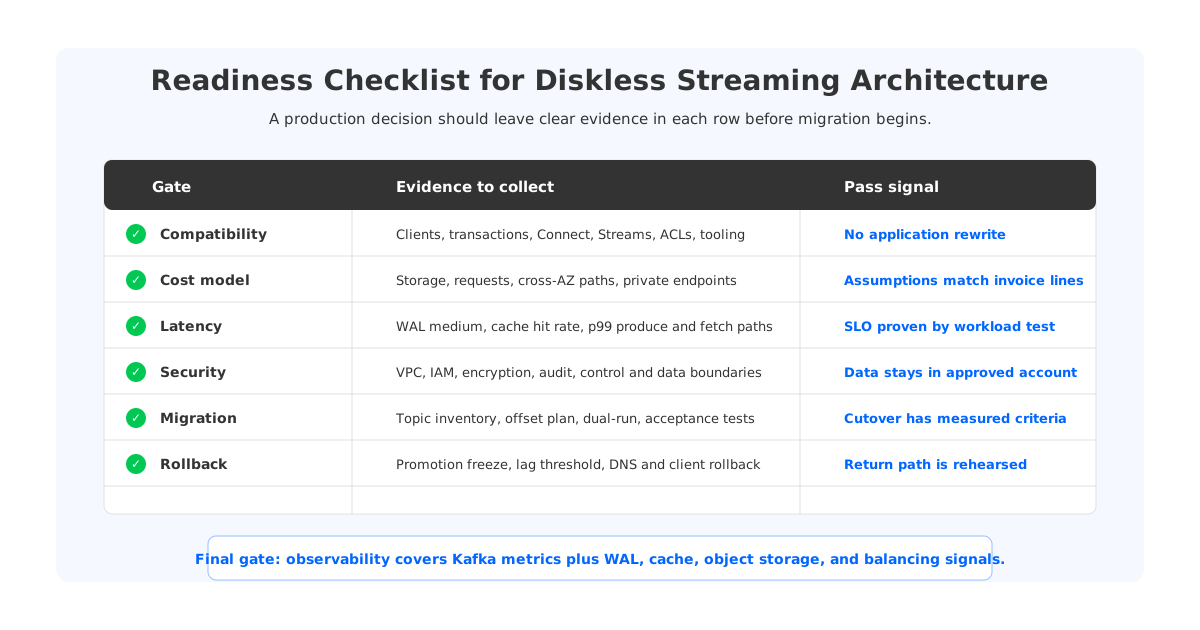
A production evaluation should begin with evidence from the current estate, not a generic diagram. Pull top topics by retained bytes, write throughput, read fanout, consumer lag, and replay frequency. Then map each workload class to the architecture decision it stresses.
The most useful early artifact is a short scorecard that SREs, platform owners, and application teams can discuss in one meeting.
Use the following checklist as a starting point:
- Define what "diskless" means for your team. No broker-local persistent data is different from no Kubernetes PersistentVolume, and both are different from no local cache. Write the definition before comparing platforms.
- Validate Kafka behavior before cost. Test producer retries, idempotent producer settings, transactions if used, consumer group rebalances, offset commits, compaction, retention, Connect workers, Streams applications, ACLs, and monitoring tools.
- Model the invoice from data paths. Separate producer writes, replica or storage writes, tail reads, catch-up reads, object storage requests, private connectivity, and cross-AZ traffic. Cloud pricing pages matter because each path may hit a different meter.
- Test the exact WAL profile. A diskless architecture with an S3 WAL has different latency behavior from one using NFS WAL or Regional EBS WAL. The right answer depends on workload SLOs and failure-domain requirements.
- Run failure drills before migration. Kill a broker, remove capacity, trigger a leader movement, run a catch-up consumer, and verify that observability explains what happened.
- Plan rollback as a first-class path. Record the last safe source state, consumer offset strategy, DNS or bootstrap changes, producer freeze conditions, and promotion criteria.
Notice the order. Compatibility comes before cost because an incompatible platform changes the project category. Latency and durability come before migration because a fast cutover into an unclear acknowledgement path is not a win. Governance spans the whole checklist because data boundary mistakes are expensive to discover late.
5How AutoMQ Changes the Operating Model
Once the neutral framework is clear, AutoMQ fits as a Kafka-compatible implementation of Shared Storage architecture. It keeps Kafka protocol compatibility while replacing broker-local log storage with S3Stream, a storage layer using WAL storage, data caching, metadata, and S3-compatible object storage.
The important change is that AutoMQ Brokers become stateless with respect to long-lived stream data. They handle Kafka requests, leadership, caching, routing, and scheduling, while durable data is stored through the shared storage layer. Scaling and recovery shift from "copy this broker's retained data elsewhere" toward "move ownership, leadership, and traffic safely."
AutoMQ still has trade-offs to evaluate. WAL type matters. AutoMQ Open Source uses S3 WAL, which is straightforward to deploy and useful for workloads that tolerate higher write latency. AutoMQ commercial editions can use WAL options such as NFS WAL or Regional EBS WAL for lower-latency production workloads when the environment supports the required storage service. A serious evaluation should test the WAL mode intended for production.
The cost model also changes. With Shared Storage architecture, retained data lives in object storage rather than being multiplied across broker-local disks. AutoMQ's S3-based design can reduce inter-zone replica replication paths because brokers do not copy replicas among themselves in the traditional way. Public-cloud teams should still validate object storage, private connectivity, requests, and data transfer pricing against the actual deployment.
Governance is part of the fit. AutoMQ BYOC runs control plane and data plane components in the customer's cloud account and VPC, while AutoMQ Software targets private data center environments. That boundary matters for teams that need to control where message data, credentials, monitoring, and operational access live.
Migration is the last practical gate. AutoMQ provides Kafka Linking for migration scenarios where teams need topic synchronization and offset continuity, but migration still deserves a runbook. Platform teams should inventory topics, test consumer group promotion, and rehearse rollback.
A strong fit signal is structural pain: retained data grows faster than compute demand, rebalancing is expensive, recovery is dominated by broker-local state, or cloud cost reviews point back to local-storage assumptions. If the main pain is an inefficient partition key, overloaded downstream system, or poor consumer configuration, fix that first.
6Decision Scorecard
Before approving a migration, ask each stakeholder to sign off on explicit statements. The platform team should know which Kafka features were tested. SRE should know what happens when a broker dies. Security should know where data and credentials live. Finance should map expected savings to specific invoice lines.
| Scorecard item | Green answer | Red flag |
|---|---|---|
| Kafka compatibility | Existing clients and tools pass workload-specific tests | The plan assumes protocol compatibility without testing transactions, offsets, or Connect |
| Write durability | The WAL and recovery path are documented and tested | Acknowledgement behavior is described only at marketing level |
| Read behavior | Tail and catch-up reads are measured separately | Replay tests are skipped because normal consumers look fine |
| Cost | Storage, requests, endpoints, and traffic are modeled by data path | The business case relies on one storage price comparison |
| Operations | Scale-out, scale-in, broker failure, and rebalancing are rehearsed | The team only tests steady-state throughput |
| Governance | Deployment boundary matches cloud account, VPC, IAM, and audit needs | Customer data path and control path are discussed as one vague boundary |
| Migration | Cutover and rollback have measurable gates | The plan depends on a one-way switch |
This is where "diskless streaming architecture kafka best practices" becomes concrete: identify which broker-local responsibility you are removing, prove which component takes over, and test the failure mode before production traffic depends on it.
If your team is evaluating Kafka-compatible shared storage in its own cloud boundary, start with an AutoMQ environment and run the scorecard against one representative workload: try AutoMQ with a BYOC deployment path. The right proof is your topic mix, latency SLO, retention policy, and rollback plan.
7FAQ
7.1Is diskless streaming architecture the same as Kafka Tiered Storage?
No. Tiered Storage moves eligible log segments to remote storage while the active log still depends on broker-local storage. A diskless Shared Storage architecture makes shared storage the primary durable home for stream data and treats brokers more like replaceable compute nodes.
7.2Does diskless Kafka mean there is no disk anywhere?
Not necessarily. The practical definition is that broker-local disks are not the primary durable store for acknowledged stream data. A system may still use cache, temporary storage, WAL media, or cloud storage devices depending on its design.
7.3What is the biggest latency risk in a diskless design?
The biggest risk is an unclear write acknowledgement path. If every write waits directly on object storage, latency can become unacceptable for many Kafka workloads. A production design needs a WAL or equivalent durable write path matched to the workload's SLO.
7.4When should a team avoid a diskless migration?
Avoid making architecture change the first answer when the main problem is application-level: poor partition keys, unbounded consumer lag, oversized messages, weak schema governance, or downstream bottlenecks. Fixing workload design may deliver more value than changing the storage architecture.
7.5Where does AutoMQ fit in this category?
AutoMQ is a Kafka-compatible streaming platform built around Shared Storage architecture, stateless brokers, WAL storage, and S3-compatible object storage. It is relevant when teams want to keep Kafka semantics while reducing the operational coupling between brokers and durable stream data.


