
Table of Contents
Table of Contents
Teams usually search for multi tenant topic isolation kafka after the first shared cluster stops feeling shared in a healthy way. A payments team wants strict retention and audit rules, an observability team wants high-ingest topics with looser latency targets, and an analytics team wants long replay windows. The question is not whether Kafka can host many topics. The harder question is how far topic-level isolation can go before storage, network, and operations force tenants into separate clusters.
Topic isolation looks like a governance problem at first. You define naming conventions, quotas, ACLs, schemas, retention policies, and consumer group boundaries. Those controls matter, but they do not change where bytes live or how the cluster recovers when a broker, disk, or Availability Zone fails. Once a tenant has high write throughput, deep retention, strict recovery objectives, or uneven read fanout, isolation becomes an infrastructure decision.
Multi-tenant topic isolation in Kafka is not a single setting. It is a placement decision across topics, partitions, brokers, storage, network paths, and team ownership. A platform team needs a framework that separates logical isolation from physical isolation, then asks which parts should remain shared and which deserve a harder boundary.
1Why teams search for multi tenant topic isolation kafka
The search query is awkward because the production problem is awkward. Teams are not asking for a generic definition of multi-tenancy. They are deciding whether a topic naming scheme, quota policy, or cluster-per-tenant model will survive real traffic. One tenant may produce steady telemetry at high volume. Another may produce fewer records but require transactional writes and strict replay guarantees. A third may run consumers that fall behind and then perform heavy catch-up reads overnight.
Kafka gives platform teams useful logical primitives: Topic, Partition, Consumer group, Offset, ACL, quota, and retention settings. Consumer groups let different applications read the same Topic independently while tracking their own offsets. Transactions and idempotent producers help applications control duplicate writes and atomicity. KRaft removes ZooKeeper from Kafka metadata management. These mechanisms are important, but they sit above the storage layout that determines how expensive or slow a tenant boundary becomes.
A clean multi-tenant platform usually starts with three boundaries:
- Logical boundary: Topic names, ACLs, schemas, quotas, and Consumer group ownership define who can access what.
- Operational boundary: SLOs, alert routes, incident ownership, and change windows define who gets paged when a tenant causes pressure.
- Physical boundary: Brokers, storage media, network paths, and cluster placement define whether a tenant can consume resources that another tenant needs.
Problems appear when the first two boundaries are mature and the third remains implicit. A platform can have strict ACLs and still let a noisy tenant fill broker-local disks. It can enforce producer quotas and still spend heavily on inter-zone replication. It can separate teams by Topic prefix and still require large reassignment when one tenant needs more capacity.
2The production constraint behind the problem
Traditional Kafka follows a Shared Nothing architecture. Each Broker owns local storage, and each Partition replica is stored on specific brokers. Durability comes from replication through ISR (In-Sync Replicas), while availability depends on leader election and follower catch-up. This design is proven, but it tightly couples storage placement and compute placement.
That coupling is where topic isolation becomes expensive. If one tenant needs more write capacity, the platform team may add brokers and move partitions. If one tenant needs deeper retention, the team must provision enough local or attached storage where that tenant's partitions live. If one tenant needs stronger fault tolerance across Availability Zones, the cluster sends replica traffic across zones.
Tiered Storage changes part of the storage equation by moving older log segments to remote storage. It is useful for long retention and replay-heavy workloads. It does not make brokers stateless, because the hot log and active write path still depend on broker-local storage. A tenant with spiky writes still pressures local disks, page cache, partition placement, and replication.
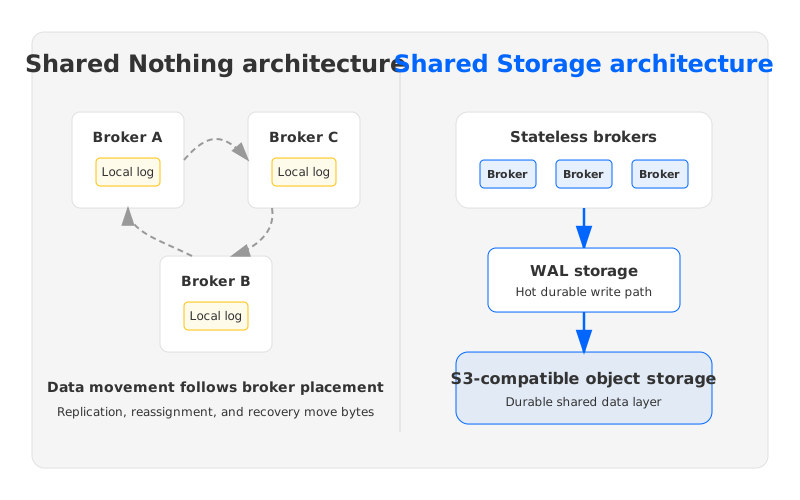
The result is a recurring trade-off. A shared Kafka cluster gives teams operational efficiency, common tooling, and better average utilization. Separate clusters give tenants stronger blast-radius control, clearer cost attribution, and independent maintenance windows. Between those poles sit hybrid models: shared clusters for low-risk tenants, dedicated clusters for regulated or high-throughput tenants, and Topic classes for different retention or latency profiles.
3Architecture options and trade-offs
The right design depends on what the platform is trying to isolate. Topic-level isolation is a good fit when teams share similar latency, durability, and retention requirements. Cluster-level isolation is a better fit when tenants need different upgrade windows, region placement, encryption boundaries, or failure budgets. Network isolation, such as VPC-level access controls or private connectivity, may be required even when Topic placement remains shared.
The following decision map is useful because it treats isolation as a set of operating choices rather than a binary architecture label.
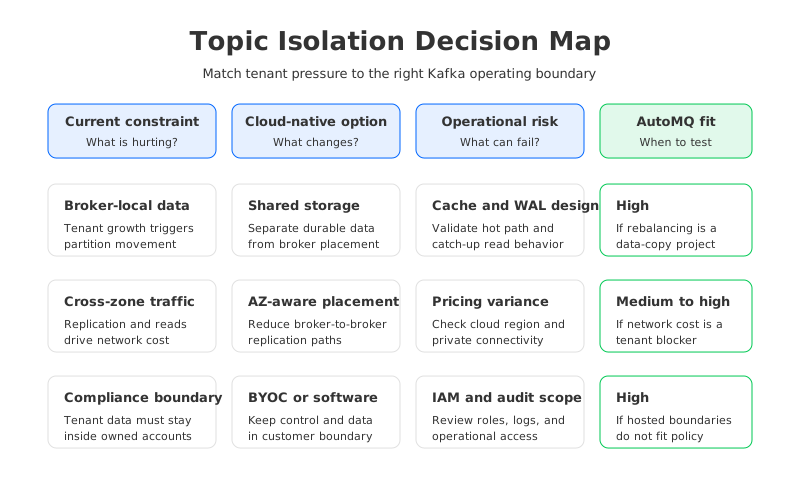
| Option | Where it works well | Main cost | Failure boundary |
|---|---|---|---|
| Shared cluster, shared broker pool | Similar workloads with common SLOs | Noisy-neighbor control and quota tuning | Broker and cluster incidents can affect many tenants |
| Shared cluster, tenant-aware Topic classes | Mixed retention or throughput patterns | More governance and placement policy work | Better logical control, still shared infrastructure |
| Dedicated cluster per major tenant | Regulated, high-value, or extreme workloads | More clusters, monitoring, upgrades, and capacity overhead | Strong tenant-level operational boundary |
| Cloud-native shared storage platform | Teams that want Kafka compatibility with less broker-local data movement | Requires validation of WAL type, object storage behavior, and tooling fit | Broker replacement and scaling are less tied to local data |
The cost column is not only a cloud bill item. It includes time spent reviewing partition placement, resizing disks, rebalancing traffic, and explaining why a tenant with small data volume still needs reserved capacity because its peak write pattern is harsh. A production platform also needs rollback paths: metadata change, client change, or data movement project.
Latency adds another constraint. A shared topic platform can meet low-latency writes when the hot path is local and stable, but tenant isolation often pushes teams toward more replication, stricter acknowledgments, or cross-zone placement. Durability adds pressure in the same direction. The safest data placement can produce the most network traffic, and the lowest network cost can leave weaker isolation.
4Evaluation checklist for platform teams
Before choosing a shared, dedicated, or cloud-native model, review the workload as a set of questions that operators can answer during an incident. The point is not to create a perfect taxonomy. The point is to avoid discovering the physical boundary after a tenant has already become too large to move comfortably.
- Compatibility: Which producer, consumer, Kafka Connect, Kafka Streams, and transaction behaviors are required? Can the platform preserve Topic names, offsets, ACLs, and client configurations during migration?
- Cost attribution: Can you explain per-tenant compute, storage, retention, and network costs? If not, a shared cluster may hide the tenant that drives most of the bill.
- Scaling behavior: Does a tenant need more throughput for hours, days, or permanently? Temporary spikes and permanent growth deserve different placement decisions.
- Durability and recovery: What happens when a broker, disk, or Availability Zone fails? Which tenant recovery objectives are stricter than the cluster default?
- Governance: Who owns schema changes, retention exceptions, access reviews, and incident communication?
- Rollback: If the tenant moves to a different cluster or architecture, can producers and consumers switch back without losing offset continuity?
- Observability: Can dashboards show tenant-level throughput, lag, throttling, storage growth, and error rates without manual filtering?
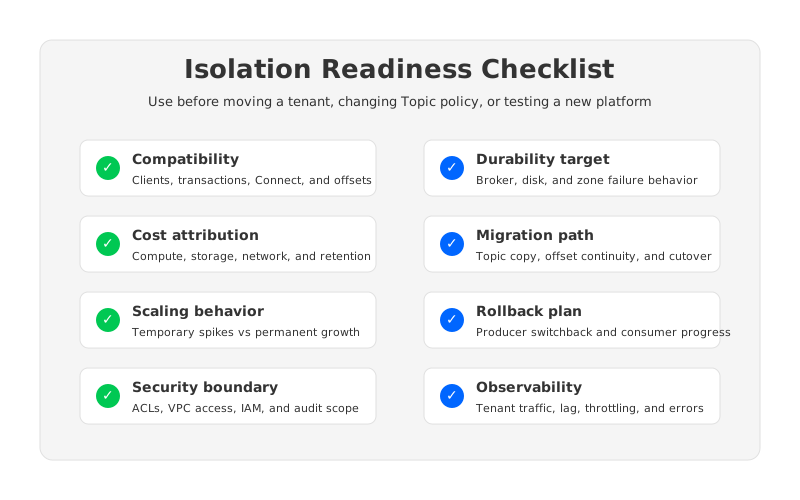
This checklist tends to expose one uncomfortable pattern: many teams use Topic-level controls to compensate for a storage model that cannot isolate cost-effectively at the physical layer. If the root problem is broker-local data movement, another quota policy will not remove it.
5How AutoMQ changes the operating model
Once the evaluation framework points to broker-local storage as the constraint, a different architecture becomes relevant. AutoMQ is a Kafka-compatible streaming platform that uses a Shared Storage architecture. It keeps Kafka protocol semantics for producers, consumers, Topic, Partition, Offset, Consumer group, and ecosystem tools, while moving durable stream storage away from broker-local disks and into S3-compatible object storage.
The core change is that AutoMQ Brokers are stateless brokers. They process Kafka requests, handle leadership, cache hot data, and coordinate with KRaft metadata, but persistent data is not tied to a broker's local disk. Writes first go through WAL (Write-Ahead Log) storage for durable acknowledgment and recovery, then are organized into object storage through S3Stream. WAL storage is the hot durability path; S3 storage is the long-term shared data layer.
For multi-tenant topic isolation, this changes the operator's set of moves. Scaling a tenant-heavy workload no longer has to mean copying that tenant's partition data from one broker's disk to another. Broker replacement is less entangled with local persistent state. Self-Balancing can focus on traffic ownership and load distribution rather than treating every rebalance as a storage relocation exercise. In supported S3-based deployment patterns, avoiding broker-to-broker replication paths can also reduce cross-AZ traffic cost, though teams should verify the exact network and object storage pricing rules in their cloud region before publishing a business case.
The architecture does not erase trade-offs. WAL type matters. AutoMQ Open Source uses S3 WAL, which keeps deployment simple and object-storage-based but is better suited to latency-tolerant workloads. AutoMQ commercial editions can use lower-latency WAL options such as Regional EBS WAL or NFS WAL, depending on the cloud and deployment model. Object storage request patterns, cache hit rates, catch-up reads, and private connectivity still need design review. The difference is that the physical isolation discussion moves away from "which broker owns these bytes forever" and toward "which compute, WAL, object storage, and governance boundary fits this tenant."
AutoMQ BYOC is also relevant for teams that need customer-controlled deployment boundaries. In BYOC, the control plane and data plane run in the customer's cloud account and VPC, so Kafka workloads and message data remain inside the customer's environment. AutoMQ Software serves teams running in private data centers or self-managed infrastructure. Those deployment models matter when multi-tenancy is constrained by procurement, compliance, or regional data residency rather than by Kafka mechanics alone.
Migration should still be treated as an engineering project. Preserve offsets, validate client compatibility, test consumer lag behavior, rehearse rollback, and run both platforms long enough to compare tenant-level metrics. AutoMQ Kafka Linking can help with migration paths that need topic replication and consumption progress continuity, but the decision should start with workload classification rather than tool selection.
6A practical decision matrix
Use this scoring model when a tenant asks for stronger isolation. Give each row a low, medium, or high score, then review the result with the application team and the platform owner.
| Dimension | Low pressure | Medium pressure | High pressure |
|---|---|---|---|
| Write throughput | Stable and small compared with cluster baseline | Bursty but predictable | Dominates broker or network capacity |
| Retention | Similar to platform default | Longer than default but bounded | Deep replay window or audit retention |
| Latency sensitivity | Batch or monitoring workload | User-facing but tolerant of brief spikes | Strict low-latency SLO |
| Durability and recovery | Cluster default is acceptable | Tenant has tighter RPO/RTO | Tenant requires separate failure planning |
| Governance | Same ACL and schema process | Some exceptions | Separate compliance or data boundary |
| Migration risk | Clients can be changed quickly | Some offset sensitivity | Offset continuity and rollback are critical |
Low-pressure tenants usually belong in a shared Topic model with strong quotas, naming, and observability. Medium-pressure tenants may need Topic classes, separate broker pools, or a cloud-native storage model that reduces data movement during scaling. High-pressure tenants deserve a deliberate boundary: a dedicated cluster, a dedicated deployment environment, or a Shared Storage architecture that can provide stronger physical flexibility without forcing a cluster-per-tenant sprawl.
This is where the original search query comes back into focus. multi tenant topic isolation kafka sounds like a naming and ACL question, but the durable answer sits lower in the stack. If topic isolation has become a recurring capacity, rebalance, and cross-zone cost discussion, evaluate the storage architecture before adding another layer of policy.
For teams reviewing Kafka-compatible alternatives, the useful next step is a workload-based architecture review rather than a generic feature comparison. You can start with AutoMQ BYOC and test one high-pressure tenant against your current cost, latency, durability, and rollback requirements.
7FAQ
7.1Is Topic-level isolation enough for multi-tenant Kafka?
It is enough when tenants have similar SLOs, retention, throughput, and governance needs. It becomes fragile when one tenant's physical resource demand dominates broker storage, network replication, or recovery planning.
7.2Should every tenant get a dedicated Kafka cluster?
No. Dedicated clusters create strong boundaries, but they also increase monitoring, upgrades, capacity planning, and cost overhead. Reserve them for tenants with clear compliance, blast-radius, or workload reasons.
7.3How does Shared Storage architecture affect topic isolation?
Shared Storage architecture separates durable data from broker-local disks. That can reduce the amount of data movement required during scaling, broker replacement, and partition reassignment. Teams still need to validate WAL choice, object storage behavior, and operational tooling.
7.4Does Tiered Storage solve multi-tenant isolation?
Tiered Storage helps with long retention by moving older log segments to remote storage. It does not fully remove broker-local dependence from the active write path, so it should not be treated as the same thing as stateless brokers.
7.5What should teams validate before migration?
Validate Kafka client behavior, Topic configuration, ACLs, Consumer group offsets, transaction usage, Kafka Connect dependencies, observability, and rollback. The riskiest migrations are usually the ones that test data copy but skip consumer progress and operational ownership.


