
Table of Contents
Table of Contents
A search for wal placement choices kafka usually starts after a team has production traffic, configured replication, and stable consumer groups. The open question is where the write path should land on cloud infrastructure: broker-local disks, attached block storage, shared file storage, object storage, or a platform design that separates durable log ownership from the broker process.
That question is architectural, not just a storage preference. WAL placement affects producer acknowledgment latency, recovery, retention cost, cross-Availability Zone traffic, operational ownership, and migration risk. The useful framing is direct: decide which part of the system owns durable bytes, which failure domain those bytes belong to, and how much work the team accepts when capacity, brokers, or cloud boundaries change.
1Why teams search for wal placement choices kafka
Kafka operators already know why a write-ahead log matters. The log is the durable record of accepted writes, and Kafka connects records, offsets, partitions, consumer groups, replication, and retention around that log. Once applications depend on those semantics, changing where durable writes land becomes a production decision.
The search usually appears when teams move Kafka onto Kubernetes, extend retention, build multi-Availability Zone infrastructure, or evaluate Kafka-compatible platforms. In each case, the team is trying to separate storage labels from the actual write path.
Those situations all collapse into the same checklist:
- Latency: When can a producer receive an acknowledgment, and which storage operation must complete first?
- Durability: What happens to acknowledged writes if a broker, volume, node pool, Availability Zone, or storage service has a failure?
- Cost: Which costs scale with write throughput, retention, object requests, cross-zone traffic, provisioned capacity, and operational time?
- Elasticity: Can compute capacity change without copying a large amount of broker-local log data?
- Governance: Who controls credentials, network paths, encryption, audit logs, and regional boundaries?
WAL placement choices decide how Kafka's familiar client contract maps onto cloud resources.
2The production constraint behind the problem
Traditional Kafka uses a Shared Nothing architecture. Each broker manages local storage, partitions are assigned to brokers, and in-sync replicas provide durability and availability. This design remains appropriate when workloads are stable and the operations team is comfortable with disk sizing, broker replacement, and reassignment workflows.
The constraint appears when the environment changes faster than data placement. In cloud deployments, brokers are compute resources, attached disks are separate billable resources, and Availability Zones add network cost and failure-domain dimensions. A broker becomes a storage owner, capacity reservation, network participant, and recovery unit. When it grows, fails, or moves, the data attached to it matters.
That creates a familiar pattern. Adding brokers does not automatically rebalance existing durable bytes. Running across Availability Zones can create repeated cross-zone traffic. Extending retention increases disk and reassignment pressure. Tiered Storage can improve cold-data economics, but the broker-local log path still remains active for recent data and broker recovery.
WAL placement is where these concerns become concrete. If the WAL is broker-local, producer acknowledgment can stay close to the broker, but broker lifecycle remains tightly coupled to local storage. If the WAL is on attached block storage, the team gets a different durability and latency profile, but it still has to manage volume topology, quotas, and attachment behavior. If the WAL is on shared file storage or object storage, the broker becomes less tied to local disks, but the team must validate latency, throughput, request patterns, and failure modes under the real workload.
The hard part is choosing the write path whose operational consequences match the workload.
3Architecture options and trade-offs
The easiest mistake is to compare WAL placements with one dimension. Low latency, durability, and lower cost only matter when they are evaluated together with failure domain, request pattern, provisioned performance, network transfer, and operational effort.
Use a decision matrix instead of a ranking table:
| WAL placement pattern | Good fit | Trade-off to validate |
|---|---|---|
| Broker-local disk or local persistent volume | Stable clusters where broker identity and storage ownership are acceptable operational units. | Broker replacement, disk expansion, partition reassignment, and recovery remain storage-heavy events. |
| Single-AZ block storage | Workloads that need a fast local write path and accept the volume's Availability Zone boundary as part of the design. | Multi-AZ durability must be handled elsewhere through replication, backup, or platform policy. |
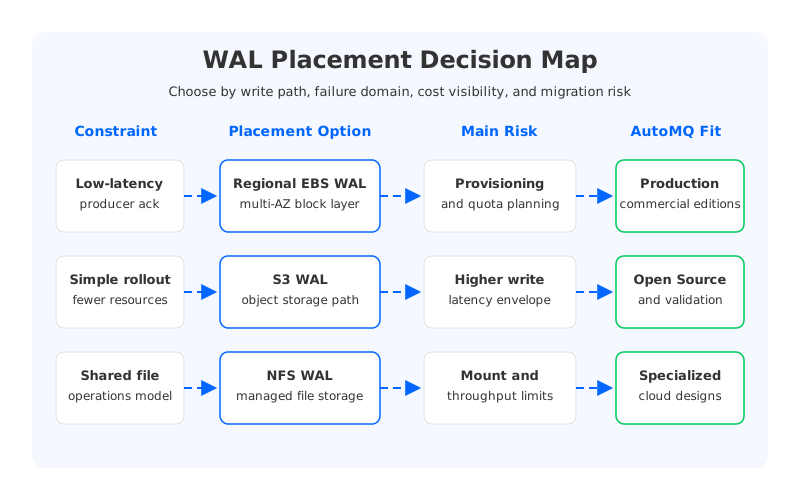
| Regional EBS WAL | Production designs that need a low-latency block-style WAL with a multi-AZ storage failure domain. | Provisioning, quota, cloud support matrix, and failover behavior must be tested before rollout. |
| NFS WAL | Teams that prefer a managed file storage operating model or have cloud-specific file service requirements. | Mount behavior, throughput ceilings, noisy-neighbor risk, and file-service availability need explicit runbooks. |
| S3 WAL | Validation, simpler diskless deployment, or workloads that can tolerate a wider write-latency envelope. | Object-storage latency, request pattern, and recovery behavior must be measured under producer load. |
Tiered Storage deserves a separate note because it is often mixed into this conversation. Apache Kafka Tiered Storage moves older log segments to remote storage while keeping broker-local storage in the active path. That can improve retention economics, but it is not the same as moving primary durable ownership away from brokers. A Shared Storage architecture changes the center of gravity: durable stream data is backed by shared storage, while brokers focus more on protocol handling, leadership, caching, and coordination.
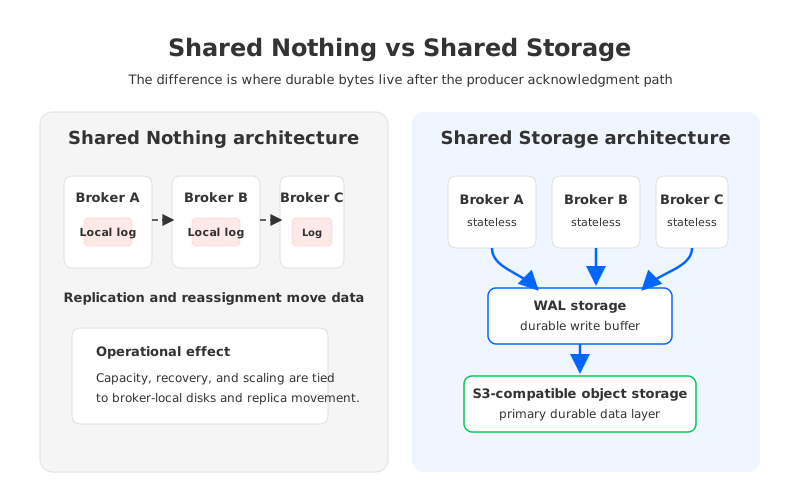
The comparison becomes clearer during failure. In a broker-local model, a failed broker is also a storage event: replicas, follower lag, leadership, and rebalancing all matter. In a Shared Storage architecture, the failed broker is primarily a compute event because durable data is not bound to the failed node's local disk, although metadata, cache warm-up, and workload-specific recovery still need validation.
This is why the WAL layer matters. It bridges low-latency acknowledgment and durable shared storage. It must make acknowledged writes recoverable, feed the upload or compaction path, and expose operational signals that on-call engineers can trust.
4Evaluation checklist for platform teams
A platform team should score WAL placement choices against production questions, not isolated storage features. The answer should be written down before migration because hidden assumptions often fail during incidents.
| Evaluation area | Question | Evidence to collect |
|---|---|---|
| Kafka compatibility | Do producers, consumers, consumer groups, offsets, transactions, Kafka Connect, and client tooling behave as expected? | Run representative clients and connectors against the target platform and verify offset, retry, and transaction behavior. |
| Write latency envelope | Which operation must complete before producer acknowledgment, and how does that behave under burst traffic? | Measure producer latency with the real message size, partition count, acknowledgment policy, and workload shape. |
| Failure domain | What can fail without losing acknowledged writes: broker, node, volume, file service, object store endpoint, or Availability Zone? | Run failure drills and document the recovery sequence, not only the architecture diagram. |
| Cost visibility | Can the team separate compute, WAL storage, object storage, object requests, network transfer, and support costs? | Build a workload-based cost model and tie every line to a cloud bill dimension or platform charge. |
| Elastic scaling | Can brokers be added, removed, or replaced without large broker-local data movement? | Test scale-out, scale-in, broker replacement, and partition leadership changes during load. |
| Governance | Are IAM roles, encryption, VPC paths, audit logs, regional control, and storage ownership clear? | Review the data path with security and compliance stakeholders before production traffic moves. |
| Migration and rollback | Can the team move topics, offsets, clients, connectors, and observability without trapping itself in the target? | Rehearse cutover and rollback using a representative topic set and downstream consumers. |
This checklist also clarifies responsibility. The platform team owns the write path, storage durability, observability, scaling, and migration controls. Application teams still own producer idempotency, transaction usage, consumer offset behavior, and connector semantics. Cloud pricing and architecture documents should be part of the evidence when Availability Zones, PrivateLink, object storage requests, or regional boundaries are involved.
5How AutoMQ changes the operating model
After the neutral framework is clear, AutoMQ becomes relevant as a Kafka-compatible cloud-native streaming platform built around Shared Storage architecture. AutoMQ keeps the Kafka protocol and ecosystem surface while replacing broker-local persistent storage with S3Stream, WAL storage, data caching, and S3-compatible object storage.
In AutoMQ, producers write through AutoMQ Brokers, and S3Stream appends data through WAL storage before data is uploaded or compacted into S3-compatible object storage. Because durable stream data is not tied to broker-local disks, AutoMQ Brokers are stateless brokers with respect to persistent log ownership. Scaling, broker replacement, and partition reassignment are less dominated by copying local log segments between brokers.
AutoMQ's WAL options also make the trade-off visible. AutoMQ Open Source supports S3 WAL, while commercial editions can support additional WAL storage types such as EBS WAL, Regional EBS WAL, and NFS WAL, depending on deployment requirements. "WAL" is not one latency profile or one durability profile; the implementation has to match the workload and cloud boundary.
The broader operating model changes in three ways:
- Cost becomes easier to decompose. Instead of treating broker disk as a single capacity envelope, teams can model compute, WAL storage, object storage, cache behavior, network placement, and request patterns separately.
- Elasticity is less storage-bound. Stateless brokers reduce the amount of broker-local data movement tied to scale-out, scale-in, and replacement. The team still needs workload tests, but the scaling question becomes less about moving retained bytes.
- Governance boundaries are clearer. AutoMQ BYOC runs the control plane and data plane in the customer's cloud account and VPC, while AutoMQ Software targets customer private environments. That helps teams evaluate who owns the data path, credentials, storage, and network controls.
This does not make every WAL choice automatic. Latency-sensitive workloads still need producer acknowledgment tests. Regulated workloads still need reviews of storage policy, encryption, identity, and audit paths. The benefit is narrower and durable: the broker no longer has to be the permanent owner of the bytes it serves.
6A practical readiness scorecard
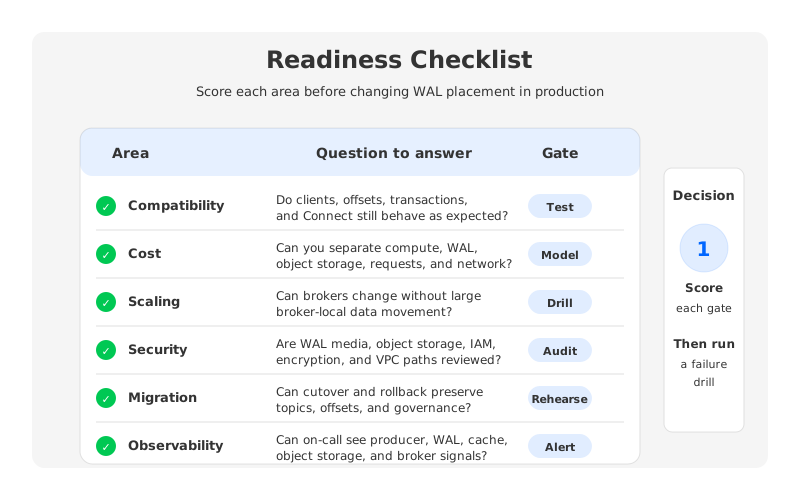
Before changing WAL placement or adopting a Kafka-compatible Shared Storage architecture, score each area as Ready, Needs Work, or Blocked. The score matters less than the evidence.
| Area | Ready means |
|---|---|
| Compatibility | Existing producer, consumer, Kafka Connect, Kafka Streams, schema, and administration workflows run against the target without application rewrites. |
| Latency | Producer acknowledgment latency is measured under representative write throughput, partition count, message size, and acknowledgment settings. |
| Durability | Failure drills cover broker loss, storage interruption, node replacement, and the relevant Availability Zone or regional assumptions. |
| Cost | The cost model separates compute, WAL media, object storage, storage requests, network transfer, and operational labor. |
| Security | IAM, encryption, VPC routing, private endpoints, audit logs, and storage ownership are approved by the security team. |
| Migration | Cutover and rollback plans include topics, offsets, consumer groups, connectors, clients, monitoring, and ownership changes. |
| Observability | Dashboards and alerts expose producer, broker, WAL, cache, object storage, upload, recovery, and consumer-lag signals. |
The scorecard prevents two mistakes: treating a fast WAL path as a complete architecture, and treating object storage as a complete durability story. Both producer acknowledgment and recovery behavior still have to be tested.
7FAQ
7.1What does WAL placement mean in Kafka architecture?
WAL placement means deciding where acknowledged writes become durable before the platform serves or uploads them. In traditional Kafka, the active log is tied to broker-local storage and replication. In Kafka-compatible Shared Storage architecture, the WAL can be a separate durability buffer while object storage holds long-term durable data.
7.2Is Tiered Storage the same as Shared Storage architecture?
No. Tiered Storage moves older log segments to remote storage while the broker-local log path remains active. Shared Storage architecture moves the primary durable data layer away from broker-local disks, using brokers more as compute nodes with WAL storage and cache in the write and read paths.
7.3Which WAL placement is right for low-latency workloads?
Low-latency workloads should test the specific WAL implementation under real producer settings. Regional EBS WAL or other block-style WAL options may fit workloads that need a tighter write-latency envelope, while S3 WAL may fit validation or workloads that can tolerate a wider envelope. The right answer depends on workload shape, failure-domain requirements, and cloud resources.
7.4Why does WAL placement affect cost?
WAL placement changes which resources scale with the workload. Costs can move between broker compute, local or attached storage, regional block storage, file storage, object storage capacity, object requests, PrivateLink or network paths, cross-zone traffic, and operational time. A useful model separates those dimensions instead of comparing storage capacity alone.
7.5When should a team evaluate AutoMQ?
Evaluate AutoMQ when the team wants Kafka-compatible APIs and ecosystem behavior with a storage model that reduces broker-local data ownership. It is most relevant when broker replacement, retention growth, partition reassignment, scaling, migration, or cross-Availability Zone traffic has become a recurring platform constraint.
Return to the original search: wal placement choices kafka. The durable answer is not a universal storage tier; it is a decision framework that keeps latency, durability, cost, elasticity, and governance in the same conversation. If your scorecard points toward Kafka-compatible Shared Storage architecture, start a focused evaluation through the AutoMQ BYOC path and test the WAL path against one production-shaped workload before widening the rollout.
8References
- Apache Kafka Documentation: Introduction
- Apache Kafka Documentation: Design and Persistence
- Apache Kafka Documentation: Transactions
- Apache Kafka Documentation: KRaft
- Apache Kafka Documentation: Tiered Storage
- Apache Kafka Documentation: Kafka Connect
- AutoMQ Documentation: Compatibility with Apache Kafka
- AutoMQ Documentation: Shared Storage Architecture
- AutoMQ Documentation: WAL storage
- AutoMQ Documentation: Zero Cross-AZ Traffic
- AWS Architecture Blog: Overview of Data Transfer Costs for Common Architectures
- AWS PrivateLink Pricing


