
Table of Contents
Table of Contents
When teams search for cqrs payment flows kafka, they are usually past the whiteboard stage. The command side already has real payment intent: authorizations, captures, refunds, chargebacks, ledger updates, fraud holds, customer notifications, and reconciliation jobs. The read side is no longer a convenience cache; it is the surface used by support teams, risk systems, finance exports, and customer-facing status pages.
That is why Kafka-compatible streaming often appears in CQRS payment architecture. The event log gives teams a durable sequence of facts, decouples write-side commands from read-side projections, and lets downstream services replay state when a projection is wrong. The hard part is not drawing that architecture. The hard part is operating it after payment volume, retention needs, compliance review, and cloud cost all grow at different speeds.
A payment flow has a different failure profile from a clickstream pipeline. Duplicate events create financial ambiguity, delayed projections create support noise, and lost events create audit gaps. A read model that falls behind during a peak sales window may recover later, but the business impact happens while customers are asking whether the payment completed.
1Why teams search for cqrs payment flows kafka
CQRS separates the write model from one or more read models. In payment systems, that separation is attractive because command handling and query serving optimize for different things. The command path cares about validation, idempotency, ordering, authorization, and durable state transitions. The read path cares about lookup, reporting shape, dashboards, and integrations that should not block the payment command.
Kafka fits this pattern because payment events become the contract between the two sides. A command handler emits an event such as PaymentAuthorized, PaymentCaptured, or RefundInitiated; consumers build projections for customer status, merchant settlement, fraud scoring, accounting, and notifications. Consumer groups allow different projections to progress independently, and committed offsets give each group its own recovery position.
The search intent usually hides three practical questions:
- Can the platform preserve Kafka client behavior while the payment application evolves? Teams do not want to rewrite producers, consumers, schemas, and operational tooling during an infrastructure change.
- Can the event log handle replay without turning recovery into a capacity incident? Payment read models are often rebuilt during incidents, schema changes, or audit investigations.
- Can the cost model survive multi-AZ durability and long retention? Payment events are not always high volume compared with telemetry, but they are often retained longer and protected more carefully.
Those questions are linked. A platform that is compatible but expensive under replay pressure will create different risk than a platform that scales smoothly but forces application rewrites. The right evaluation starts with the payment flow, not with the broker brand.
2The production constraint behind the problem
A CQRS payment system turns Kafka into a shared operational dependency. Producers care about acknowledgement behavior and idempotent writes. Consumers care about lag, offset commits, ordering per key, and replay throughput. Platform teams care about broker capacity, partition placement, storage growth, network paths, upgrades, and incident recovery. Security teams care about encryption, identity, audit logs, and where regulated data is stored.
The constraint is that each group experiences the same stream differently. Application developers see an event contract. SREs see a stateful distributed system. Finance sees compute, storage, networking, endpoint, and marketplace commitments. Compliance sees an audit boundary. If the architecture hides one of those perspectives, the missing cost appears later as operational debt.
Traditional Kafka was designed around brokers that own local storage. That model is understandable and battle-tested. It also means a broker is not only a compute process handling produce and fetch requests; it is a storage owner. Replication, disk sizing, broker replacement, and rebalancing all revolve around data placement. In a payment system, moving data can compete with payment traffic, and rebuilding read models can compete with the broker work needed to keep the cluster healthy.
The same issue appears during retention planning. Payment teams may keep compacted topics for entity state, append-only event topics for auditability, and derived topics for integration boundaries. If storage and compute scale together, a retention decision can force a broker sizing decision. If read replay grows, a compute decision can become a storage movement event. The system may still work, but the platform team has fewer independent levers.
3Architecture options and trade-offs
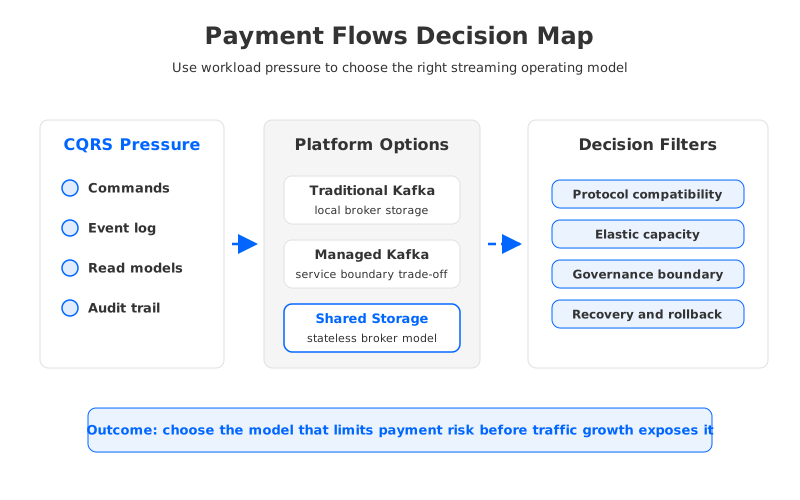
For a Kafka-compatible CQRS payment platform, the first decision is whether the operating model matches the workload risk profile. Self-managed Kafka gives teams direct control, but it also leaves them with broker lifecycle, disk planning, partition movement, upgrades, and security hardening. Managed Kafka reduces some undifferentiated operations, but the buyer still needs to understand service limits, networking cost, regional availability, configuration boundaries, and migration constraints.
Cloud-native Kafka-compatible systems introduce a third question: what happens when broker compute and durable storage are separated? If brokers can be treated more like stateless compute and event durability lives in shared storage, scaling and recovery change shape. A broker replacement does not have to mean recovering a unique local copy of payment history.
That distinction is especially important for payment flows with uneven traffic. Daily payment volume may be predictable, while flash sales, merchant batch settlement, retry storms, fraud model replays, or backfills create short windows of stress. A storage-coupled cluster handles those windows by provisioning for peak or accepting operational strain. A storage-decoupled model gives the platform team a better chance to scale compute for the hot path while keeping durability anchored in object storage.
The trade-off is not magic. Shared storage still needs a write path that can absorb latency-sensitive traffic, a metadata plane that can preserve Kafka semantics, and operational controls for security, network isolation, and observability. The evaluation should be concrete:
| Decision area | What to check | Why it matters for payment CQRS |
|---|---|---|
| Kafka compatibility | Producer, consumer, admin, transaction, security, and connector behavior | Application teams need migration without semantic surprises |
| Durability path | Where acknowledged events become durable | Payment events must remain auditable after broker failures |
| Scaling model | Whether compute and storage can scale independently | Replay and traffic spikes should not force unnecessary data movement |
| Network model | Cross-AZ replication, endpoint, and private connectivity charges | Multi-AZ payment systems can make network cost a platform issue |
| Governance | IAM, VPC boundary, encryption, audit logs, and operational ownership | Payment data needs clear control and review boundaries |
| Recovery | Offset reset, replay throughput, broker replacement, rollback, and migration tooling | Recovery plans must be tested before an incident |
This table is deliberately vendor-neutral. It helps separate the application design from the platform design. CQRS tells you how commands and reads should be separated; it does not tell you which storage ownership model will be sustainable under production traffic.
4Evaluation checklist for platform teams
The checklist should start at the event contract. Payment event names, keys, schemas, and idempotency rules are part of the platform design because Kafka preserves ordering within partitions, not across the entire cluster. A common pattern is to key payment lifecycle events by payment ID or ledger account, then handle cross-entity workflows through explicit process managers. That keeps per-entity ordering understandable while avoiding the false promise of global ordering.
The next check is consumer behavior. Read models should define how they handle duplicate events, late events, poison records, schema evolution, and replay from an earlier offset. Kafka consumer groups make independent projections possible, but they also make lag a first-class operational signal. Payment architecture needs to decide which projections are user-facing and which can lag without breaking the business promise.
Transactions and idempotent producers deserve careful review. Kafka supports transactional and idempotent producer capabilities, but infrastructure compatibility and client configuration must be verified before the payment path depends on them. If a command handler writes to a database and publishes to Kafka, teams still need a clear outbox or transactional boundary strategy.
Cost modeling is the part many architecture diagrams omit. Multi-AZ durability, object storage, private connectivity, endpoint data processing, retained bytes, request rates, and broker compute each have different pricing mechanics. A payment system with moderate write throughput but long retention may spend differently from a telemetry system with high throughput and short retention. The useful question is not whether Kafka is expensive in the abstract; it is which cost line grows when the payment business grows.
Security and governance should be evaluated as operating constraints, not paperwork. Payment topics can reveal sensitive business process names and customer states, and headers or payloads may carry regulated data. Access controls, encryption, audit logging, private networking, schema governance, and retention rules need the same design attention as producer acknowledgements.
5How AutoMQ changes the operating model
Once the evaluation reaches storage ownership, AutoMQ becomes relevant as a Kafka-compatible streaming platform built around shared storage and stateless brokers. It keeps the Kafka protocol surface familiar while moving the persistence model away from broker-local disks and toward object-storage-backed durability. For a payment CQRS workload, the important question is how operations change when brokers stop being the long-term owners of unique local data.
In a shared nothing Kafka cluster, replacing a broker or rebalancing partitions is tightly coupled to where replicas live. That coupling is manageable, but it makes infrastructure changes data-heavy. In AutoMQ's shared storage architecture, brokers are designed as compute nodes above a durable storage layer. The write path uses a WAL layer and shared object storage, while brokers can be added or removed with less dependence on moving broker-local historical data.
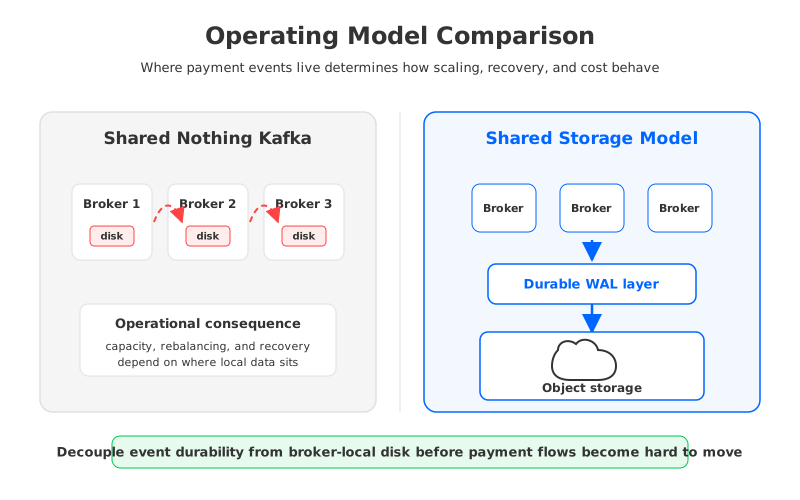
This matters for payment teams in four concrete ways. Capacity planning can separate hot-path compute from retained event history. Broker recovery can focus more on restoring service capacity and less on rebuilding local disks. Replay-heavy operations such as projection rebuilds can be planned against retained data, and the deployment boundary can stay under customer control in BYOC or software deployment models.
AutoMQ also emphasizes zero cross-AZ traffic in its architecture materials, a point worth examining in any cloud cost review. Traditional replicated storage models can create network movement across availability zones as part of durability and balancing. Object-storage-backed designs change where that traffic appears and how teams reason about it. The exact cost impact depends on workload, cloud provider, region, endpoint design, and deployment topology, so it should be validated with the same discipline as latency and availability.
The limitation is that compatibility still needs testing. A Kafka-compatible API is a starting point, not a migration waiver. Payment teams should run their actual client versions, security settings, producer configs, consumer group behavior, transaction usage, connector paths, and failure drills.
6Migration and readiness scorecard
Payment migrations should be boring by design. The safest plan starts with inventory: topics, partitions, keys, schemas, producers, consumers, ACLs, quotas, connectors, retention policies, compaction settings, and dashboards. Then the team chooses a migration pattern that matches the risk: mirror existing topics, dual-write selected command events, rebuild read models from a copied stream, or move one bounded workflow at a time.
The rollback plan must be designed before the first production cutover. If consumers move before producers, offsets and idempotency rules need special care. If producers move before consumers, old read models need a stable bridge. If both move together, the release becomes a coordinated payment incident waiting to happen. A good migration plan defines the source of truth at each step and explains how to prove that projected state matches expected payment state.
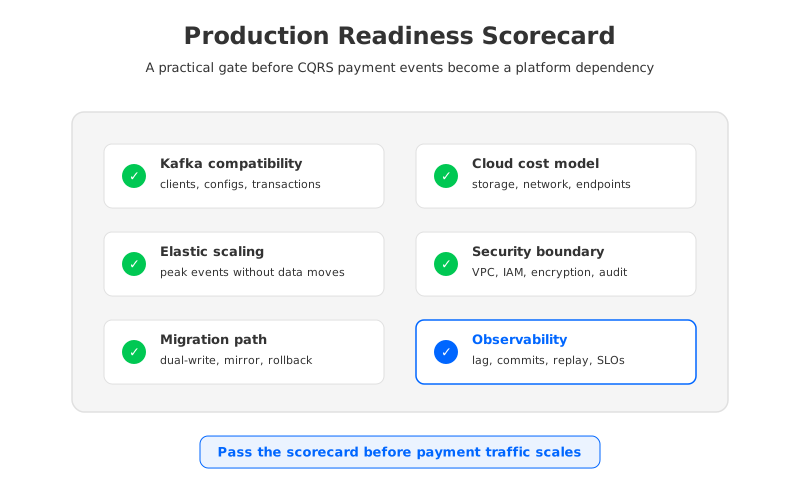
Use this scorecard as a production gate:
- Compatibility: the target platform has been tested with real producer, consumer, admin, security, and transaction behavior.
- Cost: the team knows which lines grow with write throughput, read fanout, retention, replay, networking, and private connectivity.
- Scaling: peak traffic and replay are tested separately because they stress different parts of the system.
- Security: topic access, encryption, audit logging, VPC boundaries, and operational roles are reviewed before cutover.
- Migration: dual-run, validation, rollback, and ownership are documented for each payment domain.
- Observability: lag, commit rate, error topics, broker health, storage behavior, and business-level payment SLOs are visible in one incident workflow.
The most useful output of this exercise is not a yes-or-no answer. It is a short list of risks that are explicit enough to test. A payment platform decision should survive replay drills, broker failure drills, cloud cost review, and audit review before it becomes the backbone of CQRS.
If you are evaluating Kafka-compatible infrastructure for payment flows and want to see how a shared-storage model changes the trade-offs, review the AutoMQ architecture docs or start from the verified AutoMQ entry point: explore AutoMQ with the CQRS payment evaluation lens.
7References
- Apache Kafka Documentation: https://kafka.apache.org/documentation/
- Apache Kafka KIP-405: Kafka Tiered Storage: https://cwiki.apache.org/confluence/display/KAFKA/KIP-405%3A%20Kafka%20Tiered%20Storage
- AutoMQ Documentation: Architecture Overview: https://docs.automq.com/automq/architecture/overview?utm_source=blog&utm_medium=reference&utm_campaign=RPB-0147
- AutoMQ Documentation: S3Stream Shared Streaming Storage: https://docs.automq.com/automq/architecture/s3stream-shared-streaming-storage/overview?utm_source=blog&utm_medium=reference&utm_campaign=RPB-0147
- AutoMQ Documentation: Kafka Compatibility: https://docs.automq.com/automq/what-is-automq/compatibility-with-apache-kafka?utm_source=blog&utm_medium=reference&utm_campaign=RPB-0147
- AutoMQ Documentation: Migration Overview: https://docs.automq.com/automq/migration/overview?utm_source=blog&utm_medium=reference&utm_campaign=RPB-0147
- AWS S3 Pricing: https://aws.amazon.com/s3/pricing/
- AWS PrivateLink Pricing: https://aws.amazon.com/privatelink/pricing/
8FAQ
8.1Is Kafka a good fit for CQRS payment flows?
Kafka can be a strong fit when payment events need durable ordering per key, independent read-side projections, replay, and integration across services. The fit depends on the event contract and operating discipline. Teams still need idempotent command handling, schema governance, consumer lag monitoring, and a recovery plan for projections.
8.2Should payment teams use Kafka transactions?
Kafka transactions can help when a workflow needs atomic writes across Kafka records and offsets, but they do not remove every boundary problem in a payment application. If the command database and Kafka are both involved, teams still need a clear outbox, dual-write, or transactional boundary strategy. Test the exact client behavior and platform compatibility before relying on transactions in the payment path.
8.3What is the biggest infrastructure risk in CQRS payment architecture?
The biggest risk is treating the event log as an application detail while it has become a shared platform dependency. Storage growth, replay, broker recovery, networking, governance, and observability all affect payment correctness and customer experience. The platform decision should be reviewed with SRE, application, security, and finance stakeholders together.
8.4How does shared storage help Kafka-compatible payment workloads?
Shared storage separates durable event history from broker-local disks. That can make compute scaling, broker replacement, and retained-data operations less dependent on moving local broker data. For payment workloads, the benefit is an operating model with more independent levers for replay, retention, and recovery.
8.5Does Kafka compatibility mean migration is automatic?
No. Kafka compatibility reduces application change, but critical payment flows require workload-specific validation. Test producers, consumers, admin tools, security configuration, transactions, connectors, schema tooling, offset behavior, observability, failover, and rollback before moving production traffic.


