
Table of Contents
Table of Contents
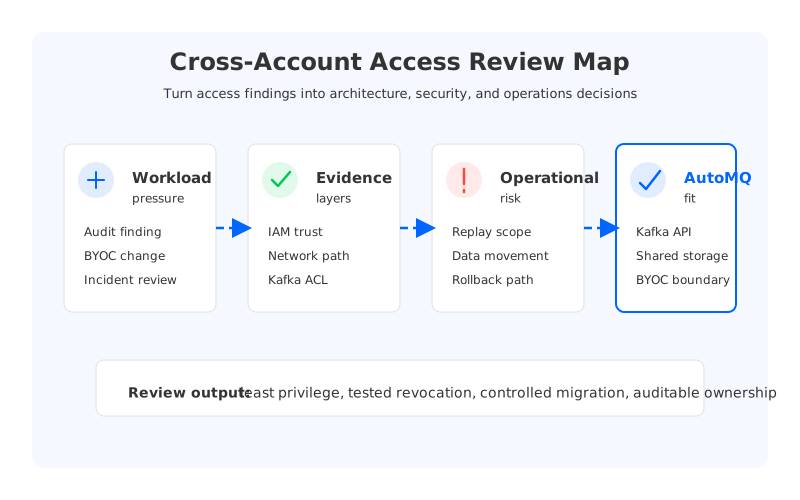
Searches for cross account access review kafka usually come from a specific kind of pressure. A security team has found that data producers, consumers, connectors, observability tools, or platform automation can reach a Kafka environment across account boundaries, and nobody is comfortable signing off on that access from a spreadsheet alone. The streaming platform is a live data plane where identity, network reachability, topic permissions, consumer offsets, connector credentials, and replication paths all interact.
That makes the review harder than a normal IAM cleanup. A principal may have permission to connect but no topic ACL. A connector may write only to one topic but run in a subnet that can reach every broker. A platform pipeline may assume a cross-account role only during deployment, while the application it deploys keeps long-lived credentials in a separate secret store. The review question is not "who has access?" It is "who can move streaming data, under which operational conditions, and what happens when that access is wrong?"
1Why teams search for cross account access review kafka
Kafka access reviews tend to start with one of three triggers. An audit finds that an IAM role, private endpoint, transit route, or service account has broader reach than expected. A platform change consolidates clusters, moves to BYOC, adds managed connectors, or separates security ownership from platform ownership. Or an incident reveals that a leaked credential, compromised CI job, or unexpected consumer group was never reviewed with the same rigor as database access.
In each case, Kafka adds a control-plane/data-plane split that general cloud access review tools do not fully understand. Cloud IAM can tell you which principal can assume a role or reach an endpoint. Kafka ACLs can tell you which identity can read, write, describe, alter, or manage consumer groups. Network policy can tell you which private paths can connect. None of those views alone tells you whether a cross-account producer can publish regulated events into a topic later consumed by a machine learning feature store.
A useful review has to join five layers:
- Cloud identity and trust policy. Which external accounts, roles, users, workloads, or service principals can assume access into the streaming environment?
- Network reachability. Which VPCs, subnets, endpoints, peering links, transit gateways, or private connectivity paths can reach brokers, controllers, schema registries, and connector workers?
- Kafka authorization. Which Kafka principals can operate on topics, groups, transactional IDs, cluster resources, and admin APIs?
- Operational credentials. Which CI jobs, Terraform roles, observability agents, secret managers, and connector runtimes can change or use those identities?
- Data movement semantics. Which access paths can produce records, consume existing records, replay historical data, mirror topics, or commit offsets?
The last layer is the one that often gets missed. A database permission review may separate read and write access, but Kafka permissions also govern replay and ordering. A consumer with group access may be able to reset offsets and reread data from the retention window. A producer with idempotent or transactional behavior may participate in workflows where write permissions affect exactly-once processing guarantees.
2The production constraint behind the problem
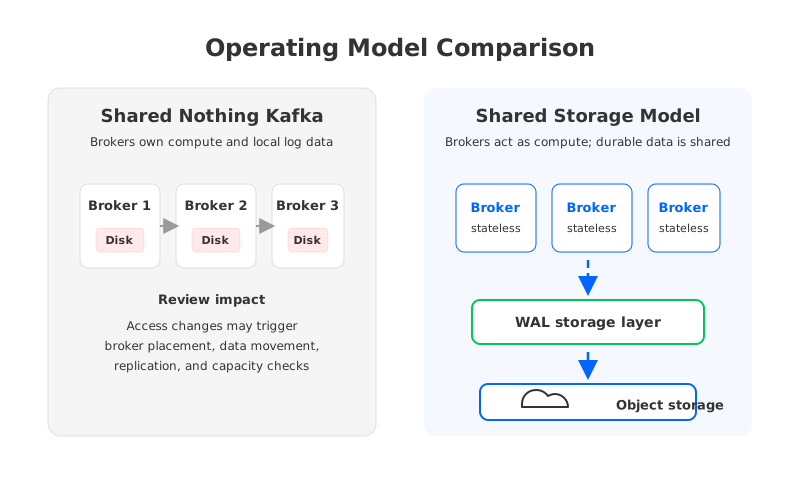
Traditional Kafka was designed around brokers that own local log storage. Each broker stores partitions on attached disks, replication distributes copies across brokers, and clients interact with leaders and followers through well-known Kafka protocol behavior. The operational cost of that model appears during governance work because storage ownership and compute ownership are bound together.
When a cross-account access review finds an exposure, remediation is rarely limited to an IAM edit. You may need to move partitions, change listeners, rotate broker or connector secrets, rebalance client traffic, isolate a VPC path, update ACLs, and confirm that consumer offsets still mean what teams think they mean. In a busy cluster, those changes can overlap with data movement and capacity planning.
The underlying architecture pushes several concerns into the same maintenance window:
- Broker-local data makes topology changes expensive. If a broker or availability zone boundary changes, partition data may have to move before the platform reaches a steady state.
- Replication creates network and review scope. Cross-AZ replication is part of Kafka's durability model, so the review must cover both client access and internal broker-to-broker movement.
- Capacity buffers become security buffers. Teams keep extra broker, disk, and network headroom because governance-driven changes can trigger rebalancing or replay.
- Connectors blur ownership. Kafka Connect workers often sit between cloud accounts and external systems, carrying both infrastructure identity and application-level authority.
None of this means Kafka is unsuitable for regulated environments. It means cross-account review must be treated as a production architecture exercise, not a quarterly permission report. The security question and the operations question are joined at the broker boundary.
3Architecture options and trade-offs
Platform teams usually evaluate four patterns when they try to make cross-account Kafka access reviewable. The first is a centralized shared cluster, where many producer and consumer accounts connect into one platform-owned Kafka environment. This is straightforward to standardize but hard to delegate cleanly. The blast radius of endpoint, ACL, or connector mistakes can be large, and the review must prove that tenant boundaries are enforced by both Kafka authorization and cloud networking.
The second pattern is per-domain or per-business-unit clusters. This narrows blast radius and makes ownership clearer, but it increases operational duplication. Every cluster needs patching, monitoring, quota management, disaster recovery planning, endpoint governance, and cost review.
The third pattern is managed streaming with private connectivity and centralized control-plane policy. This can reduce broker operations, but it does not remove the need to review cloud trust relationships, topic permissions, connector identities, and data residency. The operating model depends heavily on where the control plane runs and what evidence the team can collect during audits.
The fourth pattern is Kafka-compatible shared storage architecture. Durable stream data is separated from broker-local disks and stored through shared cloud storage with a write-ahead log layer. Brokers become closer to stateless compute. The platform still has to govern Kafka identities, topics, consumers, and endpoints, but some operational actions no longer require the same broker-local data movement.
| Evaluation dimension | Shared-nothing Kafka emphasis | Shared-storage Kafka-compatible emphasis |
|---|---|---|
| Access evidence | Join IAM, network, Kafka ACLs, broker placement, and connector state | Join the same control layers, with less broker-local storage ownership to explain |
| Remediation speed | Often constrained by partition movement, disk capacity, and broker balancing | More changes can focus on compute, endpoint, and policy boundaries |
| Cost review | Includes storage replicas, cross-AZ replication traffic, idle capacity, and operations | Shifts more durable storage economics toward object storage and independent scaling |
| Failure recovery | Broker and disk state shape recovery steps | Shared durable storage can reduce dependence on any single broker's local data |
| Migration risk | Mature ecosystem, but cutovers must preserve offsets, clients, and topic behavior | Must prove Kafka compatibility and migration tooling before production adoption |
The practical question is which model gives your organization enough evidence, isolation, and operational room to change access safely.
4Evaluation checklist for platform teams
A cross-account access review becomes manageable when the checklist is framed around actions, not nouns. The goal is to show which principals can take which streaming actions across which boundary, and whether that mapping is intentional.
Start with the data-plane map. Identify every producer, consumer, connector, stream processor, mirror job, observability agent, admin tool, and CI/CD system that can reach Kafka. For each one, record the cloud account, runtime identity, network path, Kafka principal, topic scope, group scope, and owner. This is where many reviews uncover "temporary" bootstrap roles or connector credentials that became permanent infrastructure.
Then classify access by impact:
- Produce access can introduce records into regulated or high-trust topics. Review schemas, topic naming, transactional IDs, and who can create or alter topics.
- Consume access can expose retained historical data. Review group permissions, offset reset paths, replay windows, and downstream sinks.
- Admin access can change the review surface itself. Review topic creation, ACL mutation, config changes, broker or cluster operations, and automation roles.
- Connector access can cross multiple trust domains. Review worker runtime identity, source and sink credentials, plugin supply chain, and dead-letter topics.
- Replication or linking access can duplicate data across environments. Review topic filters, offset handling, encryption, target ownership, and rollback plans.
After that, test the platform's ability to prove negative statements. Can you show that a development account cannot reach production brokers? Can you show that a connector worker cannot assume a role outside its approved sink account? Can you show that a consumer group cannot replay a topic beyond the intended retention boundary? Cloud-native review tooling such as IAM Access Analyzer helps with external access findings at the IAM layer, but it must be paired with Kafka-level and network-level evidence.
The final part of the checklist is operational rehearsal. Pick one high-risk access path and walk through removal. Rotate the credential, revoke the trust policy, close the network path, remove the Kafka ACL, and verify client behavior. Watch consumer lag, error rates, broker load, connector retries, and alert noise.
5How AutoMQ changes the operating model
Once the review reaches broker-local storage, cross-AZ traffic, capacity buffers, and customer account boundaries, architecture becomes part of the governance answer. AutoMQ fits this evaluation category as a Kafka-compatible cloud-native streaming platform built around Shared Storage architecture and stateless brokers. It keeps the Kafka-facing contract while changing the storage layer that makes production changes heavy.
Access review does not disappear. You still need cloud IAM discipline, network segmentation, Kafka ACLs, TLS, secret rotation, connector governance, and observability. What changes is the operational surface behind those controls. With durable stream data backed by shared storage and a WAL layer, broker compute can be treated more independently from the persistent log.
For BYOC-style governance, that distinction is useful. A customer-controlled deployment boundary lets platform and security teams reason about where the data plane runs, which account owns the network, which roles are trusted, and which teams can operate the environment. Shared storage and stateless brokers then reduce the amount of broker-local state that has to be moved or defended during routine operations.
There is still due diligence to do before any production decision. Verify Kafka client compatibility for your producers, consumers, transactions, consumer groups, and connectors. Test how offsets and replay behave during migration. Confirm whether your latency profile fits the selected WAL and storage configuration. A shared-storage Kafka-compatible system earns trust by passing these checks, not by avoiding them.
For teams already doing a cross-account access review, the migration question should be narrow and testable. Choose one representative streaming domain, map every access path, reproduce it in a controlled environment, and compare the remediation workflow between your current platform and the candidate architecture.
6Migration and readiness scorecard
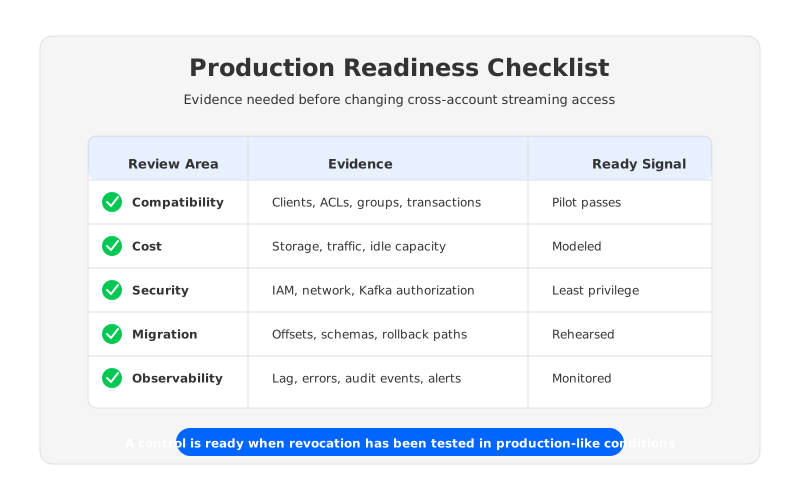
The scorecard below is designed for an architecture review meeting where security, platform engineering, data governance, and application owners are in the same room.
| Area | Questions that need evidence | Ready signal |
|---|---|---|
| Identity | Which cloud roles, service accounts, and Kafka principals can cross the boundary? | Each path has an owner, expiry model, and least-privilege policy |
| Network | Which accounts and subnets can reach brokers, controllers, registry endpoints, and connectors? | Private routes are documented, monitored, and intentionally scoped |
| Kafka semantics | Which topics, groups, transactional IDs, and admin APIs are allowed? | ACLs match data classification and replay expectations |
| Operations | Can access be revoked without unsafe rebalancing or unclear client impact? | Revocation drills have known metrics, alerts, and rollback steps |
| Cost | Does the architecture require idle broker, disk, or network headroom for governance changes? | Cost model includes replication, cross-AZ traffic, retention, and burst capacity |
| Migration | Can clients move while preserving offsets, schemas, and rollback paths? | A pilot proves producer, consumer, connector, and observability behavior |
If your current Kafka environment passes this scorecard, the review can focus on policy cleanup and evidence collection. If it does not, the finding is larger than cross-account access: the streaming data plane is harder to govern than the organization can comfortably operate.
The next step should be a concrete workload review, not a broad platform debate. Map one production stream, identify every cross-account identity and data path, then test how the architecture behaves when one path must be revoked. To evaluate that pattern with Kafka compatibility, customer-controlled deployment boundaries, and shared-storage operations, start with AutoMQ Cloud and bring your access map to the conversation.
7References
- Apache Kafka documentation
- AWS IAM Access Analyzer documentation
- AWS cross-account IAM roles tutorial
- AWS PrivateLink documentation
- AWS Organizations service control policies
- AutoMQ Kafka compatibility
- AutoMQ architecture overview
- AutoMQ BYOC environment documentation
- AutoMQ inter-zone traffic documentation
- AutoMQ migration overview
8FAQ
8.1What is a cross-account access review for Kafka?
It is a review of every identity, network path, Kafka permission, connector credential, and operational automation path that can move streaming data across cloud account boundaries. A strong review covers cloud IAM, Kafka semantics, produce, consume, replay, admin, connector, and replication behavior.
8.2Why is Kafka access review different from normal IAM review?
IAM review can show which cloud principals are trusted, but Kafka data movement depends on broker reachability, Kafka ACLs, topic permissions, consumer group permissions, connector credentials, and offset behavior. A principal may be valid at the cloud layer but unsafe at the streaming layer.
8.3Should every team use separate Kafka clusters to simplify reviews?
Separate clusters can reduce blast radius, but they also multiply operations, cost, monitoring, patching, disaster recovery, and connector management. The better decision depends on data classification, team boundaries, workload scale, and tenant isolation requirements.
8.4How does Shared Storage architecture help governance?
Shared Storage architecture separates durable stream storage from broker-local disks. This does not replace access controls, but it can reduce the operational coupling between security changes and broker-local data movement. That makes remediation workflows more testable.
8.5What should be tested before migrating access-sensitive Kafka workloads?
Test client compatibility, topic and ACL mapping, consumer offset preservation, connector behavior, transaction semantics, private connectivity, observability, rollback, and credential rotation. A migration pilot should include a deliberate access-revocation drill.


