
Table of Contents
Table of Contents
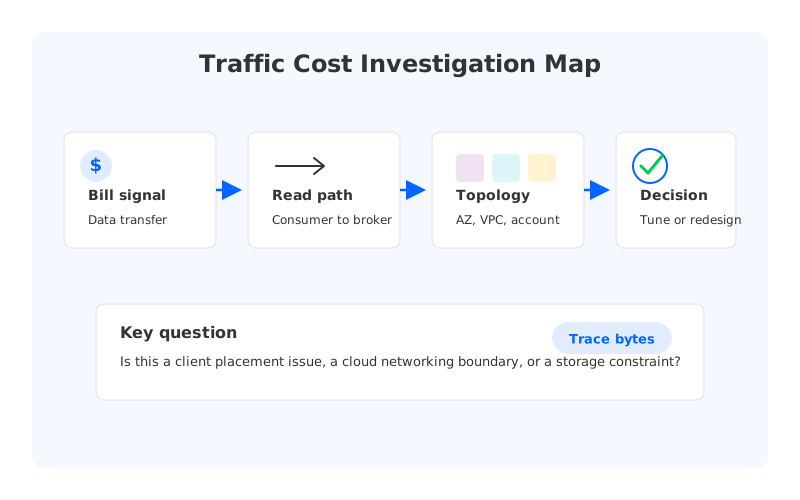
Teams searching for traffic costs Amazon MSK are usually past the first round of Kafka adoption. The cluster works, producers are writing, consumers are reading, and the AWS bill has started to expose a harder question: which data paths are part of the Kafka platform, and which paths are really cloud networking decisions wearing a Kafka label? That distinction matters because Amazon MSK abstracts broker operations, but it does not make every surrounding network boundary disappear.
The quick answer is to look for a tuning flag. Rack awareness, client placement, and nearest-replica reads can absolutely reduce unnecessary cross-AZ consumer traffic when the workload and deployment model support them. The stronger answer is to map the read path first. A consumer request may stay inside one Availability Zone, cross to a remote broker, traverse PrivateLink, reach another VPC, or participate in a replay that looks nothing like normal tailing traffic.
1Why MSK Traffic Costs Start With Read Paths
Amazon MSK runs Apache Kafka for you, but the Kafka protocol still has clients, leaders, followers, partitions, consumer groups, and topology-sensitive routing. AWS states that data transfer for in-cluster broker replication is included at no additional charge for MSK provisioned clusters, while data transferred in and out of a cluster follows standard AWS data transfer pricing rules. That makes consumer reads a practical place to start: they are visible to application teams, often distributed across zones, and sensitive to client placement.
Kafka itself gives operators a vocabulary for this problem. Broker rack awareness spreads replicas across failure domains. Consumer client.rack can tell the broker where the client is located. With follower fetching, a consumer can read from a closer replica instead of always reading from the partition leader when the broker-side replica selector is configured for that behavior. None of these mechanisms are magic; they work when the application runtime, broker metadata, and network topology agree.
The cost question therefore has two layers. First, can the current MSK deployment route steady-state reads to a same-AZ replica? Second, does that optimization still hold during rebalances, failovers, added consumer deployments, and replay-heavy incident recovery? A design that only works during a calm dashboard demo may still leak money when the platform is under pressure.
2The Four Inputs Most Cost Reviews Miss
Cost reviews often begin with broker instance type, storage volume, and hourly service pricing. Those are important, but read-path waste usually comes from workload shape. The platform team needs enough detail to model where bytes move, not only how many bytes the cluster stores.
- Consumer location. A consumer group running on EC2, EKS, ECS, Lambda, or another account can have a different network path to the same MSK broker fleet. The placement pattern matters as much as the application name.
- Read style. Tailing consumers, bursty analytics readers, backfill jobs, and incident replays stress different parts of the path. A daily replay can create a cost pattern that does not show up in average throughput.
- Replica routing.
client.rackonly helps when client rack values match broker rack metadata and the broker can serve the requested data from an appropriate replica. Mislabel one layer and the optimization becomes fragile. - Connectivity boundary. Same-VPC access, peering, transit gateways, PrivateLink, cross-account paths, and cross-region replication all have different billing and governance implications.
These inputs are not paperwork. They decide whether the right action is a client configuration fix, a Kubernetes scheduling change, a network architecture change, or a broader streaming platform review. Treating every unexpected line item as an MSK pricing problem can send the team into the wrong backlog.
3A Practical Read-Path Worksheet
Start by separating normal tailing reads from exceptional reads. A steady consumer group can often be placed and configured carefully. A replay job launched by an analytics team may not follow the same topology discipline. Both workloads use Kafka consumers, but they create different operational risk.
| Question | Why it matters | Evidence to collect |
|---|---|---|
| Are consumers scheduled in the same AZs as brokers? | Same-region does not always mean same-zone. | Runtime node labels, subnet mappings, broker endpoints |
Is client.rack set consistently? | Nearest-replica fetching depends on correct client topology metadata. | Consumer configs, deployment templates, broker rack labels |
| Do replay jobs use the same placement rules? | Recovery and analytics reads can dwarf steady-state traffic. | Job definitions, incident runbooks, historical replay windows |
| Which paths leave the MSK cluster boundary? | Data in and out of MSK follows AWS transfer rules. | VPC diagrams, account boundaries, PrivateLink and peering routes |
| What happens during leader movement or AZ impairment? | The optimized path may change during the exact moment traffic spikes. | Failure drills, rebalance logs, CloudWatch network metrics |
The table is intentionally boring. Good cost engineering usually is. It turns a vague complaint into a testable set of paths: consumer to broker, broker to consumer, consumer to downstream system, replay source to consumer runtime, and operational failover path.
4Architecture Choices That Change the Cost Curve
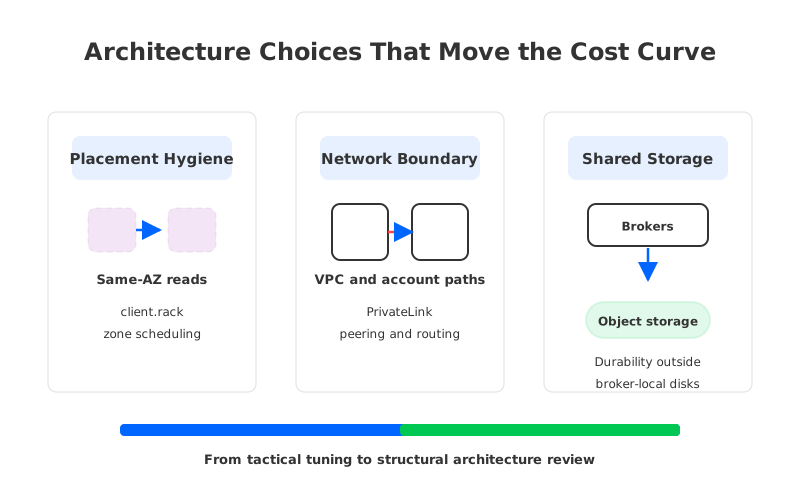
Once the paths are visible, the team can compare options without turning the conversation into a vendor debate. There are three broad categories of action, and they solve different problems.
The first category is placement hygiene. Keep consumers close to the replicas they read, set rack metadata correctly, use zone-aware scheduling for Kubernetes workloads, and review any client that bypasses the intended subnet or endpoint. This is the lowest-disruption path and often the right first move for MSK teams. It does require discipline, because every additional deployment template can reintroduce topology drift.
The second category is network boundary redesign. Some costs are not caused by Kafka replica selection at all. If consumers live in another VPC or account, if a security model pushes traffic through centralized inspection, or if downstream sinks sit across a paid boundary, client rack awareness will not erase the full bill. In that case the architecture review belongs to the cloud networking and platform teams together.
The third category is storage architecture review. Traditional Kafka binds durable log data to broker-local storage and uses broker replicas as part of the durability and availability model. Managed Kafka services can remove much of the operational burden, but the underlying data path still influences scaling, recovery, and network behavior. A Kafka-compatible system built on shared object storage changes that premise by moving durable data out of broker-local disks and letting brokers behave more like stateless compute.
This is where the evaluation becomes more strategic. If the main pain is a few misconfigured consumers, fix the consumers. If the main pain is that every growth, recovery, and placement decision reopens the same cross-zone routing debate, the team should evaluate whether the streaming storage architecture is forcing too much topology work onto application owners.
5Where AutoMQ Fits The Evaluation
AutoMQ is a Kafka-compatible cloud-native streaming platform that separates compute from storage and stores durable stream data on object storage. In this architecture, brokers are not the long-term owners of local log replicas in the traditional sense, and AutoMQ documents a Zero Cross-AZ Traffic design for relevant deployment patterns. That matters for MSK teams because the most expensive problems are often not individual misroutes; they are recurring design constraints created by tying durability, storage placement, and broker lifecycle together.
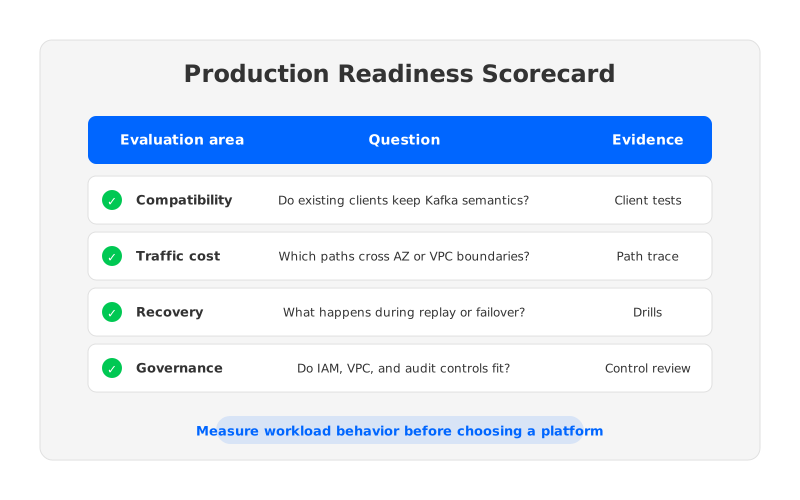
The right way to evaluate AutoMQ is not to ask whether it replaces every MSK tuning practice. It should be tested against the same read-path worksheet:
- Does the platform preserve Kafka protocol compatibility for existing producers, consumers, Kafka Connect jobs, and stream processors?
- Which traffic paths remain local, which paths use object storage, and which paths still depend on client placement?
- How does the system behave during broker replacement, scale-out, leader movement, and replay-heavy recovery?
- Can the team keep its current AWS account, VPC, IAM, encryption, and observability controls in a BYOC or software deployment model?
Those questions keep the discussion grounded. A shared-storage Kafka-compatible architecture can reduce the amount of cross-AZ traffic caused by traditional broker-local replication patterns, but client-side topology still deserves validation. A consumer deployed in the wrong place can still create a bad path to another system. Architecture removes a class of problems; it does not remove the need to measure.
6A Migration-Safe Decision Framework
The safest migration discussions start with reversibility. MSK teams are rarely short on technical curiosity; they are short on permission to risk production streams. Any alternative should therefore be evaluated through the workloads that create the bill and the controls that protect the business.
Begin with one high-signal consumer group. Pick a workload that is expensive enough to matter but bounded enough to test. Record the current path, throughput, replay behavior, consumer lag profile, and failure expectations. Then run the same workload through the candidate architecture and compare the result against the same questions, not against a generic benchmark.
Procurement and FinOps teams should also avoid compressing the model into a single $/GB number. Kafka cost is a composition of broker capacity, storage retention, network transfer, operational labor, and migration risk. A lower visible service price can be erased by replay traffic or by over-provisioning. A higher-looking platform line can be warranted if it removes recurring network paths and shortens recovery operations. The spreadsheet should show the mechanism, not only the total.
For platform owners, the most useful output is a decision record with three answers:
- Which traffic paths are accepted as normal and budgeted?
- Which paths should be eliminated through configuration or placement?
- Which paths are structural enough to warrant an architecture change?
That record prevents the same debate from repeating every quarter. It also gives application teams a clearer contract: where to run consumers, which templates to use, how to request replay capacity, and when a workload needs a platform review before launch.
7When Tuning Is Enough, And When It Is Not
MSK remains a strong option for many Kafka teams, especially when the organization wants a managed AWS-native service and the workload fits established Kafka operating patterns. Rack-aware reads are a practical optimization, not a workaround. For stable workloads with disciplined deployment topology, they can reduce avoidable cross-AZ consumer traffic while keeping the existing platform model intact.
The warning sign is repetition. If every added consumer group needs a topology review, every replay creates a cost exception, and every broker or subnet change triggers another round of placement debugging, the team is no longer solving a one-time configuration gap. It is operating a storage and network model that requires continuous human alignment across Kafka, Kubernetes, AWS networking, and FinOps.
That is the moment to compare architectures. Not because MSK is wrong, and not because every team needs to migrate. The reason is more practical: traffic cost is a symptom that exposes how the streaming platform uses cloud infrastructure. Once that symptom becomes structural, a platform team needs options beyond tuning the current path.
If your team is mapping MSK read paths and wants to compare them against a Kafka-compatible shared-storage design, review AutoMQ's documented Zero Cross-AZ Traffic architecture. Use it as a technical checklist: trace producer writes, consumer reads, replay behavior, broker replacement, and failure drills before deciding whether the architecture fits your workload.
8References
- Amazon MSK pricing: https://aws.amazon.com/msk/pricing/
- Amazon EC2 On-Demand Pricing, Data Transfer section: https://aws.amazon.com/ec2/pricing/on-demand/#Data_Transfer
- AWS Big Data Blog, reducing network traffic costs for Amazon MSK consumers with rack awareness: https://aws.amazon.com/blogs/big-data/reduce-network-traffic-costs-of-your-amazon-msk-consumers-with-rack-awareness/
- Apache Kafka consumer configuration
client.rack: https://kafka.apache.org/documentation/#consumerconfigs_client.rack - Apache Kafka KIP-392, Allow consumers to fetch from closest replica: https://cwiki.apache.org/confluence/display/KAFKA/KIP-392%3A+Allow+consumers+to+fetch+from+closest+replica
- AutoMQ Zero Cross-AZ Traffic overview: https://docs.automq.com/automq-cloud/eliminate-inter-zone-traffics/overview?utm_source=blog&utm_medium=reference&utm_campaign=gs100-0093
9FAQ
9.1Does Amazon MSK charge for broker-to-broker replication traffic inside a cluster?
AWS states that data transfer for in-cluster broker replication is included at no additional charge for MSK provisioned clusters. That does not mean all network movement around MSK is free. Data transferred in and out of a cluster can still follow standard AWS data transfer pricing depending on topology.
9.2What is the most common cause of avoidable MSK read traffic cost?
The common pattern is a consumer reading from a broker or replica outside its local Availability Zone when a local path could have been used. This can happen because clients lack correct rack metadata, workloads are scheduled without zone awareness, or replay jobs are launched outside the normal placement model.
9.3Is client.rack enough to solve MSK traffic costs?
It can help with a specific class of consumer read traffic when the broker and client configuration support nearest-replica fetching. It does not solve costs created by cross-VPC connectivity, downstream sinks, PrivateLink, cross-region movement, or application deployments that ignore topology.
9.4When should an MSK team evaluate a Kafka-compatible alternative?
Evaluate alternatives when traffic-cost work keeps recurring across teams and workloads. If the main issue is a few missing client settings, tune the current deployment. If the platform repeatedly spends engineering time on storage placement, cross-zone paths, broker lifecycle, and replay cost controls, architecture deserves a review.
9.5How is AutoMQ relevant to this discussion?
AutoMQ uses a Kafka-compatible API with a cloud-native shared-storage architecture backed by object storage. Its documented Zero Cross-AZ Traffic design is relevant when teams want to reduce structural cross-AZ traffic created by traditional broker-local storage and replication patterns, while still validating client placement and workload behavior.


