
Table of Contents
Table of Contents
Teams usually search for cross az replication spend kafka after the bill stops matching the capacity plan. The Kafka cluster did what it was designed to do: it stayed available across Availability Zones (AZs), replicated data to followers, and served multiple consumer groups. The uncomfortable part is that cloud billing treats those replication and read paths as metered network movement, not as an abstract reliability feature. When write throughput, retention, and consumer fan-out grow together, the line item can become a platform decision rather than a small networking detail.
That is why cross-AZ spend deserves its own model before a Kafka platform scales. A production Kafka plan needs to explain how bytes move between AZs, which traffic is structural, which traffic can be reduced by client placement, and which traffic comes from the storage architecture itself. The useful question is sharper than "How do we make Kafka lower cost?": which cost drivers come from workload demand, and which come from the way the platform stores durable log data?
1Why teams search for cross az replication spend kafka
The search intent is usually practical. A FinOps analyst sees data transfer charges rising faster than broker count. A platform team adds topics and discovers that the network bill grew even though CPU remained calm. An SRE enables more consumer groups and learns that read fan-out changes the network shape. A procurement team compares managed Kafka, self-managed Kafka, and Kafka-compatible alternatives, but the quotes do not expose the same cost categories.
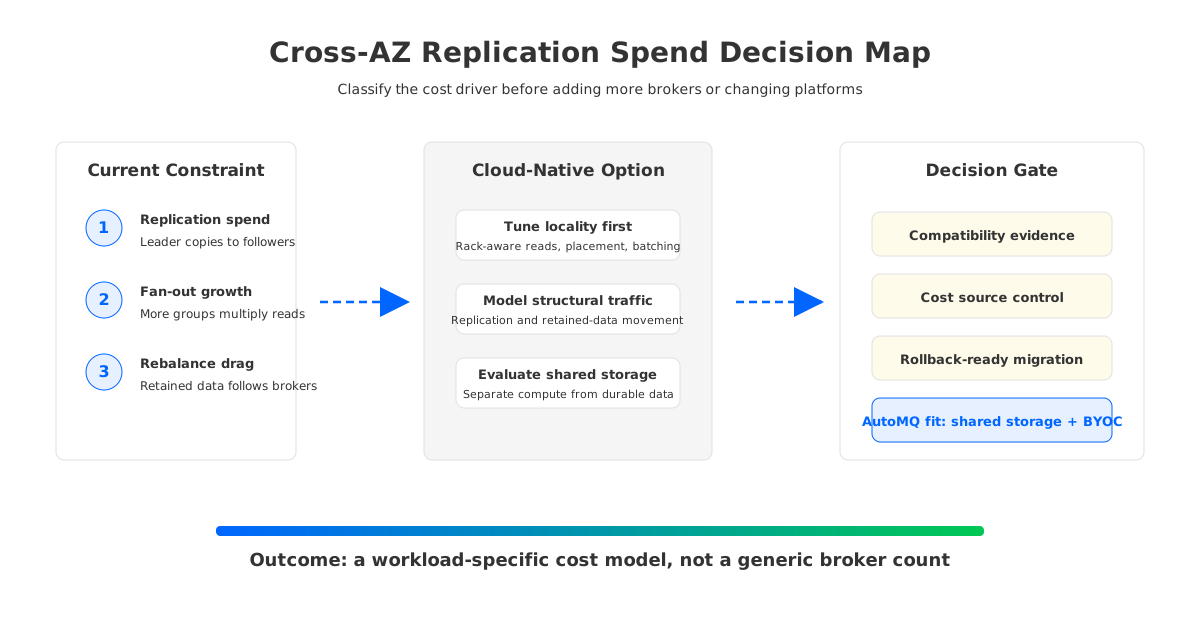
Three traffic paths should be separated in the first worksheet:
- Producer-to-leader traffic. In a multi-AZ client deployment, a Producer may send records to a partition leader in another AZ unless client locality and broker routing are handled carefully.
- Leader-to-follower replication. With a replication factor of three, the leader commonly replicates each accepted record to two followers. If followers are placed in other AZs for availability, the durability path becomes a cross-AZ network path.
- Consumer read traffic. Consumer groups can multiply traffic because each group has its own read workload. Rack-aware consumption and follower fetching can reduce avoidable movement, but every group still needs to be modeled.
These paths are easy to blur because Kafka exposes a clean topic and partition abstraction. Applications see offsets and Consumer groups; cloud invoices see bytes transferred across network boundaries. Apache Kafka's documentation is the starting point for the semantics that tuning or migration must preserve.
2The production constraint behind the problem
Traditional Kafka uses a Shared Nothing architecture. Each Broker owns local log segments for the partitions it hosts, and replicas are maintained through broker-to-broker replication. That architecture is durable and familiar, but it binds compute sizing, local storage sizing, replica placement, and rebalance time together. In the cloud, that coupling touches priced services: compute, block storage, inter-AZ transfer, and operational time.
Replication spend is driven by the write path, not by a one-time migration event. If a topic receives a steady stream of records, the cluster continuously moves replica bytes to maintain availability. Compression, batching, and cleanup help, but they do not change the durability mechanism. A team can reduce waste around the edges and still face a structural cost floor whenever the leader copies data to followers across AZ boundaries.
Retained data is operational state. Broker replacement, partition reassignment, storage expansion, and workload skew all force the platform to care where durable bytes live. Large clusters can spend hours moving data during rebalances or maintenance windows because the durable log is attached to broker-local storage. That delay forces teams to keep extra headroom and slows cost right-sizing.
Cloud bills show data transfer and storage charges, but they rarely say which topic, Consumer group, or client path created them. Platform teams need Kafka metrics, client placement data, cloud cost allocation, and network topology in the same review. Without that join, cost optimization becomes guesswork.
3Architecture options and trade-offs
Start with options that preserve the existing architecture. Client rack awareness can help consumers read from nearby replicas when clients and Brokers are placed consistently. Better partition placement can reduce skew. Producer batching and compression reduce bytes written. Retention policies limit storage growth. These controls improve the baseline and show where the workload is actually expensive.
The limit appears when the main cost is not accidental traffic. If replication between broker-local replicas dominates, the workload is paying for the durability model itself. Tiered Storage moves older log segments to object storage, but recent data and inter-broker replication remain part of the broker-local design. Managed Kafka can reduce operational toil while preserving the same stateful broker economics.
The architectural alternative is Shared Storage architecture. Durable stream data is stored in shared object storage, while Brokers focus on Kafka protocol handling, leadership, caching, request routing, and coordination. The design still needs a WAL (Write-Ahead Log) path, metadata, and cache behavior that meet workload latency and recovery requirements. The shift is that durable partition history is no longer permanently owned by one Broker's disk.
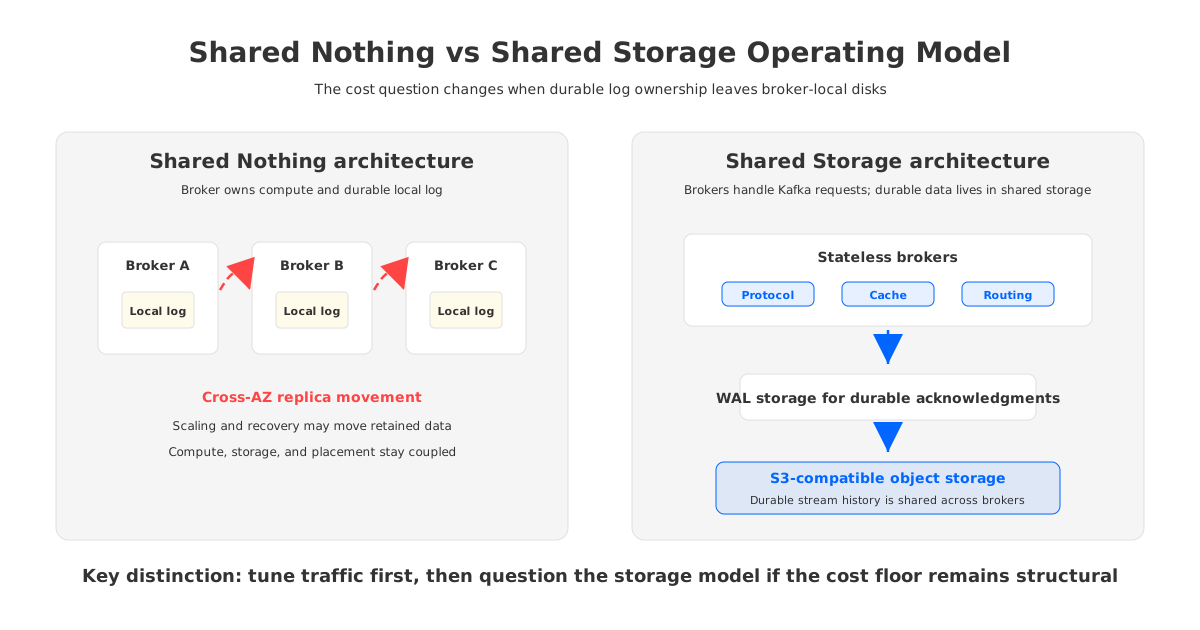
That shift changes the trade-off table:
| Evaluation area | Broker-local Kafka model | Shared Storage architecture |
|---|---|---|
| Durability path | Broker replicas and ISR across Brokers | Object storage durability plus WAL design |
| Scaling unit | Broker compute and local durable storage together | Broker compute can scale separately from durable storage |
| Cross-AZ replication | Usually structural in multi-AZ replication | Avoided when shared storage and locality routing are designed for it |
| Reassignment cost | Can require data movement between Brokers | More metadata and ownership movement than log-copy movement |
| Main validation work | Disk, network, reassignment, and replica health | Object storage, WAL, cache, metadata, and client locality |
The table is not a verdict that every workload should move. A small cluster with stable traffic, short retention, and low fan-out may get enough benefit from tuning. A high-throughput platform with multi-AZ availability, long retention, many consumer groups, or frequent scaling events should evaluate whether the storage model is now the main cost driver.
4Evaluation checklist for platform teams
A useful cross-AZ replication spend model has two layers: a traffic model and a decision model. The traffic model estimates how bytes move. The decision model explains which levers can change without breaking reliability, governance, or migration commitments. Mixing those layers leads to bad recommendations, such as reducing replication factor when the real need is architecture-level cost control.
Use this checklist before expanding a production Kafka footprint:
- Map placement before pricing. Document where Producers, Brokers, Consumers, connectors, object storage, and downstream systems run. Region and AZ placement should be visible before any per-GB price is added.
- Split structural traffic from avoidable traffic. Replication for durability, producer cross-AZ writes, consumer cross-AZ reads, connector egress, and NAT or endpoint paths need separate rows.
- Model workload growth by driver. Write throughput, message size, replication factor, retention, consumer group count, replay frequency, and cross-region mirroring do not grow at the same rate.
- Attach each number to a source. Use official cloud pricing pages for network and object storage assumptions, and record the region and access date. Use Kafka metrics for throughput and read fan-out.
- Define what cannot change. Some teams cannot weaken availability, move data outside a cloud account, change client libraries, or accept long cutover windows. Those constraints should be stated before product selection.
- Run a rollback-aware proof of concept. A cost model is incomplete if it does not include cutover, offset continuity, monitoring, rollback, and application-owner validation.
The decision model should also ask who owns each boundary. Security teams care where data lives. SREs care who answers the page when object storage throttles or consumer lag rises. FinOps cares whether infrastructure cost can be attributed to clusters, topics, teams, and environments. Architects care whether Kafka APIs, transactions, Consumer groups, Kafka Connect, and client compatibility remain intact.
5How AutoMQ changes the operating model
Once the evaluation reaches storage architecture, AutoMQ becomes relevant as a Kafka-compatible streaming platform built around Shared Storage architecture. It preserves Kafka protocol compatibility while replacing broker-local durable log storage with S3Stream, WAL storage, and S3-compatible object storage. In this model, AutoMQ Brokers are stateless brokers for durable data ownership: they handle Kafka requests and runtime responsibilities, but durable stream history is not anchored to broker-local disks.
That matters for cross-AZ replication spend because the question changes from "how many times must Brokers copy data to each other?" to "how does the platform keep client paths local while using shared storage for durability?" AutoMQ documentation describes Zero cross-AZ traffic capabilities for supported multi-AZ deployments, including elimination of server-side replica replication traffic and routing patterns for producer and consumer locality. The exact result still depends on cloud provider, AZ balance, client configuration, and WAL choice, so teams should verify it in their own account.
AutoMQ also changes scaling work. Because durable data is in shared storage, adding or replacing Brokers is less about copying retained log segments and more about assigning ownership, warming cache, and serving traffic. Self-Balancing and Auto Scaling can operate on compute pressure without making every change a data relocation project. That distinction is important for cost governance: if compute can scale independently from durable storage, headroom becomes easier to challenge during capacity review.
The deployment boundary is part of the value proposition. AutoMQ BYOC places the control plane and data plane in the customer's cloud account or VPC boundary, while AutoMQ Software supports private environment deployment. For regulated teams, the cost and security review can include cloud resources, IAM controls, buckets, network paths, metrics, and audit trails under the organization's governance model.
AutoMQ is not a shortcut around Kafka design discipline. Topic count, partition strategy, client configuration, schema evolution, Consumer group behavior, transactions, monitoring, and rollback planning still matter. The difference is that the expensive parts of the operating model can move away from broker-local durability and cross-AZ replica copying toward shared storage, locality-aware traffic, and independently scalable compute.
6A readiness scorecard for the next scaling decision
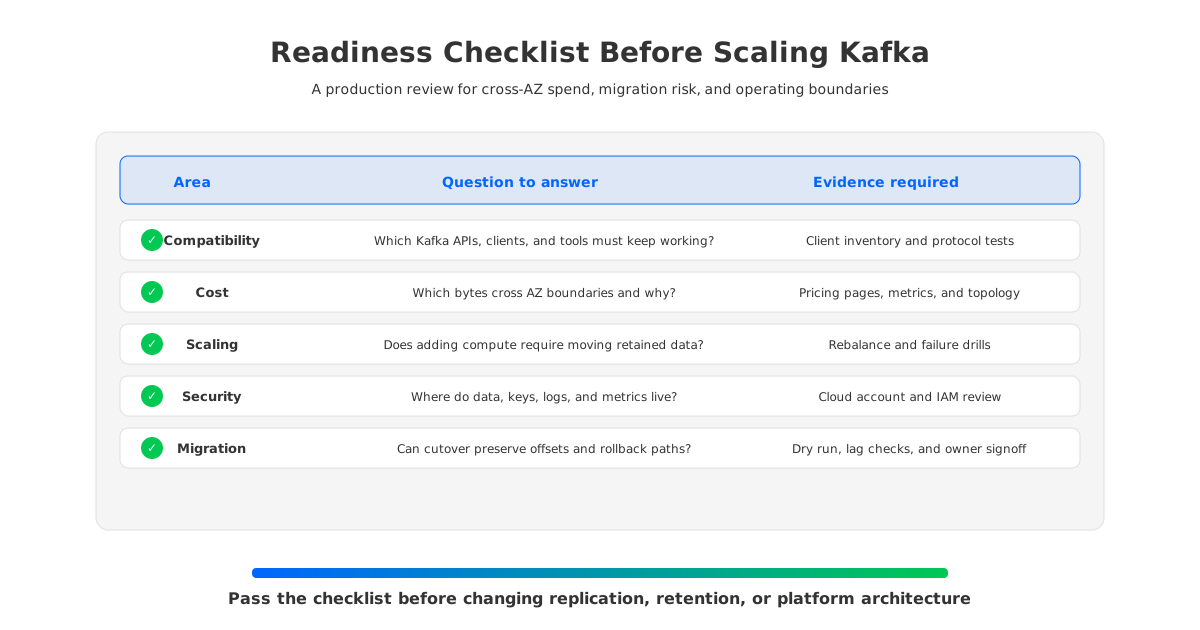
Before approving the next expansion, score the workload against five questions. If most answers are unclear, the team is still missing the baseline.
| Question | Ready signal | Risk signal |
|---|---|---|
| Do we know which Kafka paths create cross-AZ traffic? | Producer, replication, consumer, connector, and endpoint paths are separated | Data transfer is visible only as an account-level charge |
| Can we preserve Kafka semantics during change? | Client versions, offsets, transactions, and Consumer groups are inventoried | Migration plan assumes compatibility without testing |
| Is the cost model tied to official pricing? | Region, service, and date are recorded for each pricing input | Spreadsheet uses inherited or undocumented rates |
| Can we observe the target architecture? | Broker, client, WAL, object storage, cache, and cost signals have owners | Dashboards show CPU and lag but not storage or network drivers |
| Is rollback credible? | Producer cutover, consumer offset validation, and rollback windows are rehearsed | Cutover plan is one-way and depends on manual recovery |
The scorecard keeps the conversation honest. Cross-AZ replication spend is not a single knob, and Kafka cost optimization is not a single migration. It is a set of workload paths, architecture choices, and governance constraints that must be visible before scaling makes them more expensive.
If your next Kafka capacity review is already centered on cross-AZ replication spend, evaluate the architecture before adding more Brokers. Start with the traffic model, validate the constraints, and test whether shared storage changes the cost floor for your workload. To scope an AutoMQ evaluation in your own cloud boundary, use the BYOC path at go.automq.com/home.
7FAQ
7.1What is cross-AZ replication spend in Kafka?
It is the cloud network cost created when Kafka data moves across Availability Zones. The largest structural component is often leader-to-follower replication in a multi-AZ cluster, but producer placement, consumer reads, connectors, and endpoint design can also contribute.
7.2Can Kafka client rack awareness remove all cross-AZ spend?
No. Rack-aware consumer placement can reduce avoidable read traffic, and careful client placement can help producer paths. It does not remove the need for broker-to-broker replication when durable data is stored in broker-local replicas.
7.3Does Tiered Storage eliminate cross-AZ replication traffic?
Tiered Storage can reduce the amount of historical data kept on broker disks, but it does not turn Brokers into stateless compute nodes. Recent data and replication for active partitions still need to be evaluated in the broker-local architecture.
7.4When should teams evaluate Shared Storage architecture?
Evaluate it when cross-AZ replication, retained data movement, long rebalance windows, or storage-coupled scaling dominate the Kafka operating model. The strongest candidates usually have high write throughput, multi-AZ availability, long retention, frequent scaling, or many consumer groups.
7.5How should a proof of concept measure success?
Measure Kafka compatibility, producer latency, Consumer group behavior, offset continuity, failure recovery, object storage behavior, WAL metrics, cache effectiveness, network paths, and cost attribution. A successful proof of concept should explain both performance and cloud bill movement.


