
Table of Contents
Table of Contents
Someone searching kafka cross az traffic cost is usually past the first Kafka bill review. The cluster already works. The replication factor is defensible. The multi-Availability-Zone layout is there for availability, not decoration. Then a FinOps report shows that traffic moving between zones has become large enough to affect architecture decisions, and the team has to explain whether that spend is waste, resilience, or both.
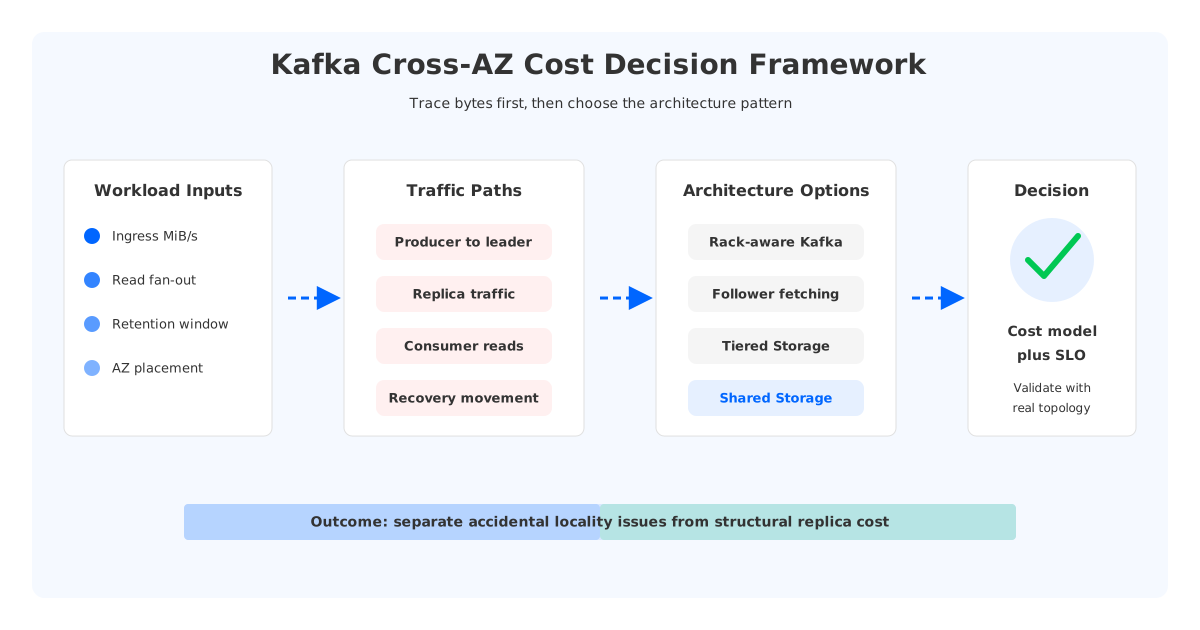
The hard part is that cross-AZ traffic is not one data path. In a production Kafka deployment, the bill can include producer traffic to a remote leader, follower replication, consumer reads from a non-local broker, connector traffic, recovery copies, and operational backfills. Some of those paths are necessary in a broker-local replica model. Others are placement mistakes. Treating them all as one line item leads to weak fixes, such as moving clients around while ignoring broker-to-broker replication, or changing broker sizes while leaving the same bytes crossing the same zone boundary.
The useful question is more specific: which bytes cross an Availability Zone boundary because of workload placement, and which bytes cross because of the storage architecture? That distinction gives platform, SRE, and FinOps teams a way to compare tuning, rack-aware Kafka patterns, Tiered Storage, managed services, and Kafka-compatible Shared Storage architecture without turning the discussion into a vendor checklist.
1Why kafka cross az traffic cost matters now
Kafka's reliability model was designed around replica placement. A partition has a leader, followers replicate from that leader, and producers and consumers interact with the partition through brokers. In a three-AZ cloud deployment with replication factor 3, operators often spread replicas across zones so the cluster can tolerate a zone failure. That topology is sensible. It also means the write path can copy records across zone boundaries as part of normal operation.
Cloud billing makes that topology visible. AWS publishes data transfer pricing for EC2 traffic, including paths between Availability Zones in the same Region. Google Cloud documents pricing for inter-zone VM-to-VM data transfer. Azure, AWS, GCP, and other providers each have service-specific rules, regional differences, and exceptions. The exact price must be checked against the current provider page for the target Region, but the engineering pattern is stable: when Kafka makes durability by copying broker-owned data across zones, network locality becomes a cost control.
That does not mean every multi-AZ Kafka cluster is poorly designed. It means the cost model has to follow the data path rather than the service name. A simple model starts with four variables:
- Ingress volume: sustained MiB/s written by producers, including peak periods and batch jobs.
- Replication behavior: replication factor, leader placement, ISR (In-Sync Replicas), and whether replicas live in different zones.
- Read fan-out: number of consumer groups, local versus remote reads, replay volume, and connector placement.
- Operational movement: reassignment, broker replacement, backfills, disaster recovery, and catch-up reads.
Those variables interact. A write-heavy workload with low read fan-out may be dominated by follower replication. A consumer-heavy workload may pay more for non-local reads than for writes. A long-retention workload may look quiet day to day, then create a large network event during recovery or reassignment. Cross-AZ spend becomes painful when the architecture creates a multiplier that grows with the workload.
2The production constraints behind the search
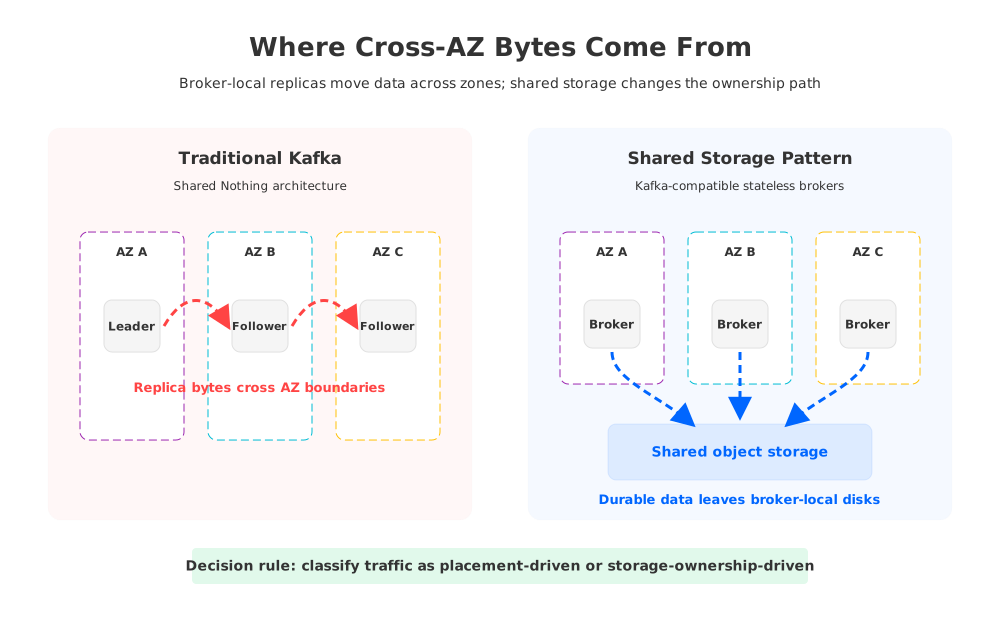
Traditional Kafka uses a Shared Nothing architecture: each broker owns local storage, and durability comes from replicas distributed across brokers. This model is proven and operationally familiar, but it binds compute, storage, and network movement together. A broker is not only CPU and memory; it is also the owner of retained log segments, a participant in ISR replication, and a potential source or destination for reassignment traffic.
That binding is why cross-AZ cost is more than a routing issue. Client placement can reduce some paths, but broker-local replication remains part of the write durability model. Tiered Storage can reduce pressure from historical data on local disks, but the active write path and recent data still depend on broker-owned storage. Larger brokers can reduce node count, but they can also create larger failure domains and heavier recovery events.
The right mitigation depends on which path is dominant:
| Traffic path | Why it appears | Typical control |
|---|---|---|
| Producer to remote leader | Producers run in one AZ while the partition leader is in another | Client placement, partitioning strategy, rack-aware routing, or locality-aware proxying |
| Leader to follower replicas | Replicas are intentionally placed across AZs for availability | Replication-factor review, shared-storage architecture, or accepting the cost as resilience spend |
| Consumer from remote broker | Consumers read from leaders or replicas outside their AZ | client.rack, follower fetching where supported, consumer placement, or read locality design |
| Connector and processing traffic | Kafka Connect, Flink, Spark, or sinks run outside the Kafka AZ footprint | Co-locate workers, use private networking deliberately, and model egress paths |
| Reassignment and recovery | Broker changes require partition data movement | Reduce reassignment churn, automate placement, or use an architecture where brokers do not own durable data |
This table is deliberately not a product comparison. It is a diagnostic map. If the largest line is producer-to-leader traffic, locality controls may pay back quickly. If the largest line is replica traffic, the team is looking at a durability architecture question. If the largest line appears during recovery, the issue may be operational elasticity rather than steady-state throughput.
3Architecture patterns teams usually compare
The first pattern is to tune the existing Kafka cluster. This is often the right starting point because it separates accidental traffic from structural traffic. Check whether producers and consumers are spread evenly across zones, whether client.rack is configured for consumers, whether partition leaders are skewed, whether connectors sit in a different network boundary, and whether any backfill jobs bypass the locality assumptions used for normal traffic. These fixes preserve the current platform and can remove surprisingly expensive mistakes.
The second pattern is to use rack-aware Kafka design more intentionally. Apache Kafka documents rack awareness for replica placement, and consumer configuration includes client.rack so consumers can prefer nearby replicas when the cluster supports follower fetching. This can reduce cross-zone consumer traffic while preserving fault isolation. It does not remove leader-to-follower replication, so the benefit depends on read fan-out and client placement.
The third pattern is Tiered Storage. Tiered Storage is useful when long retention forces large local disks and expensive replays. It moves older log segments to remote storage while keeping recent data and the active write path broker-local. That can improve storage economics and replay behavior, but it should not be confused with stateless brokers. The cluster still has broker-owned active data, leader placement, and ISR replication in the hot path.
The fourth pattern is to move to a Kafka-compatible Shared Storage architecture. In this model, durable stream data lives in shared object storage, and brokers focus on Kafka protocol handling, caching, coordination, and traffic serving. The architecture changes the cross-AZ conversation because brokers no longer have to maintain multiple long-lived local replicas of the same partition data. The evaluation then shifts from "how many replica bytes cross zones?" to "how does the system preserve Kafka semantics, write latency, read locality, object-storage durability, and migration safety?"
4Evaluation checklist for platform teams
A good evaluation starts with evidence. Pull network metrics by source, destination, AZ, and service where possible. Separate steady-state traffic from operational events. Normalize all numbers into logical bytes written, bytes replicated, bytes read, and bytes moved during maintenance. Then compare architecture choices against the same workload instead of using a generic benchmark from another team.
Use the checklist below before changing topology or platform:
- Workload shape: Measure sustained write throughput, peak write throughput, read fan-out, replay frequency, and retention. Cross-AZ cost is often a multiplier on throughput, so averages can hide peak-driven spend.
- Locality map: Draw where producers, brokers, consumers, connectors, stream processors, and sinks run. A missing worker placement detail can invalidate a pricing model.
- Durability requirement: Confirm which failure domains the business needs to survive. Reducing replica movement is not useful if it weakens the availability target.
- Protocol behavior: Validate Kafka client compatibility, idempotent producers, transactions, consumer groups, offsets, ACLs, Schema Registry dependencies, and Connectors.
- Migration path: Define dual-write, mirroring, cutover, rollback, and observability before the final pricing comparison. Network savings do not compensate for an uncontrolled migration.
- Provider pricing: Verify current cloud data transfer, object storage, request, private connectivity, and managed-service pricing for the exact Region and account model.
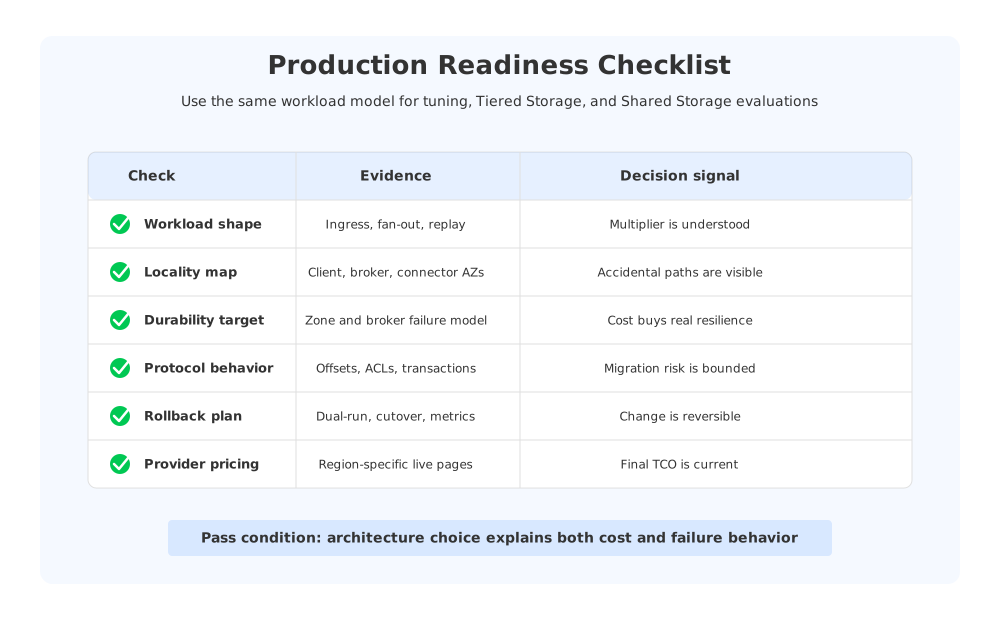
The important discipline is to avoid treating cross-AZ traffic as purely a cloud bill artifact. It is a symptom of how the streaming platform assigns ownership. If the same brokers own compute, hot storage, durable replicas, and recovery, then network cost follows those ownership rules. If durable data is moved out of broker-local disks, the cost model changes, but the team must inspect the resulting write path with the same rigor.
5Where AutoMQ changes the operating model
Once the evaluation reaches the storage-ownership layer, AutoMQ becomes relevant as a Kafka-compatible cloud-native streaming platform built around Shared Storage architecture. AutoMQ keeps the Kafka protocol and ecosystem surface while replacing broker-local log storage with S3Stream, a streaming storage layer that uses WAL (Write-Ahead Log) storage and S3-compatible object storage. In that design, AutoMQ brokers are stateless: they serve traffic, cache data, and coordinate with the cluster, but persistent stream data is not bound to local broker disks.
For cross-AZ cost, the architectural difference is direct. Traditional Kafka spreads replicas across brokers and often across zones. AutoMQ uses shared object storage as the durable storage layer and provides Inter-Zone traffic routing so producers and consumers can communicate with local brokers while the system avoids broker-to-broker replica copying across AZs. AutoMQ's documentation describes this as Zero cross-AZ traffic when the required deployment and routing conditions are met.
Those conditions matter. AutoMQ's cross-AZ traffic optimization is not a magic label that applies to every topology. The documented setup expects the applications and AutoMQ instance to be deployed across matching AZs, with supported three-AZ deployment assumptions and balanced capacity. Client rack awareness or server-side CIDR mapping is used so the system can identify locality. For teams evaluating production use, that means the proof of value should include a topology check, traffic monitoring, and workload-specific latency validation.
The broader operating-model change is elasticity. With broker-local Kafka, scaling or replacing brokers can trigger data movement because partitions are tied to storage on specific machines. With AutoMQ's Shared Storage architecture, partition reassignment is mostly a metadata and traffic-ownership operation because the durable data already lives in shared storage. That changes the cost discussion from "how much extra capacity do we reserve so recovery does not hurt?" to "how much compute do we need for current traffic, cache, and failure headroom?"
6Decision table
The right choice depends on whether cross-AZ traffic is accidental, structural, or part of a larger elasticity problem.
| Situation | First move | When to evaluate AutoMQ |
|---|---|---|
| Clients are frequently talking to remote brokers | Fix placement, rack settings, and connector locality | Evaluate if locality fixes do not address broker replica traffic |
| Consumer fan-out drives most transfer | Use follower fetching and place consumers by AZ | Evaluate if read fan-out and replays still force non-local data movement |
| Replica traffic dominates writes | Confirm durability requirements and replication topology | Strong fit for Shared Storage architecture evaluation |
| Reassignment and recovery create large network events | Reduce churn and improve automation | Evaluate if data movement limits scaling or maintenance windows |
| Long retention drives disk and recovery cost | Consider Tiered Storage and retention controls | Evaluate if the team wants stateless brokers, not only remote historical storage |
The practical takeaway is simple: do not start with a product name, and do not stop at a cloud bill line. Trace the bytes. If most cross-AZ spend comes from placement mistakes, fix placement. If it comes from the broker-local replica model itself, the architecture has become part of the cost problem. AutoMQ is worth testing when the team wants Kafka-compatible semantics while moving durable stream storage out of broker-local disks and into a shared storage model.
If you are reviewing this cost path now, use your next Kafka bill review to build the traffic map first. Then compare the resulting architecture choices against the same workload, including compatibility, latency, migration, and rollback. To explore the shared-storage path hands-on, start with the AutoMQ open-source project and validate it with your own traffic shape.
7References
- AWS EC2 On-Demand Pricing: Data Transfer
- Google Cloud VPC Network Pricing
- Apache Kafka Documentation: Rack Awareness
- Apache Kafka Documentation:
client.rack - AutoMQ Documentation: Eliminate Inter-Zone Traffic
- AutoMQ Documentation: Architecture Overview
- AutoMQ Documentation: S3Stream Shared Streaming Storage
8FAQ
8.1Is cross-AZ traffic always bad in Kafka?
No. Cross-AZ traffic may be the cost of a deliberate availability design. It becomes a problem when the team cannot explain which bytes are buying resilience and which bytes are accidental placement or architecture overhead.
8.2Does client.rack remove Kafka cross-AZ traffic?
It can reduce consumer-side cross-AZ reads when follower fetching is supported and the cluster is configured correctly. It does not remove leader-to-follower replication traffic in a traditional broker-local Kafka architecture.
8.3Is Tiered Storage the same as a Shared Storage architecture?
No. Tiered Storage moves older log segments to remote storage while keeping the active write path broker-local. Shared Storage architecture changes the durable ownership model so brokers do not own persistent partition data on local disks.
8.4When should a team evaluate AutoMQ for cross-AZ cost?
Evaluate AutoMQ when cross-AZ spend is driven by broker-to-broker replication, reassignment, recovery movement, or over-provisioning tied to broker-local storage. Also validate client compatibility, latency, WAL choice, topology, and migration before making a production decision.


