
Table of Contents
Table of Contents
Teams rarely search for cross cluster replication review kafka because replication is academic. They search when a production decision has become hard to reverse: a regional migration, cloud exit, disaster recovery audit, or Kafka version upgrade while applications keep producing and consuming events. At that point, cross-cluster replication is no longer a connector checkbox. It is the boundary between controlled migration and dual-running uncertainty.
Most reviews begin too late. The source cluster already carries years of topic naming habits, ACL exceptions, client drift, uneven partition counts, and retention assumptions. The destination is cleaner on paper, but it has not earned trust under the same write pattern, consumer lag, failure modes, and governance rules. Replication sits between those worlds, and every hidden difference becomes visible when traffic moves.
That is why a useful review should not start with the question, "Which replication tool should we use?" The better question is: "What must remain true while data is copied, consumers move, and rollback stays possible?" Once the review is framed that way, architecture, cost, security, observability, and team ownership become part of the same decision instead of separate sign-off documents.
1Why Teams Search for cross cluster replication review kafka
Cross-cluster replication is often presented as data movement, but platform owners experience it as control. The source must continue accepting writes. Consumers must not silently skip records or replay more than the business can tolerate. Security teams want the destination to follow current identity and network standards, while application teams want clients to keep working. Finance wants to know whether the temporary migration path will become a permanent cost center.
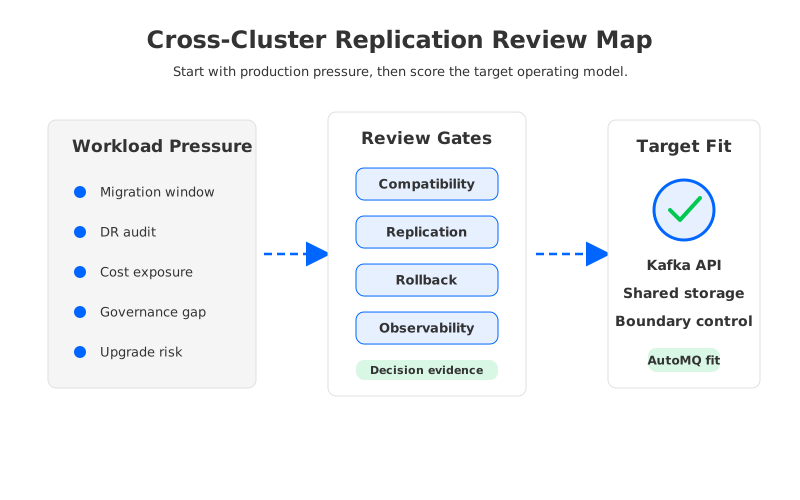
These pressures tend to arrive together:
- Migration pressure. A team needs to leave self-managed Kafka, consolidate clusters, or change regions for data residency.
- Reliability pressure. Leadership asks whether a region outage can be handled without manual topic surgery.
- Cost pressure. Cross-AZ replication, duplicate clusters, connector fleets, and over-provisioned brokers make the "temporary" layer expensive to keep.
- Governance pressure. The target must preserve ACLs, encryption expectations, audit trails, topic policies, and ownership boundaries.
- Upgrade pressure. A Kafka version, KRaft transition, or storage architecture change makes in-place upgrades riskier than a staged move.
The common failure mode is treating those pressures as independent projects. A migration plan owned by one team, a disaster recovery plan owned by another, and a security review owned by a third can all pass individually while the combined operating model remains fragile. A cross-cluster replication review is valuable because it forces those dependencies into the same room before production traffic depends on them.
2The Migration Risk Behind the Workload
Traditional Kafka clusters couple compute, coordination, and durable storage around broker-local disks. That design is proven, but it shapes migrations. Data placement matters because partitions live on brokers. Scaling matters because adding or removing brokers usually triggers data movement. Failure recovery matters because replicas and leaders are tied to broker state.
This is where review conversations become more concrete. If a source topic has high write throughput, long retention, many partitions, and strict consumer recovery expectations, a replication tool can copy records but cannot remove the operational consequences of duplicating the workload. The destination cluster still needs enough broker capacity, disk throughput, network bandwidth, and partition leadership headroom before cutover. If the source cluster is already close to limits, replication may add load exactly when the team has the least room for error.
MirrorMaker 2 and Kafka Connect are useful building blocks because they operate in Kafka's ecosystem and preserve familiar concepts. They also introduce their own operational surface area: connector tasks, offset synchronization, monitoring, error handling, rebalance behavior, and deployment lifecycle. A review should respect the tool without pretending the tool is the whole migration. The tool moves data; the platform team still owns the decision about when the destination is trustworthy enough to receive producers and consumers.
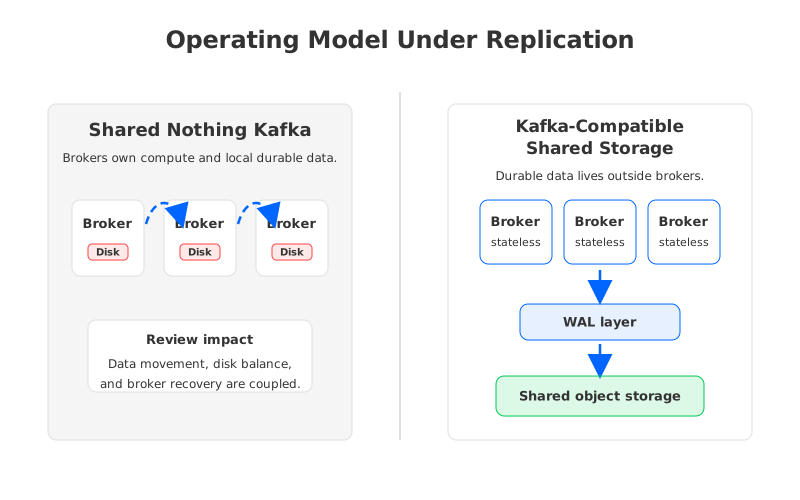
The bigger architectural question is whether the target should reproduce the same operating model or use the migration to change it. Reproducing the model can be safer when the team has deep muscle memory and the workload is stable. Changing the model can be attractive when the old model created too much capacity planning, disk management, cross-AZ traffic, or slow recovery work.
3Compatibility, Replication, Rollback, and Observability Trade-Offs
Compatibility is the first gate because the cleanest replication design is useless if clients need broad rewrites. Kafka-compatible does not only mean producers and consumers can connect. It means client libraries, authentication flows, topic configuration expectations, consumer group behavior, transactional semantics where used, and operational tooling all have a credible path through migration. The review should identify which clients can move unchanged, which need configuration changes, and which depend on broker behavior that must be tested.
Replication semantics come next. Teams should decide whether they need active-passive disaster recovery, active-active writes, a migration bridge, or a long-running analytics copy. Those patterns are often conflated, but they carry different expectations. Active-passive designs optimize for controlled failover. Migration bridges optimize for cutover and rollback. Analytics copies may tolerate lag but care about schema and retention boundaries. Active-active writes create conflict and ordering questions that a simple replication pipeline cannot make disappear.
The rollback path deserves the same attention as the forward path. A migration is not production-ready when data reaches the new cluster; it is production-ready when the team can explain what happens if producers are moved and a defect appears later. Can consumers return to the old cluster without losing committed progress? Are topic names mirrored or rewritten? How are offsets translated and validated? Which system is the source of truth during a partial cutover? These questions are unpleasant during planning and much worse during an incident.
Observability is where teams often under-specify requirements. Lag metrics are necessary, but they are not enough. Platform owners need a view of connector health, replication throughput, failed records, consumer group movement, broker saturation, topic-level skew, and access failures. They also need runbooks that define action thresholds.
| Review Area | Question to Answer | Evidence to Collect |
|---|---|---|
| Client compatibility | Which producers, consumers, and admin tools can move without code changes? | Client versions, auth modes, protocol features, integration test results |
| Replication design | Is the goal migration, DR, analytics copy, or multi-region writes? | Target topology, expected lag, topic mapping, failover objective |
| Rollback | What happens after a partial producer or consumer cutover fails? | Offset plan, dual-write policy, source-of-truth decision, rehearsal notes |
| Cost | Which costs continue after cutover, and which are only migration scaffolding? | Broker capacity, network path, connector fleet, retention, object storage assumptions |
| Governance | Can the target enforce the same or better controls? | ACLs, encryption, audit logs, ownership model, regional boundaries |
| Operations | Who owns the pipeline at 02:00 when lag rises? | On-call path, alerts, runbooks, escalation boundaries |
The review outcome should be a decision record: the intended topology, the accepted risks, the rollback contract, and the evidence still missing before production traffic moves. That record matters because replication failures cut across application, platform, security, and budget owners.
4Evaluation Checklist for Migration Teams
A useful checklist should be short enough for a real architecture review and specific enough to prevent hand-waving. Start with the workload, not the vendor. Classify topics by business criticality, throughput, retention, ordering sensitivity, and consumer recovery tolerance. Then decide which topics must move together and which can be staged.
After workload classification, test the destination under conditions that resemble production. Synthetic benchmarks help with baseline capacity, but they do not expose every operational issue. Real client versions, message sizes, partition counts, security configuration, consumer group behavior, and failure drills matter more than a single throughput number. The goal is to prove that the target can be boring during cutover.
The final checklist should include these gates:
- Readiness gate. Destination topics, ACLs, quotas, retention policies, schemas, and monitoring are created from a repeatable process rather than manual clicks.
- Replication gate. The pipeline can catch up from a planned pause, expose lag clearly, and handle task restarts without hidden data loss.
- Consumer gate. At least one representative consumer group is moved, validated, and moved back in a rehearsal.
- Producer gate. Write-path changes are controlled by configuration or routing, not emergency code deployment.
- Rollback gate. The team has a documented point after which rollback is no longer safe without data reconciliation.
- Cost gate. The temporary dual-running period has an owner, budget, and removal condition.
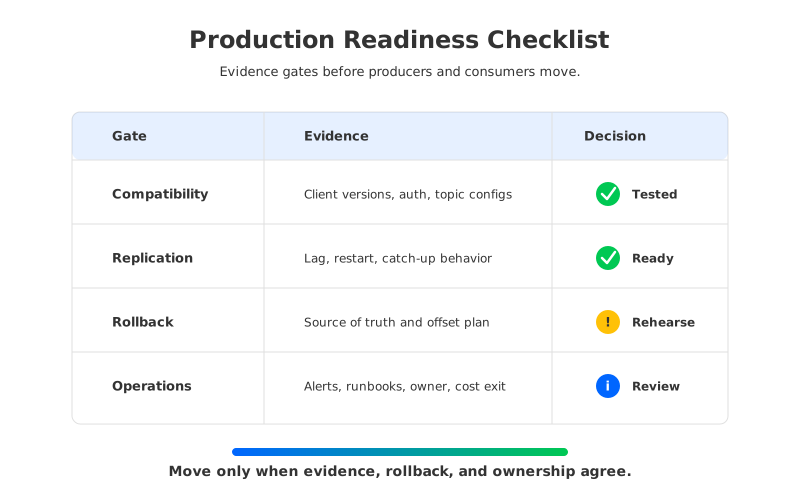
One practical pattern is to assign every topic group a readiness score rather than a binary pass/fail. A low-risk topic may be ready once replication, ACLs, and monitoring are validated. A critical topic may require consumer replay testing, a business reconciliation check, and an incident drill. The point is to stop pretending that every topic carries the same blast radius.
5How AutoMQ Changes the Operating Model
If the review shows that the hard part is not record copying but broker-local storage operations, the target architecture becomes part of the answer. AutoMQ is a Kafka-compatible cloud-native streaming system that keeps Kafka protocol compatibility while moving durable data to shared object storage and making brokers more stateless. That architecture changes the operating model that migration teams have to review: storage durability, broker replacement, capacity scaling, and cross-AZ traffic are handled differently from a traditional shared-nothing Kafka deployment.
The important shift is that compute and storage can be reasoned about separately. In a broker-local storage model, increasing capacity means thinking about partition movement, disk balance, replica placement, and recovery time together. In a shared storage model, brokers are not the long-term home of the data. That changes what the destination must prove: protocol compatibility, workload behavior, governance, and failover process matter more than whether the broker fleet can absorb a long local-disk reshuffle during cutover.
AutoMQ also gives platform owners a different way to discuss cloud cost. Traditional Kafka replication in the cloud can amplify network and storage costs because data is copied across brokers, zones, and sometimes clusters. AutoMQ's shared storage architecture and Zero cross-AZ traffic design are intended to reduce that amplification by changing where durable data lives and how brokers access it. A serious review should still model the specific cloud region, traffic pattern, retention, and network path.
For teams that need customer-controlled boundaries, deployment model matters as much as architecture. AutoMQ BYOC and AutoMQ Software are designed for environments where the data plane runs in the customer's cloud or infrastructure boundary. That matters because security, network routing, procurement, and compliance sign-off often decide whether a technically valid migration can proceed.
AutoMQ is not a reason to skip the checklist. It is a reason to change the questions in the checklist. Instead of asking only how much broker-local disk must be pre-provisioned, ask how the target separates compute from durable storage. Instead of asking only how long replica reassignment will take, ask how broker replacement behaves when data is already in shared storage.
6Decision Matrix for Platform Owners
The final review should produce a decision, not a pile of meeting notes. A simple matrix usually works better than a long scoring spreadsheet because it exposes trade-off language that executives and engineers can both understand.
| Decision Signal | Traditional Kafka Target May Fit When | Shared Storage Target May Fit When |
|---|---|---|
| Operational familiarity | The team values known broker-local behavior over architectural change. | The team wants to reduce disk movement, broker state, and storage planning work. |
| Migration urgency | The source cluster is healthy and cutover risk is low. | The migration is driven by reliability, elasticity, or cost pressure in the old model. |
| Cost profile | Broker, disk, and network costs are predictable and acceptable. | Cross-AZ traffic, duplicate capacity, or long retention makes the current model hard to justify. |
| Governance boundary | Existing controls already match the destination environment. | The target must run inside customer-controlled cloud or infrastructure boundaries. |
| Recovery model | The team can tolerate broker-local recovery procedures. | Fast broker replacement and storage durability separation are core requirements. |
This matrix should be used as a forcing function, not as a universal answer. Some teams should migrate to a conventional Kafka cluster because their risk profile rewards continuity. Other teams should use the migration window to adopt a Kafka-compatible architecture that removes the operational pressure that caused the review in the first place. The mistake is choosing either path without naming the trade-offs.
When the search begins with cross cluster replication review kafka, the real question is whether the next cluster will only receive copied data or also reduce the reasons the old cluster became difficult to operate. If your review points toward a Kafka-compatible shared storage model, the AutoMQ documentation is a practical next stop for validating architecture, compatibility, and deployment boundaries: review the AutoMQ overview.
7References
- Apache Kafka documentation: Geo-replication
- Apache Kafka documentation: Kafka Connect
- Apache Kafka wiki: KIP-405: Kafka Tiered Storage
- Apache Kafka wiki: KIP-1150: Diskless Topics
- AWS documentation: What is AWS PrivateLink?
- AWS documentation: Amazon S3 User Guide
- AutoMQ documentation: AutoMQ architecture overview
- AutoMQ documentation: Compatibility with Apache Kafka
8FAQ
8.1What is the main goal of a Kafka cross-cluster replication review?
The goal is to decide whether production traffic can move safely while data consistency, client compatibility, security controls, observability, and rollback remain understandable. Tool selection is part of the review, but it should not be the starting point.
8.2Is MirrorMaker 2 enough for a Kafka migration?
MirrorMaker 2 can be a useful replication layer, especially for Kafka-to-Kafka movement. A production migration still needs workload classification, offset and consumer movement planning, rollback rules, monitoring, and a decision about how long the replication layer should remain after cutover.
8.3When should a team consider a Kafka-compatible shared storage architecture?
Consider it when the migration is driven by broker-local disk operations, slow scaling, high cross-AZ traffic, long retention pressure, or recovery procedures that depend too heavily on broker state. The target still needs compatibility testing, but the steady-state operating model can be simpler.
8.4How should platform owners evaluate rollback?
Rollback should be tested before the highest-risk workloads move. The review should define source-of-truth ownership, offset translation or validation, producer routing, consumer restart behavior, and the point where rollback requires reconciliation instead of a clean switchback.
8.5Does cross-cluster replication solve disaster recovery by itself?
No. Replication can move data, but disaster recovery also needs failover criteria, client routing, security access, observability, operational ownership, and periodic drills. Without those, the second cluster is a copy of data rather than a recovery capability.


