
Table of Contents
Table of Contents
Teams rarely search for replication lag scorecard kafka when everything is calm. The query usually appears after a dashboard shows that a standby Region is falling behind, a data product misses its freshness service-level objective, or a migration plan depends on a target cluster being "close enough" to production. The hard part is not seeing one lag number. The hard part is deciding whether that number means "healthy replication," "manageable backlog," or "do not cut over."
A useful scorecard treats freshness as an operating state, not a single metric. Kafka replication involves Producers, brokers, Connect workers, network paths, Consumer groups, offsets, schema changes, and recovery procedures. A cross-region stream can be milliseconds behind on one Topic and hours behind on another, while the business risk depends on which Topic drives orders, fraud checks, billing, or model features. The scorecard has to connect technical lag to the decision a human is trying to make.
1Why Replication Lag Becomes a Decision Problem
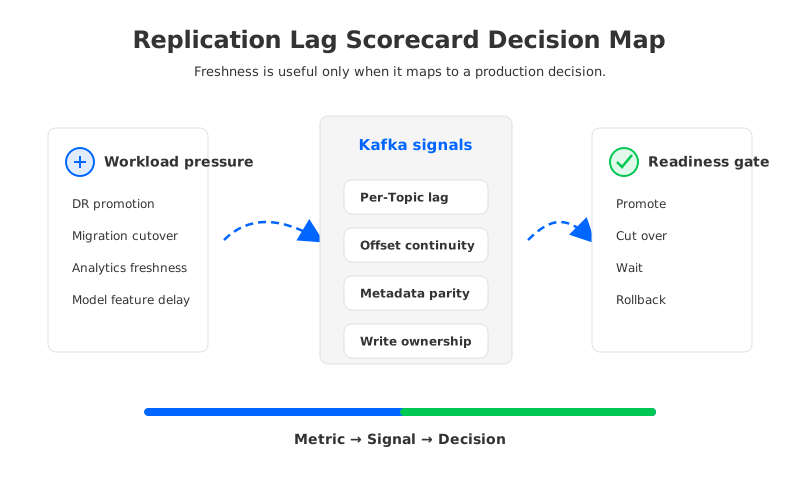
Consumer lag is familiar to every Kafka operator: it compares where a Consumer group has read with the latest Offset in a Partition. Cross-region replication lag is related, but it answers a different question. Instead of asking whether one Consumer group is keeping up, it asks whether a second cluster has enough of the source log, metadata, and consumption progress to support a business action.
That action changes the meaning of "fresh." For analytics replication, a few minutes may be acceptable if dashboards are labeled correctly. For disaster recovery, the important question is whether the standby cluster can take writes without losing the recovery point the business promised. For migration, lag is only one input. The target also needs compatible Topic configuration, preserved or mapped offsets, validated ACLs, and a rollback plan that operators trust under pressure.
This is why a scorecard works better than a threshold. A single "lag under 60 seconds" rule may be useful during a controlled migration batch, but it says little about skew across Topics, offset continuity, or whether the target cluster is safe for stateful applications such as Flink jobs. A scorecard can still include hard gates. It also shows which gates are about data freshness, which are about operational readiness, and which are about business risk.
2The Workload Pressure Behind Cross-Region Replication
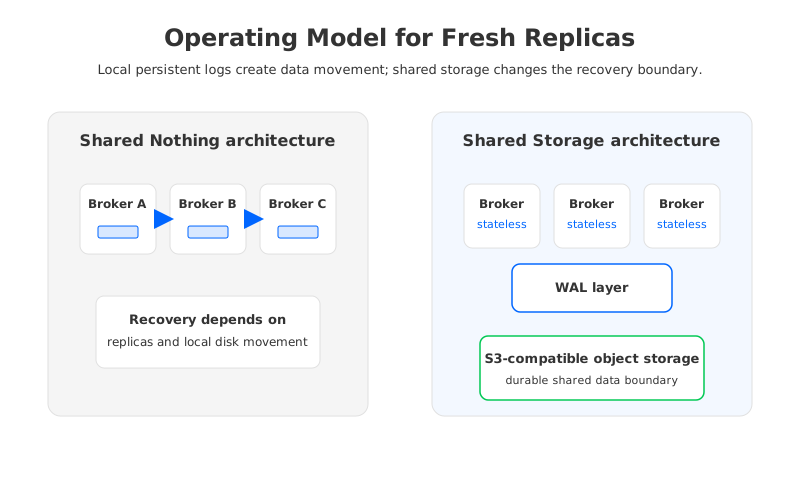
Traditional Kafka was designed around a Shared Nothing architecture. Each Broker owns local storage, and reliability comes from replication between leaders and followers. That model is durable and well understood, but it turns recovery and migration into data movement problems. When traffic grows, the platform team has to plan local or cloud disk capacity, broker placement, replica synchronization, Partition reassignment, and network paths at the same time.
Cross-region replication adds another layer. Tools built on Kafka Connect, including MirrorMaker 2, can replicate Topic data and synchronize parts of the cluster state. They are useful for disaster recovery, aggregation, analytics, and phased migration. The operational burden appears when teams treat replication progress as the whole readiness signal. A target cluster that has copied the data may still be unsafe for cutover if Consumer offsets are not usable, if write ownership is unclear, or if rollback depends on a manual runbook nobody has rehearsed.
Cloud cost also changes the calculation. Multi-Availability Zone and cross-region deployments move data through billable network paths. AWS publishes separate data transfer pricing, and those costs can matter when Kafka replication, Producer routing, and Consumer reads all cross fault-domain boundaries. The exact number depends on Region, topology, and discounts, so the scorecard should not hard-code a universal price. It should force the team to ask where bytes move and who pays for every replicated copy.
3A Practical Replication Lag Scorecard for Kafka Teams
The scorecard below is intentionally boring. That is the point. During a migration or incident, operators need a small set of signals that maps to a decision, not a dashboard full of attractive charts.
| Dimension | What to Measure | Good Decision Signal | Risk Signal |
|---|---|---|---|
| Data freshness | Per-Topic replication latency, backlog, and maximum skew | Critical Topics remain within their freshness objective for the full observation window | One low-priority Topic hides a critical Topic that is far behind |
| Offset continuity | Consumer group progress, offset translation, or byte-for-byte offset preservation | Consumers can resume from an expected position after the switch | Stateful Consumers need manual offset resets or accept duplicate processing |
| Write ownership | Which cluster accepts Producer writes at each phase | Exactly one write path is active for each Topic during cutover | Source and target can both accept writes for the same logical stream |
| Metadata parity | Topic configs, partitions, ACLs, quotas, and client authentication | Target cluster can run the workload without emergency config changes | Operators discover missing auth, retention, or partition changes during cutover |
| Cost exposure | Cross-AZ, cross-region, disk, Connect worker, and standby capacity cost | Replication cost is modeled before the project starts | The target is fresh only when oversized workers and network paths stay hot |
| Recovery action | Promotion, rollback, and validation steps | Operators can explain the next command and the expected blast radius | Freshness looks good, but no one owns the recovery decision |
The important column is not "What to Measure." Most teams already collect those metrics somewhere. The important column is "Good Decision Signal." It turns a metric into a yes-or-no operating judgment. If the team cannot define that signal before the migration window, the dashboard will not define it during the migration window.
4Compatibility, Replication, Rollback, and Observability Trade-Offs
Replication tools solve the data-copy part of the problem first. That is a reasonable design choice. The source cluster continues to accept writes, the target receives replicated records, and operators watch lag decline. For read-only analytics or standby environments, this can be enough. The target is not trying to become a perfect continuation of the source; it is trying to hold a useful copy.
Migration and disaster recovery raise the bar. The target must become writable at a specific moment, and Consumers must know where to resume. Kafka Offsets are not abstract bookmarks. They are positions in a Partition log. If replication writes records into a different target log, offset mapping becomes part of the recovery path. That mapping may be correct, but it is another system operators must trust during a high-stakes switch.
Rollback is the part that exposes weak scorecards. A cutover plan often says, "switch clients back if something fails." That sentence hides several questions: did Producers write new records to the target, did Consumers advance on the target, were any side effects committed downstream, and does the source still have a consistent view of the world? A freshness indicator that does not mention rollback is measuring replication health, not migration readiness.
Observability needs the same separation. A cross-region Kafka dashboard should show at least three layers:
- Replication path health, including Connector task status, throughput, retry behavior, and per-Topic lag.
- Application progress, including Consumer group lag, processing errors, downstream write rates, and duplicate handling.
- Platform readiness, including target broker health, storage pressure, authentication, quotas, and network transfer.
When those layers are mixed together, the team gets false confidence. A Connector can be healthy while the target cluster is under-provisioned. A Consumer group can be caught up while a critical ACL is missing. A target can be technically fresh while rollback is already unsafe.
5How Architecture Changes the Operating Model
Once the scorecard is clear, the architecture question becomes easier: which platform model reduces the number of moving parts that affect freshness? Traditional Kafka keeps persistent data tied to Broker-local storage. That means scaling, recovery, and rebalancing often involve moving data between Brokers. Tiered Storage can reduce the amount of local storage needed for older data, but the primary hot log still lives with the Broker and still follows the leader/follower replication model.
Shared Storage architecture changes that boundary. In AutoMQ, a Kafka-compatible cloud-native streaming platform, Brokers stay compatible with Kafka clients while durable stream data is stored in S3-compatible object storage through S3Stream and a WAL (Write-Ahead Log) layer. Brokers become stateless for persistent data, so scaling and replacement are less tied to copying full Partition data between machines.
That difference matters for a replication lag scorecard because it reduces several background risks. If Broker replacement is mostly a metadata and ownership operation, the platform has less local state to protect during scaling or failure recovery. If storage is shared and object-storage-backed, the team can reason about durability and capacity outside individual Broker disks. If the deployment also uses Inter-Zone traffic routing, Kafka replication paths no longer have to create the same broker-to-broker cross-AZ data movement pattern as a classic three-replica deployment.
This does not remove the need for a scorecard. It changes what the scorecard emphasizes. With a Kafka-compatible Shared Storage architecture, teams still need to validate client compatibility, Connector behavior, Consumer group progress, security boundaries, and rollback. The difference is that the platform’s own operating model contributes fewer disk-bound rebalancing events and fewer local-storage capacity surprises during the project.
6Evaluation Checklist for Migration and DR Teams
The cleanest readiness review is a short checklist that every stakeholder can read. Platform engineers care about broker health and offsets. SREs care about recovery steps and blast radius. FinOps cares about standby and network cost. Application owners care about duplicates, ordering, and downtime. The scorecard should make those concerns visible in the same room.
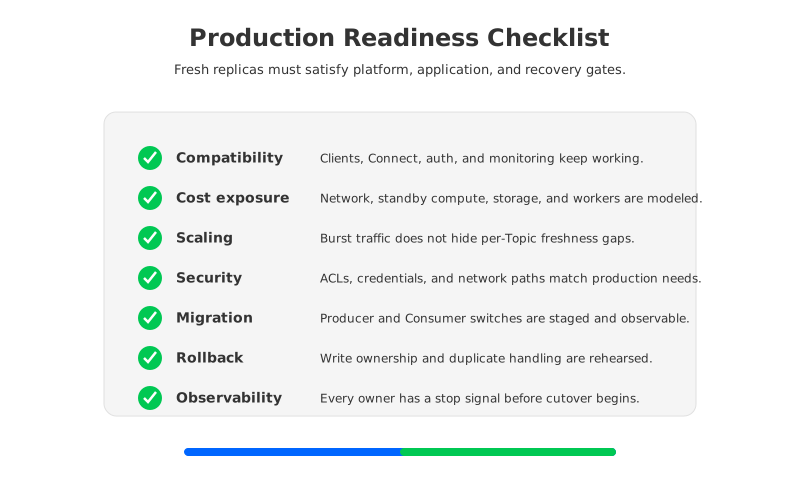
Use this checklist before relying on any cross-region freshness number:
- Define freshness per workload. Put critical Topics into tiers, then assign an objective to each tier. "All Topics under one minute" is rarely the right policy if the business impact differs by stream.
- Separate replication health from cutover readiness. A green replication task does not prove that Producers, Consumers, ACLs, schemas, and offsets can switch safely.
- Test Consumer recovery with real groups. Do not rely only on synthetic Consumers. Pick representative stateful and stateless applications and validate their resume behavior.
- Model cost at the byte path level. Include cross-AZ traffic, cross-region traffic, standby compute, local or cloud disk, object storage, and replication workers.
- Rehearse rollback before cutover. The team should know which side owns writes, which Consumers may duplicate work, and what data must be reconciled.
- Keep compatibility boring. Standard Kafka clients, Kafka Connect, MirrorMaker, monitoring tools, and security integrations should work with minimal application change. Anything custom belongs in the risk register.
There is a useful test for the final review: ask each owner to point to the metric that would stop the cutover. If an owner cannot name one, the scorecard is incomplete. If every owner names a different dashboard, the scorecard is not yet an operating tool.
7Where AutoMQ Fits in the Decision
AutoMQ is relevant after the team has separated technical freshness from operational readiness. Its Kafka-compatible API surface lets existing Producers, Consumers, Kafka Connect workloads, and monitoring tools remain in the Kafka ecosystem, while its Shared Storage architecture changes the storage and scaling model underneath. AutoMQ Linking can also support migration workflows where offset preservation and coordinated cutover matter more than generic replication alone.
The practical evaluation is not "replace every replication tool." MirrorMaker 2 and Kafka Connect remain useful for replication, disaster recovery copies, aggregation, and data distribution. The better question is whether your project is asking a replication tool to become a migration control plane. If the answer is yes, the scorecard should include cutover coordination, write ownership, offset continuity, and rollback as first-class gates.
If your team is building a cross-region freshness scorecard because a migration or recovery decision is approaching, start with one non-critical workload and make the scorecard earn trust. Validate the byte path, observe lag under normal and burst traffic, switch a real Consumer group, and rehearse rollback. Then expand to higher-value streams only after the signals predict what operators actually see.
For teams evaluating Kafka-compatible migration or Shared Storage architecture, start with AutoMQ and test a small set of Topics, Consumer groups, and rollback procedures before moving critical production streams.
8References
- Apache Kafka documentation: operations and MirrorMaker
- Apache Kafka documentation: replication design
- Apache Kafka documentation: Consumer configuration
- AWS EC2 pricing: data transfer
- AWS documentation: Regions and Availability Zones
- AutoMQ documentation: compatibility with Apache Kafka
- AutoMQ documentation: Shared Storage architecture overview
- AutoMQ documentation: migrating from Apache Kafka to AutoMQ
9FAQ
9.1What is a replication lag scorecard in Kafka?
A replication lag scorecard is a small decision framework that combines freshness metrics with cutover and recovery readiness. It usually includes per-Topic lag, backlog, Consumer group progress, offset continuity, metadata parity, cost exposure, and rollback ownership. The goal is to decide whether a replicated cluster is safe for analytics, disaster recovery, or migration, not only whether data is moving.
9.2Is Consumer lag the same as cross-region replication lag?
No. Consumer lag measures how far a Consumer group is behind the latest Offset in a Topic Partition. Cross-region replication lag measures how far a target cluster is behind the source cluster. A migration or DR plan usually needs both, because the target can be fresh while Consumers are not ready to resume, or Consumers can be caught up while the replication path is not safe for promotion.
9.3When is MirrorMaker 2 enough?
MirrorMaker 2 is a reasonable choice for many replication, standby, aggregation, and analytics use cases. It fits well when the target cluster needs a usable copy and the team can tolerate offset mapping, replication lag, and separate cutover procedures. For production migration, the team should add explicit checks for write ownership, Consumer coordination, offset behavior, and rollback.
9.4How does Shared Storage architecture affect replication readiness?
Shared Storage architecture does not eliminate replication planning, but it changes the platform risks around scaling and failure recovery. When Brokers are stateless for persistent data and durable records live in shared object storage with a WAL layer, Broker replacement and Partition movement depend less on copying full local logs. That can reduce operational noise while teams validate the actual migration or DR workflow.


