
Table of Contents
Table of Contents
Someone searching cross region kafka recovery drills is usually not asking whether disaster recovery matters. The harder question is whether the streaming platform can fail over without turning a controlled incident into a data, cost, or governance problem. Kafka may already run across Availability Zones, backups may exist, and a second region may have a cluster waiting. None of that proves that producers, consumers, offsets, security controls, and operating teams can survive the moment when the primary region is unavailable.
A recovery drill is useful when it tests the whole business path, not a single replication mechanism. The drill has to expose how fresh the standby region is, which clients move first, how consumer groups resume, what happens to transactional workloads, how much network traffic the recovery path creates, and how the team decides to roll back. The uncomfortable part is that many Kafka recovery plans look complete on a diagram but depend on assumptions that are not visible until the drill runs under production-like load.
Evaluate cross-region Kafka recovery by separating four questions: what state must be available, how that state crosses regions, who can switch traffic, and how the system proves correctness after the switch. That framing gives platform teams a vendor-neutral checklist before comparing MirrorMaker2, managed replication features, custom dual-write designs, or Kafka-compatible Shared Storage architecture.
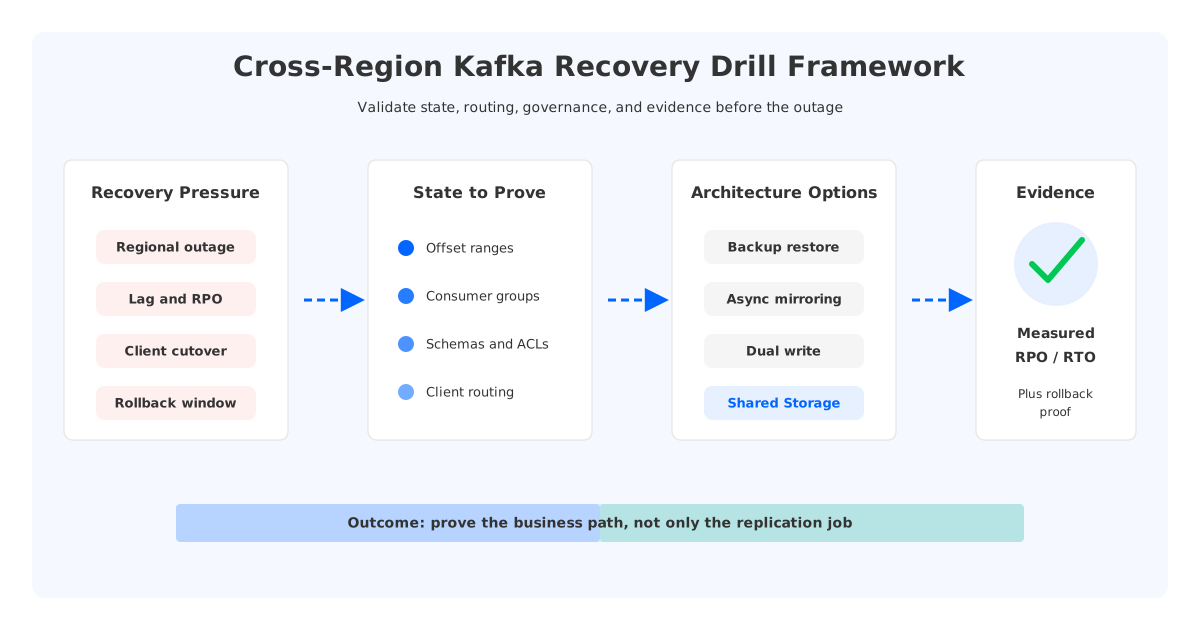
1Why cross region kafka recovery drills matters now
Kafka sits on the path between operational systems, analytics pipelines, AI features, fraud controls, observability, and customer-facing workflows. In a regional outage, the streaming layer is the continuity boundary for downstream systems that expect ordered offsets, consumer progress, schemas, ACLs, and replayable history. If that boundary is not rehearsed, every team learns the failure semantics at the same time, which is an expensive way to discover gaps.
The first trap is equating "data is being copied" with "the platform is recoverable." Apache Kafka's MirrorMaker2 can replicate records and checkpoints between clusters, but cross-cluster mirroring has its own configuration, topic naming, consumer group checkpointing, and offset translation behavior. Those details are manageable, but they are not automatic proof that failover is clean for every workload.
The second trap is testing the happy path only. A real recovery drill needs operational friction:
- Producer routing: validate how bootstrap servers, DNS, service discovery, private connectivity, and client retry settings behave when the primary region is degraded rather than neatly offline.
- Consumer continuity: verify whether consumer groups resume at the intended point, whether duplicate consumption is acceptable, and whether idempotent sinks can absorb replay.
- Governance state: replicate or recreate ACLs, credentials, quotas, schema dependencies, topic configuration, retention rules, and audit evidence before traffic moves.
- Cost and capacity: measure the bandwidth, standby compute, object storage, private link, and egress profile created by the drill. A recovery path that cannot be afforded during normal operation often becomes stale.
- Rollback authority: define who can reverse the switch, under what data conditions, and how split-brain writes are prevented.
These checks separate a drill that proves a replication tool runs from a drill that proves a production platform can move.
2The production constraints behind the search
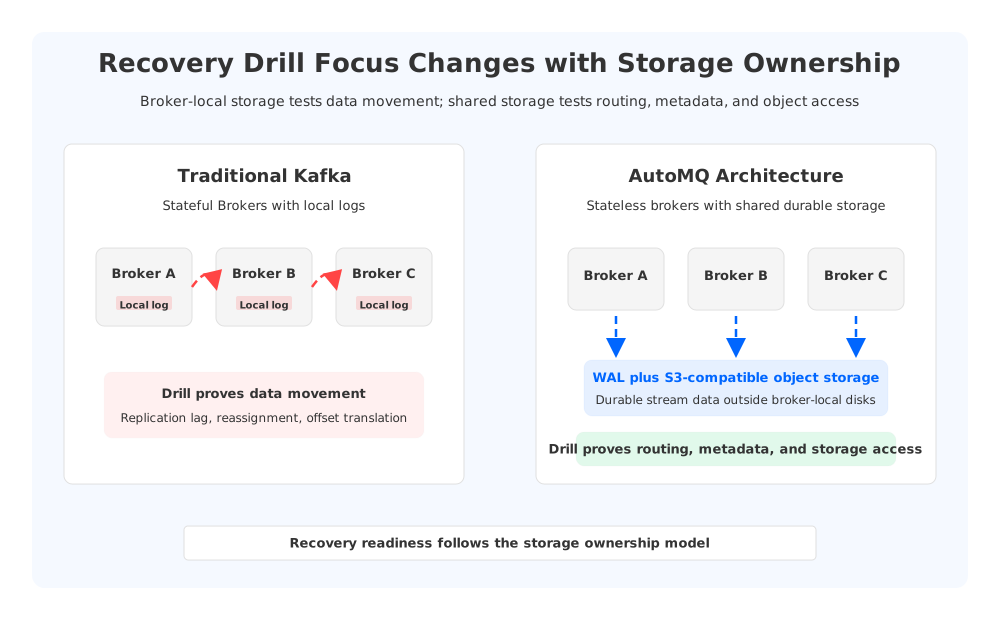
Traditional Kafka uses a Shared Nothing architecture. Each Broker owns local log storage, partitions have leaders and followers, and durability comes from replicas distributed across Brokers. Inside one region, operators tune replication factor, rack awareness, ISR (In-Sync Replicas), broker capacity, and reassignment plans. Across regions, the same broker-local ownership model creates a wider problem because the second region is a separate cluster with separate state.
That separation affects every recovery drill. Records may replicate continuously, but client-facing metadata and operational state still need explicit handling. Consumer offsets may be translated, synchronized, or intentionally reset. Topic configuration, schema policies, and security rules can drift. The drill must treat all of those as recovery state, because applications experience them as one platform.
Cross-region distance also changes the physics of Kafka operations. Synchronous replication across regions is usually too costly or too latency-sensitive for ordinary streaming workloads, so many architectures use asynchronous replication. The drill must define acceptable RPO (Recovery Point Objective) and RTO (Recovery Time Objective) in workload terms, not slogans. For analytics ingestion, duplicate records may be acceptable if downstream compaction is reliable. For payment or inventory workflows, replay and ordering behavior may require a stricter cutover plan.
The key architectural constraint is ownership. When a Broker owns durable data locally, scaling, recovery, and migration often involve moving or translating state. When durable stream data is stored in shared object storage and Brokers are stateless, the drill shifts toward metadata, routing, object storage durability, and workload compatibility. That does not remove testing; it changes what the test should prove.
3What a good recovery drill should prove
A useful drill has a narrow objective and a broad evidence trail. "Switch the cluster to another region" is too vague. A stronger objective is: "Move producers for three critical topics, resume two consumer groups in the standby region from verified offsets, and prove downstream idempotency under replay." That level of specificity makes success measurable.
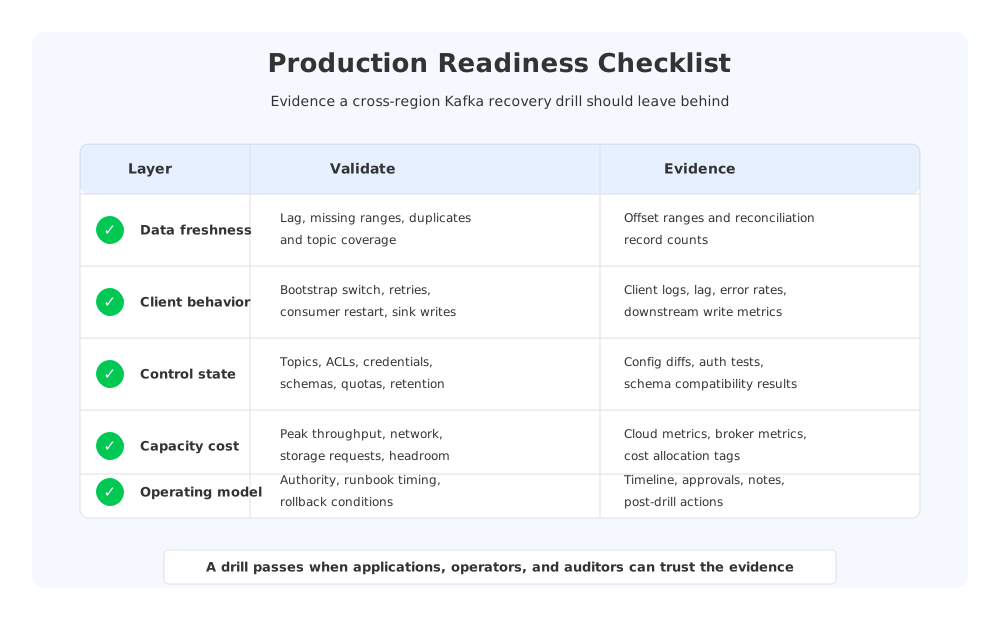
Use a drill plan that covers five layers:
| Layer | What to validate | Evidence to collect |
|---|---|---|
| Data freshness | Replication lag, missing ranges, duplicate ranges, and topic coverage | Offset ranges, lag dashboards, record-count reconciliation |
| Client behavior | Producer retries, bootstrap changes, DNS TTL, consumer group restart, and sink idempotency | Client logs, error rates, consumer lag, downstream write metrics |
| Control state | Topic config, ACLs, credentials, quotas, schema rules, and audit trails | Config diffs, authorization tests, schema compatibility results |
| Capacity and cost | Standby throughput, network transfer, object storage requests, and scaling headroom | Cloud metrics, broker metrics, cost allocation tags |
| Operating model | Decision authority, runbook timing, rollback conditions, and communications | Timeline, incident notes, approvals, post-drill action items |
The evidence matters because drills decay. A plan that worked before a major topic growth, schema rollout, identity change, or networking refactor may fail later. Treat the drill report as a production artifact: it should name the workload, versions, regions, replication method, cutover steps, measured lag, observed duplicates, and unresolved risks.
One discipline helps more than any template: test the ambiguous middle state. Do not only test primary healthy and primary fully unavailable. Test packet loss, partial region degradation, high replication lag, a blocked private endpoint, and a consumer group that was already behind before the drill started. These are the states where teams create split-brain writes or restart consumers from an unsafe point.
4Architecture patterns teams usually compare
The simplest pattern is backup and restore. It is useful for compliance retention and last-resort recovery, but it rarely satisfies low RTO for active streaming workloads. Restoring a cluster from backup does not automatically recover client routing, consumer progress, schemas, ACLs, or downstream idempotency.
The second pattern is asynchronous cluster replication. MirrorMaker2 and similar tools can replicate topics from a primary cluster to a secondary cluster. This model preserves independent regional clusters and avoids putting cross-region latency in the write path. The trade-off is that the drill must validate offset handling, topic naming, consumer progress, duplicate tolerance, and lag between source and target.
The third pattern is application-level dual write. Some teams write to two regions from the producer side to reduce replication lag. This can be effective for carefully designed applications, but it pushes ordering, deduplication, and partial-write semantics into application logic.
The fourth pattern is active-active architecture. It can reduce regional dependency when workloads are naturally partitioned by geography or tenant, but it raises conflict-resolution questions when the same keys can be written in multiple regions. It is strong when data ownership boundaries are clean and risky when the team cannot explain how conflicts are resolved.
The fifth pattern is Kafka-compatible Shared Storage architecture combined with migration or linking workflows. This is where AutoMQ becomes relevant after the neutral evaluation. AutoMQ is a cloud-native streaming platform compatible with Apache Kafka that uses Shared Storage architecture: AutoMQ Brokers handle Kafka protocol traffic while S3Stream stores durable stream data in S3-compatible object storage with WAL (Write-Ahead Log) storage for low-latency persistence and recovery. AutoMQ Linking adds a migration path that supports byte-level message synchronization with offset consistency, which is important when a recovery or migration drill needs consumers to resume without offset translation surprises.
That does not mean every cross-region design should start with AutoMQ. If the workload needs only nightly restore, a simpler backup design may be enough. If a Kafka estate already has stable asynchronous replication and the business accepts the measured RPO, the first investment may be drill automation. AutoMQ is worth evaluating when broker-local storage makes recovery, scaling, cost, or migration windows harder than the business can tolerate.
5Where AutoMQ changes the operating model
AutoMQ's architectural difference is not that it avoids disaster recovery planning. It changes the failure domains that the plan must rehearse. In traditional Kafka, Brokers are both compute nodes and durable storage owners, so a cross-region recovery drill has to reason about local replicas, cluster mirroring, and recovery data movement. In AutoMQ's Shared Storage architecture, durable data is placed in S3-compatible object storage, while stateless brokers can be replaced, scaled, or rebalanced without moving the full retained log between machines.
For recovery drills, that means teams can test a different set of assumptions:
- Broker replacement: a failed Broker should be treated as compute loss, not as loss of locally owned durable log data.
- Capacity elasticity: standby or target capacity can be evaluated around traffic serving, cache behavior, and WAL choice rather than full data relocation.
- Migration continuity: AutoMQ Linking for Kafka can be tested for byte-level synchronization, offset consistency, consumer progress, producer cutover, and rollback windows.
- Deployment boundary: AutoMQ BYOC runs control plane and data plane components in the customer's cloud account VPC, while AutoMQ Software runs in the customer's private environment. That matters for governance reviews where data residency and access boundaries are part of the drill.
- Object storage strategy: S3Stream supports object storage as the primary durable layer, and AutoMQ commercial editions support multi-bucket strategies such as failover or replication for stricter disaster recovery designs.
The important point is to test the full path. Shared storage reduces the need to move broker-local durable data, but a production drill still has to validate object storage access, WAL behavior, metadata, client routing, security, observability, and application idempotency.
6A practical drill sequence
Start with a read-only simulation, then move toward controlled write traffic. The first drill should prove inventory: topics, partitions, consumer groups, ACLs, schemas, quotas, connector dependencies, private endpoints, and downstream systems. The next drill should prove data movement: measure replication or linking lag, reconcile offset ranges, and record duplicate behavior. After that, introduce client cutover for a small set of topics with an explicit rollback window.
The production-like drill should be boring in execution and rich in evidence. Operators should know the command sequence. Application owners should know when to pause writes or accept replay. Security teams should know which credentials are used in the standby region. Observability should show both the streaming platform and downstream systems, because a Kafka failover that overloads a sink is still a failed recovery.
Use the following decision table when the drill results come back:
| Drill result | Likely diagnosis | Next move |
|---|---|---|
| Replication lag is low, but consumers resume incorrectly | Offset and consumer group handling are under-tested | Add offset reconciliation, sink idempotency checks, and consumer restart tests |
| Data is fresh, but cutover takes too long | Routing, DNS, approval, or client configuration is the bottleneck | Automate bootstrap changes and pre-approve runbook authority |
| Standby region cannot absorb peak load | Capacity model is based on idle standby assumptions | Reserve or automate capacity and rerun with peak-like traffic |
| Recovery creates unacceptable duplicate or reordered events | Application semantics are not aligned with replication behavior | Add idempotency, ordering constraints, or workload-specific failover rules |
| Broker-local data movement dominates recovery time | Storage ownership is limiting elasticity | Evaluate Shared Storage architecture and stateless brokers |
The best recovery drill is not the one with the cleanest report. It is the one that makes the hidden dependency visible while the primary region is still healthy. If your next drill shows that most risk comes from offset handling and runbook authority, fix those. If it shows that broker-local storage and data movement define the recovery window, compare that architecture against a Kafka-compatible shared-storage path.
To explore that path with your own workload, start with the AutoMQ open-source project, then validate recovery behavior, client compatibility, and migration semantics in a drill that looks like your real outage model.
7References
- Apache Kafka Documentation: MirrorMaker 2
- Apache Kafka KIP-382: MirrorMaker 2.0
- Apache Kafka Documentation: Consumer Configurations
- AWS Well-Architected Framework: Reliability Pillar
- Google Cloud Architecture Center: Disaster Recovery Planning Guide
- AutoMQ Documentation: Migration Overview
- AutoMQ Documentation: S3Stream Shared Streaming Storage
- AutoMQ Documentation: S3 Storage
8FAQ
8.1How often should teams run cross-region Kafka recovery drills?
Run a drill whenever the platform changes in a way that affects routing, security, replication, schemas, topic configuration, consumer behavior, or regional capacity. Many teams also run scheduled drills, but change-triggered drills are more valuable than a calendar exercise that ignores system drift.
8.2What is the difference between RPO and RTO for Kafka recovery?
RPO defines how much data loss or lag the business can tolerate. RTO defines how long the recovery can take. For Kafka, both should be measured per workload because consumer replay, duplicate tolerance, and downstream idempotency can vary by topic.
8.3Does MirrorMaker2 guarantee seamless regional failover?
MirrorMaker2 is a Kafka tool for cross-cluster mirroring, but a seamless failover also depends on offset handling, topic configuration, client routing, security state, downstream idempotency, and runbook execution. The drill should validate those surrounding conditions.
8.4When should AutoMQ be evaluated for recovery drills?
Evaluate AutoMQ when broker-local storage makes recovery windows, scaling, migration, or standby cost difficult to control. Its Kafka-compatible Shared Storage architecture and stateless brokers change the operating model, but production adoption should still be validated through workload-specific drills.


