
Table of Contents
Table of Contents
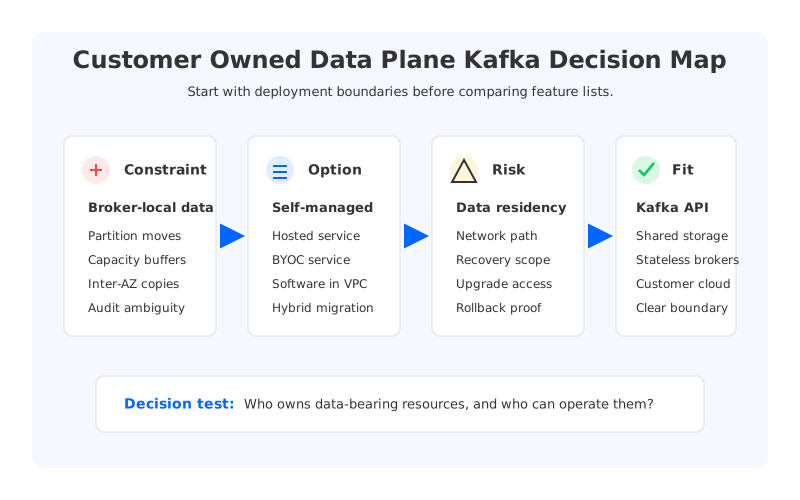
Teams do not search for customer owned data plane kafka because they want another deployment acronym. They search for it when the Kafka decision has moved beyond throughput, partitions, and retention into questions that security, finance, procurement, and platform engineering all care about. Where does durable event data live? Which cloud account holds the network path, encryption keys, logs, and storage bills? Who can operate the cluster during an incident, and what evidence can the customer review after the fact?
That is the real buying question. A Kafka-compatible platform can look attractive in a feature comparison and still fail a deployment-boundary review. The inverse is also true: a platform can keep data-bearing resources inside the customer's cloud account but still leave too much operational work on the customer. The useful frame is not "managed versus self-managed." It is how much of the data plane the customer owns, how much of the operating model the vendor automates, and whether those two boundaries are explicit enough for production.
1Why teams search for customer owned data plane kafka
The phrase usually appears after a first round of Kafka platform evaluation has already happened. The team knows it needs Kafka API compatibility. It has producers, consumers, Kafka Connect jobs, schemas, ACLs, monitoring dashboards, and incident runbooks that cannot be replaced in one procurement cycle. The hard part is deciding whether a hosted service boundary, a self-managed cluster, or a BYOC model fits the risk profile of the business.
The pressure often comes from more than one direction. A security team may need customer-controlled keys and private network paths. A data platform team may need to prove that consumer offsets, transactional producers, and client compatibility survive migration. A finance team may want storage, compute, and network costs separated instead of bundled into a bill it cannot reason about. A procurement team may ask who can access the system, which evidence is available, and what happens when the vendor relationship changes.
These are not abstract governance questions. Kafka is frequently placed between payment systems, operational databases, fraud pipelines, analytics jobs, AI feature pipelines, manufacturing telemetry, or user-facing applications. Event data may not be the database of record, but it often carries enough business context to trigger data residency, retention, access control, and audit concerns. Once Kafka becomes part of that boundary, the deployment model is a first-order architecture decision.
2The production constraint behind the problem
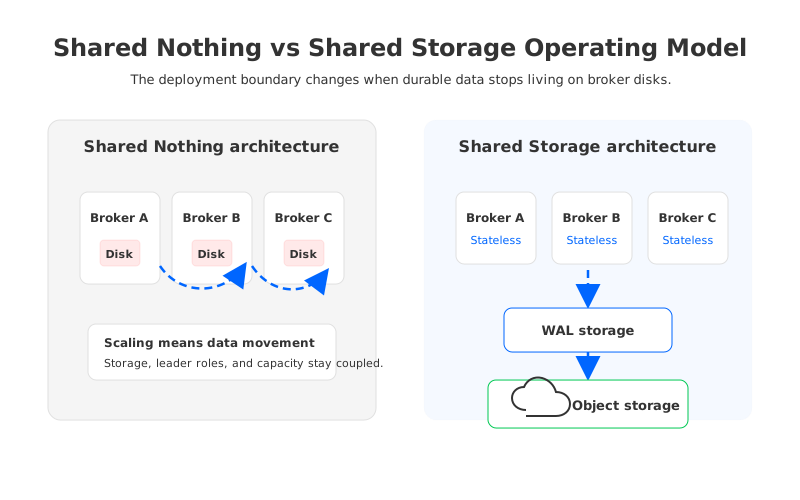
Traditional Kafka was designed around a Shared Nothing architecture. Each broker owns local storage for the partitions assigned to it, and replication across brokers provides durability and availability. This design is coherent and battle-tested. It also means storage, compute, and failure domains are tightly coupled. When a broker is overloaded, when retention grows, or when the cluster needs to rebalance, the platform team is often moving data as well as moving leadership.
That coupling turns ordinary production work into infrastructure negotiation. Adding brokers can require partition reassignment. Replacing brokers can require careful recovery. Scaling storage can mean resizing disks or adding machines ahead of demand. Multi-Availability Zone deployments can introduce broker-to-broker replication traffic because durability is implemented inside the Kafka cluster rather than delegated to a shared storage layer.
Apache Kafka has added useful capabilities over time, including KRaft for metadata management and Tiered Storage for offloading older log segments. Those features matter, and buyers should understand them. They do not automatically make the broker stateless. Tiered Storage changes where older data can live, but recent data and broker-local operating constraints still matter in the hot path. For buyers, that distinction is the line between a storage optimization and a different operating model.
3Architecture options and trade-offs
A customer-owned data plane does not mean one thing. It is a spectrum of ownership and automation. At one end, self-managed Kafka gives the customer direct control over infrastructure, configuration, upgrades, and data-bearing resources. At the other end, an external fully managed service can remove most cluster operations but may place the data plane outside the customer's account boundary. BYOC and software deployments sit between those poles: the customer's environment holds the data-bearing resources, while the platform vendor supplies automation, lifecycle management, and support.
The following matrix is a better starting point than a feature list:
| Option | Data-bearing resources | Operating burden | Boundary question |
|---|---|---|---|
| Self-managed Kafka | Customer account or data center | Highest | Can the team operate storage, balancing, upgrades, and recovery alone? |
| External managed service | Vendor-controlled service boundary | Lowest for cluster mechanics | Is the external data plane acceptable for data, network, and evidence requirements? |
| BYOC Kafka | Customer cloud account and VPC/VNet | Shared | Are vendor actions, customer controls, and audit evidence clearly separated? |
| Customer-operated software | Customer cloud or private environment | Shared to high | Does the team want maximum boundary control with vendor-supported software? |
This table is intentionally blunt. Buyers often spend weeks comparing API features while postponing the ownership question. That delay is expensive because deployment boundaries affect identity design, network routing, encryption, monitoring, procurement review, and incident response. A customer-owned model is valuable only when the boundary is precise enough to operate. Otherwise, the buyer inherits complexity without getting a cleaner control model.
4Evaluation checklist for platform teams
Start with compatibility, because it is the easiest place to fool yourself. "Kafka-compatible" should cover the client protocol, producer and consumer behavior, consumer group coordination, offsets, security mechanisms, ecosystem tooling, Kafka Connect, and observability integrations that your teams already use. If the migration requires broad application rewrites, the deployment boundary may be clean on paper but costly in practice.
Then separate the cost model. A Kafka platform buyer should be able to explain which costs come from compute, durable storage, inter-zone networking, data retention, private connectivity, observability, and support. Exact numbers depend on cloud region, traffic shape, retention, and negotiated contracts, so this article avoids invented TCO math. The practical test is whether the architecture lets your team inspect and change the main cost drivers instead of treating the bill as a black box.
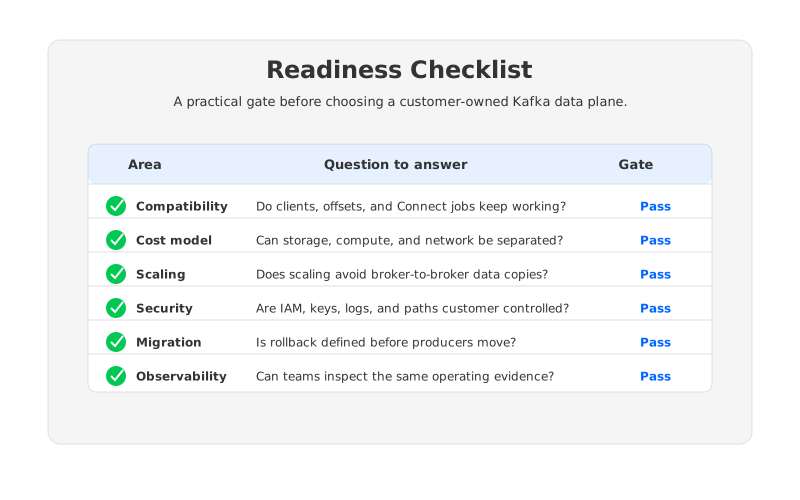
The readiness review should cover seven areas:
- Compatibility: Validate producers, consumers, transactions, offsets, ACLs, quotas, schema workflows, and Kafka Connect jobs before committing to the target platform.
- Data residency: Confirm which account, region, VPC or VNet, bucket, disk, and key-management boundary holds data-bearing resources.
- Network path: Draw producer, consumer, connector, broker, control-plane, object-storage, and observability paths. Hidden cross-zone or public paths tend to surface late.
- Scaling behavior: Ask what happens when write traffic doubles, retention expands, or a broker pool is replaced. The answer should describe data movement, not only capacity limits.
- Failure recovery: Define who can restart, replace, isolate, upgrade, or roll back each component, and what evidence remains after the incident.
- Migration plan: Test offset continuity, dual-run behavior, cutover order, and rollback criteria with a representative workload.
- Observability: Make sure platform, security, and finance teams can inspect the same operational evidence without granting broader access than necessary.
This list is deliberately operational. Procurement language tends to flatten risk into "compliant" or "not compliant." Kafka failures are not that tidy. A cluster can meet a data residency requirement and still be hard to recover. A managed service can remove upgrade toil and still leave a buyer uncomfortable with the data plane boundary. The right decision is the one whose trade-offs your team can explain during an architecture review and execute during an incident.
5How AutoMQ changes the operating model
Once the evaluation frame is clear, AutoMQ becomes relevant as a Kafka-compatible cloud-native streaming platform built around Shared Storage architecture. AutoMQ keeps the Kafka protocol and ecosystem compatibility that platform teams care about, but changes the storage model underneath. Durable data is placed in object storage through S3Stream, while AutoMQ Brokers are designed as stateless compute nodes rather than owners of broker-local persistent logs.
That design matters for customer-owned data planes because it separates questions that traditional Kafka tends to bind together. Storage ownership can align with the customer's object storage, IAM, encryption, lifecycle, and audit controls. Compute capacity can be adjusted with less dependence on broker-local data movement. Failure handling can focus on replacing or isolating compute nodes while durable data remains in shared storage. The point is not that operations disappear. The point is that the operating unit changes from "broker plus its local data" to "stateless broker fleet plus customer-controlled storage boundary."
AutoMQ BYOC and AutoMQ Software address different deployment boundaries. In AutoMQ BYOC, the control plane and data plane run inside the customer's cloud environment, with the customer retaining cloud-account and VPC-level control over data-bearing resources. AutoMQ Software serves private or customer-operated environments where the organization wants software and support inside its own infrastructure boundary. In both cases, buyers should still review IAM roles, networking, observability, upgrade permissions, and support workflows. A customer-owned data plane is a contract of responsibilities, not a slogan.
The migration story also changes when the target platform remains Kafka-compatible. Existing Kafka clients and ecosystem components can be evaluated through protocol behavior rather than rewritten around a new streaming API. In AutoMQ commercial editions, Kafka Linking is designed for Kafka-to-AutoMQ movement with offset consistency, while open source or heterogeneous environments may use tools such as MirrorMaker2 depending on requirements. The important buying rule is simple: require a rollback plan before the first production producer moves.
6A scorecard for the architecture review
Before approving a customer-owned data plane Kafka platform, give each category a red, yellow, or green status. Red means the answer is unknown or unacceptable. Yellow means the answer exists but needs a mitigation. Green means the owner, evidence, and operating action are clear enough for production.
| Category | Green signal | Red signal |
|---|---|---|
| Kafka compatibility | Representative apps pass client, offset, transaction, and Connect tests | "Compatible" is asserted without workload validation |
| Data boundary | Account, region, storage, keys, logs, and network paths are documented | Data-bearing resources are hidden behind a vague service boundary |
| Elasticity | Scaling changes compute without large broker-local data relocation | Scaling depends on long partition movement or manual storage expansion |
| Cost review | Compute, storage, and network drivers can be inspected separately | The team cannot explain the largest line items |
| Operations | Vendor and customer responsibilities are explicit for upgrades and incidents | Support access and remediation authority are unclear |
| Migration | Cutover, offset validation, dual-run, and rollback are rehearsed | Migration is treated as a one-way DNS change |
The scorecard forces a useful conversation. If the team chooses an external service, it does so with eyes open about the service boundary. If it chooses self-managed Kafka, it accepts the operational work rather than pretending ownership is free. If it chooses BYOC or customer-operated software, it validates both halves of the promise: customer control over the data plane and enough automation to avoid rebuilding a Kafka operations team from scratch.
7FAQ
7.1Is a customer-owned data plane the same as self-managed Kafka?
No. Self-managed Kafka means the customer operates the cluster directly. A customer-owned data plane means the data-bearing resources are inside a customer-controlled environment. The vendor may still provide software, automation, lifecycle management, monitoring, and support, depending on the platform model.
7.2Does a customer-owned data plane automatically solve compliance requirements?
No. It can make compliance evidence more concrete because storage, keys, logs, and network paths can sit inside the customer's boundary. The team still needs to verify access control, retention, encryption, incident response, audit logging, and vendor operating permissions.
7.3What is the main architectural difference between traditional Kafka and AutoMQ?
Traditional Kafka uses Shared Nothing architecture, where brokers manage local persistent storage and replicate partition data. AutoMQ uses Shared Storage architecture, where durable data is stored in object storage and brokers are stateless compute nodes.
7.4When should a buyer consider AutoMQ BYOC or AutoMQ Software?
Consider them when Kafka compatibility matters, but the organization also needs customer-controlled data-bearing resources, clearer cloud-account boundaries, and a storage model that reduces dependence on broker-local data movement.
If your Kafka review is stuck between managed-service convenience and infrastructure ownership, use the scorecard above with your security and platform teams. To evaluate the customer-owned deployment path with AutoMQ, start from the AutoMQ Cloud Console.


