
Table of Contents
Table of Contents
Teams usually start searching for a customer owned Kafka data plane after a procurement or security review has slowed down a streaming platform decision. The engineering team may already know what it wants from Kafka: predictable throughput, low operational friction, compatibility with existing clients, and room to scale. The security and procurement teams are asking a different question: where does the data actually live, who can reach it, who can operate the infrastructure, and what evidence proves those boundaries hold in production?
That question matters because event streams are not a peripheral integration layer anymore. Kafka topics often carry payment events, user behavior, ML features, fraud signals, audit trails, and operational telemetry. A platform that looks efficient on a feature checklist can still be hard to approve if the data plane sits outside the customer's cloud account, depends on opaque network paths, or makes incident response depend on a vendor-only operating model.
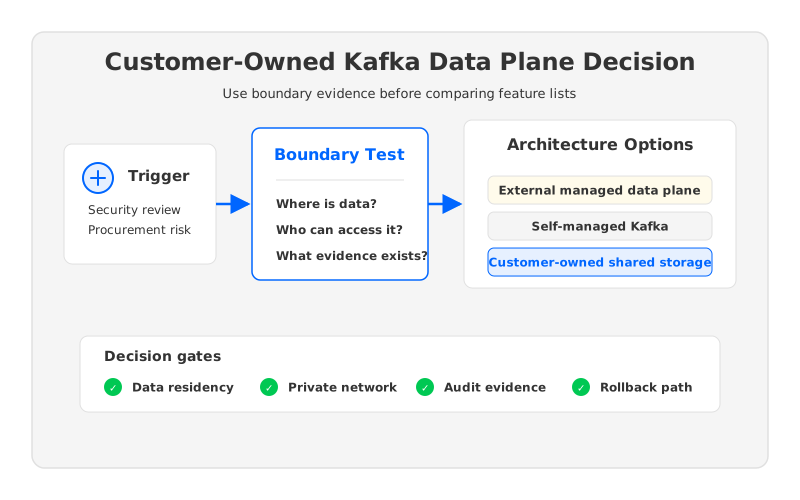
A customer-owned data plane does not mean "run everything yourself." It means the streaming system's data-bearing resources sit inside infrastructure boundaries the customer controls: cloud account, VPC or VNet, IAM policies, encryption keys, logs, private network paths, and sometimes Kubernetes clusters or VM subnets. The vendor may still provide software, automation, upgrades, monitoring, and support. The difference is that the blast radius, evidence trail, and data residency model are anchored in the customer's environment rather than hidden behind a fully external service boundary.
1Why Customer Ownership Changes the Kafka Conversation
The traditional managed-service tradeoff is clear: the vendor takes over more of the operational burden, and the customer accepts a smaller operating surface. For many workloads, that is the right tradeoff. Kafka workloads get more complicated because the data plane is not just a database endpoint. It is a constantly moving replication system with producers, consumers, brokers, partitions, controller metadata, retention policies, internal topics, access control, and sometimes cross-region replication.
When data plane ownership enters the discussion, the buying committee is usually trying to reduce four kinds of ambiguity:
- Data boundary ambiguity. The team needs to know whether message payloads, logs, snapshots, temporary buffers, and backups remain inside the customer's cloud boundary.
- Access ambiguity. Procurement wants to distinguish vendor control-plane access from vendor access to customer data-bearing resources.
- Network ambiguity. Security reviewers need concrete answers for public endpoints, PrivateLink or private endpoint patterns, egress paths, DNS, and firewall rules.
- Operational ambiguity. SREs need to know who can restart brokers, rotate certificates, inspect logs, perform upgrades, and recover from partition or storage incidents.
Those questions are not paperwork. They decide whether the streaming platform fits a regulated environment, a multi-cloud governance model, or an internal platform standard that already assumes customer-controlled keys, logs, and infrastructure-as-code.
2The First Boundary to Draw: Control Plane vs Data Plane
The most useful procurement artifact is a boundary diagram, not a feature list. A control plane typically handles provisioning, metadata, policy orchestration, upgrade workflows, fleet health, and user-facing management APIs. A data plane handles message ingress, storage, replication, fetch, topic data, local buffers, object storage, network interfaces, logs, and secrets used by the running cluster.
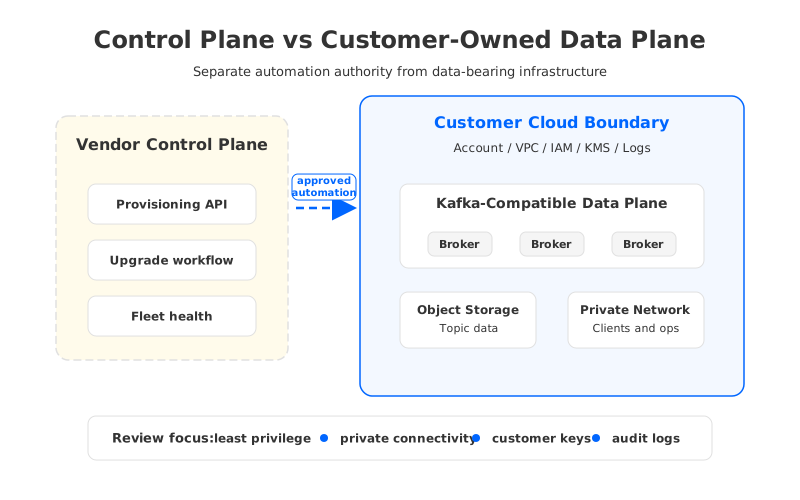
The security posture changes depending on where each component lives:
| Area | Procurement question | Evidence to request |
|---|---|---|
| Compute | Are brokers, controllers, proxies, or agents in the customer's cloud account? | Deployment topology, IAM roles, instance profiles, Kubernetes manifests, Terraform modules |
| Storage | Where do Kafka records, snapshots, logs, and backups persist? | Storage bucket/container policy, encryption configuration, retention policy, deletion workflow |
| Network | Can producers and consumers stay on private paths? | VPC/VNet diagram, endpoint policy, DNS model, ingress and egress rules |
| Identity | Who can operate the cluster and under what role? | RBAC model, service account scope, audit trail, break-glass procedure |
| Encryption | Who owns keys and certificate rotation? | KMS/key-vault policy, TLS plan, certificate authority workflow, rotation evidence |
This table also keeps the discussion honest. A vendor can say "customer-owned" while still managing critical data-bearing paths through vendor accounts. That may be acceptable, but it should be explicit. Conversely, a platform can keep data inside the customer account while still letting the vendor automate upgrades and health checks through constrained service roles. The procurement goal is not to force one operating model; it is to remove hidden assumptions before production traffic arrives.
3Kafka-Specific Security Checks
Kafka brings its own security surface. Apache Kafka supports TLS encryption, SASL authentication mechanisms, authorization through ACLs, quotas, and operational controls around listeners, brokers, topics, and consumer groups. Those primitives are powerful, but they do not answer the ownership question by themselves. A Kafka cluster can have strong ACLs and still place the data-bearing infrastructure in a boundary the customer cannot inspect.
Separate Kafka-level controls from cloud-level controls:
- Kafka identity and authorization. Validate how client identities map to principals, how ACLs are managed, how topic-level permissions are reviewed, and whether internal topics are protected with the same discipline as application topics.
- Cloud identity and infrastructure access. Validate the service roles used by brokers or operators, the minimum permissions needed for storage and network resources, and the audit trail for any vendor-operated automation.
- Encryption and key ownership. Confirm whether data is encrypted in transit and at rest, who controls the key material, how key rotation works, and what happens when a key is disabled or scheduled for deletion.
- Auditability. Require logs for administrative actions, API operations, network access, and platform changes. Kafka audit logs alone are not enough when cloud resources also determine the data boundary.
- Private connectivity. Check whether producers, consumers, monitoring systems, and admin tools can avoid public internet exposure. If private endpoints are used, confirm which direction traffic flows and who owns endpoint policies.
Kafka's KRaft mode also changes the operational shape of the platform by removing the ZooKeeper dependency from newer Kafka deployments. That simplifies one historical security and operations surface, but it does not remove the need to review controller metadata, quorum placement, credentials, backup posture, and disaster recovery. Procurement teams should treat KRaft as a modernization signal, not a shortcut around data plane due diligence.
4Procurement Evidence That Actually Helps Engineers
Security questionnaires tend to collapse into generic questions: encryption, access control, logging, compliance, incident response. Those are necessary, but Kafka teams need evidence that maps to how streaming systems fail and recover. Ask for artifacts that engineers can use during an architecture review, not only policy statements that legal teams can file.
Good evidence usually looks like this:
| Evidence artifact | Why it matters for Kafka |
|---|---|
| Reference deployment diagram | Shows where brokers, control-plane agents, storage, keys, and observability endpoints live. |
| IAM or RBAC permission matrix | Reveals whether vendor automation has broad cloud permissions or narrowly scoped operational roles. |
| Network flow table | Makes ingress, egress, replication, metrics, logs, and support access explicit. |
| Upgrade and rollback runbook | Proves the data plane can be changed without improvising during a production incident. |
| Data deletion and retention procedure | Connects Kafka topic retention to storage lifecycle, backups, object versions, and audit requirements. |
| Incident response ownership model | Clarifies who acts first when broker health, storage access, or client connectivity breaks. |
The last item is easy to underestimate. A customer-owned data plane shifts some evidence into the customer's environment, but it should not shift all accountability to the customer. The useful contract is shared operation with explicit boundaries: the customer controls cloud resources and data residency, while the vendor documents what it can observe, operate, and remediate.
5Architecture Patterns Teams Usually Compare
Most Kafka procurement decisions fall into a small set of patterns. Self-managed Kafka gives the customer maximum direct control, but it also leaves the team responsible for capacity planning, broker replacement, partition balancing, storage expansion, patching, and incident response. A fully managed external service reduces that operational load, but the data plane boundary may be outside the customer's account. A customer-owned data plane tries to keep the ownership boundary close to self-managed infrastructure while preserving more automation than a do-it-yourself cluster.
The hard part is that the broker storage model affects the ownership model. In traditional Kafka, brokers are stateful because partitions live on broker-local disks. Scaling the cluster, replacing brokers, or moving partitions often means moving data through the cluster. The platform team owns the boundary, but it also inherits the mechanics of local-disk replication and rebalance behavior.
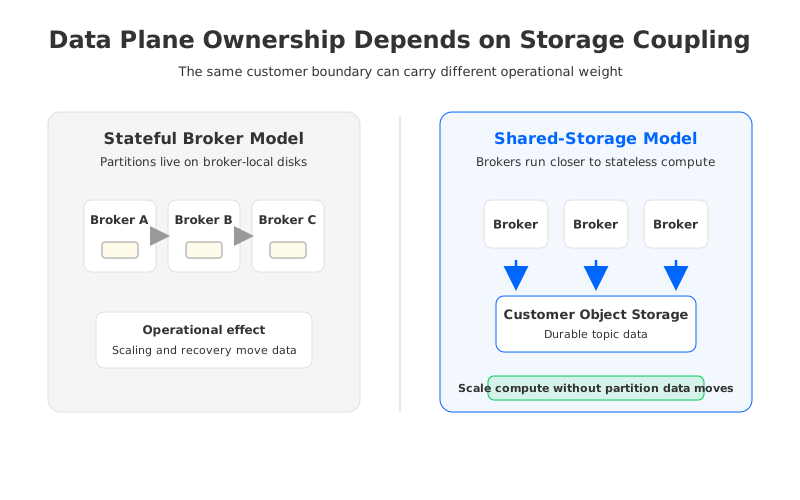
Shared-storage Kafka-compatible architectures change that tradeoff. Instead of binding durable log data to broker-local disks, they keep brokers closer to stateless compute and place durable data in object storage or another customer-controlled shared storage layer. This does not make security automatic; it changes the evidence set toward storage policies, WAL placement, IAM roles, private endpoints, metadata services, and operational agents.
6Where AutoMQ Fits in the Evaluation
If the evaluation has reached this point, the buying question is no longer "managed or self-managed?" It is "can we keep the data plane inside our cloud boundary without accepting all the operational weight of traditional Kafka?" That is where Kafka-compatible, shared-storage systems become relevant.
AutoMQ is one option in this category. It keeps the Kafka protocol surface familiar while using a shared-storage architecture with stateless brokers and object storage as the durable data layer. In BYOC-style deployments, the important security point is not that the vendor disappears from the system. The point is that the data-bearing infrastructure can be placed inside the customer's cloud environment, so cloud IAM, network boundaries, storage policies, and observability evidence remain under customer control.
For procurement teams, AutoMQ should be evaluated with the same discipline as any other platform:
- Confirm the exact deployment model: BYOC, self-managed software, Kubernetes, VM-based, cloud marketplace, or another approved path.
- Map control-plane actions to cloud permissions. Avoid treating "automation" as a black box.
- Review Kafka compatibility for client APIs, authentication, authorization, transactions, consumer groups, and operational tooling.
- Validate storage and WAL design against the organization's durability, latency, key management, and residency requirements.
- Test migration and rollback with real producer and consumer behavior, not only synthetic topic creation.
This framing keeps the product discussion grounded. AutoMQ's shared-storage model can reduce the amount of broker-local state that operators need to manage, and customer-owned deployment boundaries can help regulated teams satisfy procurement requirements. Those benefits matter only if the evidence matches the customer's security model.
7A Practical Readiness Checklist
The readiness review should end with a decision artifact that engineering, security, procurement, and operations can all understand. A useful checklist is short enough to run during architecture review, but precise enough to block vague answers.
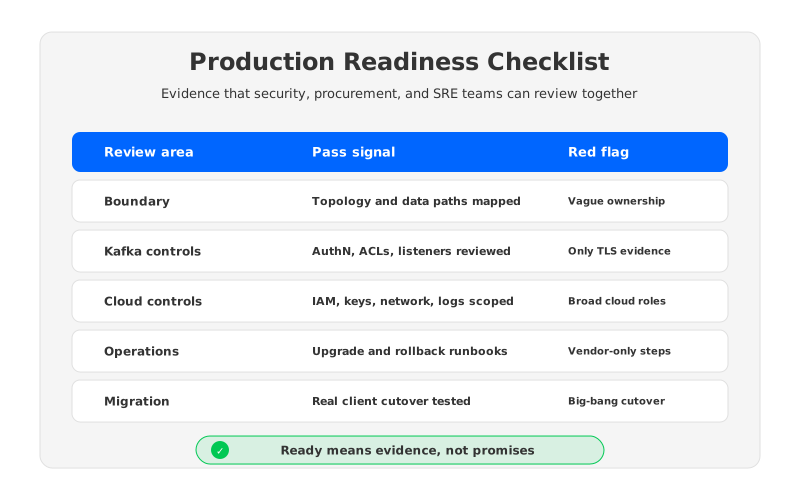
| Review area | Pass signal | Red flag |
|---|---|---|
| Boundary | Data-bearing compute, storage, keys, logs, and network paths are mapped. | "Customer-owned" is used without a topology diagram. |
| Kafka controls | AuthN, authZ, ACLs, listeners, quotas, and admin roles are documented. | Kafka security is described only as "TLS enabled." |
| Cloud controls | IAM, storage policy, private connectivity, and audit logs are reviewable. | Vendor access requires broad cloud roles or unclear exceptions. |
| Operations | Upgrade, backup, recovery, scaling, and rollback runbooks exist. | The operating model depends on tribal knowledge or vendor-only actions. |
| Migration | Client compatibility and rollback are tested with representative workloads. | The migration plan assumes all clients can cut over at once. |
| Exit | Data deletion, export, retention, and contract termination steps are explicit. | The data plane can be created easily but not cleanly unwound. |
The checklist does not choose a vendor by itself. It forces each option to answer the same architectural questions. That is the real value: security gets evidence, procurement gets risk language, and engineers get a platform model they can operate under pressure.
8Decision Guidance
A customer-owned Kafka data plane is most compelling when the organization already has strong cloud governance and wants the streaming platform to inherit that governance. It is also useful when private connectivity, customer-managed keys, regional data control, or audit evidence are hard requirements rather than nice-to-have features. In those environments, a fully external data plane can create more review work than the managed-service convenience removes.
The model is less attractive when the team wants to outsource nearly all operations and has no requirement to keep data-bearing resources inside its own account. Customer ownership creates more evidence to review and more boundaries to manage. The point is to align Kafka with the organization's security and procurement reality.
For platform teams, the best next step is to turn the checklist into a proof-of-architecture exercise. Deploy a non-production cluster, connect real clients, review IAM and network flows, rotate keys, simulate broker replacement, test a rollback, and inspect the audit trail. If the architecture still looks understandable after those tests, it is much more likely to survive the first production incident.
9References
- Apache Kafka Security Documentation
- Apache Kafka KRaft Documentation
- AWS Shared Responsibility Model
- AWS PrivateLink Documentation
- AutoMQ Documentation
- AutoMQ BYOC Installation on AWS
10FAQ
10.1What is a customer-owned Kafka data plane?
A customer-owned Kafka data plane is a deployment model where Kafka data-bearing resources run inside customer-controlled infrastructure, such as a cloud account, VPC or VNet, IAM boundary, storage bucket, key-management system, and observability stack. A vendor may still provide automation and support.
10.2Is customer-owned the same as self-managed Kafka?
No. Self-managed Kafka usually means the customer operates the whole stack. Customer-owned data plane models can still include vendor automation, managed upgrades, support tooling, and control-plane services. The key distinction is where Kafka data, keys, and network paths live.
10.3Does a customer-owned data plane automatically solve compliance requirements?
No. It can make compliance easier to evidence because infrastructure, keys, logs, and network paths are under customer control. Compliance still depends on concrete implementation: IAM scope, encryption, audit logs, operational process, data deletion, private connectivity, and contractual responsibilities.
10.4Why does shared storage matter for Kafka data plane ownership?
Traditional Kafka brokers are stateful because durable log data is tied to broker-local disks. Shared-storage architectures reduce that coupling by placing durable data in a shared storage layer and keeping brokers closer to stateless compute. That can simplify scaling and broker replacement, but it shifts security review toward storage policies, IAM, WAL design, and private connectivity.
10.5Where should AutoMQ be evaluated in this process?
Evaluate AutoMQ after the organization has defined its data boundary, cloud controls, Kafka compatibility needs, migration plan, and operating model. AutoMQ is relevant when a team wants Kafka-compatible streaming with shared storage and customer-controlled deployment options, but it should still be tested against the same evidence checklist.


