
Table of Contents
Table of Contents
Teams usually search for customer social data streams kafka after a dashboard has already become too slow for the business conversation around it. The marketing team wants campaign sentiment while the campaign is still running. Trust and safety wants suspicious account behavior before the next wave of posts spreads. Customer success wants complaints, mentions, comments, profile updates, and support events joined into one operational view, not delivered as a daily export after the window for action has closed.
Kafka is a natural fit for that pressure because social data is event-shaped. It arrives as records, needs ordering within useful keys, and often fans out to several consumers: real-time analytics, feature stores, moderation systems, alerting, customer 360 pipelines, and lakehouse tables. The hard part is not putting Kafka in the diagram. The hard part is operating the stream when the workload combines bursty traffic, unpredictable retention, data governance, and a user-facing business clock.
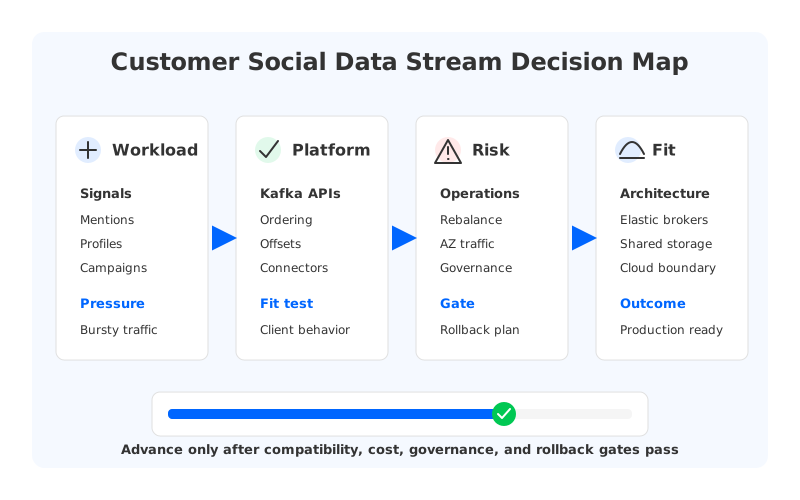
That is why this decision should start with the operating model, not a tool shortlist. A customer social stream is rarely one clean feed. It is a collection of sources with uneven quality, consent rules, changing schemas, and peaks driven by campaigns, incidents, or external events. A platform that looks fine in a steady benchmark can become fragile when it has to absorb a spike, preserve offsets during migration, and keep customer attributes inside a defined cloud boundary.
1Why Teams Search for customer social data streams kafka
The search intent is specific because the problem sits between application integration and analytics infrastructure. A team may already have a warehouse, BI tool, and social listening vendor, yet still struggle to answer operational questions in time. Batch ingestion can tell you what happened yesterday. A stream can let product, support, and risk systems react while the customer interaction is still active.
In practice, a customer social data stream often has four traffic classes. Public social interactions create high-cardinality, bursty events. First-party customer events add identity, account, and consent context. Enrichment services attach sentiment, language, topic, or safety labels. Downstream consumers materialize the stream into search indexes, feature stores, alerting systems, and analytical tables.
Those classes create a familiar but uncomfortable platform question: should the team run a traditional Kafka cluster, use a managed Kafka service, adopt a Kafka-compatible shared-storage system, or push more of the pipeline into a lakehouse ingestion stack? The right answer depends less on brand preference than on the shape of the workload.
| Evaluation area | What to test for social data streams | Why it matters |
|---|---|---|
| Event model | Keys, ordering scope, duplicate tolerance, schema evolution | Social events are noisy and often reprocessed after enrichment logic changes. |
| Consumer behavior | Lag tolerance, replay volume, fanout, offset preservation | Real-time analytics and moderation workloads may have different recovery windows. |
| Cost drivers | Broker floor, storage growth, cross-zone traffic, connector runtime | Bursts and retention can make the bill diverge from the average throughput estimate. |
| Governance | PII handling, consent state, encryption, audit trails, data residency | Social and customer data often carries compliance obligations even when sources are public. |
| Migration risk | Topic mapping, ACLs, cutover order, rollback, client compatibility | The stream becomes a shared dependency once multiple teams consume it. |
The table is intentionally neutral. Kafka may be the right substrate, but the platform team still has to decide where durable data lives, how brokers scale, and which operational boundary owns the data path.
2The Production Constraint Behind the Problem
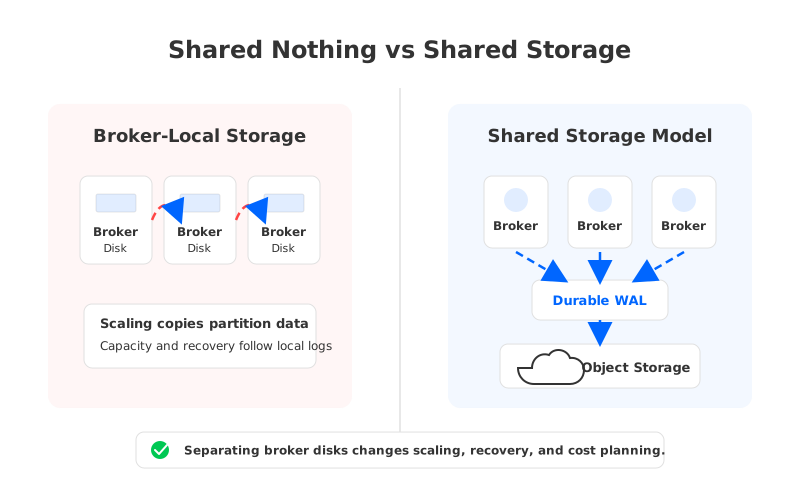
Traditional Kafka was designed around a Shared Nothing architecture: each broker owns local log segments, partitions have leaders and followers, and replication copies data between brokers for fault tolerance. That design gives Kafka strong semantics around ordered logs, consumer groups, offsets, and replay. Apache Kafka's own documentation remains the right baseline for understanding these concepts before evaluating any compatible platform.
The constraint appears when this model meets cloud economics and social workload volatility. Local broker storage makes capacity planning sticky. If retention grows or a downstream consumer needs a long replay window, brokers need enough disk and network headroom before demand arrives. If brokers are added, removed, or replaced, partition movement can copy large amounts of data between machines. If the cluster spans availability zones, replication and client placement can produce cross-zone traffic that deserves explicit cost modeling.
Customer social streams amplify this mismatch because their peaks are not always under the platform team's control. A planned campaign can be forecast. A viral product issue, fraud pattern, or celebrity mention cannot. During a spike, teams need the stream to absorb writes, protect consumers from uncontrolled lag, and keep enough retention for replay after enrichment or moderation logic is corrected. Over-provisioning for every possible peak is wasteful; under-provisioning makes the stream unreliable exactly when the business asks for it most.
The operational burden is not only storage. Kafka Connect jobs or custom source connectors need secrets, schemas, dead-letter handling, retries, rate limits, and deployment ownership. Analytics consumers need stable offsets and predictable replay. Security teams need to know where customer attributes flow. FinOps teams need a cost model that separates compute, storage, network, and managed-service fees.
3Architecture Options and Trade-Offs
The first option is self-managed Kafka or a managed service built around traditional brokers. It gives teams the broadest Kafka ecosystem surface and a familiar operating model. It is a good fit when the organization already has strong Kafka SRE practices, predictable throughput, short retention, and clear ownership for rebalancing, disk sizing, connector operations, and incident response.
The trade-off is that the team still owns Kafka's physical shape, even when someone else manages parts of the service. Broker count, storage, partition placement, network topology, and rebalance behavior remain production concerns. Tiered storage can reduce long-retention pressure on broker disks, and Apache Kafka's tiered storage work is important for the ecosystem. But tiered storage is not the same as making brokers stateless. Hot data, leadership, replication, and recovery still need testing.
The second option is to make the lakehouse the primary landing zone and treat Kafka as a thinner ingestion path. This can work well when the main goal is historical analytics, not low-latency operational reactions. Object storage is cost-effective for large data volumes, and table formats make downstream query access easier. The risk is latency and coupling: teams can end up rebuilding stream semantics around batch files, or pushing application-facing reactions through systems designed for analytical freshness rather than event-time response.
The third option is Kafka-compatible streaming with Shared Storage architecture. The goal is to keep Kafka-facing applications and ecosystem tools while changing the storage and elasticity model underneath. In this category, durable stream data is not tied to one broker's local disk in the same way. Brokers focus on Kafka protocol processing, request serving, caching, ownership, and scheduling, while a WAL and object storage provide the durable path.
That architecture does not remove the need for testing. It changes what the test should measure. Instead of asking only "can this cluster run Kafka clients," teams should test produce latency, catch-up reads, object storage request patterns, broker replacement, cache warm-up, consumer group stability, connector compatibility, and observability. For social streams, this is often the more honest benchmark because the workload combines hot-path reactions with long-tail replay.
4Evaluation Checklist for Platform Teams
A useful checklist starts with the interfaces that applications already depend on. Producers and consumers should be tested with real client versions, authentication, compression, idempotent producer settings, transactions if used, schema registry behavior, and admin workflows. Kafka compatibility is not a slogan at this level; it is the sum of client behavior, operational tooling, and failure semantics under load.
Cost modeling should come next because social data streams often look smaller in average throughput than they feel in production. Model the steady write rate, peak multiplier, read fanout, retention, replication or shared-storage behavior, connector runtime, object storage requests, and cross-zone or private connectivity charges. Cloud providers document data transfer and storage pricing separately for a reason. A platform review that ignores network paths is incomplete.
Governance needs the same specificity. Social data may include public posts, account data, profile metadata, support records, and enrichment labels. Some fields can be retained for analytics; others may need deletion, masking, or restricted access. Kafka topics are not a governance system by themselves, so the architecture has to define where classification, ACLs, encryption, audit logging, and deletion workflows live.
Use this readiness list before turning the stream into a shared production dependency:
- Verify topic boundaries around consent and sensitivity. A single "social_events" topic may be convenient for ingestion, but it can make downstream access control and deletion workflows harder.
- Test replay from realistic offsets. Many pipelines pass a happy-path consume test and fail when a consumer needs to reprocess a busy campaign window.
- Put connector failure modes in the runbook. Rate limits, malformed payloads, expired credentials, schema drift, and poison records should have visible metrics and ownership.
- Separate business freshness from infrastructure latency. A dashboard that updates in 30 seconds may tolerate a different architecture than fraud detection that reacts in seconds.
- Require a rollback path. Migration is not complete until the team can describe how producers, consumers, offsets, and ACLs move back or pause safely.
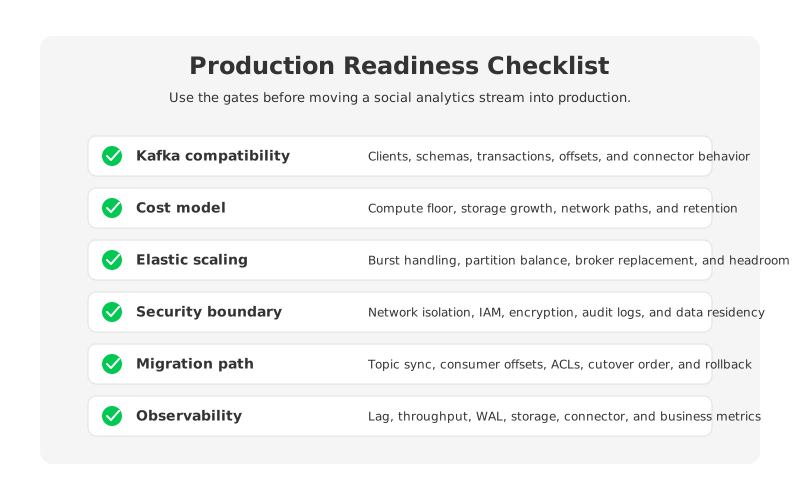
This checklist also exposes where the organization boundary matters. A SaaS-only service can be attractive when the team wants minimal operations. A BYOC or self-managed deployment can be attractive when the data path, VPC boundary, IAM model, or regional control must remain in the customer's cloud account. The point is to make the boundary explicit before regulated customer data starts flowing.
5How AutoMQ Changes the Operating Model
Once the neutral framework is clear, AutoMQ becomes relevant as a Kafka-compatible cloud-native streaming platform built around Shared Storage architecture. The important point is not that it replaces every Kafka decision with a product checkbox. It changes the relationship between brokers and durable data, which is the same relationship that makes social data streams hard to scale and recover in broker-local designs.
AutoMQ keeps Kafka protocol compatibility while using stateless brokers, S3Stream shared storage, and a WAL-based write path. In practical terms, the platform team can evaluate existing Kafka clients and ecosystem tools against a different operating model: durable data is backed by object storage, broker replacement is less tied to copying broker-local logs, and compute and storage can be reasoned about more independently.
The architecture is especially relevant when hard requirements include cloud boundaries and cost visibility. AutoMQ BYOC is designed for deployments where the data plane runs in the customer's cloud account, which helps teams keep networking, storage, and governance controls within their own environment. AutoMQ documentation also describes Kafka compatibility, WAL storage, Shared Storage architecture, Continuous Self-Balancing, AutoMQ Linking, and inter-zone traffic reduction. Those capabilities belong in the evaluation matrix, not in a blind replacement plan.
There are still trade-offs to validate. Shared storage introduces object storage behavior, WAL choices, cache effects, and metadata correctness into the production model. A latency-sensitive moderation pipeline may choose a different WAL option than a social analytics lake ingestion stream. A platform with unusual interceptors, legacy clients, or custom tooling should test those edges before migration.
The most useful AutoMQ proof of concept is therefore not the easiest topic. Pick the topic that combines bursty writes, multiple consumer groups, non-trivial retention, security controls, and a realistic cutover path. Run it through the same checklist used for any Kafka-compatible platform.
6A Practical Migration Path
Migration should start with dependency mapping, not data copying. List producers, consumers, connectors, schemas, ACLs, service owners, retention policies, and dashboards for each topic. Then classify topics by blast radius: low-risk analytical topics can move earlier, while customer-facing alerting or moderation topics should wait until offset preservation, replay, and rollback have been tested with real traffic.
For a social data platform, the cleanest pattern is usually parallel validation. Mirror selected topics into the target environment, run shadow consumers, compare message counts and derived metrics, then cut over consumers before producers where possible. This validates read behavior and dashboard correctness before changing the write path. The migration plan should also cover connector tasks, dead-letter topics, schema changes, and paused consumers.
The final gate is operational ownership. Someone must own lag alerts, connector retries, object storage errors, WAL health, schema drift, and cost anomalies after launch. If those signals are split across application, data, and platform teams, the runbook should say who acts first. A real-time customer stream is production-ready when the people and alerts around it can handle the next unusual spike.
If your team is evaluating Kafka-compatible infrastructure for customer social data streams, use the checklist above as the first filter and benchmark your hardest workload against the architecture, not the brochure. To see how AutoMQ's Shared Storage model, Kafka compatibility, and customer-controlled deployment options fit that evaluation, start with AutoMQ Cloud.
7References
- Apache Kafka Documentation
- Apache Kafka KIP-405: Kafka Tiered Storage
- Apache Kafka KRaft Documentation
- Amazon S3 Documentation
- AWS Data Transfer Documentation
- AutoMQ Kafka Compatibility
- AutoMQ Shared Streaming Storage
- AutoMQ WAL Storage
- AutoMQ Continuous Self-Balancing
- AutoMQ Linking Migration Overview
8FAQ
8.1Is Kafka a good fit for customer social data streams?
Kafka is a strong fit when the workload needs ordered event streams, consumer groups, replay, and fanout to multiple downstream systems. The platform still needs careful planning around schemas, consent, retention, cost, connector ownership, and consumer lag because social data can be bursty and sensitive.
8.2What makes social data streams different from ordinary clickstream pipelines?
Social streams often combine public interactions, customer identity, enrichment labels, moderation signals, and campaign context. That mix makes governance and replay more complex than a simple append-only clickstream, especially when downstream teams need different freshness and access-control guarantees.
8.3Does tiered storage make Kafka brokers stateless?
No. Tiered storage can reduce pressure on broker-local disks by moving older log segments to remote storage, but brokers still have important local-state, leadership, replication, and recovery responsibilities. A Shared Storage architecture changes the model more directly by separating durable stream data from broker-local disk ownership.
8.4Where should AutoMQ enter the evaluation?
AutoMQ should enter after the team has defined the workload and platform gates. It is relevant when the goal is Kafka compatibility plus a cloud-native operating model based on stateless brokers, WAL storage, shared object storage, elastic scaling, migration support, and customer-controlled deployment boundaries.
8.5What should be tested before migration?
Test real client versions, authentication, topic configuration, transactions if used, consumer offsets, connector behavior, lag recovery, object storage access, WAL health, cost signals, observability, and rollback. The test should use a representative high-pressure topic, not only a low-volume development stream.


