
Table of Contents
Table of Contents
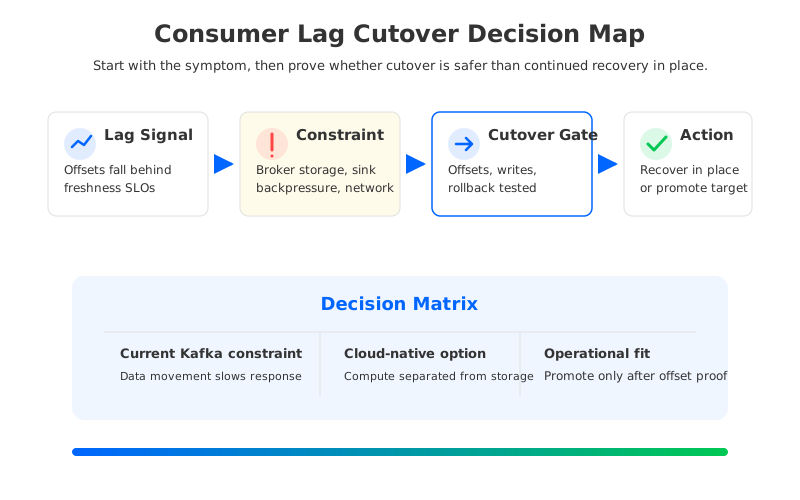
A team searching for consumer lag incident response kafka is rarely looking for a definition. They already know what the graph means: committed offsets are falling behind the log end offset, downstream jobs are missing freshness targets, and the incident channel is filling with questions that cannot be answered by a single restart. The hard part is deciding whether this is a consumer bug, a broker capacity problem, a storage bottleneck, a network side effect, or the moment when the platform should cut traffic to a different Kafka-compatible target.
That last decision is where many incident runbooks get thin. Consumer lag looks like an application symptom, but the response often depends on platform facts: how fast partitions can move, whether the target has byte-identical data, whether offsets can be preserved, and whether rollback leaves the business in a known state. A useful cutover plan treats lag response as an architecture decision, not a panic button.
1Why teams search for consumer lag incident response kafka
Consumer lag is useful because it compresses several failure modes into one visible signal. A consumer group may lag because processing time increased, a sink system slowed down, a rebalance paused work, a partition leader moved, storage reads became cold, or producers suddenly wrote more data than the consumer fleet was sized to handle. Apache Kafka's consumer model makes this measurable through offsets and consumer groups, but the metric alone does not say which layer owns the fix.
That ambiguity is why the first response should separate freshness loss from data loss. If producers are still writing successfully and the cluster is healthy, the question is how much backlog the consumers can safely burn down. If broker availability is unstable, the question changes to whether the current cluster can remain the source of truth. If a migration or disaster recovery target is already in place, the team has a third question: can the platform cut consumers over without changing the offset contract that applications depend on?
The incident gets harder when lag is tied to a planned migration. Platform teams often use a migration window to reduce old capacity, change networking, consolidate clusters, or move to a cloud-native Kafka target. Those changes remove slack exactly when rollback must be boring.
- Which consumer groups can tolerate replay, and which require exact offset continuity?
- Which topics are allowed to pause writes during cutover, and which must continue accepting producer traffic?
- Which teams own the sink systems that may be causing backpressure?
- Which metric proves the target path is healthy enough to promote?
- Which action returns traffic to the previous path if consumers fall behind again?
The goal is not to eliminate every risk. It is to keep the incident from becoming a debate about ownership while the backlog grows.
2The production constraint behind the problem
Traditional Kafka clusters use a Shared Nothing architecture. Each broker owns local log segments for assigned partitions, and durability depends on replication through the in-sync replica set. This design keeps storage close to the broker handling reads and writes. During a consumer lag incident, though, the same design turns capacity and recovery work into data movement work.
If a broker is saturated, the immediate response is to add brokers or move partitions. In a local-disk design, that means copying partition data to another broker's storage before the updated layout can carry traffic. If the lagging consumers are performing Catch-up Read from older segments, broker disks and page cache behavior matter. If the cluster spans multiple Availability Zones, replication traffic and client routing can also become part of the incident cost and throughput envelope. None of these details are visible in the lag metric, but they decide how quickly the platform can create headroom.
Tiered Storage changes part of that equation by moving older log data to remote storage. It can reduce pressure from long retention and historical reads, but it does not make brokers stateless. Recent data, leader placement, replication behavior, and partition operations still have broker-local consequences. For incident response, that means Tiered Storage helps with old-data pressure more than fast cutover, rapid capacity reshaping, or rollback under a strict offset contract.
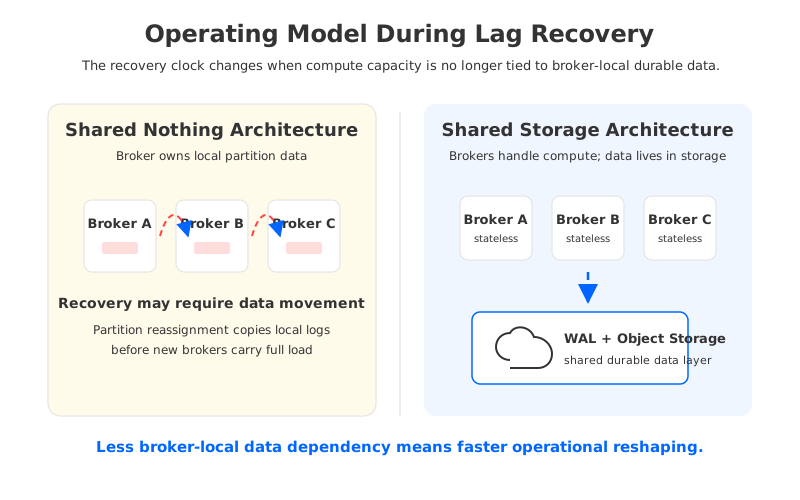
This is the constraint platform teams should name directly: consumer lag response is not only about consumers. It is about whether the streaming platform can change its operating shape faster than the backlog grows. If every meaningful change requires moving data between brokers, the incident clock is partly controlled by storage placement rather than by the SRE team.
3Architecture options and trade-offs
There are four common responses when lag persists after application-level fixes. Each can be right, but each carries a different cutover risk.
| Option | What it fixes well | Cutover risk to check |
|---|---|---|
| Add consumer instances | Processing bottlenecks when partitions are available for parallelism | Rebalances may pause work; partition count can cap parallelism |
| Scale Kafka brokers | Broker CPU, network, or request handling saturation | Local partition data may need reassignment before capacity helps |
| Mirror to another cluster | Regional failover, migration, or isolation from a degraded cluster | Offset translation, producer ordering, and rollback can become application work |
| Move to a shared-storage Kafka-compatible platform | Faster compute reshaping and less broker-local data dependency | Compatibility, WAL choice, governance boundaries, and migration tooling must be verified |
The table is intentionally not a vendor ranking. It is a way to keep the team honest about the failure mode. If the root cause is a slow database sink, more brokers will not help. If the root cause is broker-local disk pressure, more consumers may amplify fetch load. If the root cause is migration uncertainty, the missing piece is not another dashboard; it is a cutover contract that defines data, offsets, writes, and rollback.
The strongest plans also separate response time from recovery time. Response time asks how quickly freshness loss stops getting worse. Recovery time asks how quickly the system returns to steady state. A consumer group can stop falling behind after scale-out while still needing hours to clear backlog. For user-facing systems, downstream applications may care more about staleness than the existence of lag.
4Evaluation checklist for platform teams
A cutover-ready platform does not need a giant checklist, but it does need answers specific enough to execute. The following questions fit the moment before a migration, failover test, or major capacity change, when teams still have time to fix gaps.
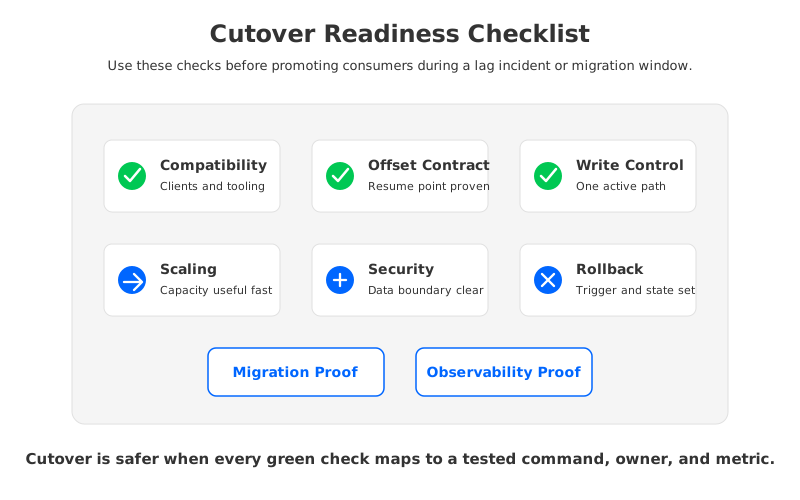
Compatibility. Can existing producers, consumers, Kafka Streams jobs, Kafka Connect workers, ACLs, authentication methods, and serializers run against the target without code changes? Apache Kafka client compatibility is the difference between a platform cutover and an application migration.
Offset continuity. Does the plan preserve consumer group progress, or require replay from a chosen point? Replay is acceptable for many analytical pipelines. It is dangerous for workflows that trigger external side effects, update operational databases, or depend on exactly-once semantics. If offset continuity is required, test it with the actual groups that will be promoted.
Write path control. Can producers keep writing during the cutover, and can the platform prevent split-brain writes? Many migration tools handle data replication better than write coordination. During an incident, write path control decides whether rollback is clean or investigative.
Scaling boundary. When lag rises, which layer scales first: consumers, brokers, storage throughput, network, or sink systems? The answer should be tied to metrics. Scaling all layers at once may clear the incident, but it also hides the root cause and makes the next event harder to reason about.
Cold-read behavior. Can the platform serve Catch-up Read without starving tailing consumers? Backlog recovery often reads older data while live consumers still need fresh data. Poor read isolation can turn recovery into a second production incident.
Governance and data boundary. Where do data, credentials, logs, metrics, and control operations live? For regulated workloads, the right answer may be a BYOC or self-managed deployment where the data plane stays in the customer's cloud account or private environment.
Rollback. What exact condition triggers rollback, and what state is safe to roll back to? The answer should include producer routing, consumer offsets, topic creation, ACLs, and observability. "Switch back if needed" is not a plan.
These questions make the incident smaller because they turn a broad platform debate into a few contracts: client behavior, offset behavior, write behavior, scaling behavior, and ownership boundaries.
5How AutoMQ changes the operating model
Once the evaluation framework is clear, a different architecture becomes easier to reason about. AutoMQ is a Kafka-compatible cloud-native streaming platform that keeps the Apache Kafka protocol and client ecosystem while replacing broker-local durable storage with a Shared Storage architecture. Persistent data is stored in S3-compatible object storage through S3Stream, with WAL (Write-Ahead Log) storage used for durable write buffering and recovery.
That shift matters during consumer lag incident response because brokers no longer carry the same local-data burden. AutoMQ Brokers handle Kafka protocol work, leadership, caching, and scheduling, while durable data is anchored in shared storage. When compute capacity changes, the platform can rebalance traffic and partition ownership without copying each partition's full local log to another broker. The result is a shorter path from "we need more headroom" to "the added headroom is useful."
For cutover planning, the more interesting point is control. AutoMQ's Kafka compatibility reduces application change risk. Its Shared Storage architecture changes the operational cost of broker replacement, scaling, and recovery. Self-Balancing helps keep traffic distributed as brokers come and go. Kafka Linking in AutoMQ commercial editions supports migration scenarios where byte-to-byte topic synchronization and consumer group progress matter to the switchover plan.
The deployment boundary is also part of the incident story. AutoMQ BYOC runs the control plane and data plane in the customer's cloud account and VPC, while AutoMQ Software targets private environments. That matters when a review asks where data moved, which credentials were used, and whether the recovery target crossed a governance boundary.
There are still design choices to make. WAL storage type affects latency and deployment complexity. Object storage behavior affects recovery and cold-read economics. Network routing, PrivateLink usage, and cross-AZ data transfer rules still need cloud-specific review. The advantage is that these choices become explicit parameters instead of hidden broker-local disk placement and emergency partition moves.
6A cutover readiness scorecard for lag incidents
The scorecard below helps decide whether to cut over, keep scaling the current cluster, or pause and fix prerequisites. Use it before the migration window, then keep it in the incident runbook.
| Question | Green signal | Red signal |
|---|---|---|
| Are consumers lagging because of application processing? | Lag is isolated to known groups and sink metrics show backpressure | Lag appears across unrelated groups and broker metrics degrade |
| Can the target preserve required offsets? | Tested consumer groups resume from expected offsets | Offset mapping is manual, approximate, or untested |
| Can writes continue safely? | Producer routing has one active write path and a tested promotion step | Producers may write to both clusters or require a full application stop |
| Can compute capacity change quickly? | Brokers or consumers can scale without long data movement | Partition reassignment or disk warmup dominates the response time |
| Is rollback defined? | Metrics, owner, command, and acceptable state are documented | Rollback depends on judgment during the incident |
| Are governance boundaries clear? | Data plane, credentials, logs, and metrics stay in approved locations | Recovery requires a temporary exception nobody pre-approved |
A green score does not mean "cut over immediately." It means the platform has enough mechanical sympathy to make cutover an operational choice. A red score means the response should focus on clearing backlog and closing migration gaps before the next switchover.
The uncomfortable lesson from consumer lag incidents is that the lag graph is late. By the time it is visible, the system has already spent some recovery budget. Teams that plan cutover around offsets, write paths, storage placement, and rollback get more of that budget back. If you are evaluating a Kafka-compatible target for that operating model, test AutoMQ against one real lag scenario rather than a generic benchmark. Start with the consumer group that would hurt most if rollback were messy, then work backward from its offset contract.
Explore AutoMQ on GitHub or use the same checklist with your own migration plan before the next incident decides the schedule for you.
7FAQ
7.1What is consumer lag in Kafka?
Consumer lag is the difference between the latest offset available in a partition and the offset a consumer group has processed or committed. It shows how far a consumer group is behind the producers for the partitions assigned to that group.
7.2When should consumer lag trigger a cutover?
Lag should trigger cutover only when the target path has tested data synchronization, offset behavior, write routing, observability, and rollback. If the root cause is an application sink or processing bottleneck, cutover may move the symptom without fixing the cause.
7.3Does Tiered Storage solve consumer lag incident response?
Tiered Storage can help with long retention and historical data pressure, but it does not remove every broker-local operational constraint. For cutover planning, teams still need to evaluate leader placement, recent data, consumer offsets, write coordination, and rollback.
7.4Why do stateless brokers matter for lag recovery?
Stateless brokers reduce the amount of durable data tied to a specific broker. That can make broker replacement, scaling, and traffic rebalancing faster because the system does not need to copy full partition logs before added compute capacity becomes useful.
7.5How should teams test Kafka migration readiness?
Use a production-like consumer group, replicate its topics, verify offset continuity, promote reads in a controlled window, validate downstream idempotency, and rehearse rollback. Include the slowest acceptable Catch-up Read path, not only tailing traffic.
8References
- Apache Kafka documentation: Consumers
- Apache Kafka documentation: Consumer configs
- Apache Kafka documentation: KRaft
- Apache Kafka documentation: Tiered Storage
- AutoMQ documentation: Kafka compatibility
- AutoMQ documentation: Shared Storage architecture
- AutoMQ documentation: WAL storage
- AutoMQ documentation: Continuous Self-Balancing
- AutoMQ documentation: Kafka Linking
- AWS documentation: Amazon S3 data durability
- AWS pricing: Data transfer
- AWS pricing: PrivateLink


