
Table of Contents
Table of Contents
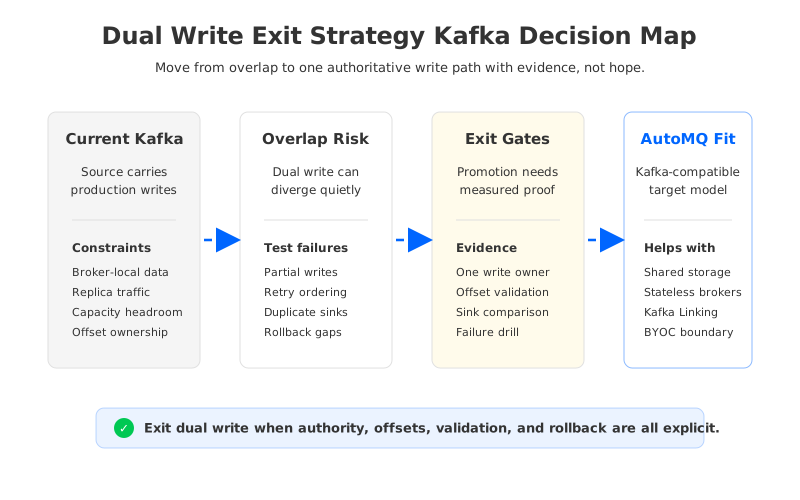
Teams usually search for dual write exit strategy kafka after the migration has already become real. The source cluster is still carrying production traffic, the target platform is receiving copied or duplicated events, dashboards show two versions of the same stream, and nobody wants to be the person who declares the old path safe to turn off. Dual write looks like a safety net when the project starts. Near cutover, it becomes a question of authority: which system is allowed to accept writes, which offsets define progress, and what evidence proves the target path can stand on its own?
That is the right moment to slow down. A dual-write exit is not a final checkbox after a Kafka migration; it is the part of the plan where application semantics, Consumer group progress, infrastructure capacity, and rollback ownership meet. If those decisions are left implicit, the team may keep both paths alive for weeks because every group has a different fear. If they are written down early, the exit becomes a controlled promotion rather than an argument during a release window.
1Why teams search for dual write exit strategy kafka
Dual write is attractive because it gives platform teams a way to observe the target path without breaking the source path. Producers can send records to the existing Kafka cluster and the candidate platform. Consumers can compare counts, keys, lag, and sink output. SREs can test alerts and dashboards against live-shaped traffic instead of synthetic load. This is useful work, but it does not remove the distributed-systems problem underneath it.
The hard part is partial failure. A producer can succeed on one write and fail on the other. Retries can preserve order in one path and change timing in the other. A downstream sink can be idempotent for one topic and duplicate-sensitive for another. Apache Kafka documents the core primitives that matter here: records are ordered within partitions, consumers track progress through offsets, Consumer groups coordinate partition ownership, and transactions can bind multiple writes under specific conditions. Those primitives help teams reason precisely, but they do not make two independently written systems magically identical.
The exit question is therefore not "Did both clusters receive data?" A safer question is: "Can the target path become authoritative without creating unbounded duplicate, missing, or reordered effects?" That answer depends on the workload. Analytics topics may tolerate replay and reconciliation. Payment, fraud, inventory, and customer-notification streams usually need stricter controls. A single exit pattern applied to every topic is a sign that the plan is optimizing the spreadsheet, not the system.
2The production constraint behind the problem
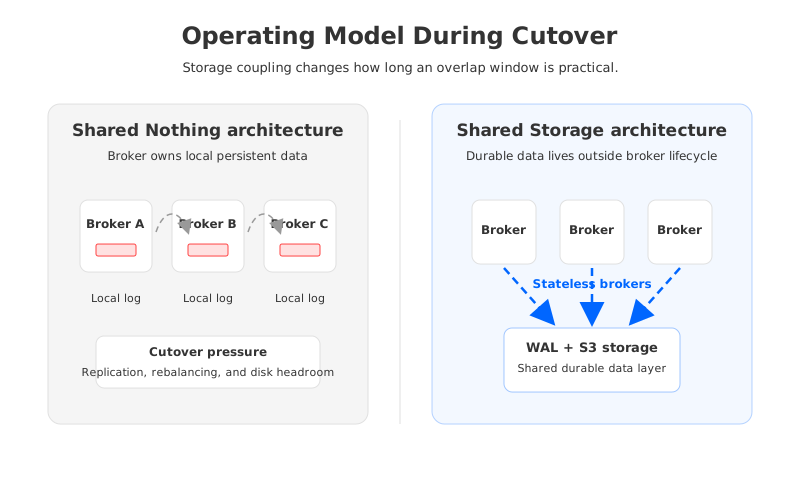
Traditional Kafka runs on a Shared Nothing architecture: each broker owns local storage, and partition replicas are spread across brokers for durability and availability. That model is well understood and operationally proven. It also means a migration touches more than client endpoints. Topic placement, replication, broker capacity, disk headroom, leader movement, and retained history all affect whether the source and target can run in parallel long enough to prove correctness.
During a dual-write window, this pressure multiplies. The source cluster must keep serving production traffic while the target platform absorbs mirrored or duplicate writes. Observability must distinguish source lag from target lag. Security teams may need temporary credentials, network paths, and access control rules for both systems. Capacity planners may need to reserve headroom for backfill, catch-up reads, validation consumers, and rollback. The migration is no longer a copy operation; it is a temporary production architecture.
The storage model shapes that temporary architecture. In traditional Kafka, retained data is tied to broker-local storage, so rebalancing and capacity changes can require data movement across brokers. Apache Kafka Tiered Storage helps by moving older log segments to remote storage, but brokers still keep local log segments and remain part of the storage lifecycle. That distinction matters during a cutover because the target platform's failure and scaling behavior determine how long the overlap period can safely last.
3Architecture options and trade-offs
There are several defensible ways to leave a dual-write phase. The right choice depends on whether the producer, migration tooling, or platform layer owns write authority. A clean plan names that owner before the first production topic moves.
| Option | Where control lives | Best fit | Main risk to test |
|---|---|---|---|
| Single-writer cutover | Release or routing layer | Ordered workloads with strict ownership | Pause duration, client refresh behavior, and target readiness |
| Dual-write exit | Application producer | Workloads with application-owned deduplication | Partial writes, retry divergence, and sink idempotency |
| Replication-first promotion | Migration tool or connector | Topic-by-topic migration with source authority | Replication lag, offset mapping, and promotion timing |
| Kafka-compatible platform migration | Target platform plus Kafka clients | Teams changing operating model while keeping Kafka APIs | Compatibility surface, rollback path, and operational evidence |
The table is deliberately neutral. Application dual write may be the right answer when the producer already owns idempotency keys and downstream systems can reconcile duplicates. Replication-first promotion may be safer when the source must remain authoritative until the final switch. A single-writer cutover is often easier to reason about for ordered workloads, but it demands a well-rehearsed freeze, fast validation, and a clear rollback trigger. The architecture decision is less about elegance than about who can prove correctness under failure.
Offset handling deserves separate attention because it is where many migration plans become vague. A copied topic is not enough if consumers resume from the wrong position. Consumer group state, committed offsets, sink checkpoints, and stream-processing state need a shared timeline. The team should be able to explain whether each consumer will reset, resume from synchronized offsets, replay from a known point, or run in shadow mode until promotion. If a consumer group cannot tolerate duplicate processing, its cutover gate should be stricter than a batch analytics reader.
4Evaluation checklist for platform teams
The exit plan should be written as questions with evidence, not as a happy-path sequence. A release manager can mark a step complete; a platform owner needs to know why the next action is safe. Use this checklist as a readiness review before disabling the old write path.
- Write authority: Which system is authoritative before, during, and after promotion? The answer should name the producer route, the block on stale writes, and the exact moment dual write ends.
- Offset continuity: Which Consumer groups need offset preservation, and which can replay? For each critical group, record the source offset, target offset, validation method, and owner who accepts the result.
- Ordering and idempotency: Which topics rely on partition order or unique side effects? These topics need explicit duplicate handling before any dual-write path is trusted.
- Capacity and catch-up: Can the target absorb live traffic, validation consumers, backfill, and catch-up reads at the same time? The evidence should come from measured load during the overlap window, not from steady-state sizing alone.
- Security and governance: Are ACLs, service accounts, certificates, schema access, audit trails, and network policies equivalent enough for production? A migration can fail because a sink is unauthorized even when data replication is healthy.
- Rollback boundary: What event triggers rollback, and what happens to target-only records? A rollback plan that cannot answer this question is a pause plan, not a recovery plan.
- Observability parity: Do dashboards show produce errors, Consumer lag, broker health, replication lag, target write success, sink failures, and business-level validation? Cutover evidence should be visible to both platform and application owners.
These questions force an uncomfortable but useful distinction. Some topics are ready to exit dual write; others are only ready to keep testing. Treating every workload as one migration unit creates a large release risk. Treating topic groups or application domains as independent cutover units lets the team retire overlap gradually while keeping rollback local.
5How AutoMQ changes the operating model
Once the evaluation framework is clear, the platform choice becomes easier to discuss. AutoMQ is a Kafka-compatible streaming platform that keeps Kafka protocol behavior while replacing broker-local persistent storage with a Shared Storage architecture backed by object storage. That means the migration still has to respect Kafka semantics, but the target operating model is different: AutoMQ Brokers are stateless, durable data lives in shared storage, and scaling or broker replacement no longer depends on moving partition data from one broker disk to another.
That difference matters for a dual-write exit because overlap periods are operationally expensive. If the target platform needs prolonged manual rebalancing every time throughput changes, the migration team may become conservative and keep source authority longer than planned. In AutoMQ's model, WAL (Write-Ahead Log) storage handles low-latency durable writes, S3 storage holds the primary data, and S3Stream maps Kafka log behavior onto shared object storage. The broker is still on the Kafka request path, but its lifecycle is less entangled with retained data.
For migration specifically, AutoMQ's Kafka Linking capability is designed around the risks platform teams usually try to solve with hand-built dual write. Public AutoMQ documentation describes byte-to-byte topic synchronization, Consumer group progress synchronization, and a producer proxy path for staged switching. Those capabilities do not remove the need for workload validation, but they move key concerns away from application code: offset consistency, topic promotion, and producer routing can be handled as migration mechanics instead of being reimplemented by every producing service.
This is also where BYOC boundaries matter. AutoMQ BYOC runs control plane and data plane components in the customer's cloud account or VPC, so teams evaluating governance, network control, and data residency can keep the migration discussion inside their own operational boundary. For private environments, AutoMQ Software serves a similar architectural goal in customer-operated infrastructure. The important point for cutover planning is not a product label; it is whether the target platform lets the team prove Kafka compatibility, exit dual write, and simplify steady-state operations after the migration.
6A practical exit scorecard
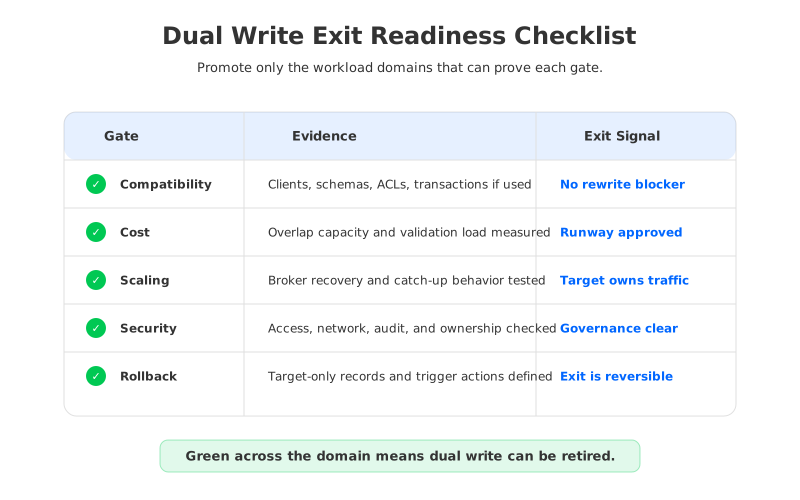
The cleanest exit plan is boring. It has named owners, measured evidence, and a rollback decision that does not require improvisation. Before declaring a topic group ready, score each area as green, yellow, or red. Green means evidence exists and the owner accepts it. Yellow means a known issue has a documented mitigation. Red means the topic stays in the overlap phase.
| Gate | Green signal | Red signal |
|---|---|---|
| Producer route | One authoritative write path is enforced | Old and target producers can both accept writes accidentally |
| Consumer progress | Critical groups have validated resume or replay rules | Offset behavior is assumed but not measured |
| Data comparison | Counts, keys, timestamps, and sink effects match agreed tolerances | Validation only checks that records exist |
| Failure drill | Broker, producer, and sink failures have been rehearsed | Rollback depends on manual guesswork |
| Target operations | Scaling, monitoring, access, and incident response are owned | Platform team still treats target as a test cluster |
The scorecard should be run per workload domain, not per cluster. A search-index topic, a payment ledger topic, and an observability topic do not deserve the same tolerance for replay or duplicates. When a domain reaches green, retire dual write for that domain and reduce the temporary architecture. Keeping both paths alive after the exit criteria are met only creates another production system to monitor.
7FAQ
7.1Is dual write a safe Kafka migration strategy?
It can be safe for workloads that own idempotency, ordering, retries, and reconciliation in application logic. It is risky when teams treat dual write as a generic safety layer. The exit plan must define write authority, partial-write behavior, duplicate handling, offset validation, and rollback before production traffic depends on it.
7.2Should producers or consumers move first?
Consumers often move first when the team can validate reads from the target without changing write authority. Producers should move only when the target path, offset plan, observability, and rollback rules are proven. Ordered or side-effect-heavy topics usually need stricter producer cutover controls than analytics topics.
7.3How does Kafka compatibility reduce cutover risk?
Kafka compatibility lets existing clients, topics, offsets, Consumer groups, and ecosystem tools keep the same mental model. It does not make migration automatic. Teams still need to validate client versions, security rules, schemas, transactions if used, connector behavior, lag, and rollback.
7.4Does Shared Storage architecture replace migration planning?
No. Shared Storage architecture changes the operating model after traffic moves by reducing broker-local storage coupling and data movement during scaling or recovery. The migration plan still needs workload-specific evidence for correctness, especially around offsets, ordering, and downstream side effects.
7.5When can a team turn off the old write path?
Turn it off when one write path is authoritative, critical Consumer groups have validated progress, downstream sinks meet agreed tolerances, observability is production-ready, and rollback has a tested decision boundary. If target-only writes cannot be explained, the old path should stay available until that gap is closed.
If your migration plan still depends on prolonged application dual write, compare that design with a Kafka-compatible shared-storage target and a migration tool that handles topic, offset, and producer-routing mechanics. Start with the AutoMQ BYOC trial and test one workload domain before widening the cutover.


