
Table of Contents
Table of Contents
Teams usually search for Redpanda alternatives after the easy part of event streaming is already behind them. The application has producers and consumers. The first topics are running. Latency looks promising in a benchmark or early production slice. Then the platform team has to answer the harder question: what happens if this becomes the shared streaming layer for dozens of services, multiple availability zones, strict recovery targets, and a cloud bill that finance actually reads?
That question is not a vote against Redpanda or any Kafka-compatible engine. It is the normal point where an architecture choice becomes an operating model. A streaming platform is a contract across client compatibility, storage durability, network boundaries, failover behavior, compliance controls, and migration safety.
The right evaluation is less like a product ranking and more like a cutover worksheet. Which workloads can move first? Which Kafka semantics are mandatory? Which cost line is likely to surprise you? Which rollback path keeps the old platform trustworthy while the target is being proven? Teams that answer those questions early have fewer surprises than teams that start with a feature matrix.
1Why Teams Search for Redpanda Alternatives
The phrase redpanda alternatives hides several intents. Some teams are comparing managed services because they no longer want to run brokers themselves. Some want Kafka API compatibility but are open to a different storage architecture. Others have standardized on Kafka clients and need a platform that makes cloud cost and multi-AZ operations easier to reason about. Treating them as one generic query produces shallow decisions.
A practical shortlist starts with the workload, not the vendor name. A fraud detection pipeline with strict latency budgets will weight tail latency and producer behavior differently from a log aggregation pipeline with high retention and bursty reads. A central platform team may prefer stronger operational controls, while a product team moving one application may care more about migration speed and client compatibility.
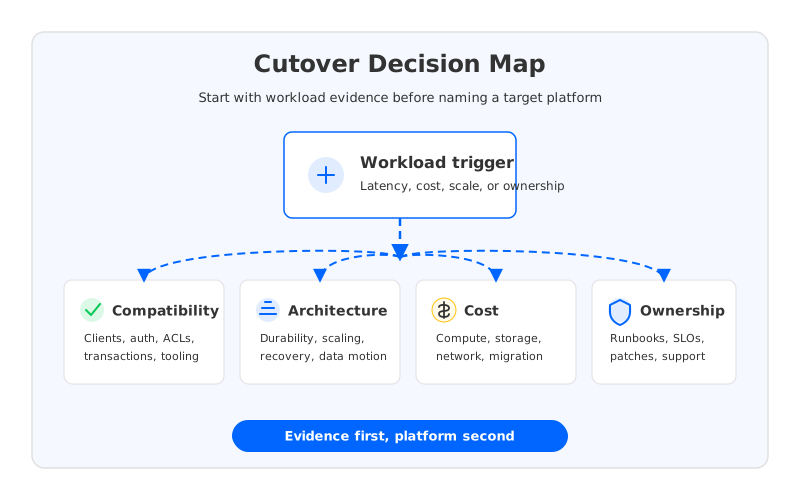
Before comparing platforms, separate the decision into four buckets:
- Compatibility risk: the Kafka APIs, client versions, security controls, transactions, consumer group behavior, and ecosystem integrations the workload actually uses.
- Architecture risk: how the system stores durable data, moves replicas, handles hot partitions, scales brokers, and recovers from node or zone failure.
- Cost risk: compute, storage, inter-zone traffic, cross-region traffic, management fees, data transfer, retention growth, and migration overlap.
- Ownership risk: who patches, monitors, scales, secures, audits, and debugs the platform when the migration is no longer a project but a dependency.
That framing keeps the discussion factual. It also prevents a common mistake: assuming Kafka compatibility means migration risk is low. Compatibility reduces risk only when it covers the exact behaviors your applications rely on. A workload can be "Kafka-compatible" at the happy path and still be blocked by one unsupported admin workflow, authentication mode, or connector dependency.
2What High-Level Comparison Pages Usually Miss
High-level comparison pages reveal active buying intent, but they rarely give a platform team enough information to plan a production cutover. Short summaries and broad pros and cons cannot answer whether your consumer lag recovery model still works, whether ACL automation maps cleanly, or whether cross-AZ replication traffic changes workload economics.
The missing layer is the system boundary. In a production streaming platform, the boundary is not "broker versus broker." It includes the cloud network, storage, identity provider, schema registry, CI/CD path for topic changes, observability stack, incident response model, and contracts application teams already depend on.
Cutover planning becomes more valuable than feature comparison when the team asks questions that force evidence:
| Cutover area | Question that matters | Evidence to collect |
|---|---|---|
| Kafka behavior | Which client APIs and admin operations are used in production? | Client version inventory, producer configs, consumer group patterns, transaction usage |
| Storage model | Where is the durable copy of data, and how is it recovered after broker loss? | Recovery tests, retention model, rebuild time, storage durability documentation |
| Network boundary | Which bytes cross AZ, VPC, account, or region boundaries? | Cloud billing reports, network diagrams, load tests with real replication and read patterns |
| Operations | Who owns upgrades, scaling, monitoring, and incident response? | Runbooks, SLOs, alert definitions, support model, upgrade rehearsal |
| Rollback | How do you return traffic to the old platform without data ambiguity? | Dual-write plan, offset mapping, validation windows, freeze criteria |
The table is intentionally boring. Boring questions catch expensive problems and create a shared language between SREs, architects, FinOps, procurement, and application teams. A vendor conversation becomes more productive when the buyer can state the required Kafka behaviors, traffic shape, rollback requirement, and cost model.
3Architecture Criteria Behind the Shortlist
Every Redpanda-compatible workload evaluation eventually reaches an architecture fork. One path keeps the traditional broker-centered model: brokers own compute and durable storage, and replication keeps multiple copies available. Another path uses a managed Kafka service where the provider absorbs much of the operational surface, while the buyer still manages sizing, storage, networking, and pricing choices. A third path keeps Kafka-compatible APIs while changing the storage layer, often by separating compute from durable data.
The fork matters because Kafka was originally designed around local broker storage and broker-level replication. That model is proven and widely understood. It also means rebalancing, scaling, and failure recovery are tied to data movement. When a broker is added, removed, or replaced, the platform must account for partitions, replicas, leader placement, and catch-up work.
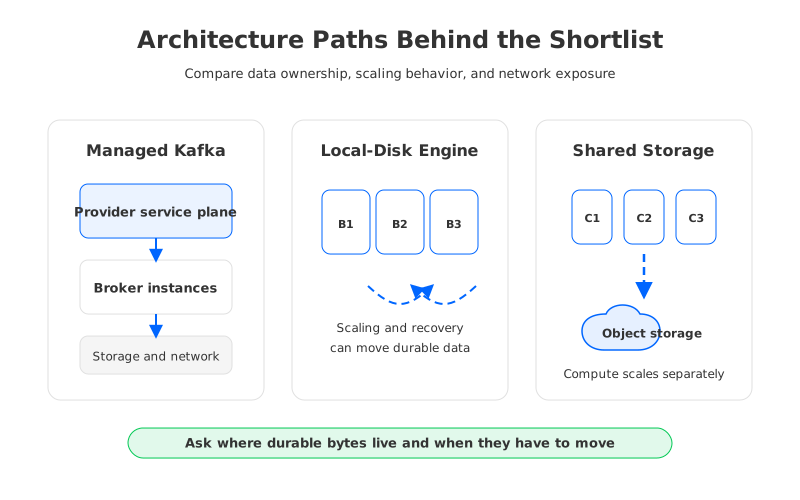
Teams should evaluate storage architecture with three questions in mind. First, what is the authoritative durable copy of the log? Second, how much data must move when compute capacity changes? Third, which network paths are charged when the system maintains availability? These questions are more durable than any one benchmark because they explain how the platform behaves under growth, failure, and topology changes.
For many teams, managed Apache Kafka remains a strong candidate because it preserves familiar semantics and reduces infrastructure ownership. Amazon MSK publishes pricing dimensions for broker instances, storage, provisioned throughput features, and other choices, while AWS separately publishes data transfer pricing that can apply when traffic crosses cloud boundaries. A streaming workload with high fan-out or multi-AZ replication can turn network placement into a first-order design constraint.
Kafka-compatible engines and cloud-native streaming systems approach the fork differently. Some optimize broker internals and keep local-disk thinking. Some provide a fully managed service surface. Others push durable storage into shared object storage so that brokers can behave more like stateless compute. The point is to connect the architecture to the workload instead of treating "alternative" as a brand category.
4Migration and Ownership Questions for Platform Teams
A cutover succeeds when application teams experience it as a controlled infrastructure change rather than a surprise rewrite. That requires more than protocol compatibility. It requires a migration plan that protects data correctness, operational visibility, and rollback authority.
Start with the client inventory. List producers, consumers, Kafka Streams applications, connectors, schema dependencies, security mechanisms, and administrative automation. Then classify each workload by blast radius. A stateless metrics producer with replayable data can move early. A payments workflow using transactions, strict ordering assumptions, or tightly controlled ACLs deserves a longer validation window. This classification prevents the loudest service from defining the migration schedule.
The second planning layer is data movement. Teams often focus on producing to the target cluster, but consumers are where migrations become subtle. Offsets, lag, replay windows, compaction topics, and exactly-once assumptions need explicit handling. A good plan answers when consumers switch, how progress is compared, and how long the source platform remains authoritative.
Use a readiness scorecard before moving shared production traffic:
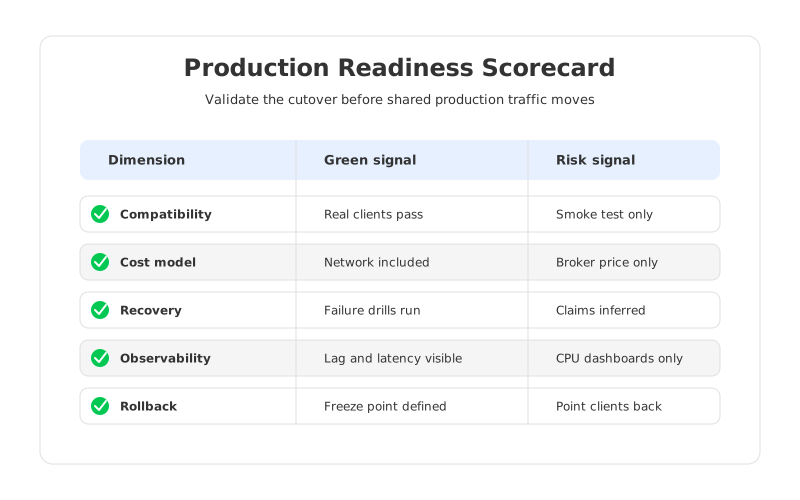
| Readiness dimension | Green signal | Red signal |
|---|---|---|
| Client compatibility | All required clients, auth modes, admin workflows, and integrations pass realistic tests | Only produce/consume smoke tests have passed |
| Cost model | Storage, compute, replication, network, retention, and migration overlap are modeled together | Only broker or subscription price is compared |
| Failure recovery | Broker, zone, and network failure behavior has been rehearsed | Recovery is inferred from architecture claims |
| Observability | Lag, throughput, error rate, request latency, controller health, and storage signals are visible | Dashboards cover only node CPU and memory |
| Governance | Topic creation, ACLs, quotas, encryption, audit, and change control map to existing workflows | Platform access is manually configured |
| Rollback | Clear freeze point, validation rules, and source-of-truth decision are documented | Rollback means "point clients back" without offset and data rules |
This scorecard is deliberately strict because migrations rarely fail at the headline feature. They fail where two teams made different assumptions. The application owner assumes the platform team can replay data. The platform team assumes consumers are idempotent. Finance assumes the target architecture removes an old cost line. A worksheet forces those assumptions into the open.
5Cost Questions That Belong in the Architecture Review
Cost should not be the sole reason to evaluate Redpanda alternatives, but it belongs in the architecture review from the beginning. Streaming platforms are sensitive to data movement because the same byte may be written by a producer, replicated for durability, read by multiple consumer groups, retained for days, and moved again during rebalancing or migration.
The cleanest cost model separates steady-state cost from change cost. Steady-state cost includes compute, durable storage, retention, throughput, management fees, support, and network traffic. Change cost includes migration overlap, dual writes, backfills, rebalancing, temporary clusters, test environments, and engineering time. Many platform decisions look different when both are visible.
For cloud deployments, network boundaries deserve special attention:
- Inter-zone paths: replication, client placement, and consumer fan-out can create traffic between availability zones. Whether and how this is billed depends on provider pricing and service architecture.
- Cross-region paths: disaster recovery, mirror topics, analytics exports, and global applications can move data across larger billing boundaries.
- Private connectivity: PrivateLink, NAT gateways, VPC peering, and transit gateways can add charges outside the broker service itself.
- Migration overlap: dual writes and validation reads can temporarily double traffic. That temporary cost is acceptable when planned, but it becomes a surprise when omitted.
This is why procurement should not ask only for a unit price. The better question is, "What workload shape did we price?" A benchmark with one producer and one consumer tells you little about a shared platform where several teams read the same topics at different rates.
6How AutoMQ Fits the Evaluation
Once the evaluation reaches storage architecture, AutoMQ becomes relevant as one example of a Kafka-compatible, cloud-native streaming system that separates compute from durable storage. The important part is not the product name. The important part is the category: keep Kafka protocol compatibility where application teams need it, while changing the broker storage model so cloud object storage becomes the durable data layer and brokers can be managed more elastically.
AutoMQ documents Apache Kafka compatibility for common Kafka APIs and ecosystem expectations, and its architecture is built around S3Stream shared storage with stateless brokers and object-storage-backed durability. In practical evaluation terms, that maps to several worksheet questions: how much data moves when compute scales, how recovery works after broker loss, how retention growth affects storage planning, and how network traffic behaves in a multi-AZ design. AutoMQ also documents a zero cross-AZ traffic design for relevant cloud deployments, which is worth examining for workloads where inter-zone data transfer is a major cost driver.
This does not remove the need for testing. A serious buyer should still run client compatibility checks, load tests, failure drills, security validation, and operational rehearsals. It does, however, give the platform team a different architecture to test: whether a shared-storage Kafka-compatible model changes the cost and recovery envelope enough to warrant a cutover.
The most useful AutoMQ conversation is therefore not "replace Redpanda with AutoMQ." It is: if your workload is Kafka-compatible, cloud-hosted, retention-heavy, sensitive to cross-AZ traffic, or constrained by broker data movement during scaling and recovery, test whether a shared-storage architecture changes the decision.
When you are ready to turn the worksheet into a hands-on evaluation, start with a small workload that represents your hardest constraint rather than your easiest success. A latency-critical topic, a high-retention pipeline, or a fan-out-heavy topic will teach you more than a generic smoke test. You can explore AutoMQ Cloud from the AutoMQ console and use the results to decide whether the architecture deserves a broader migration plan.
7References
- Apache Kafka Documentation
- Apache Kafka Security Documentation
- Amazon MSK Pricing
- AWS EC2 On-Demand Pricing and Data Transfer Notes
- Amazon S3 Pricing
- AutoMQ Compatibility with Apache Kafka
- AutoMQ Zero Cross-AZ Traffic Overview
8FAQ
8.1Is Redpanda Kafka-compatible enough for every Kafka workload?
Kafka compatibility should be tested against the workload, not assumed from the category label. Check client versions, producer and consumer configuration, transactions, security, admin operations, connectors, schema tooling, monitoring, and operational automation before planning a cutover.
8.2What is the first question to ask when comparing Redpanda alternatives?
Ask what problem triggered the comparison. If the issue is operational ownership, a managed Kafka service may be the right benchmark. If the issue is cloud network cost, retention growth, or broker data movement, storage architecture belongs at the center of the evaluation.
8.3Should cost comparison include migration traffic?
Yes. Dual writes, validation reads, backfills, temporary clusters, and parallel retention can create temporary but real cost during migration. Treat migration overlap as a planned cost line rather than a surprise.
8.4Where does AutoMQ fit in a Redpanda alternatives evaluation?
AutoMQ fits when the team wants Kafka-compatible APIs with a shared-storage, cloud-native architecture. It is especially relevant to evaluate when independent compute and storage scaling, object-storage-backed durability, and reduced cross-AZ traffic are part of the decision criteria.
8.5How should a team choose the first workload for a cutover test?
Choose a workload that exposes the constraint you care about most. If cost is the concern, pick a high-throughput or fan-out-heavy topic. If recovery is the concern, pick a workload with clear replay and validation rules. Avoid choosing a trivial smoke-test workload and calling the migration proven.


