
Table of Contents
Table of Contents
Teams rarely evaluate msk alternatives because the first Kafka cluster was hard to create. Amazon MSK gives AWS teams a managed path for Apache Kafka, and that can be exactly the right place to start. The evaluation changes when Kafka becomes a shared platform rather than a single application dependency. More teams connect to it, retention expands, consumer fan-out grows, and the bill starts reflecting broker compute, storage, network paths, and operational effort.
At that point, the question is not whether MSK can run Kafka. It can. The sharper question is whether the current operating model still matches the workload the company has built around it. A cutover decision should therefore read less like a product shortlist and more like a readiness review: what must stay compatible, which costs are structural, how rollback works, and who owns the data path after migration.
1Why Teams Search for msk alternatives
The first search often starts with a cost symptom. FinOps sees inter-AZ transfer, broker hours, storage, or PrivateLink-related line items that do not scale cleanly with business value. SREs see another symptom: adding capacity or changing broker shape can involve planning around partition distribution, traffic placement, client behavior, and incident windows. Architecture teams see a third: Kafka is becoming a platform contract, so the service boundary has to satisfy security, governance, and recovery requirements rather than provisioning convenience alone.
Those signals point to different actions. Some teams should stay on MSK and tune topic retention, consumer placement, and broker sizing. Some should move from self-managed Kafka into MSK because managed provisioning and AWS integration are the dominant needs. Others should evaluate a Kafka-compatible engine with a different storage model because broker-local log ownership is creating scaling or recovery friction.
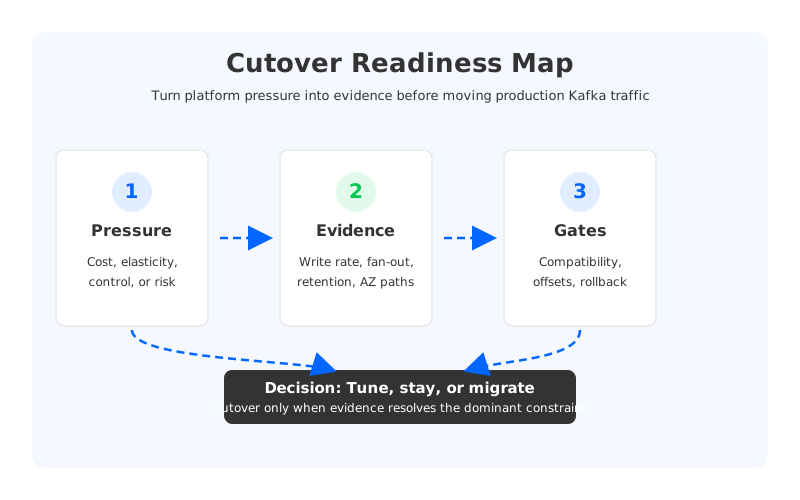
The readiness review starts by separating four kinds of pressure:
- Cost pressure comes from traffic shape, retention, broker sizing, storage, and network paths. It needs a workload model, not a generic price table.
- Elasticity pressure appears when adding compute also means thinking about where log data lives and how partitions rebalance.
- Control pressure appears when the team wants clearer ownership of VPC placement, deployment automation, auditability, upgrade policy, or emergency operations.
- Migration pressure appears when existing producers, consumers, connectors, ACLs, and observability tools define a contract that the target must preserve on day one.
The strongest migration case usually combines more than one pressure. A team that has cost pressure but no compatibility risk may have a tuning project. A team that has elasticity pressure, network-cost pressure, and a mature Kafka contract is dealing with an architecture decision.
2The Incumbent Baseline Still Matters
Amazon MSK is a managed AWS service for Apache Kafka and compatible Kafka APIs. It reduces the operational work of provisioning and maintaining brokers, integrates with AWS networking and security primitives, and gives teams a familiar way to run Kafka without owning every broker lifecycle task. That baseline matters because any alternative has to beat the real incumbent, not an imagined version of it.
The comparison also has to be fair to the workload. A small eventing cluster, a high-throughput logging platform, a fraud-detection stream, and a long-retention replay system all stress Kafka differently. The same MSK bill may be acceptable for one workload and a warning sign for another. The right question is not "Which platform is lower cost?" The right question is "Which architecture turns our dominant constraint into something we can control?"
That framing prevents two common mistakes. The first is treating a managed service as a black box and then being surprised by the cloud resources behind it. The second is treating every alternative as a drop-in replacement because it speaks the Kafka protocol. Protocol compatibility is necessary, but cutover readiness also depends on storage behavior, network locality, access control, operations, and rollback.
3Architecture Criteria Behind the Shortlist
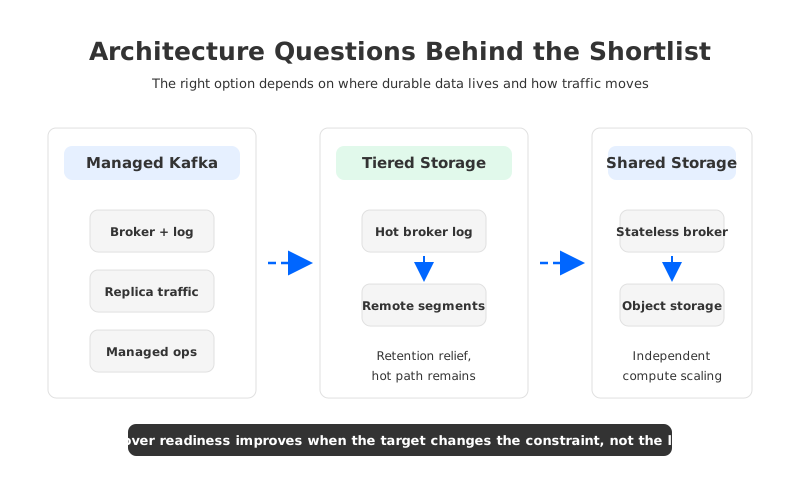
Kafka's traditional architecture ties durable log ownership to brokers and their local or attached storage. Replication protects availability, but it also moves data across brokers and fault domains. In the cloud, those movements intersect with availability zones, network billing, storage performance, and the time it takes to recover or rebalance under stress.
Apache Kafka tiered storage changes part of that equation by moving older log segments to remote storage. That can improve retention economics, and it is a valuable capability for many deployments. It is not the same as designing the primary durable log around shared object storage from the beginning. With tiered storage, the hot path still depends heavily on broker-local storage. With shared storage, durable data is outside the broker ownership boundary, so brokers behave more like compute and protocol nodes.
Use the shortlist to test the architecture, not the label:
| Criterion | Why it matters before cutover | Evidence to request |
|---|---|---|
| Kafka contract | Existing applications depend on more than produce and consume APIs | Client versions, transactions, ACLs, compaction, Connect, admin tooling |
| Storage model | Storage ownership determines elasticity, recovery, and retention behavior | Local disk, tiered storage, or shared object storage design |
| Network model | Multi-AZ replication and read paths can become recurring cost drivers | AZ placement, client routing, PrivateLink, replication, consumer fan-out |
| Operational boundary | The team must know what the vendor runs and what it inherits | Upgrade flow, observability, emergency access, IaC fit, support process |
| Migration mechanics | A good target still fails if offsets and rollback are unclear | Mirror plan, dual-write policy, topic scope, rollback test, incident owner |
This table is intentionally more concrete than a feature checklist. If a vendor cannot show how the target behaves when a broker disappears, when a consumer group lags, when a topic is compacted, or when traffic shifts across zones, the evaluation has not reached production depth.
4Build the Workload Model Before the Vendor Model
Cost analysis should begin with the workload shape. Start with sustained write throughput, peak write throughput, read fan-out, number of consumer groups, retention, message size, compaction topics, and AZ placement. Then map those inputs to the resources that move or store bytes. For MSK and most Kafka-style deployments, that means broker compute, broker storage, replication traffic, client traffic, cross-AZ paths, cross-region paths, and the operational work needed to keep the cluster healthy.
AWS publishes separate pricing and documentation for MSK, EC2 network transfer, PrivateLink, and related services. The exact result depends on region and architecture, so a responsible article should not pretend there is a universal monthly number. What matters is the shape of the formula. If every retained byte expands broker storage, if every replicated write crosses fault domains, or if every consumer group multiplies read traffic across zones, those are structural costs. Negotiation and tuning can help, but they do not change the underlying mechanics.
The workload model also exposes migration risk. A high-throughput append-only topic may be easier to mirror and validate than a compacted topic used for application state. A low-latency consumer group with strict offset expectations needs a different test plan than an offline analytics consumer. Long retention sounds like a storage problem, but during migration it becomes a historical replay and validation problem.
5Migration and Ownership Questions for Platform Teams
A cutover plan has two clocks. The data clock tracks topics, retained history, offsets, and consistency. The application clock tracks endpoint changes, credential rotation, deployment windows, and the point at which producers and consumers trust the target. Treating these clocks as one timeline is how migrations turn into prolonged incident response.
Before production traffic moves, platform teams should answer a short set of ownership questions:
- What is the source of truth during the overlap period? Dual write, mirroring, and replay each create different failure modes.
- How will offsets be validated? Consumer lag dashboards are useful, but cutover needs a plan for group-by-group correctness.
- Which topics are excluded from the first wave? Compacted topics, high-value transactional flows, and long-retention topics often deserve separate gates.
- Who owns rollback? Rollback cannot depend on a vendor handoff or an unclear escalation path during a live incident.
- What changes for security and governance? Credentials, ACLs, audit logs, encryption boundaries, and network access need to be reviewed before the migration window.
These questions are not paperwork. They define whether the team is changing Kafka endpoints or changing the platform contract. Mature teams often start with low-risk topics, keep parallel observability, rehearse rollback, and move critical streams after the target has proven client compatibility under real traffic.
6How AutoMQ Fits the Evaluation
Once the evaluation points to storage architecture, network movement, and operational ownership, Kafka-compatible shared storage becomes relevant. AutoMQ is a Kafka-compatible cloud-native streaming platform that keeps the Kafka protocol surface while moving durable streaming storage to object storage. Its architecture separates stateless brokers from the durable data layer, using S3Stream, WAL storage, cache, and object storage to change how compute and storage scale.
That model matters most when the MSK constraint is structural. If brokers do not own long-lived local log data in the same way, adding or replacing compute can avoid a large class of partition-data movement. If durable storage is designed around object storage, retention and recovery discussions move away from broker disk expansion. If the architecture reduces inter-zone data movement, network-cost modeling becomes easier to reason about for multi-AZ workloads.
AutoMQ is not the answer for every MSK user. Teams that mainly want AWS-managed operations may prefer to stay with MSK and improve workload hygiene. Teams evaluating msk alternatives because storage growth, elasticity, network paths, or ownership boundaries are becoming hard to govern should include AutoMQ in the architecture review rather than as a late-stage pricing comparison.
7A Practical Cutover Readiness Score
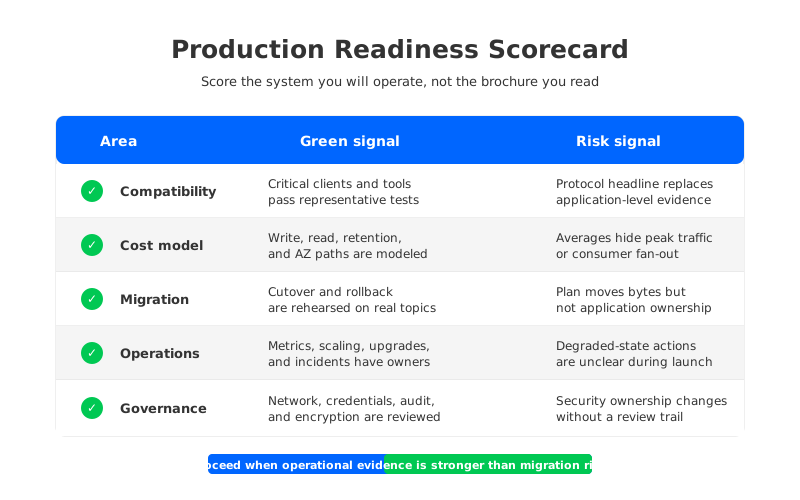
The final decision should produce a score that a platform owner can defend to SRE, security, procurement, and application teams. The score does not need false precision. It needs evidence for the risks that would hurt in production.
| Readiness area | Green signal | Red signal |
|---|---|---|
| Compatibility | Critical clients, security settings, admin tools, and topic types pass tests | Compatibility is described only at the protocol headline level |
| Cost model | Write, read, retention, and network paths are modeled from real workload data | Savings depend on averages that hide peak traffic or fan-out |
| Migration plan | Cutover, validation, and rollback are rehearsed on representative topics | Migration plan focuses on moving bytes but not offsets or applications |
| Operations | Metrics, logs, scaling, upgrades, and incident ownership are explicit | The team cannot explain who acts during a degraded state |
| Governance | VPC, IAM or credentials, encryption, audit, and access boundaries are clear | The target changes security ownership without a review trail |
The decision becomes easier when one option is green where the current platform is persistently red. If every option is mixed, postpone the cutover and run narrower tests. Kafka migrations reward patience because the riskiest problems tend to appear in small differences: a connector assumption, a compacted topic, a consumer that treats offsets as a contract, or a network path that was invisible in the first cost model.
8The Decision Path
The cleanest path is to write down the current MSK constraint in one sentence. "Broker storage grows faster than compute needs." "Inter-AZ traffic grows with each added consumer group." "The team needs data-plane ownership inside its own deployment workflow." "Cutover risk is higher than the expected savings." Each sentence leads to a different decision, and that is the point. A serious alternative evaluation should make the trade-off clearer, not bury it under a generic feature matrix.
When the constraint is architectural, compare platforms against the workload you actually run: write rate, read fan-out, retention, topic types, AZ placement, security model, and rollback tolerance. For teams that want to test Kafka-compatible shared storage as part of that comparison, start with the AutoMQ architecture and deployment documentation, then bring your workload model into the discussion: review the AutoMQ docs or contact the AutoMQ team with the specific cutover risks you need to de-risk.
9References
- Amazon MSK Developer Guide: What is Amazon MSK?
- Amazon MSK pricing
- AWS PrivateLink documentation
- Apache Kafka documentation
- Apache Kafka documentation: Tiered storage
- AutoMQ architecture overview
- AutoMQ zero inter-zone traffic overview
10FAQ
10.1When should a team evaluate MSK alternatives?
Evaluate alternatives when the dominant issue is structural rather than operational housekeeping. Common triggers include storage growth that does not match compute needs, network costs that grow with replication or fan-out, migration requirements that demand more control, or governance boundaries that the current service model does not satisfy.
10.2Is moving away from MSK mainly a cost decision?
No. Cost often starts the conversation, but cutover readiness depends on compatibility, rollback, observability, ownership, and security. A lower estimate is not useful if the target increases migration risk or weakens the platform team's ability to operate during incidents.
10.3What should be tested before moving production Kafka traffic?
Test client compatibility, authentication and authorization, topic configuration, compaction behavior, consumer offsets, observability, scaling behavior, and rollback. Representative topics matter more than synthetic happy-path tests because real applications depend on operational details.
10.4How is shared storage different from tiered storage?
Tiered storage moves older log segments to remote storage while the hot path still depends on broker-local storage. Shared storage changes the primary ownership model so durable streaming data is not bound to broker-local disks in the same way. That difference affects elasticity, recovery, and network-cost design.
10.5Where does AutoMQ fit in an MSK alternatives review?
AutoMQ fits when a team wants Kafka-compatible streaming with shared object-storage-backed durability, stateless brokers, independent compute and storage scaling, and deployment models designed for customer-owned environments. It is most relevant when the MSK review is driven by storage architecture, network movement, elasticity, or data-plane ownership.


