
Table of Contents
Table of Contents
A Kafka migration usually looks calm until the cutover window appears. Replication has been running, dashboards look acceptable, and the new cluster can handle synthetic traffic. Then the questions arrive: when do producers switch, how far can consumers lag, who freezes connectors, which offsets are authoritative, and how quickly can the team reverse the change if production behaves differently from rehearsal?
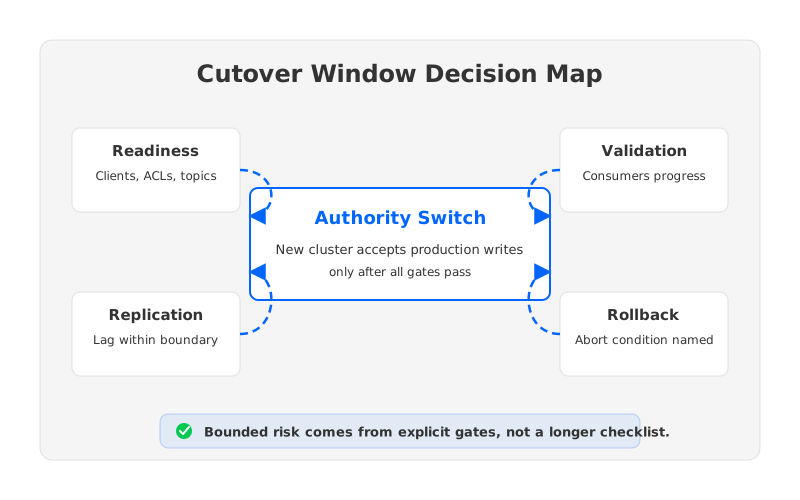
That is why kafka migration cutover planning is less about copying bytes and more about controlling time. The window is the period when a streaming platform changes from one source of truth to another. During that period, every assumption about client compatibility, topic configuration, offset translation, replication lag, security policy, and observability becomes operationally visible.
Good cutover planning does not promise a risk-free migration. It makes the risk bounded, measured, and reversible. The plan should let an SRE say which workloads can move, which signals prove readiness, which failures trigger rollback, and who owns each gate.
1Why Teams Search for kafka migration cutover planning
Teams rarely search for cutover planning when the migration is still a slide. They search after discovering that the hard part is not creating another Kafka-compatible endpoint. The hard part is moving production clients without losing writes, duplicating downstream effects, breaking consumer progress, or inventing rollback during an incident.
Kafka-compatible workloads are sensitive to details outside the obvious produce and consume API. Producers may rely on idempotence, acknowledgments, batching, compression, and transactions. Consumers may depend on group coordination, committed offsets, partition assignment, and replay semantics. Connectors may carry their own offsets and external system state. A plan that treats clients as stateless network connections will miss the real risk.
Design around these facts:
- The old cluster and the new cluster cannot both be the source of truth indefinitely. Replication can buy time, but the team still needs a clean authority boundary.
- Consumer progress is not the same as data replication. A target cluster can contain the records while downstream consumers still point to offsets, group metadata, or connector state that was produced elsewhere.
- Rollback is a workload decision, not only an infrastructure decision. Returning producers to the old cluster may be easy; undoing side effects in databases, search indexes, fraud systems, or billing pipelines may not be.
- Observability must be aligned before the window opens. During cutover, every dashboard should answer a decision question instead of displaying unrelated cluster health.
These facts explain why migration planning feels different from capacity planning. Capacity planning asks whether the target can run the workload. Cutover planning asks whether the team can change authority under pressure and still know what is true.
2The Migration Risk Behind the Workload
Traditional Kafka deployments make this pressure heavier because broker compute and broker-local storage are tightly coupled. Partitions live on brokers, replicas occupy local disks, and cluster changes often involve data movement inside the broker fleet. That architecture can be workable, but it turns migration into a storage, network, and operations problem at the same time.
The effect shows up in cutover planning. A team may need extra broker capacity for replication traffic, catch-up consumers, and transition retention. If the migration spans availability zones or regions, network paths and egress policies become part of the plan. If the target cluster uses different broker sizing, partition placement and rebalancing need attention before production clients move.
The workload itself adds another layer. A low-throughput audit topic with loose latency expectations can move through a simple drain-and-switch process. A payment authorization stream, real-time bidding pipeline, or operational alerting stream needs a stricter plan because duplicated messages and delayed consumers have business consequences. The migration mechanism may be the same, but the cutover policy should not be.
This is where many plans become too generic. They list "pause producers," "sync data," "switch clients," and "monitor." Those steps are not wrong, but they are not enough. A production plan needs decision gates: what must be true before the next action starts, who checks it, and what happens if the signal fails.
3Compatibility, Replication, Rollback, and Observability Trade-Offs
The cleanest way to structure a cutover plan is to separate the technical layers that often get discussed as one task. Each layer has its own failure mode, and hiding them under "migration" makes the window harder to control.
| Layer | Cutover question | Common failure mode |
|---|---|---|
| Client compatibility | Do producers, consumers, and tools behave correctly against the target endpoint? | A client library, security setting, or transactional pattern behaves differently under load. |
| Data replication | Is the target cluster close enough to become authoritative? | Replication appears healthy globally, but critical topics still lag or have configuration mismatches. |
| Offset and state handling | Can consumers resume from the intended position? | Data exists on the target, but consumer groups replay too much or skip records. |
| Rollback policy | Can the team return to the previous authority boundary without making downstream state worse? | Producers can switch back, but downstream systems have already processed divergent events. |
| Observability | Can operators distinguish normal catch-up from a failed cutover? | Dashboards show many metrics but do not answer the go/no-go question. |
This table prevents one green signal from hiding a red one. Replication lag can be acceptable while ACLs are incomplete. Client tests can pass while connector offsets are not ready. A rollback path can exist for producers but not for external systems that already consumed new records.
Mirror-based migrations make the separation even more important. Apache Kafka includes MirrorMaker tooling for copying data between clusters, and Kafka Connect has its own model for source and sink connectors. Those tools can support a strong plan, but they do not remove the need to define authority, consumer state, and rollback semantics for each workload group.
4A Cutover Window Is a Sequence of Gates
The safest cutover window is not a long checklist of commands. It is a sequence of gates where each gate has an owner and an abort condition. That design keeps the team from improvising after the window opens.
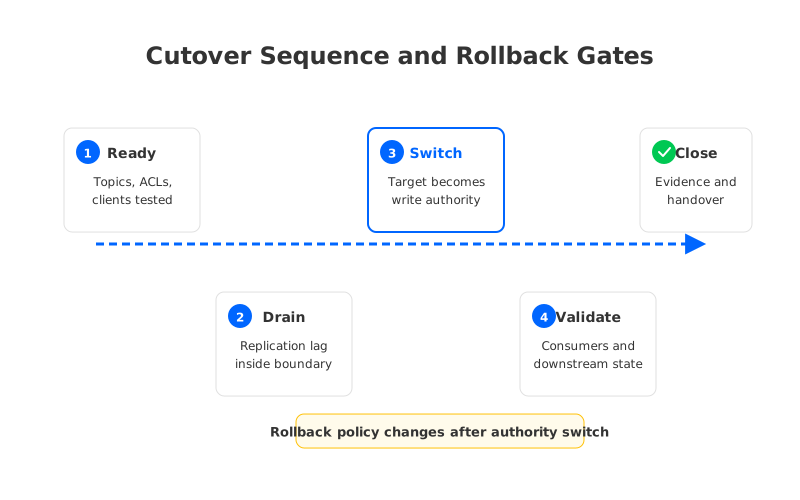
Start with readiness. The target platform should already have the required topics, configurations, identities, ACLs, network access, monitoring, and alert routing. Producers and consumers should have been tested against the target with production-like settings. For stateful components, the team should know where offsets and connector state will come from and how they will be validated.
Then define the authority switch. Some workloads can tolerate a brief producer pause while replication drains and clients reconnect. Others need a phased approach where a small producer group moves first, or dual-write is used briefly. The plan must name the moment when the target becomes authoritative for new writes.
Rollback must be defined before that moment. A rollback before the authority switch is usually an infrastructure reversal. A rollback after the authority switch is a data consistency decision because downstream systems may already have processed records from the target. If the plan cannot handle those side effects, it should not describe rollback as simple.
5Evaluation Checklist for Migration Teams
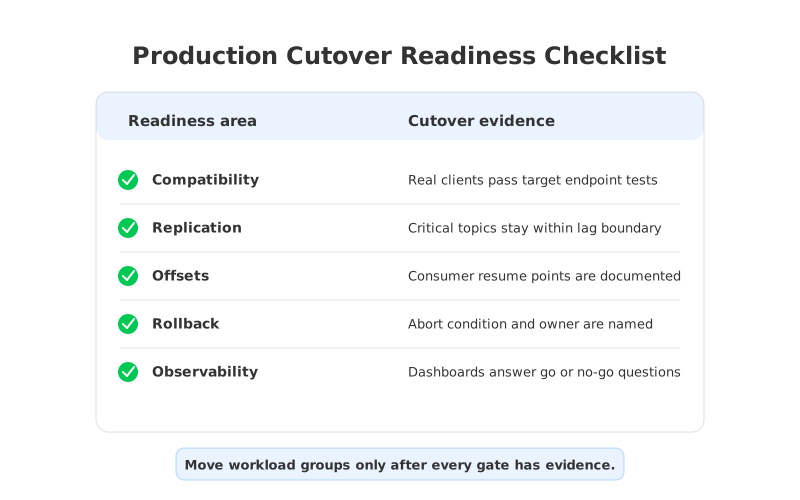
Cutover readiness should be evaluated by workload class, not by cluster. A cluster-level migration can pass broad health checks while a critical application remains unsafe to move. Segmenting workloads gives the team smaller authority changes and clearer rollback boundaries.
Use a readiness checklist that forces each workload group to earn its window:
| Readiness area | What to verify before cutover | Evidence to capture |
|---|---|---|
| Topic and config parity | Topic names, partitions, retention, compaction, and relevant configs are intentionally matched or intentionally changed. | Diff record approved by platform and application owners. |
| Client behavior | Producers, consumers, and connectors work against the target using their real security and runtime settings. | Test run, error budget decision, and owner sign-off. |
| Replication health | Critical topics are within the agreed lag boundary and stay stable under normal traffic. | Lag dashboard linked to a go/no-go threshold. |
| Offset strategy | Consumers have a documented resume point and replay policy. | Group mapping or application-owned replay plan. |
| Rollback boundary | The team knows which actions are reversible and which require forward repair. | Decision tree with owner and abort condition. |
| Operational coverage | Alerts, logs, metrics, and escalation paths point to the target before production traffic moves. | On-call review and dashboard drill. |
This checklist also makes migration governance easier. Instead of asking whether "Kafka is ready," the migration lead can ask whether a workload class has passed the gates that matter for its business impact.
6How AutoMQ Changes the Operating Model
Once the cutover requirements are clear, the infrastructure architecture becomes easier to evaluate. The question is not whether a platform can expose Kafka-compatible APIs. The question is whether its operating model reduces data movement, capacity reservation, and broker-local storage work during production change.
AutoMQ is a Kafka-compatible cloud-native streaming system that keeps Kafka protocol compatibility while moving the storage layer to shared object storage and making brokers stateless in the long-term data path. The architecture changes what the team has to treat as fixed during migration. Brokers focus on serving traffic and coordinating the runtime, while durable data is backed by shared storage rather than broker-local disks.
That distinction matters during cutover planning. A shared-storage design does not eliminate replication, validation, ACL review, consumer state planning, or rollback policy. It does reduce the operational weight of broker-local data placement and capacity coupling. Scaling compute for a rehearsal, absorbing temporary traffic shape changes, or recovering from broker changes becomes less entangled with moving durable topic data across a fixed broker fleet.
AutoMQ also fits the governance side of migration. Teams can keep Kafka-compatible clients and semantics while evaluating cloud deployment boundaries, object-storage-backed durability, independent compute and storage scaling, and network cost controls such as zero cross-AZ traffic designs. The value is not "migration magic." The value is a platform model that gives operators fewer moving parts at the worst moment of the project.
7A Practical Cutover Runbook Shape
A good runbook should be boring to execute because the hard decisions were made before the window. It should not be a general migration guide. It should be a timed operational artifact for a specific workload group.
One workable shape is:
- Confirm freeze criteria. Name the producers, connectors, and admin changes that must stop before the authority switch.
- Verify target readiness. Check topic configuration, security, network path, client connectivity, observability, and owner availability.
- Drain or bound replication. Use the topic-level lag threshold and focus on business-critical topics instead of cluster-wide averages.
- Switch authority. Move producer traffic, connector writes, or routing according to the workload plan.
- Validate consumer progress. Confirm that consumer groups, connectors, and downstream systems are processing from the intended position.
- Hold the rollback window. Keep the team assembled until the agreed signals prove that rollback is no longer the preferred recovery path.
- Close with evidence. Capture dashboards, incident notes, configuration diffs, and any follow-up repair tasks.
The shape is intentionally simple. Complexity belongs in preparation, not in the minute-by-minute execution path. When a step fails, the runbook should point to a named decision rather than asking the team to debate architecture during the window.
8Cost, Governance, and Team Boundaries
Cutover planning exposes cost and ownership questions that were invisible during steady state. Replication traffic, temporary duplicate clusters, extra retention, cross-zone or cross-region movement, and longer on-call coverage all have a cost. The plan should assign those costs to the migration project instead of hiding them in shared infrastructure.
Governance boundaries matter too. The platform team can own cluster readiness, security templates, replication tooling, and observability. Application teams should own client release timing, replay tolerance, downstream side effects, and business validation. Security and compliance teams should review identity mapping, network exposure, encryption posture, and data residency if deployment boundaries change.
The worst cutover plan is one where every team assumes another team owns the risky part. The better plan has a responsibility matrix short enough to use during the window and detailed enough to prevent silence when a signal turns red.
9The Window Is a Product of Architecture
The duration and risk of a cutover window are products of architecture. A platform that requires heavy broker-local data movement, large temporary capacity buffers, and manual rebalancing will shape the plan differently from a platform that separates compute from durable storage. A workload with unclear ownership will shape the plan differently from one with clean contracts and tested replay behavior.
That is the practical lesson behind Kafka migration cutover planning. Do not start with the switch command. Start with the authority boundary, workload class, consumer state model, and rollback consequence. Then choose tooling and infrastructure that make those decisions easier to execute.
If your migration plan forces excess broker capacity, a longer cutover window, or rollback by hope, review whether a Kafka-compatible shared-storage architecture changes the operating model. The AutoMQ deployment overview is a useful next step: review AutoMQ deployment options.
10References
- Apache Kafka Documentation: https://kafka.apache.org/documentation/
- Apache Kafka MirrorMaker: https://kafka.apache.org/documentation/#basic_ops_mirror_maker
- Apache Kafka Connect: https://kafka.apache.org/documentation/#connect
- Apache Kafka Consumer Configuration: https://kafka.apache.org/documentation/#consumerconfigs
- Apache Kafka Tiered Storage: https://kafka.apache.org/documentation/#tiered_storage
- AutoMQ Architecture Overview: https://docs.automq.com/automq/architecture/overview?utm_source=blog&utm_medium=reference&utm_campaign=aivk-0047
- AutoMQ Deployment Overview: https://docs.automq.com/automq/deployment/overview?utm_source=blog&utm_medium=reference&utm_campaign=aivk-0047
11FAQ
11.1What is a Kafka migration cutover window?
A Kafka migration cutover window is the controlled period when production authority moves from one Kafka or Kafka-compatible cluster to another. It usually includes readiness checks, replication validation, producer or connector switching, consumer validation, rollback monitoring, and ownership confirmation.
11.2How should teams plan rollback during a Kafka migration?
Rollback should be planned around the authority boundary. Before the target becomes authoritative, rollback may be routing or client configuration. After the target accepts production writes, rollback becomes a data consistency decision because downstream systems may already have processed records from the new cluster.
11.3Is replication lag enough to decide whether a Kafka cutover is ready?
No. Replication lag is necessary but not sufficient. Teams also need topic configuration parity, client compatibility, ACL readiness, offset strategy, connector state handling, observability, and a workload-specific rollback policy.
11.4Should Kafka workloads move all at once or in phases?
Most teams reduce risk by grouping workloads by business impact, client behavior, and rollback complexity. Low-risk topics can move earlier, while critical streams should move only after rehearsals prove the target configuration, consumer state plan, and operational dashboards.
11.5How does shared storage help Kafka migration planning?
Shared storage changes the operating model by reducing the dependence on broker-local durable data placement. Migration teams still need replication, validation, and rollback planning, but compute scaling and broker operations are less tightly coupled to long-term topic storage.


