
Table of Contents
Table of Contents
Security detection teams usually meet Kafka at the point where batch collection has stopped being acceptable. Endpoint events, authentication logs, DNS records, proxy telemetry, cloud audit trails, and application traces no longer arrive as neat files for later analysis. They arrive as a live signal stream, and the useful window for detection can be measured in minutes. A cybersecurity signal pipeline kafka architecture is attractive because Kafka gives teams a durable commit log, consumer groups, replay, and a large ecosystem of clients and connectors. The harder question is whether the infrastructure behind that log can survive the shape of security workloads.
That shape is uncomfortable. Normal days create steady ingest across many topics, while incident days create bursty traffic from the exact systems analysts want to inspect. Retention periods are driven by investigation needs, not by the convenience of broker disks. Consumers include stream processors, SIEM exports, alert enrichment jobs, and forensic replay tools, each with a different lag pattern. When the pipeline becomes the backbone for detection, the Kafka cluster becomes part of the security control plane.
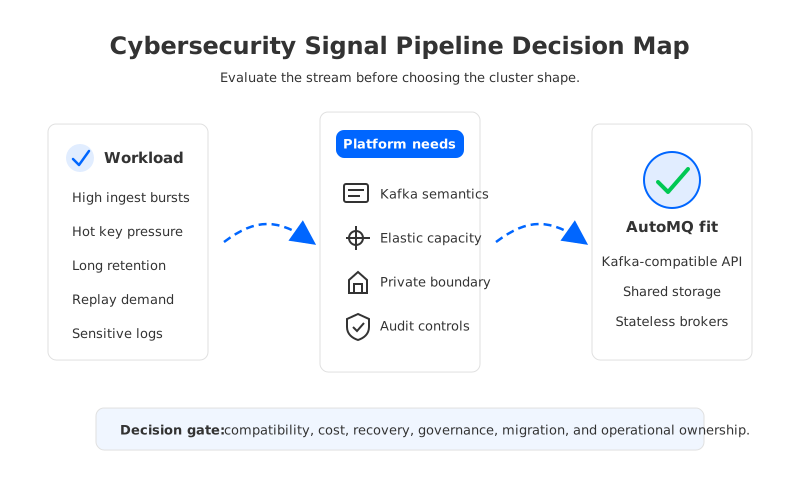
The architectural mistake is to evaluate this pipeline as a throughput benchmark alone. Throughput matters, but security teams also need clean replay semantics, predictable cost during retention growth, governance boundaries, and a migration path that does not interrupt detection. A platform can look healthy under a load test and still fail when analysts replay several days of data while detection is catching up from a burst.
1Why teams search for cybersecurity signal pipeline kafka
The search usually starts with a practical bottleneck. A detection team adds more log sources, a SIEM bill grows faster than the security budget, or a threat hunting workflow needs access to raw events that were previously discarded. Kafka becomes the natural buffering and fan-out layer because producers can write once while multiple teams consume independently. Security engineering gets a cleaner contract: producers publish facts, consumers build detections, and the platform owns durability and delivery mechanics.
That contract depends on details that are easy to underweight during early design. Consumer groups isolate downstream systems, but they also create separate lag profiles. Offsets make replay possible only when retained data remains available and the cluster can serve catch-up reads without harming live ingest. Kafka Connect can standardize data movement, but connector operations become part of the security platform's operational surface.
A high-volume cybersecurity pipeline often has five recurring traffic classes:
- Telemetry ingest from endpoints, identity providers, networks, cloud services, and applications. These sources grow independently, so the platform must absorb uneven expansion.
- Real-time detection consumers whose SLO is tied to incident response, not dashboard freshness.
- Enrichment jobs that read multiple topics and write derived signals.
- Forensic consumers that scan retained data after an investigation begins.
- Export jobs that deliver curated signals to warehouses, lakehouses, SIEM tools, or case management systems.
This is why a security pipeline cannot be designed as a single path from producer to consumer. It is a shared substrate for detection, investigation, compliance, and analytics. The platform needs Kafka compatibility, elasticity, and enough operational clarity for SREs to reason about failure.
2The production constraint behind the problem
Traditional Kafka is a shared-nothing system: brokers serve compute and own local log storage. That design is robust and well understood, but it couples storage growth, broker replacement, and partition movement. When a broker changes, data locality matters. When retention grows, disk capacity planning matters. When partitions are rebalanced, moving leadership is not the same as making historical data cost-effective to serve.
In cybersecurity pipelines, that coupling shows up in three places. Retained raw signals accumulate because investigation value often appears after the event. Replay reads compete with live detection for broker, disk, and network resources. Incident response changes the traffic profile at the worst possible time, when the team asks for more history, joins, and exports under pressure.
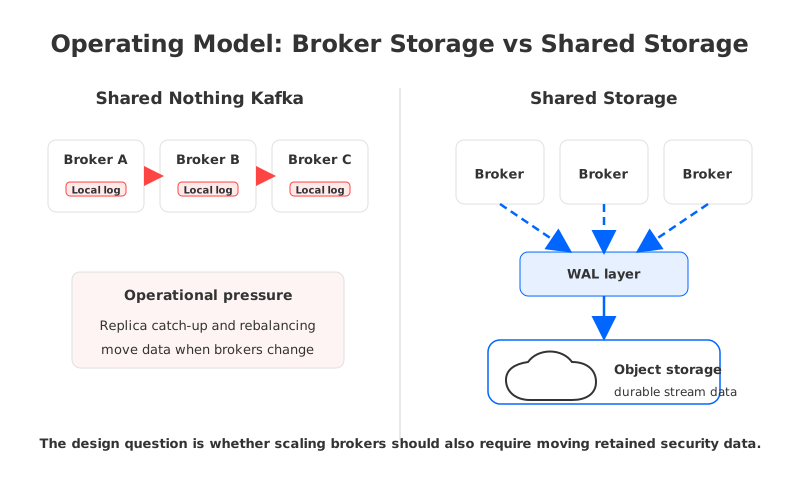
The cloud adds another layer of cost and governance. Running Kafka across availability zones improves resilience, but replication and client traffic can create inter-zone network charges depending on placement and routing. Private connectivity, identity boundaries, encryption, and audit evidence have to be designed around the streaming layer. A cluster that is available but expensive to replay or hard to isolate can still be a poor fit.
The constraint is not that Kafka is wrong for cybersecurity signals. Kafka remains a strong abstraction for ordered topics, replay, consumer groups, and stream processing integration. The constraint is that the operating model underneath Kafka determines how much pain the team absorbs as volume, retention, and consumers grow.
3Architecture options and trade-offs
Platform teams usually face four broad choices. They can run self-managed Apache Kafka, choose a managed Kafka service, adopt a Kafka-compatible cloud-native streaming platform, or split the pipeline across Kafka plus a lakehouse or SIEM-specific ingestion layer. Each choice can work, but each shifts responsibility to a different place.
| Option | Strength | Constraint to examine |
|---|---|---|
| Self-managed Apache Kafka | Maximum control over brokers, networking, and operational policy. | The team owns capacity planning, rebalancing, upgrades, failure drills, and cost tuning. |
| Managed Kafka | Less infrastructure ownership and cleaner provisioning. | Elasticity, network topology, storage behavior, and cost levers depend on the provider. |
| Kafka-compatible shared storage | Kafka APIs with a storage model designed for cloud elasticity. | Teams must validate semantic compatibility, deployment boundaries, and operational maturity. |
| Kafka plus lakehouse or SIEM staging | Strong long-term analytics and search paths. | The live detection path still needs a durable streaming substrate with replay discipline. |
The comparison should start from workload mechanics, not product labels. If the pipeline stores high-volume security signals for replay and investigation, the cost of local replicas, broker replacement, and catch-up reads becomes important. If the organization has strict data sovereignty requirements, the platform's deployment boundary may matter more than a managed service feature.
There is also a subtle difference between tiered storage and a shared-storage operating model. Tiered storage can offload older log segments to object storage while brokers still own hot data and leadership. That helps retention cost, but it does not automatically make brokers stateless. A shared-storage architecture goes further by treating durable stream data as a cloud storage responsibility.
For cybersecurity pipelines, that distinction matters because the investigation workload is not purely cold. Analysts may need to scan older data while live detection continues. A platform that reduces the operational cost of serving history gives the team more room to preserve evidence.
4Evaluation checklist for platform teams
The most useful evaluation is a readiness review that mirrors production failure modes. A benchmark can tell you whether the system can ingest a target rate. A readiness review tells you whether the team can operate the pipeline after a region incident, a runaway producer, a connector failure, a consumer lag event, or an urgent forensic replay.
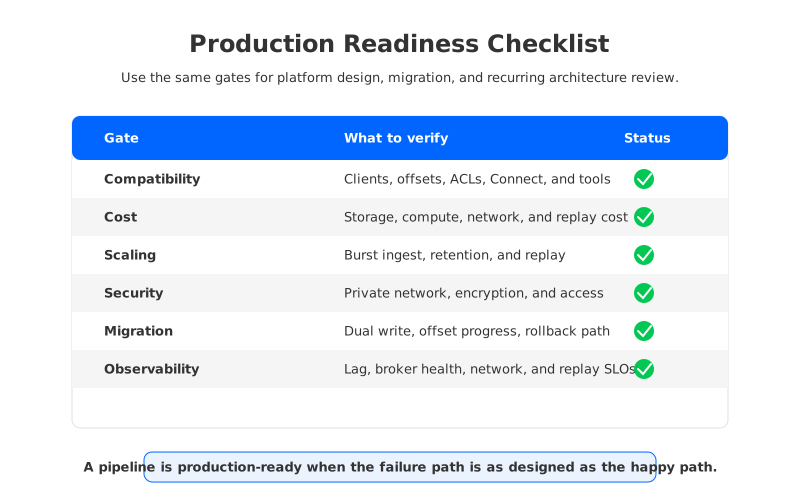
Start with compatibility. Kafka compatibility is the difference between migrating a platform and rewriting the security stack. Validate producer and consumer behavior, client versions, authentication, authorization, topic configuration, offset management, transactions if used, Kafka Connect integration, and operational tooling. A small semantic mismatch can be expensive when detection logic assumes a specific ordering or replay behavior.
Then examine cost in the same units as the workload. Storage cost is visible, but network and compute costs often hide in replication, cross-zone reads, catch-up traffic, and connector fan-out. A reasonable model separates live ingest, retained history, replay reads, inter-zone traffic, and downstream export. The goal is to avoid a design where cost rises whenever the team uses the pipeline for the security work it was built to support.
Governance deserves the same attention as throughput. Cybersecurity signals include credentials in logs, identity events, endpoint metadata, customer identifiers, and privileged operational traces. The platform must support private networking, encryption, least-privilege access, auditability, and clean separation between environments. If your security organization needs customer-controlled infrastructure, evaluate bring-your-own-cloud and private deployment patterns before committing to a platform shape.
Migration risk is the final gate. A detection pipeline rarely has the luxury of a long outage window. Plan for dual writes or mirroring, topic-by-topic rollout, offset validation, replay comparison, rollback, and alert noise control. The migration plan should prove that consumers see equivalent records while the cutover is in progress.
5How AutoMQ changes the operating model
If the evaluation points toward Kafka semantics plus a cloud storage operating model, AutoMQ is one implementation to examine. AutoMQ is a Kafka-compatible streaming platform that keeps the Kafka protocol and client ecosystem while redesigning the storage layer around shared object storage and stateless brokers. It is not asking security teams to abandon Kafka patterns. It changes what the infrastructure has to do when volume, retention, and broker count change.
With broker-local storage, adding or replacing brokers can trigger data movement tied to the data already on disk. With shared storage, durable stream data is not trapped inside a broker's local volume. Brokers can focus on serving Kafka APIs while the storage layer backs the log. For a cybersecurity pipeline, that reduces the operational connection between retention growth and broker lifecycle.
AutoMQ's architecture also changes the cost conversation. Object storage is typically a more natural home for retained security signals than replicated broker disks, especially when not every byte is read continuously. AutoMQ documentation describes shared storage, stateless brokers, Kafka API compatibility, and inter-zone traffic reduction patterns. Validate those claims against your workload, cloud provider, and network design.
The strongest reason to evaluate this architecture is not a generic promise of lower cost. It is the ability to separate decisions that traditional Kafka tends to bind together:
- Keep Kafka-compatible producer and consumer contracts while changing the storage operating model underneath.
- Scale compute for live ingest and serving without sizing every broker around the full retained history.
- Treat object storage as the durable layer for accumulated signal data while using WAL mechanisms for the write path.
- Reduce broker-local data movement during scaling and recovery events.
- Keep deployment boundaries aligned with cloud accounts, private networking, and security ownership requirements.
That separation gives platform teams a cleaner way to negotiate between security engineering and infrastructure operations. Security teams can ask for longer retention without forcing the same broker-local disk expansion. SREs can reason about broker lifecycle with fewer data movement side effects. Finance teams can model storage, compute, and network costs separately.
6A practical readiness scorecard
Before selecting any platform, write down the workloads that would embarrass the design. For a cybersecurity signal pipeline, those are rarely average-day metrics. They are the incident replay, the runaway log source, the connector stuck behind a downstream limit, the consumer group that falls behind during a deployment, and the compliance request that requires a longer raw-data window.
Use a scorecard that forces evidence rather than preference:
| Readiness area | Evidence to collect |
|---|---|
| API and semantic compatibility | Client integration tests, consumer group behavior, offset reset tests, ACL checks, and transaction validation if applicable. |
| Burst and replay behavior | Ingest plus catch-up read tests under realistic topic counts, partition counts, and downstream lag. |
| Cost model | Separate estimates for compute, storage, network, connector operations, and replay-heavy investigation windows. |
| Security boundary | VPC or private network design, identity model, encryption controls, audit evidence, and administrator access policy. |
| Failure recovery | Broker replacement tests, zone impairment drills, restore procedures, and rollback exercises. |
| Migration path | Mirroring or dual-write plan, consumer cutover sequence, offset validation, and alert noise management. |
The scorecard will often reveal that the debate is less about Kafka versus another log and more about who pays for coupling. If retained data lives on broker disks, the broker fleet pays for retention. If replay reads share constrained resources with live ingest, detection pays for investigation. If network topology is left to default placement, the cloud bill pays for resilience in a way no one planned.
AutoMQ is worth evaluating when those couplings are the source of pain. Its Kafka-compatible shared-storage model lets teams keep familiar stream processing contracts while changing the economics and operations of the underlying log. The decision still belongs in a measured proof of concept, with your topics, client versions, data sensitivity, and cloud network.
When the pipeline is part of detection, the right question is not whether Kafka can move enough bytes on a quiet day. The right question is whether the platform can preserve evidence, serve replay, control cost, and stay operable when the security team needs it most. To test that model with Kafka-compatible shared storage, start with the AutoMQ architecture overview.
7References
- Apache Kafka Documentation: https://kafka.apache.org/documentation/
- Apache Kafka Connect documentation: https://kafka.apache.org/documentation/#connect
- Apache Kafka consumer configuration documentation: https://kafka.apache.org/documentation/#consumerconfigs
- Apache Kafka message delivery semantics: https://kafka.apache.org/documentation/#semantics
- AutoMQ architecture overview: https://docs.automq.com/automq/architecture/overview?utm_source=blog&utm_medium=reference&utm_campaign=cybersecurity-signal-pipelines
- AutoMQ compatibility with Apache Kafka: https://docs.automq.com/automq/what-is-automq/compatibility-with-apache-kafka?utm_source=blog&utm_medium=reference&utm_campaign=cybersecurity-signal-pipelines
- AutoMQ shared streaming storage overview: https://docs.automq.com/automq/architecture/s3stream-shared-streaming-storage/overview?utm_source=blog&utm_medium=reference&utm_campaign=cybersecurity-signal-pipelines
- AutoMQ inter-zone traffic overview: https://docs.automq.com/automq/eliminate-inter-zone-traffics/overview?utm_source=blog&utm_medium=reference&utm_campaign=cybersecurity-signal-pipelines
- AWS PrivateLink documentation: https://docs.aws.amazon.com/vpc/latest/privatelink/what-is-privatelink.html
- Amazon S3 data durability documentation: https://docs.aws.amazon.com/AmazonS3/latest/userguide/DataDurability.html
- AWS EC2 On-Demand pricing: https://aws.amazon.com/ec2/pricing/on-demand/
8FAQ
8.1Is Kafka a good fit for cybersecurity signal pipelines?
Kafka is a strong fit when the pipeline needs durable ingestion, independent consumers, replay, and integration with stream processing or connector ecosystems. The platform still needs careful sizing and governance because security workloads combine live detection, long retention, and bursty forensic replay.
8.2What is the biggest Kafka architecture risk for high-volume security logs?
The biggest risk is coupling retained data, broker lifecycle, and replay traffic too tightly. A design can pass a throughput test but struggle when incident response creates heavy catch-up reads or when retention growth forces broker-local storage expansion.
8.3How is shared storage different from Kafka tiered storage?
Tiered storage can move older log segments to object storage while brokers still retain core ownership of hot data and leadership. A shared-storage model treats durable stream data as a storage-layer responsibility and makes brokers more stateless.
8.4When should a team evaluate AutoMQ for this use case?
Evaluate AutoMQ when the team wants Kafka-compatible clients and tools but needs a cloud-native operating model for retention, elasticity, broker lifecycle, and network cost control. The proof of concept should use real topics, client versions, security controls, and replay scenarios.
8.5What should be tested before migrating a detection pipeline?
Test producer and consumer compatibility, offset handling, ACLs, connector behavior, burst ingest, catch-up reads, broker replacement, private networking, encryption, monitoring, rollback, and alert noise during cutover. A migration is ready when the failure path is documented and rehearsed.


