
Table of Contents
Table of Contents
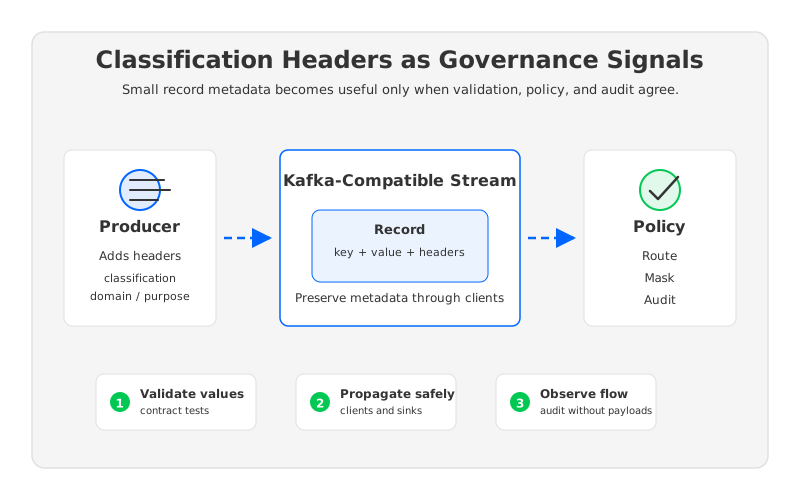
A Kafka record can carry more than a key and value. Headers often become the smallest practical place to say what the data is, how it should be handled, and which downstream systems are allowed to touch it. For teams under security, privacy, and audit pressure, that metadata can become a governance signal that travels with every event.
The search query data classification headers kafka usually comes from a team that already runs streaming systems in production. They are asking how to make classification operational without rewriting every producer, breaking client compatibility, or turning Kafka into a compliance bottleneck. The hard part is making the header meaningful across producers, brokers, stream processors, connectors, observability tools, and incident response.
1Why Data Classification Belongs Near the Event
Batch governance often starts with catalogs, schemas, and storage locations. Streaming governance has a different shape because an event can pass through multiple consumers before it ever becomes a table. If classification appears after warehouse landing, the most sensitive part of the path has already happened without a machine-readable policy signal.
Headers are attractive because they are attached to the Kafka record while leaving the payload mostly untouched. A producer can label a record as classification=restricted, data_domain=payments, or purpose=fraud_detection without changing the Avro, Protobuf, JSON, or binary body. Kafka clients expose record headers through producer and consumer APIs, so the mechanism fits the existing programming model.
That convenience creates a second problem: headers are easy to add and easy to misuse. A consumer can ignore one, a producer can spell it differently, and a connector can drop it if the pipeline is not tested end to end. Useful classification requires more than a naming convention. It needs a control loop.
| Governance question | Header signal | Operational check |
|---|---|---|
| What kind of data is this? | classification, data_domain | Validate allowed values at producer boundaries. |
| Who may process it? | policy_scope, purpose | Map values to ACLs, service identities, and sink allowlists. |
| Where may it move? | region_policy, residency | Check connector destinations and cross-region replication paths. |
| How should it be observed? | audit_level, masking_required | Align logging, metrics tags, and sampling behavior. |
| How should incidents be triaged? | risk_tier, owner_team | Route alerts and runbooks to the accountable team. |
The table looks simple, but each row crosses team boundaries. Security owns the policy, platform engineering owns Kafka, application teams own producers, and data engineering owns many sinks. Classification headers work when those teams treat the header as a decision input, not a decorative label.
2The Production Constraint Behind the Problem
Traditional Kafka deployments were designed around durable logs, ordered partitions, replication, and consumer groups, not per-event governance. Those primitives are still why Kafka is valuable, but they do not automatically answer governance questions. A broker stores the record, an authorized consumer group reads it, and a configured connector writes it to a sink. None of those defaults prove that a restricted event followed the right route.
The first production constraint is compatibility. A classification strategy that requires custom brokers, nonstandard clients, or payload rewrites will fail in a large Kafka estate. The governance layer must work with ordinary Kafka producer and consumer behavior, existing serialization formats, and established topic naming conventions.
The second constraint is cost. Governance programs often ask for more segmentation: separate topics by sensitivity, separate clusters by business unit, separate networks by residency, and separate retention policies by risk. Those moves can be correct, but every split increases operational surface area. Security policy should not force the platform team into a permanently overprovisioned architecture.
The third constraint is auditability. If a team cannot explain which systems saw restricted events, the header did not solve the governance problem. Auditability requires consistent metadata propagation, contextual logs, and metrics that show where sensitive streams flow. The platform need not inspect every payload, but it must preserve the signal.
3A Practical Header Taxonomy
A good classification header set is small enough that producers can use it correctly and precise enough that downstream systems can make decisions. The common failure mode is to encode an entire policy manual into headers. A better pattern is to separate stable classification from policy interpretation.
Use headers to describe the event, then use platform policy to decide what that description means:
classification: the sensitivity tier, such aspublic,internal,confidential, orrestricted. This should be the most stable field and should have a short allowed-value list.data_domain: the business domain, such aspayments,identity,inventory, orsupport. This helps ownership, routing, and incident response.purpose: the intended processing purpose, such asfraud_detection,billing, oranalytics. This is useful when the same data class may be allowed for one purpose but not another.residency: the regional or jurisdictional handling requirement. Keep the values operational, not legalistic, so routing systems can act on them.schema_idorcontract_version: the data contract version used by the event, useful for validating whether a producer is using the expected policy shape.
The producer should not be the sole enforcement point. Producer-side validation catches obvious mistakes early, but a real system also needs contract tests, schema checks where applicable, connector propagation tests, and consumer-side behavior for missing or invalid headers. The goal is to prevent silent downgrades when deployments change.
A classification header is useful only when a downstream system can safely treat it as input to a decision. That trust comes from validation, propagation tests, and platform controls, not from the header name itself.
There is also a privacy design choice hidden here. Do not put personal identifiers, raw customer attributes, or secrets in the header. The header should describe the class of the data, not duplicate the data.
4Architecture Options and Trade-Offs
Once classification headers exist, platform teams have to decide where policy should be evaluated. Three patterns show up repeatedly.
| Pattern | Where the decision happens | Strength | Risk |
|---|---|---|---|
| Producer contract enforcement | Application code, SDKs, schema rules | Catches mistakes before events enter Kafka | Inconsistent adoption across teams |
| Stream processing policy layer | Flink, Kafka Streams, or custom processors | Can enrich, route, mask, or quarantine events | Adds another processing dependency |
| Connector and sink controls | Kafka Connect, lakehouse writers, data warehouse loaders | Protects the boundary where data leaves Kafka | May be too late for internal consumers |
The broker layer should preserve headers and enforce access control, but it should not become the sole home for classification logic. Kafka authorization is commonly expressed around principals, resources, and operations. Classification policy is about event semantics. Collapsing those into one mechanism usually makes both weaker.
That division works only if the streaming platform is stable under governance-driven changes. Suppose a security review decides that restricted events need separate topics, shorter retention, and narrower consumer access. In a broker-local storage model, those changes can trigger partition growth, storage skew, reassignment, and capacity planning. The governance decision is logical, but the operational cost lands on the Kafka team.
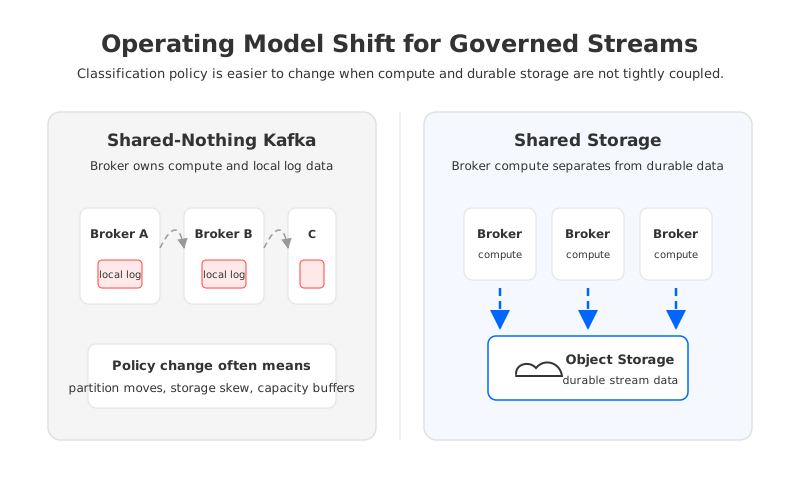
This is where architecture starts to matter. In a shared-nothing Kafka cluster, brokers own local log storage. Scaling, recovery, and rebalancing are tightly coupled to data movement across brokers. If classification policy causes more topic segmentation or retention variation, governance becomes entangled with disk planning.
In a shared-storage architecture, the broker is less tied to local durable data. Storage moves to object storage, and brokers can be treated more like stateless compute in the streaming control plane. That does not remove governance work, but it changes the cost of adapting the platform when policy changes.
5Evaluation Checklist for Platform Teams
The fastest way to evaluate a classification-header strategy is to run it through production failure modes. A clean whiteboard design may break when a connector strips headers, a consumer library behaves differently, or a topic split creates unexpected cost.
Use this checklist before standardizing the pattern:
- Header contract: Are the required header names, allowed values, and missing-value behavior documented and tested? If a producer sends
restrictedin one service andhighly_sensitivein another, the platform has two policies pretending to be one. - Client compatibility: Do the producer, consumer, stream processing, and connector libraries preserve headers in the actual versions deployed? Test this with real messages, not only API documentation.
- Access boundary: Which decisions are made by Kafka ACLs, which are made by processors, and which are made by sinks? Ambiguity here creates audit gaps.
- Connector propagation: Do sink connectors write classification into destination metadata, audit logs, or lineage systems where appropriate? If the signal disappears at the sink, downstream governance becomes manual again.
- Observability: Can operators see classified traffic by topic, service, and destination without logging sensitive payloads? The observability model should expose the policy signal, not the data itself.
- Rollback behavior: If a new classification rule blocks traffic incorrectly, can the team roll back without losing events or bypassing policy entirely? Governance outages are still outages.
- Cost impact: Does the architecture tolerate more topics, more partitions, different retention classes, and isolated consumers without forcing large unused capacity buffers?
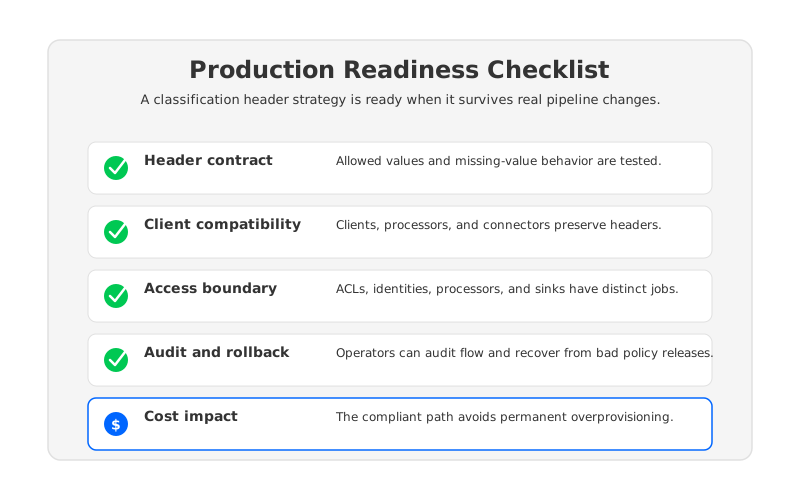
The last item deserves attention because cost pressure changes governance behavior. If every policy improvement requires a cluster expansion, teams will delay policy work or implement shortcuts. A streaming governance design should make the compliant path operationally reasonable.
6How AutoMQ Changes the Operating Model
After the neutral evaluation, the architecture requirement becomes clearer: the platform should keep Kafka client compatibility, preserve event metadata, support strict deployment boundaries, and reduce the operational cost of policy-driven change. AutoMQ fits this category as a Kafka-compatible streaming platform that separates compute from storage by placing durable stream data on object storage.
For classification headers, the first benefit is compatibility. Applications continue to use Kafka-compatible producer and consumer APIs, including record headers. Governance projects rarely get permission to rewrite every application before showing value, so a platform migration should not force the classification program to restart at the client layer.
The second benefit is elasticity. When classification policy creates more topic segmentation, uneven traffic, or new retention classes, the infrastructure should adapt without long broker-local data movement cycles. AutoMQ's shared storage architecture is designed to decouple storage capacity from broker compute, so platform teams can reason about streaming governance separately from local disk ownership.
The third benefit is deployment control. Security and compliance teams often care as much about where the platform runs as how it runs. AutoMQ BYOC deployments place the environment in the customer's cloud account and VPC, which supports data sovereignty, private networking, and customer-controlled operational boundaries.
AutoMQ's cloud-native model also changes the cross-AZ traffic discussion. In traditional replicated Kafka deployments, durability and availability can create substantial inter-zone movement because replicas live on brokers. AutoMQ documentation describes an S3-based storage architecture and zone-aware routing patterns intended to reduce inter-zone traffic, which matters when classified workloads need zone or region isolation.
None of this removes the need for policy design. AutoMQ will not decide what restricted means for your bank, healthcare platform, or SaaS product. The narrower point is that a Kafka-compatible shared-storage platform can reduce infrastructure friction around enforcing the policy you already chose.
7Migration and Readiness Scorecard
A classification-header rollout should start with one high-value stream, not with a universal mandate. Pick a stream where the data domain is clear, the producer team is cooperative, and the downstream path includes at least one connector or processor.
Score the first candidate on five dimensions:
| Dimension | Ready signal | Warning signal |
|---|---|---|
| Producer ownership | One accountable team can change and test headers | Multiple producers disagree on event meaning |
| Header taxonomy | Small allowed-value list exists | Values are copied from policy documents verbatim |
| Downstream path | Consumers and sinks are known | Unknown consumers depend on the topic |
| Platform capacity | Topic and retention changes fit the operating model | Governance split requires major overprovisioning |
| Audit workflow | Logs and dashboards show policy-relevant flow | Teams must inspect payloads to answer audit questions |
If two or more warning signals appear, fix the operating model before expanding the rollout. Many failed governance programs are blocked by brittle infrastructure and unclear ownership.
8References
- Apache Kafka Javadocs: Headers: https://kafka.apache.org/40/javadoc/org/apache/kafka/common/header/Headers.html
- Apache Kafka Javadocs: ProducerRecord: https://kafka.apache.org/40/javadoc/org/apache/kafka/clients/producer/ProducerRecord.html
- Apache Kafka Javadocs: ConsumerRecord: https://kafka.apache.org/40/javadoc/org/apache/kafka/clients/consumer/ConsumerRecord.html
- Apache Kafka documentation: producer configuration: https://kafka.apache.org/documentation/#producerconfigs
- Apache Kafka documentation: consumer configuration: https://kafka.apache.org/documentation/#consumerconfigs
- AWS Macie data classification: https://docs.aws.amazon.com/macie/latest/user/data-classification.html
- AWS security and compliance overview: https://docs.aws.amazon.com/whitepapers/latest/aws-overview/security-and-compliance.html
- AutoMQ architecture overview: https://docs.automq.com/automq/architecture/overview?utm_source=blog&utm_medium=reference&utm_campaign=rpb-0117-data-classification-headers
- AutoMQ compatibility with Apache Kafka: https://docs.automq.com/automq/what-is-automq/compatibility-with-apache-kafka?utm_source=blog&utm_medium=reference&utm_campaign=rpb-0117-data-classification-headers
- AutoMQ Kafka ACLs: https://docs.automq.com/automq-cloud/manage-security/manage-kafka-acls?utm_source=blog&utm_medium=reference&utm_campaign=rpb-0117-data-classification-headers
- AutoMQ encryption at rest: https://docs.automq.com/automq-cloud/manage-security/data-encryption-at-rest?utm_source=blog&utm_medium=reference&utm_campaign=rpb-0117-data-classification-headers
- AutoMQ inter-zone traffic overview: https://docs.automq.com/automq/eliminate-inter-zone-traffics/overview?utm_source=blog&utm_medium=reference&utm_campaign=rpb-0117-data-classification-headers
If classification headers are becoming part of your streaming governance design, evaluate the infrastructure at the same time as the taxonomy. The header can carry the signal, but the platform determines how expensive that signal is to preserve. To explore a Kafka-compatible shared-storage operating model, start here: https://go.automq.com/?utm_source=blog&utm_medium=cta&utm_campaign=rpb-0117-data-classification-headers
9FAQ
9.1Are Kafka headers the right place for data classification?
Kafka headers are a practical place for compact classification metadata because they travel with the record and do not require a payload schema change. They are not a complete governance system; treat them as a policy signal that must be validated, propagated, observed, and mapped to controls.
9.2Should sensitive values be placed in Kafka headers?
No. Headers should describe the class, domain, purpose, or residency requirement of the event. They should not contain personal data, secrets, access tokens, or raw sensitive attributes.
9.3Can Kafka ACLs enforce classification policies by themselves?
Kafka ACLs are important for controlling which principals can read or write topics, but classification policy usually depends on event semantics. Use ACLs for access boundaries and use classification headers as input to application, stream processing, connector, and sink policies.
9.4What should happen when a required classification header is missing?
Define the behavior before rollout. Common patterns include rejecting the record at producer validation, routing it to a quarantine topic, applying the most restrictive default, or alerting the owning team. Silent acceptance is the weakest option.
9.5How does shared storage help streaming governance?
Shared storage does not create the policy, but it can reduce the operational cost of policy-driven changes. When brokers are less tied to local durable data, teams can adapt compute, recovery, and traffic placement with less broker-local data movement.


