
Table of Contents
Table of Contents
The first broken event rarely looks dramatic. A producer ships a field as a string instead of an integer. A team removes an optional-looking attribute that another service treats as required. A batch contains a region code that violates the privacy model, but the topic is already feeding analytics, fraud detection, and an AI retrieval pipeline. Kafka does what Kafka is supposed to do: it durably spreads the event to everyone who asked for it.
That is why teams search for kafka data contracts after they already have a streaming platform, not before. The problem extends beyond schema compatibility. A schema can say an event is shaped correctly while the event is still unsafe, semantically wrong, or too expensive to repair after fan-out. A data contract is the production agreement around the event: structure, meaning, ownership, compatibility, privacy, observability, and the enforcement points that stop a bad event before it becomes shared state.
1Why kafka data contracts matters now
Kafka topics have become APIs. Producers publish into a graph where consumers make decisions, train models, refresh caches, and trigger workflows. The more valuable the stream, the more expensive a contract break becomes. A late warehouse correction can fix a report, but it cannot always undo a payment decision, a customer notification, or a model context update that already consumed the event.
The pressure has moved from data engineering into platform governance. Security teams care about sensitive fields before they fan out. Compliance teams care about lineage and retention. Platform teams care about replay storms and dead-letter queues. FinOps teams care that every malformed event may be stored, replicated, transformed, indexed, monitored, and reprocessed before anyone notices it.
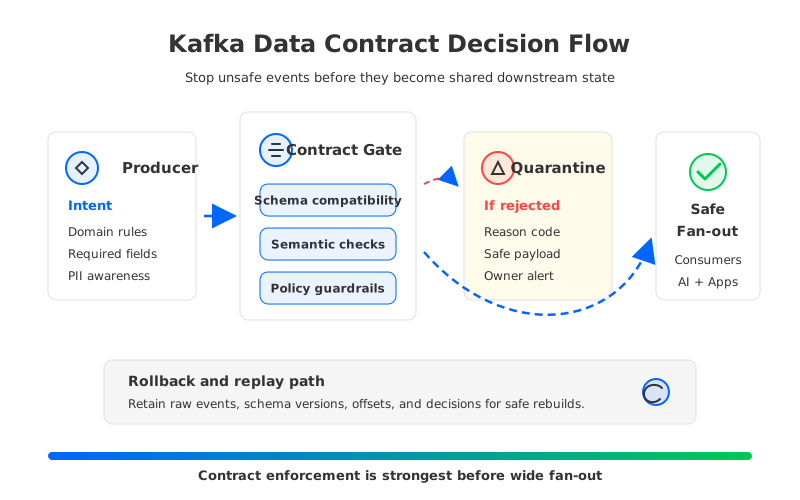
That mix changes the contract discussion. A production Kafka data contract should answer five questions:
- What must be true before an event enters the topic? This includes schema, required fields, semantic ranges, and policy requirements.
- Who owns compatibility? Producers, consumers, and the platform need a shared rule for backward, forward, or full compatibility rather than a per-team interpretation.
- Where is the contract enforced? Validation can happen in producer code, a schema registry, broker-side validation, stream processing, connectors, or consumer checks. Each point catches a different class of failure.
- How is drift detected? Observability should show contract violations, rejected events, schema versions, consumer lag, and downstream blast radius.
- What is the rollback path? When a contract change is wrong, the team needs retained raw events, versioned schemas, offset strategy, and a way to replay without creating a second incident.
The mistake is treating those questions as documentation. Documentation helps, but the contract matters when it changes runtime behavior.
2The production constraints behind the search
Schema governance is the visible part of the problem because it is easy to name. Avro, JSON Schema, and Protocol Buffers give teams a way to define record structure. Registries can check compatibility, manage versions, and give producers and consumers a common vocabulary. These tools are usually the right starting point.
But Kafka production failures do not stop at type mismatch. A field can be valid JSON and still contain sensitive data that should not leave a boundary. An event can pass schema validation while violating a business invariant, such as order_total being negative. A schema can be backward compatible while the semantic meaning of a field changes enough to break a fraud model. The contract has to cover both format and intent.
The enforcement pattern usually becomes layered:
| Layer | What it catches | What it misses |
|---|---|---|
| Producer validation | Domain-specific invariants before write | Cross-team policy drift and later consumer assumptions |
| Schema registry compatibility | Shape and version compatibility | Sensitive data policy, value ranges, and semantic meaning |
| Broker or platform enforcement | Shared rules before broad fan-out | Deep business logic that belongs near the producer |
| Stream processing guardrail | Stateful checks, enrichment, quarantine, repair | Bad events may already exist in the source topic |
| Consumer validation | Local expectations and defensive reads | Platform-wide blast radius prevention |
No single layer is enough because no team owns the whole lifecycle. The producer owns domain truth, the platform owns shared enforcement, and consumers own local interpretation. A good Kafka data contract makes those boundaries explicit.
The cost side is easy to underestimate. Every violation creates work after the write: retained bad records, duplicate derived topics, dead-letter storage, alerts, incident triage, replays, and sometimes consumer-side compensating logic. If the cluster already runs hot, repair replays compete with normal traffic. If the platform uses broker-local storage, longer rollback history can become a capacity project.
3Why broker-local Kafka can amplify contract mistakes
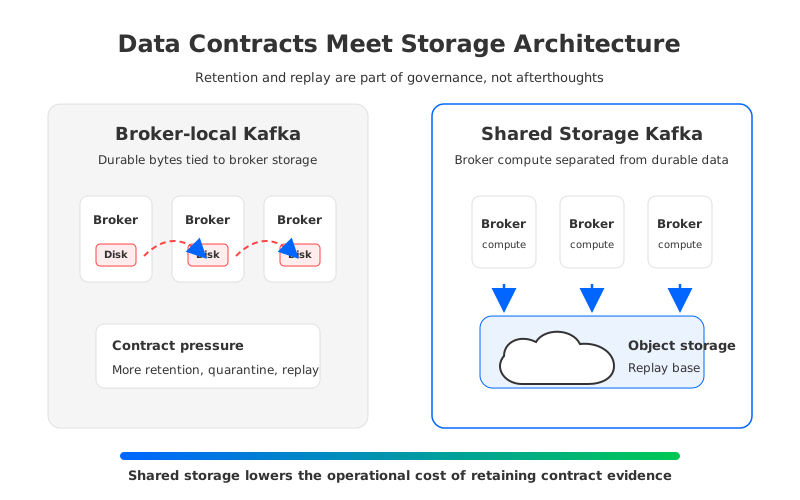
Traditional Apache Kafka is a shared-nothing system. Brokers own local log segments, partitions are assigned to brokers, and replication provides durability. This model is mature and widely deployed, but it makes data ownership operationally concrete: bytes live on broker storage, and workload changes affect broker disk, network, and partition movement.
Data contracts interact with that model in a direct way. Stronger contracts usually mean more versions, more retained history, more quarantine topics, more replay paths, and more derived streams. A platform that validates, quarantines, repairs, and replays events is doing useful governance work, but it is also increasing the amount of data the streaming layer must store and serve. The program succeeds only if the platform can absorb those patterns without turning governance into a cluster scaling problem.
Tiered storage can help long-retention economics by moving older log segments to remote storage. Still, tiered storage does not make broker compute stateless. Hot data, leadership, local cache behavior, and recovery remain important. When a contract change causes a large replay, the platform must serve historical reads while producers and tail consumers continue to run.
That is why Kafka data contracts should be evaluated with storage architecture in view. Contract enforcement is an operating model, not a registry feature alone. The platform needs enough elasticity to isolate catch-up reads, enough retention for rollback, and enough compatibility to avoid rewriting applications that already depend on Kafka APIs.
4Architecture patterns teams usually compare
Most teams do not choose between "data contracts" and "no data contracts." They choose where to put enforcement and how much responsibility the Kafka platform should carry. The answer depends on schema change rate, data sensitivity, consumer count, and rollback cost after a bad write.
Producer-owned enforcement works well when the producer team has strong domain ownership and the event has few consumers. It keeps business rules close to the source. The trade-off is consistency: when many producers publish similar event types, each team may implement policy differently unless the platform supplies shared libraries and review gates.
Registry-centered enforcement works well for format compatibility. A schema registry gives the platform a versioned control point and helps consumers reason about change. The trade-off is scope. Compatibility proves that the event can be decoded according to a rule set; it cannot prove that the event is semantically correct or policy-safe.
Platform enforcement works well when topics are shared broadly or sensitive fields must not fan out. Validation near the streaming boundary can reject, quarantine, or route events before they reach dozens of consumers. The trade-off is ownership: too much business logic turns the platform into a bottleneck.
Stream-processing enforcement works well for stateful checks: reference-data validation, deduplication, enrichment, anomaly detection, and quality scoring. The trade-off is timing. If the raw topic is already consumed broadly, the correction stream may arrive too late.
The practical pattern is layered governance with clear ownership. Use producer validation for domain truth, registry compatibility for structure, platform guardrails for shared policy, and stream processing for stateful checks. Then decide which topics are raw, certified, quarantine, or remediation paths.
5Evaluation checklist for platform teams
A useful contract review is concrete. It should ask whether a bad event can enter, spread, hide, and resist rollback. If the answer is yes, the contract is still mostly a document.
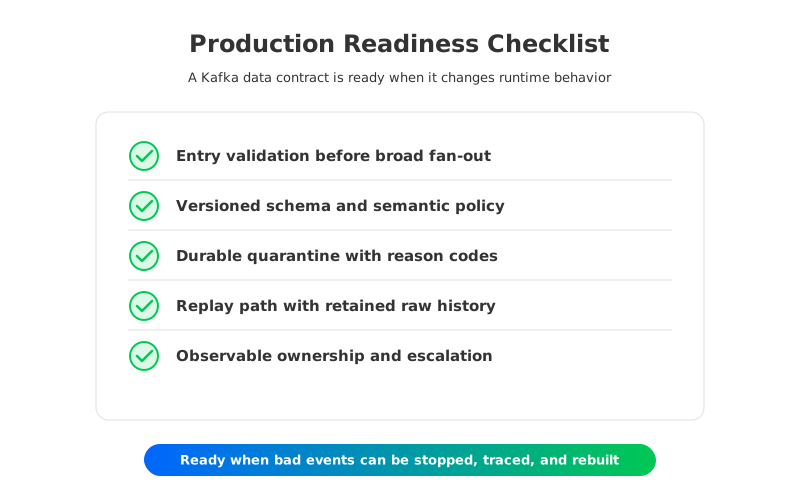
Start with the event lifecycle:
- Entry. Define the validation performed before the record is acknowledged. Separate schema shape, semantic invariants, and policy checks.
- Versioning. Decide which compatibility modes are allowed per topic and how exceptions are reviewed. A payment topic and an experimentation topic should not share the same change policy.
- Quarantine. Route rejected events to a durable, observable path with enough context to debug without exposing sensitive data.
- Replay. Retain raw or pre-transformed events long enough to rebuild certified topics. Document the offset and schema-version strategy for replay.
- Observability. Track violations, schema versions, rejected record counts, consumer lag, replay throughput, and downstream impact.
- Ownership. Assign producer, platform, and consumer owners for every certified topic.
The review should also include a migration path. Existing Kafka topics often have years of assumptions embedded in consumer code. Enforcing a strict contract in one step can break applications that are already handling messy data defensively. A safer rollout usually starts with observe-only validation, then producer warnings, quarantine for high-risk violations, and hard rejection once teams agree.
For regulated or AI-facing workloads, prove that the contract controls data freshness and exposure together. An AI pipeline that consumes stale context can produce wrong answers quickly. A stream that masks fields only after fan-out still exposes raw values to systems that never needed them. In both cases, the contract is strongest before the event becomes widely shared.
6Where AutoMQ changes the operating model
Once the review reaches retention, replay, and elasticity, AutoMQ becomes relevant as a Kafka-compatible, cloud-native streaming platform built around compute-storage separation. AutoMQ preserves Kafka protocol compatibility while moving durable stream storage to shared object storage through its S3Stream architecture. Storage architecture does not replace data contracts; it gives the contract program a platform that can retain, replay, and scale without making every governance requirement a broker-local disk problem.
AutoMQ uses stateless brokers with shared storage so broker compute is less tightly coupled to durable partition data. Writes are acknowledged through a write-ahead log path and uploaded to object storage, while controllers and metadata coordinate ownership. That design changes several contract-related operations:
- Longer rollback windows become more practical. Retaining raw and certified streams on object storage can reduce broker-local disk pressure.
- Replay and catch-up become architecture concerns, not emergency exceptions. Shared storage and stateless broker design let teams reason about historical reads without treating every scaling event as a data movement project.
- Governance can stay inside the customer boundary. AutoMQ BYOC and AutoMQ Software are designed for customer-controlled environments, which matters when contracts include sensitive data, residency, IAM, audit, and private networking.
- Kafka compatibility protects the contract surface. Producers, consumers, offsets, topics, and common integrations remain familiar, so contract work can focus on event behavior rather than application rewrites.
AutoMQ does not remove the need for schema registries, producer discipline, or ownership. A cloud-native storage layer cannot decide whether customer_status changed meaning. It can reduce the operational penalty of doing contracts properly: retaining raw history, isolating replays, scaling compute, and keeping Kafka-compatible interfaces while the platform evolves.
7Decision table: when to optimize, when to redesign
The right next step depends on the failure mode. Some teams need better schemas. Some need stronger enforcement. Some need to revisit the streaming platform because the operational cost of governance has outgrown the tooling.
| Signal | Likely next step | Why it matters |
|---|---|---|
| Producers make small schema mistakes, but blast radius is limited | Add registry compatibility, CI checks, and producer validation | The platform problem is still mostly change discipline |
| Sensitive fields can reach broad consumer groups before masking | Move policy enforcement closer to ingestion or certified topics | Documentation alone will not prevent exposure |
| Contract changes trigger large replays that disrupt normal traffic | Review retention, catch-up isolation, and storage architecture | Governance depends on reliable rebuild paths |
| Broker disk sizing is driven by rollback windows and quarantine topics | Evaluate shared-storage Kafka-compatible architecture | Data contracts should not force permanent overprovisioning |
| Consumers rely on Kafka APIs and cannot absorb a platform rewrite | Prefer Kafka-compatible modernization | Contract rollout is hard enough without application migration |
The deeper lesson is that Kafka data contracts are not only a data quality feature. They are a platform reliability practice. If bad events spread faster than teams can detect and repair them, the contract is not close enough to the stream. If enforcement makes the platform brittle, the architecture is carrying the wrong kind of state.
For teams reviewing Kafka architecture around governance, retention, and replay, AutoMQ provides a Kafka-compatible path to separate compute from durable stream storage while keeping data-plane deployment under customer control. Map your highest-risk topics against the checklist above, then compare the operational cost of enforcing contracts on your current cluster with a shared-storage Kafka-compatible design. You can start from the AutoMQ architecture overview or talk with the AutoMQ team about a production evaluation.
8References
- Apache Kafka Documentation
- Apache Kafka KIP-405: Kafka Tiered Storage
- Apache Avro Specification
- JSON Schema Specification
- CloudEvents Specification
- Apicurio Registry Documentation
- AutoMQ Architecture Overview
- AutoMQ S3Stream Overview
- AutoMQ Stateless Broker
9FAQ
9.1What is a Kafka data contract?
A Kafka data contract is the production agreement around a topic or event type. It usually includes schema, compatibility rules, semantic expectations, ownership, privacy requirements, observability, and enforcement behavior. In production, the enforcement behavior matters as much as the written agreement.
9.2Are schemas and data contracts the same thing?
No. Schemas define structure and compatibility, while data contracts define the broader runtime promise. A schema can prove that a record is decodable, but a contract should also address meaning, policy, ownership, drift, and rollback.
9.3Where should Kafka data contracts be enforced?
Most production systems use multiple enforcement points. Producer validation catches domain-specific errors early. A schema registry manages structural compatibility. Platform guardrails protect shared policy before fan-out. Stream processing can handle stateful checks and remediation. Consumers still need defensive validation for local assumptions.
9.4Do data contracts require changing Kafka clients?
Not always. Many contract controls can be introduced through schemas, CI checks, registries, platform validation, connector policies, or certified topics. Client changes are usually needed when producers must add missing fields, fix semantics, or adopt stronger validation before publishing.
9.5How does AutoMQ help with Kafka data contracts?
AutoMQ helps with the platform side of contract enforcement. Its Kafka-compatible shared-storage architecture can make retention, replay, catch-up, and elastic scaling easier to operate than broker-local storage designs. Teams still need schema governance and ownership, but the storage architecture can reduce the operational penalty of doing contracts seriously.


