
Table of Contents
Table of Contents
An upstream team adds a status value to an event. The producer deploys cleanly, the record still serializes, and the topic keeps accepting writes. Downstream, a fraud rule treats the unfamiliar value as unknown, a warehouse mapping drops it, and a notification service takes a fallback path. Nothing in the broker's write path says that the change violated a promise.
That is the uncomfortable part of a Kafka data contract. The break may be visible only after several consumers have interpreted the same record in different ways. A contract has to protect more than payload shape. It must also state what fields mean and how a change moves through a mixed-version system.
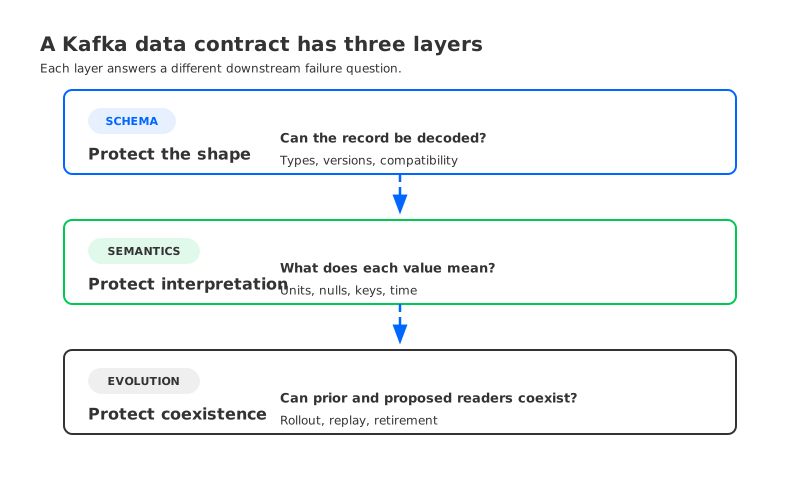
The practical model has three layers: schema validation, semantic meaning, and evolution over time. Each layer has different tools, a different owner, and a different failure signal. Treating all three as "schema governance" leaves gaps that appear during handoffs and rollouts.
1The contract no one signed
Apache Kafka® transports records between producers and consumers. A topic can define retention and access rules, but the broker does not know whether amount is expressed in cents or dollars, whether a missing customer_id means unknown or invalid, or whether event_time is when a business action happened or when a service observed it.
That makes a topic contract an operating agreement around a stream, not a topic description in a catalog. It should connect the event shape to its business meaning, permitted changes, validation point, failure behavior, and named owners. A useful contract lets a producer answer what it must publish and lets a consumer answer what it may safely assume.
The distinction matters during incident response. If a consumer fails to decode a record, the team needs a schema and serializer answer. If it decodes the record but makes the wrong decision, the team needs a semantic answer. If both versions are valid in isolation but cannot coexist during deployment, the team needs an evolution answer. Those are three different investigations.
2Three layers of a Kafka data contract
The layers are related, but they should not be collapsed into one control. A schema registry can help with structural compatibility. It cannot decide whether a valid string still means the same thing. A consumer test can reveal a semantic mismatch. It cannot define the producer's rollout order.
| Contract layer | Question to settle | Practical controls | Primary owner |
|---|---|---|---|
| Schema validation | Can the record be encoded, decoded, and checked against the permitted shape? | Serializer and deserializer checks, schema versions, registry compatibility when used, CI fixtures | Producer team, with platform support |
| Semantic meaning | What does each field mean, and what values are valid in the domain? | Field definitions, units, null rules, examples, producer assertions, consumer data-quality checks | Domain owner |
| Evolution over time | How can the event change while prior and proposed writers and readers coexist? | Compatibility policy, rollout order, replay fixtures, deprecation rules, version matrix | Contract owner with producer and consumer teams |
2.1Schema validation: protect the shape
Schema validation is the part teams usually implement first because the failure is concrete. A field has the wrong type, a required field is absent, or a reader cannot resolve the writer's record. Avro, JSON Schema, and Protocol Buffers can describe structure, while a schema registry can store versions and apply a compatibility rule when a proposed version is submitted.
The enforcement point still matters. A producer should validate before it sends a record, so malformed data does not become shared state. A consumer should validate at read time as a defensive boundary, especially when it reads retained history or receives records from an older producer. CI should exercise representative writer and reader pairs rather than checking only that the latest schema file parses.
The producer owns the output it publishes. The platform team can provide registry access, serializer libraries, and a standard failure path, but those tools do not transfer responsibility for a field's shape to the platform. A rejected write should be observable and actionable, with enough context to identify the contract version and the producing application.
2.2Semantic meaning: protect interpretation
A structurally valid event can still be wrong. status: "closed" may mean that an order is shipped in one service and that a case is archived in another. timestamp may be event time, processing time, or ingestion time. region may be a sales territory, a cloud region, or a data residency boundary.
Semantics belong beside the schema, in language that a downstream team can use during implementation and review. At minimum, define:
- Units and precision for quantities, amounts, rates, and durations.
- The difference between missing, null, unknown, and not applicable.
- The allowed values and what each value means in the domain.
- The identity represented by the key and the ordering assumptions a consumer may make.
- The time field that drives windows, freshness checks, or late-event handling.
The domain owner is accountable for these definitions because a platform team cannot infer business meaning from field names. Producers encode the meaning in examples and assertions. Consumers confirm that the meaning matches the decision they make. When a value's business interpretation changes, a compatible data type is not enough. The contract needs a reviewed semantic change, a changed event meaning, or a migration path that makes the distinction visible.
2.3Evolution over time: protect coexistence
A contract is tested in the gap between deployments. Prior records remain in retention while a producer starts writing a proposed shape. A consumer may be rolled back, a sink may replay history, or a second team may adopt the topic before the first rollout is complete.
Evolution rules need to answer three questions:
- Which writer and reader versions can coexist?
- Which compatibility direction protects that rollout order?
- When can an old field, value, or event meaning be retired?
A compatibility check is useful, but it is not a rollout plan. Record the expected writer and reader matrix, test representative prior and proposed records, and include replay in the test path. A change can pass a latest-version check while failing against data that remains within the retention window.
The contract owner should also distinguish additive, removal, rename, and meaning changes. Adding an optional field may be safe when readers can ignore it. Removing a field may fail because a retained consumer still depends on it. Renaming a field may be safe only when the business meaning remains unchanged. Changing meaning under the same name is a contract break even when every serializer accepts it.
3Who owns each layer
Ownership fails when a topic has a platform owner but no business owner, or when every consumer believes the producer is responsible for its assumptions. Assign one accountable contract owner for the topic or event family, then make the supporting duties explicit.
| Work | Domain owner | Producer team | Platform team | Consumer team |
|---|---|---|---|---|
| Meaning | Defines terms, units, and valid states | Encodes examples and assertions | Publishes metadata location | Confirms meaning for its use |
| Shape | Approves required fields and types | Validates records before write | Runs shared schema tooling | Handles missing and unknown fields |
| Change | Approves meaning changes and retirement | Stages writers and communicates impact | Enforces agreed compatibility gates | Tests old, current, and replayed data |
| Signals | Defines what is a contract violation | Emits reject and validation context | Routes and alerts on contract failures | Reports downstream impact |
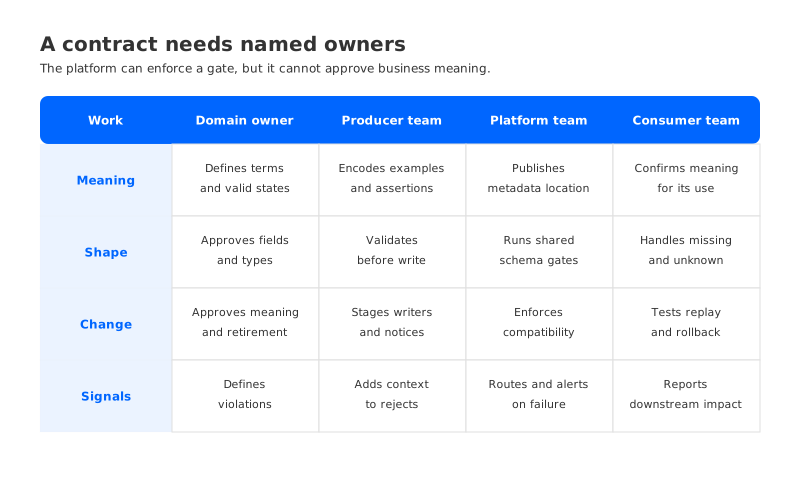
The table is a division of labor, not a request for four separate committees. A small team may fill every column. "The platform owns the topic" still cannot mean "the platform owns the business promise." The platform can enforce a gate, but it cannot approve a semantic change that it cannot interpret.
4Producer and consumer obligations
A topic contract becomes real when it changes the work required to publish and consume an event.
Producer obligations
- Publish the topic purpose, event identity, schema format, sample records, semantic definitions, and owner before inviting downstream use.
- Validate required fields, types, allowed values, and domain invariants before the record reaches Kafka.
- Make units, time semantics, key meaning, null behavior, and sensitive-field handling explicit in code and documentation.
- Classify a meaning change as a contract change even when the serialized type stays the same.
- Announce the rollout order, compatibility rule, and retirement condition for fields or values.
- Keep validation failures visible to the owning team instead of silently coercing data into a shape that appears valid.
Consumer obligations
- Declare which fields, values, and event versions the application depends on.
- Handle permitted missing, null, and unknown states explicitly rather than treating field names as guarantees.
- Test the current record, retained older records, and the proposed record before accepting a producer change.
- Avoid silently converting a semantic mismatch into a default value that changes a business decision.
- Emit a useful signal when the contract fails at the application boundary, including the topic and contract version.
- Remove a dependency only after the contract owner confirms that the field or meaning can be retired.
The dependency boundary follows from these obligations. Producers and consumers may use serializers and deserializers, and a schema registry may provide version storage and compatibility checks. Those are optional ecosystem components around Kafka's transport path. They are not broker-owned definitions of business meaning.
AutoMQ is a factual example of that boundary. Because AutoMQ is compatible with the Kafka protocol, teams can evaluate standard Kafka clients, serializer/deserializer (SerDe) libraries, and a separate Schema Registry as part of the application and platform integration surface. The contract still lives in the producer, domain, consumer, and rollout responsibilities described above. The Kafka compatibility documentation explains the protocol boundary; it does not turn the broker into a semantic contract owner.
5A contract checklist that survives handoffs
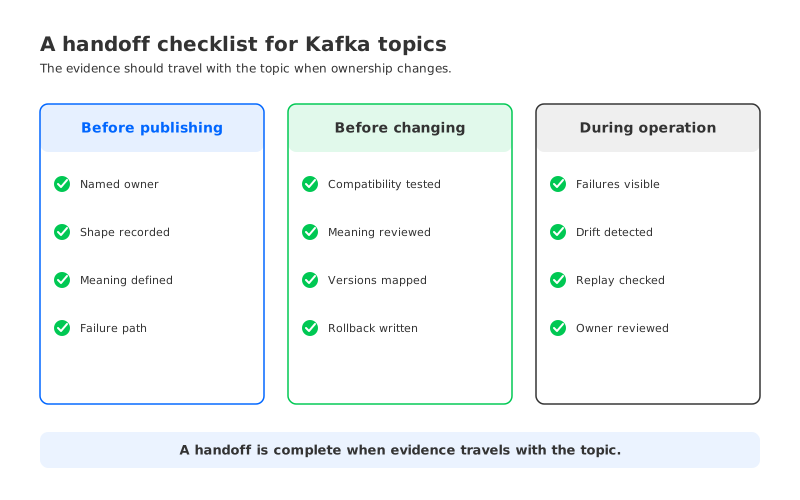
A handoff is complete when the next team can answer the same questions without asking the original producer to translate tribal knowledge. Keep the checklist with the topic's code, registry subject, or metadata record, and make changes reviewable.
5.1Before publishing
- Owner: A domain owner, producer owner, platform contact, and consumer contact are named.
- Shape: The serialization format, required fields, allowed types, sample record, and validation point are recorded.
- Meaning: Units, time semantics, key identity, null rules, valid states, and sensitive-field handling are defined.
- Failure: The team knows whether invalid records are rejected, quarantined, or accepted with an explicit warning.
- Use: Known consumers and the decisions they make from the event are listed.
5.2Before changing
- Compatibility: The old and proposed schemas are tested in the direction required by the rollout.
- Semantics: The domain owner confirms that field names, values, units, and event meaning remain valid.
- Coexistence: The producer and consumer version matrix includes retained data and replay paths.
- Rollout: The deployment order, observation signal, rollback action, and retirement condition are written down.
- Handoff: The change record links the schema version, contract decision, affected consumers, and owner approval.
5.3During operation
- Quality: Producers and consumers surface validation failures with topic and version context.
- Drift: The team can detect unknown values, missing fields, and changes in event-time behavior.
- Replay: A representative retained record can be decoded and interpreted by the current consumer.
- Review: A topic with no active owner is treated as a governance gap, even if its producers still run.
Return to the opening incident: the producer's proposed status value was a shape-compatible write, but its meaning had no reviewed owner and no consumer rollout plan. The schema layer could not catch that failure by itself. A durable Kafka data contract makes the missing decision visible before the next field change reaches every downstream system.
If you are evaluating a Kafka-compatible platform and want to test this boundary with real producers, consumers, schemas, and replay fixtures, start an AutoMQ evaluation. Bring the contract checklist with the workload so the platform decision and the data agreement are reviewed together.
6FAQ
6.1What is a Kafka data contract?
A Kafka data contract is the agreed promise around an event or topic. It covers the record's schema, field meaning, permitted evolution, validation behavior, ownership, and consumer assumptions.
6.2Does Kafka enforce data quality?
Kafka transports and stores records, but it does not know whether a value is meaningful for a business domain. Producers, consumers, schema tooling, and platform controls must define and enforce the quality rules.
6.3How is schema governance different from Kafka data semantics?
Schema governance checks structural facts such as fields, types, and compatibility. Kafka data semantics explain what those fields and values mean, including units, time, identity, null behavior, and valid states. A record can pass the first and fail the second.
6.4Who owns a Kafka topic contract?
A domain or product owner should be accountable for the business meaning. The producer owns the records it emits, the consumer owns its declared assumptions, and the platform team owns shared enforcement and observability.
6.5Is a schema registry required for a Kafka topic contract?
No. A registry can help store versions and enforce schema compatibility, but a contract still needs semantic definitions, rollout rules, and ownership. If a registry is used, its subject naming, compatibility policy, and failure behavior should be part of the handoff record.


