
Table of Contents
Table of Contents
Revenue protection sounds like a finance problem until the missing signal arrives 20 minutes late. A payment decision is made before the fraud score is refreshed. A subscription entitlement changes, but the billing workflow still reads an old state. The event reaches the warehouse eventually, yet the operational decision that depended on it already happened.
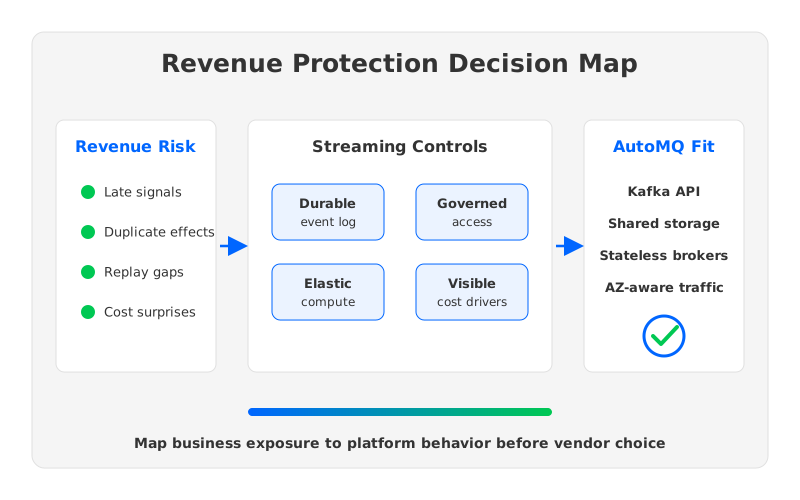
That is the real search intent behind data driven revenue protection kafka. The buyer is asking whether a Kafka-compatible platform can keep revenue-critical decisions durable, replayable, governed, and cost-controlled while many teams produce and consume the same facts at different speeds. The work sits between application engineering, data engineering, SRE, security, and FinOps, which is why architecture choices become business controls.
1Why teams search for data driven revenue protection kafka
Revenue leakage usually hides in gaps between systems. A commerce service knows an order was canceled, a fulfillment service knows the shipment already started, a customer profile service knows the account has elevated risk, and a finance system reconciles the final transaction later. Batch reconciliation can find the mismatch, but it rarely prevents the decision that created it. The earlier the business can observe and act on the event, the more likely it is to protect margin, cash flow, and customer trust.
Kafka became common in this category because it gives teams a durable event log with independent producers and consumers. Fraud services can process payment events without blocking checkout. Billing can consume usage events without owning the metering service. Analytics, audit, and operations can replay the same topics from different offsets. Those primitives match revenue protection because the same event often feeds prevention, detection, reconciliation, and investigation workflows.
The difficulty starts when the event stream becomes part of a control loop. At that point, "eventually delivered" is not a strong enough promise. Teams need to know how the platform behaves when a consumer falls behind, a connector fails, or a bad deployment requires replay. The impact is duplicate billing, uncollected usage, false fraud declines, or audit trails that are hard to reconstruct.
The best platform discussions therefore start with failure behavior: which decisions depend on an event arriving before a deadline, which events must be replayable, which teams can read sensitive signals, which workloads need isolation, and which costs grow with replication, cross-zone traffic, or retention. These questions turn a Kafka deployment into an operating model.
2The production constraint behind the problem
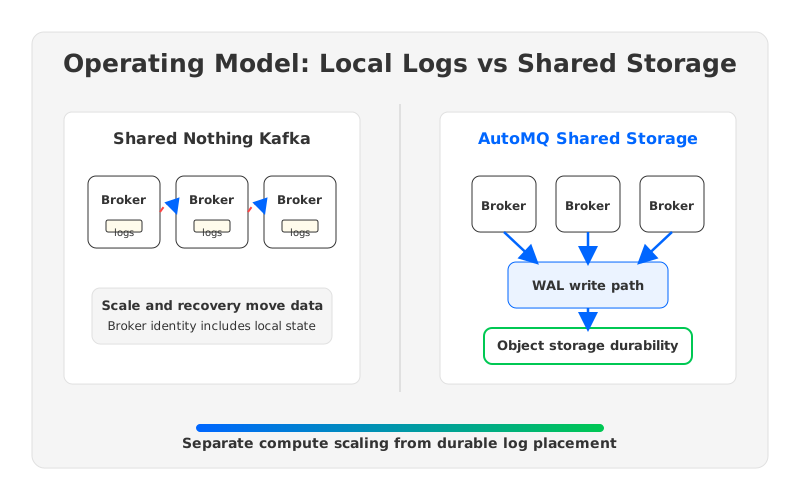
Traditional Kafka uses a shared-nothing architecture: brokers own local log segments for their assigned partitions, and replication copies those logs across brokers. This model is proven, widely understood, and still appropriate for many deployments. It also means storage placement is part of broker identity. When the platform scales or fails, teams must reason about where data lives, not only where compute runs.
Revenue protection workloads put pressure on that binding. They often combine high fan-out, uneven bursts, strict retention, and many operational owners. A metering topic may ingest steadily for months, then spike after a large customer rollout. A fraud topic may have low average throughput but require low-lag processing and fast replay after a model release. A reconciliation topic may need longer retention because finance and compliance workflows move on different timelines from application services.
Broker-local storage makes these differences expensive to manage. If retention grows, broker disks become the planning unit. If traffic grows, broker compute and network may be the bottleneck while disks remain unevenly filled. If a broker is replaced or added, the cluster must still account for partition data placement. None of these behaviors are surprising to Kafka operators, but they matter more when the stream protects revenue instead of feeding an offline dashboard.
There is also a governance constraint. Revenue protection streams carry sensitive facts: payment attempts, billing status, entitlement updates, usage measurements, and fraud signals. Kafka's ACLs, consumer groups, offsets, transactions, and connector ecosystem provide the base machinery, but the platform team still needs policy discipline around ownership, schema changes, replay rights, retention, and emergency access.
3Architecture options and trade-offs
Teams usually evaluate several patterns, and each can be valid under the right conditions. The mistake is treating them as a maturity ladder where one option is universally superior. The better comparison is operational: what does each model make easy, what does it make hard, and who owns the remaining risk?
| Pattern | Where it fits | Revenue-protection risk to test |
|---|---|---|
| Self-managed Kafka | Platform teams with deep Kafka skills and custom deployment needs. | Internal ownership remains high for upgrades, broker recovery, partition reassignment, security policy, and capacity planning. |
| Managed Kafka service | Teams that want operational delegation while keeping familiar Kafka APIs. | Delegation may reduce infrastructure toil, but storage locality, network cost, connector limits, and recovery behavior still need validation. |
| Kafka plus stream processing | Teams that need real-time scoring, aggregation, enrichment, or reconciliation. | Stream processing does not replace durable event retention, replay controls, or source-of-truth topic governance. |
| Kafka-compatible shared storage | Teams that want Kafka semantics while separating broker compute from durable storage. | Compatibility, latency path, failure recovery, migration tooling, and cloud boundary controls must be proven with real workloads. |
The important distinction is between service model and storage model. A managed service changes who performs many operations. A shared-storage architecture changes which operations are necessary around broker replacement, storage growth, and data movement. Revenue protection needs both questions answered.
The stream processing layer deserves special attention. Fraud scoring, entitlement enforcement, usage metering, and reconciliation often require joins, windows, state stores, and exactly-once or effectively-once processing patterns. Kafka Streams, Flink, Spark Structured Streaming, and custom services can all appear in the design. But if the platform cannot retain, replay, isolate, and secure the input topics, the processing layer inherits a weak foundation.
4Evaluation checklist for platform teams
A practical evaluation starts with the control points that protect revenue, then maps those controls to Kafka platform behavior. Product features matter after the team defines the production behaviors it must preserve.
| Evaluation area | Question to answer before production |
|---|---|
| Kafka compatibility | Do existing producers, consumers, transactions, ACLs, offsets, and client versions behave as expected under the target platform? |
| Durability and replay | Can revenue-critical topics be replayed independently for correction, audit, and investigation without putting broker capacity under surprise pressure? |
| Elastic capacity | Can the team add compute during seasonal traffic, customer onboarding, or fraud spikes without a long data movement project? |
| Governance | Are schema rules, retention policies, topic ownership, access control, and sensitive-data handling part of the delivery workflow? |
| Failure recovery | What happens after broker loss, zone impairment, connector failure, consumer lag, or a bad deployment that requires rollback? |
| Cost visibility | Can FinOps separate compute, storage, cross-zone traffic, connector runtime, observability, and data egress in forecasts? |
| Migration risk | Can the platform be introduced topic by topic, with output validation and a rollback path for each revenue workflow? |
Compatibility is the first gate because revenue systems accumulate long-lived integrations. Payment, subscription, usage, ERP, data warehouse, and fraud systems may run different Kafka client versions and configuration styles. A platform proof of concept should test consumer groups, offset commits, producer acknowledgments, idempotent producers, transaction usage if present, ACLs, quotas, and connector behavior. A producer-consumer smoke test proves almost nothing for this category.
Durability and replay are the second gate because revenue protection is not only about the hot path. A fraud model may be redeployed against recent events, a billing pipeline may replay usage after a schema fix, and an audit team may ask for a reconstruction of the decision trail. The platform should make those workflows normal rather than exceptional.
Cost visibility is the gate that gets ignored until the bill arrives. High fan-out means one event can be read by prevention, analytics, finance, support, and machine-learning workflows. Replication, cross-zone reads, long retention, and connector egress can grow faster than raw ingest. If the evaluation cannot explain these cost drivers separately, the production architecture will be hard to govern.
5How AutoMQ changes the operating model
Once the evaluation reaches storage behavior, a specific requirement appears: Kafka-compatible APIs with broker compute separated from durable log storage. AutoMQ is a Kafka-compatible cloud-native streaming platform built around that requirement. It retains the Kafka protocol surface while moving the storage layer to shared object storage and using a write-ahead log path to keep the write path practical for streaming workloads.
The shift is operational. In a traditional shared-nothing cluster, broker identity and local data ownership are tightly coupled. In AutoMQ's shared storage model, durable data lives in object storage, while brokers serve Kafka traffic and coordinate the hot path. Scaling broker compute is less entangled with moving historical data, and retention becomes more of an object-storage and governance decision.
For revenue protection, the most relevant effects are concrete. Elasticity becomes safer to discuss with business teams because onboarding spikes, seasonal payment volume, or fraud-event bursts do not have to imply a long rebalance. Replay becomes a first-class operating concern because longer windows can be evaluated against object-storage-backed durability and access policy. Network design also becomes part of the cost model; AutoMQ documents zero cross-AZ traffic best practices for eligible deployments, which matters when fan-out makes network charges visible.
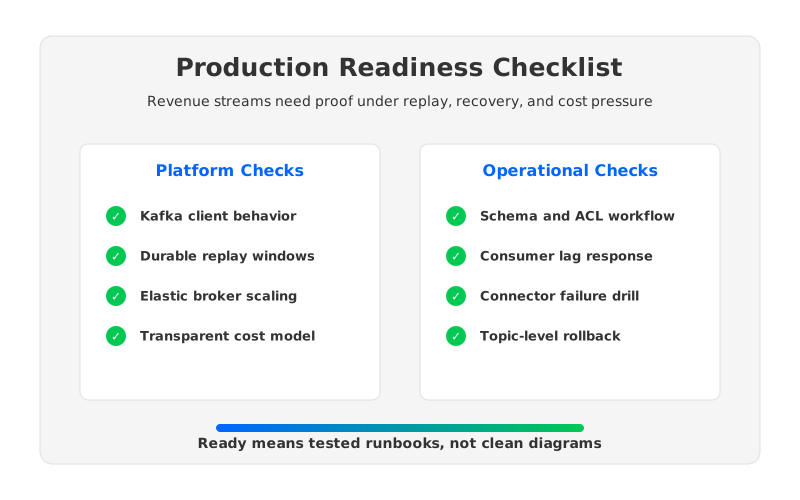
This is not a reason to skip engineering validation. A revenue protection proof of concept should still measure latency, consumer lag under backfill, connector throughput, transaction behavior, failure recovery, observability, and access-control workflows. Shared storage does not replace good topic design or stream processing discipline; it narrows the places where broker-local storage turns routine scale or recovery into a data placement project.
6A practical revenue protection architecture
A durable revenue protection design starts by separating facts from decisions. Payment attempts, entitlement changes, usage measurements, order state, refunds, chargebacks, and risk signals should be represented as domain-owned event streams. Decision services can build materialized views, risk scores, reconciliation tables, or alerts, but the source topics should remain replayable and auditable.
That separation also keeps ownership legible. Billing may own metered-usage events, identity may own account status changes, commerce may own order lifecycle events, and fraud may own risk signals. Platform engineering owns the Kafka-compatible substrate, but it should not become the schema owner for every revenue fact in the company.
The consumer side needs similar discipline. A fraud scoring consumer group should not share operational fate with an analytics sink. A reconciliation backfill should be throttled so it does not create lag for live authorization decisions. Offset reset and replay procedures should be controlled because they can create duplicate downstream effects when consumers are not idempotent.
Migration should be incremental. Pick one bounded workflow, such as metered usage, entitlement changes, or refund reconciliation. Validate ordering, lag, schema compatibility, downstream results, and rollback. Move consumers in waves, then retire the old path when the revenue outcome and operational runbooks are proven. A platform migration that cannot roll back by topic is not a revenue protection plan.
7Readiness scorecard
The final checkpoint is practical: score the platform against behaviors that would matter during a real revenue incident.
| Scorecard item | Ready signal | Risk signal |
|---|---|---|
| Event model | Revenue facts have domain owners, schemas, retention, and keys documented. | A generic "revenue events" topic collects unrelated facts because it is quick to start. |
| Replay control | Teams can replay one workflow with authorization, throttling, and duplicate-effect protection. | Replay depends on manual offset resets and tribal knowledge. |
| Recovery | Broker loss, connector failure, consumer lag, and bad deployment rollback have tested runbooks. | Runbooks describe intent but have not been exercised under load. |
| Cost model | Compute, storage, cross-zone traffic, connectors, and observability are forecast separately. | Finance sees only aggregate streaming spend after the month closes. |
| Migration | Cutover, validation, and rollback are defined per topic or workflow. | Migration is treated as a one-time infrastructure switch. |
Kafka-compatible durable streams are a strong foundation for this problem. The scorecard asks whether the operating model is strong enough for the business process that will depend on it.
8Take the next step
Go back to the first missed signal: the event that arrived late, the replay that was risky, the consumer lag that hid a billing issue, or the cloud bill nobody could explain. That incident is the right starting point for a platform evaluation because it ties architecture to business exposure.
If your team is evaluating Kafka-compatible infrastructure for data-driven revenue protection, use the checklist above as the structure for your proof of concept. To see how AutoMQ approaches shared-storage Kafka with object-storage-backed durability and stateless brokers, start with the AutoMQ Cloud trial and test it against your own producers, consumers, replay workflows, and failure drills.
9References
- Apache Kafka Documentation
- Apache Kafka Producer Configurations
- Apache Kafka Consumer Configurations
- Apache Kafka Streams Documentation
- Apache Kafka Connect Documentation
- Apache Kafka KIP-405: Kafka Tiered Storage
- AWS S3 Data Durability
- AutoMQ Compatibility with Apache Kafka
- AutoMQ Architecture Overview
- AutoMQ Zero Cross-AZ Traffic Best Practice
10FAQ
10.1What is data-driven revenue protection?
Data-driven revenue protection is the use of timely, governed operational data to prevent or reduce revenue leakage, billing errors, fraud loss, entitlement mistakes, reconciliation gaps, and audit failures. In event-driven systems, it depends on durable streams that can feed prevention, detection, correction, and investigation workflows.
10.2Why use Kafka for revenue protection workflows?
Kafka gives teams durable topics, independent producers and consumers, consumer groups, offsets, replay, and a mature connector ecosystem. Those primitives are useful when the same revenue-critical event must be consumed by billing, fraud, analytics, customer support, finance, and machine-learning systems without creating point-to-point integrations.
10.3What makes revenue protection different from ordinary event streaming?
Revenue protection workflows have direct business exposure when events are late, lost, duplicated, misgoverned, or hard to replay. The architecture must be evaluated against recovery, replay, access control, cost visibility, and migration behavior, not only throughput.
10.4Is managed Kafka enough for data-driven revenue protection?
Managed Kafka can be enough when the operational boundaries and workload requirements fit the service. Teams should still validate Kafka compatibility, storage behavior, replay workflows, connector limits, cross-zone traffic, recovery procedures, and governance controls before using it for revenue-critical decisions.
10.5Where does AutoMQ fit in a revenue protection architecture?
AutoMQ fits when a team wants Kafka-compatible APIs with a cloud-native operating model based on shared storage, stateless brokers, object-storage-backed durability, and customer-controlled deployment boundaries. It should be evaluated with real producers, consumers, connectors, replay jobs, security policies, and failure drills.


