
Table of Contents
Table of Contents
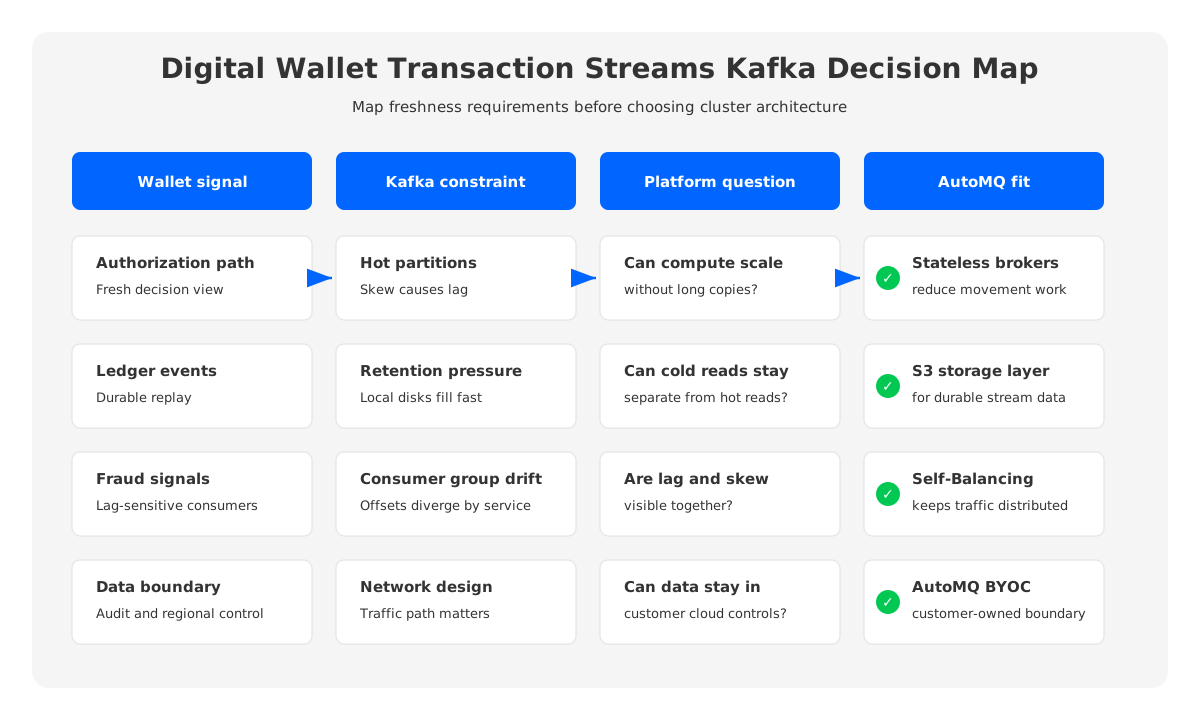
Searches for digital wallet transaction streams kafka usually come from teams that already know why streaming matters. The harder question is whether the transaction stream is fresh enough for the decisions built on top of it. A wallet authorization, balance update, fraud signal, reward event, ledger entry, and customer notification may all depend on the same event flow, but they do not tolerate staleness in the same way. Treating them as one generic Kafka workload creates a platform that looks healthy at the cluster level while the business workflow is already late.
Freshness is not the same as raw latency. Latency measures how long one operation takes; freshness measures how far downstream data has drifted from the business event it represents. A Kafka consumer group can be connected and producers can still be writing while risk scoring reads a view several minutes behind. For digital wallets, that gap turns into duplicate customer actions, stale account state, delayed fraud decisions, and reconciliation work.
The practical platform question is therefore narrower than "Can Kafka handle wallet transactions?" It is: can the Kafka-compatible streaming layer preserve data freshness while the workload spikes, partitions move, brokers fail, consumers replay history, and governance rules keep data inside the right cloud boundary?
1Why teams search for digital wallet transaction streams kafka
Digital wallet systems create several streams that look similar in infrastructure diagrams but behave differently under pressure. Authorization events are hot-path decisions. Ledger events are accounting evidence. Customer activity events feed risk, growth, and support workflows. Settlement events often need durable replay because downstream systems may be batch-oriented or operated by external partners. The platform has to support all of them without pretending that one freshness target is enough.
This is why the search query tends to appear during architecture reviews rather than early education. The team already has topics, producers, consumer groups, and offsets in its vocabulary. What it needs is a way to separate business freshness requirements from implementation details before choosing a cluster shape, replication model, migration path, and operating model.
A useful freshness model starts with four questions:
- Which decisions are blocked by stale data? Fraud scoring, wallet balance presentation, and transaction notifications usually have different tolerance levels, so they should not share one vague "real-time" requirement.
- Which consumers are allowed to replay? Analytics and dispute workflows may read older offsets, but hot-path account state should not compete with bulk catch-up reads without a capacity plan.
- Which data must stay inside a controlled boundary? Payment and wallet data often have regional, network, audit, and encryption requirements that influence deployment more than feature checklists do.
- Which failures are part of the design? Broker replacement, consumer lag, overloaded partitions, object storage access, and network isolation should be modeled before the first production peak.
Those questions turn a broad Kafka conversation into an engineering decision. They also expose why many wallet workloads become expensive to operate in the cloud: the freshness target is business-driven, but the storage and replication model determines how much capacity must be reserved to protect it.
2The production constraint behind the problem
Traditional Kafka follows a Shared Nothing architecture. Each broker owns local storage for the partitions it serves, and durability is achieved through replicated logs across brokers. This model is mature, well understood, and supported by the Apache Kafka ecosystem. It also creates a direct relationship between data placement and operational work: when partitions move, data moves; when brokers are replaced, recovery depends on replica catch-up; when traffic grows unevenly, the platform team has to rebalance partitions and storage together.
That coupling matters for digital wallet streams because freshness is usually lost at the edges of steady state. A cluster may perform well during normal load, then fall behind when a promotion, payroll day, or fraud wave changes the write pattern. If rebalancing requires large data movement, the platform can spend its recovery budget copying historical logs instead of restoring headroom for hot partitions.
The cloud adds another constraint: reliability traffic has a billable shape. Multi-Availability Zone deployments are standard for resilient financial workloads, but cross-zone replication, consumer placement, PrivateLink patterns, and data egress can affect Kafka cost. Exact prices vary by provider, region, and network path, so validate pricing with the target architecture.
Freshness also depends on consumer behavior. Apache Kafka's consumer group model assigns partitions across group members, and offsets represent progress through each partition. This is powerful because each service can manage its own view of the stream, but it also means a slow fraud consumer, a backfilled analytics job, and a schema issue can create very different lag profiles on the same topic. Platform teams need lag observability at the consumer group and partition level, not a broker dashboard that hides downstream delay.
3Architecture options and trade-offs
The first option is to stay with a classic Kafka deployment and tune the operating model. This can be the right choice when the team has strong Kafka operations skills, predictable growth, and a workload that fits the existing broker and disk design. The trade-off is that freshness protection often comes from overprovisioning: extra brokers, extra disk, extra network headroom, and careful partition planning.
The second option is to use Tiered Storage. In Apache Kafka, Tiered Storage moves older log segments to remote storage while brokers keep the local log for active traffic. That helps retention-heavy workloads because historical data no longer has to sit entirely on broker-local disks. It does not remove the broker's responsibility for the hot log, and it does not make brokers stateless. For wallet workloads, Tiered Storage is a retention and replay tool; it should not be mistaken for a full answer to elastic hot-path freshness.
The third option is a Kafka-compatible Shared Storage architecture. In this model, durable stream data is placed in shared object storage, while brokers focus on protocol handling, partition leadership, caching, and request processing. The key difference is operational: partition movement becomes a metadata and traffic ownership problem rather than a large local-log copy problem. That shift changes how a team thinks about scaling, recovery, and reserved capacity.
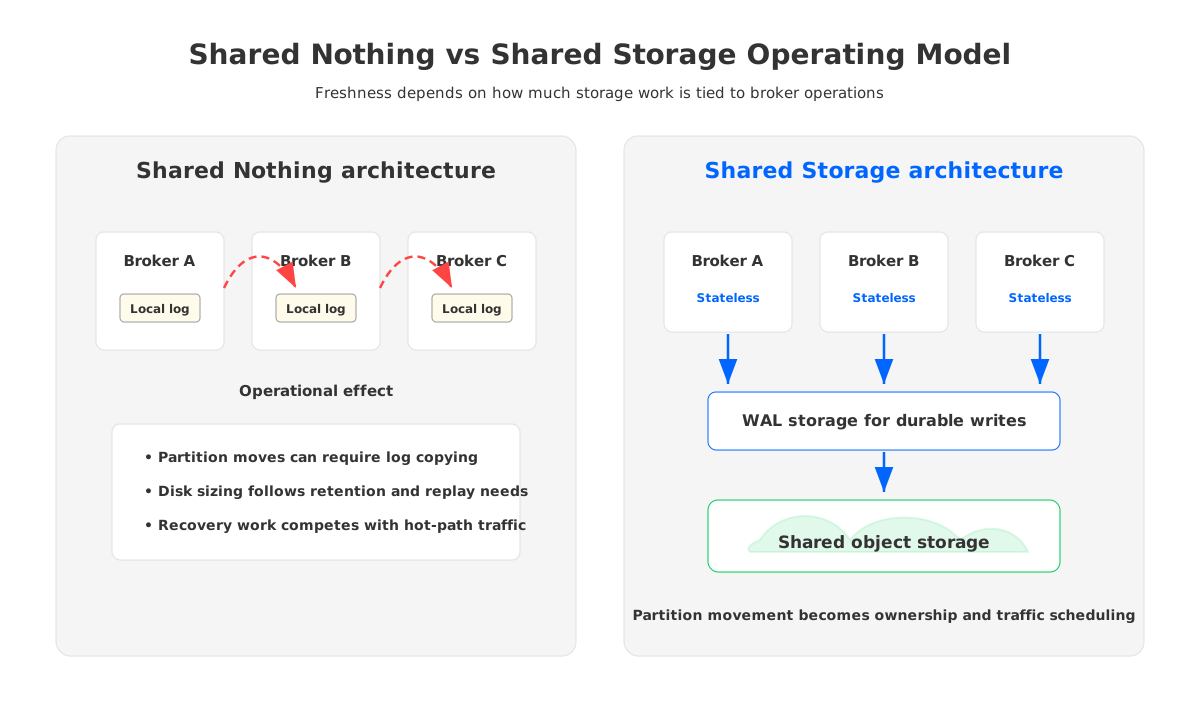
No architecture removes the need for good Kafka discipline. Producers still need idempotence where retries can duplicate writes. Consumer groups still need offset management. Transactions still require careful boundaries. Kafka Connect pipelines still need backpressure handling, schema control, and operational ownership. The platform decision is about where the hardest work lands during failure and growth: on broker-local storage operations, on managed service boundaries, or on a shared storage layer designed for cloud elasticity.
4Evaluation checklist for platform teams
A wallet streaming platform should be evaluated from the freshness requirement outward. Start with the business decision, map it to a topic and consumer group, and then decide what the platform must guarantee during normal operation, catch-up, and failure recovery. The following matrix is a practical way to keep the conversation grounded.
| Evaluation area | Question to answer | Why it affects freshness |
|---|---|---|
| Kafka compatibility | Can existing clients, producer settings, consumer groups, transactions, and tooling continue to work? | Rewriting clients introduces migration risk before the team has solved the freshness problem. |
| Hot-path scaling | Can the platform add write and read headroom without long data movement windows? | Peaks are where wallet decisions become stale. |
| Retention and replay | Can replay traffic be isolated from hot-path consumers? | Historical reads should not starve authorization, balance, or risk consumers. |
| Cost visibility | Can storage, compute, and network charges be modeled separately? | Hidden data movement makes it harder to reserve capacity rationally. |
| Security boundary | Can the deployment keep wallet data inside the required VPC, region, and account controls? | Governance requirements can overrule a technically attractive architecture. |
| Migration and rollback | Can the team migrate topics, offsets, and producers without losing a recovery path? | Cutover risk is part of the production design, not an afterthought. |
| Observability | Can operators see lag, partition skew, broker pressure, storage behavior, and client errors together? | Freshness incidents rarely have one metric as the root cause. |
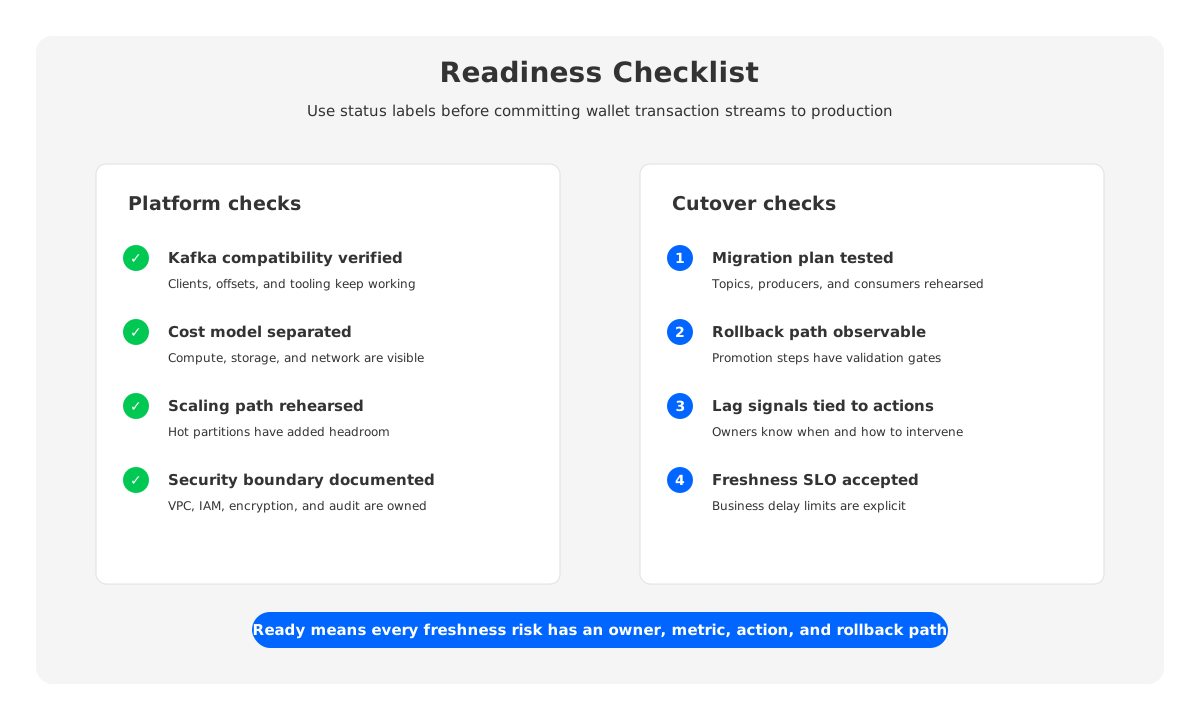
The strongest architecture review is not the one with the longest feature list. It is the one where every freshness requirement has an owner, a metric, an operational action, and a rollback path. If the team cannot say what happens when the fraud consumer falls behind while settlement replay is running, the platform is not ready for wallet production traffic.
5How AutoMQ changes the operating model
Once the evaluation framework is clear, the architectural requirement becomes easier to state: keep Kafka protocol semantics, reduce broker-local state, and make scaling less dependent on copying data between brokers. AutoMQ is a Kafka-compatible streaming platform built around that requirement. It keeps the Kafka API and ecosystem model while moving the storage layer to a Shared Storage architecture backed by object storage.
In AutoMQ, brokers are designed as stateless brokers. Durable data is written through S3Stream, with WAL (Write-Ahead Log) storage used for write durability and recovery before data is organized in S3 storage. This does not change the application contract that wallet teams care about: producers still write to Kafka topics, consumers still read with offsets, and existing Kafka tools remain central to the workflow. The change is below the protocol boundary, where storage no longer has to be bound to the lifecycle of a broker node.
That difference shows up during the operational moments that threaten freshness. Scaling out can focus on adding compute capacity and reassigning partition ownership instead of moving large local logs. Broker replacement can rely on shared durable storage rather than waiting for a local disk identity to come back. Self-Balancing can keep traffic distribution closer to workload reality as partitions heat up or cool down. For wallet teams, the result is not a magical latency claim; it is a cleaner separation between business freshness and storage placement.
AutoMQ BYOC is also relevant for wallet workloads because many payment teams need customer-controlled deployment boundaries. In a BYOC model, the control plane and data plane run inside the customer's cloud environment, and business data remains in customer-controlled storage and network boundaries. That deployment model fits teams that want Kafka compatibility and cloud-native operations while keeping audit, encryption, IAM, and network policy under their own cloud account.
Migration deserves the same level of care as architecture. AutoMQ Kafka Linking is designed to move Kafka workloads while preserving message bytes and consumer progress, which matters when wallet services depend on offset continuity. A platform team should still rehearse topic selection, consumer group promotion, producer cutover, rollback, and validation against non-production traffic first.
6A readiness scorecard for wallet streaming
Before choosing a platform, assign each wallet stream a readiness status. Use "ready," "needs design," and "not acceptable" rather than abstract numeric scores. Numeric scores can hide disagreement; status labels force the platform, application, security, and finance teams to write down what is missing.
Start with the transaction authorization stream because it sets the strictest freshness expectation. Then repeat the same review for ledger updates, customer notification events, fraud signals, rewards, and settlement. The exercise will reveal which streams can share infrastructure and which ones need isolation through topics, quotas, consumer group design, or cluster boundaries.
The decision should look like this:
- Freshness SLO: the maximum acceptable delay between transaction creation and downstream decision.
- Degradation behavior: what the application does when data is stale, consumers lag, or the stream is unavailable.
- Replay boundary: which consumers can perform catch-up reads, when they can do it, and what capacity they are allowed to use.
- Governance boundary: where data may be stored, who can access it, and how audit evidence is collected.
- Migration plan: how topics, producers, consumers, offsets, and rollback are validated before production cutover.
This is where the original search query becomes useful again. A team searching for digital wallet transaction streams kafka needs a way to connect business freshness to Kafka mechanics, cloud cost, operational recovery, and deployment control. When those connections are explicit, choosing between classic Kafka tuning, Tiered Storage, managed operations, or Shared Storage becomes an engineering decision.
If your team is evaluating Kafka-compatible infrastructure for wallet or payment event streams, review the AutoMQ architecture and deployment model, then test it against your own freshness scorecard. The next step is to explore AutoMQ BYOC with the exact topics, consumer groups, and recovery paths your production system depends on.
7FAQ
7.1Is Kafka a good fit for digital wallet transaction streams?
Kafka can be a strong fit when the team needs ordered partitioned logs, independent consumer groups, replay, and integration with stream processing or connector ecosystems. The design still has to separate hot authorization paths from replay-heavy workflows and define freshness SLOs for each downstream decision.
7.2Is data freshness the same as consumer lag?
No. Consumer lag is a key signal, but freshness is a business measurement: how old the data is when a downstream system uses it. A platform should monitor lag, processing time, error rates, and application-level decision delay together.
7.3Does Tiered Storage make Kafka brokers stateless?
No. Tiered Storage offloads older log segments to remote storage, but brokers still manage the active local log. A Shared Storage architecture changes the model more deeply by placing durable stream data in shared object storage and reducing broker-local state.
7.4Where should AutoMQ appear in a wallet streaming evaluation?
AutoMQ belongs after the team has defined freshness SLOs, compatibility needs, governance boundaries, and migration risk. It is most relevant when Kafka compatibility must be preserved while the team wants stateless brokers, Shared Storage architecture, and customer-controlled cloud deployment.


