
Table of Contents
Table of Contents
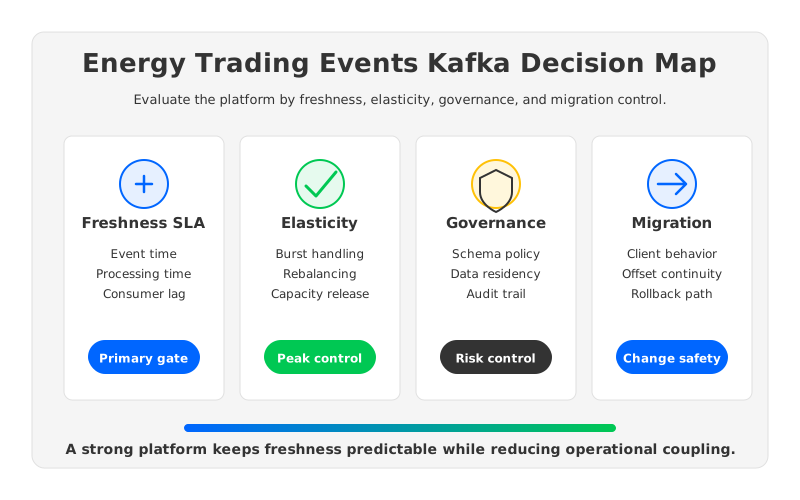
Teams searching for energy trading events kafka are rarely asking whether Kafka can move events from one service to another. They already know Kafka can do that. The harder question is whether a Kafka-compatible streaming platform can keep trading signals, market positions, settlement events, telemetry updates, and risk calculations fresh while the system is under pressure. In energy trading, stale data is not only a dashboard problem. It can change bidding decisions, hedge exposure, reconciliation accuracy, and the confidence operators have in automated workflows.
That makes data freshness a broader operating target than raw broker latency. A trading event may be produced quickly, but still arrive late at the application that matters because a consumer group is lagging, a connector is backfilling, a schema change slowed processors, or a broker rebalance moved data during a demand spike. The platform decision is therefore not “Kafka or not Kafka.” It is how to run Kafka-compatible streaming so freshness remains predictable when volume, retention, governance, and cloud operations all pull in different directions.
1Why teams search for energy trading events kafka
Energy trading has an unusual event profile. Some streams look like conventional business events: trades, orders, nominations, confirmations, invoices, and reconciliation updates. Others are closer to operational telemetry: meter readings, grid constraints, asset availability, weather signals, forecast revisions, and real-time price feeds. The common thread is that each event becomes less useful as its arrival time drifts away from the decision window it was meant to support.
Kafka fits this problem because it gives teams a durable commit log, ordered partitions, consumer groups, offsets, and a broad integration ecosystem. Producers can write events once, and multiple applications can read them at their own pace. Risk engines, settlement systems, analytics pipelines, and monitoring tools do not have to be connected through brittle point-to-point integrations. That architectural benefit is real, and it is why Kafka shows up so often in trading platform discussions.
Freshness requirements expose the part of Kafka architecture that generic reference diagrams tend to hide. A platform team has to define which delay matters: producer acknowledgement latency, broker append time, replication delay, connector delay, consumer lag, event-time skew, or end-to-end processing time. A subcomponent may be healthy while the business workflow is late. For trading events, the service-level objective should be measured where the event is used, not where the broker first accepted it.
2The production constraint behind the problem
The production constraint is simple to state: the platform must absorb bursty event flow without forcing the team to over-provision for every possible trading interval. Energy markets have predictable busy periods, but they also have discontinuities. Price volatility, weather changes, grid incidents, and operational corrections can create sudden fan-in from producers and sudden fan-out to consumers. A Kafka cluster sized for the average day can become fragile during the few windows that matter most.
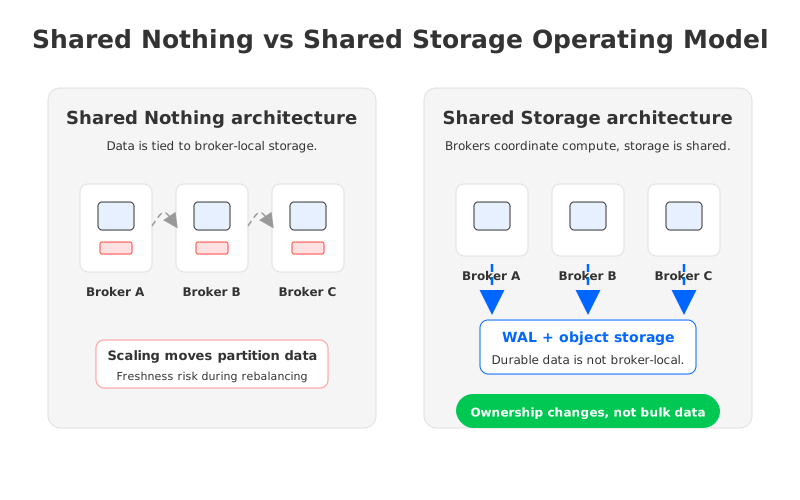
Traditional Kafka’s Shared Nothing architecture turns this business shape into a storage and operations problem. Each broker owns local storage for its partitions. Durability comes from replication across brokers, and in multi-Availability Zone deployments that usually means data is copied across failure domains. When the cluster needs more capacity, the team often has to move partition data, rebalance leaders, watch disk utilization, and keep consumers from falling too far behind during the operation.
This model is not wrong. Kafka was designed around a log abstraction that works extremely well for many workloads. The mismatch appears when cloud operations demand fast elasticity while the storage model still treats broker-local disks as the place where the data lives. Capacity planning becomes a negotiation between peak trading traffic, retention, disk headroom, replication traffic, and the operational risk of moving data at the wrong time.
Tiered Storage can help with long retention by moving older segments to remote storage, and it deserves a fair place in an evaluation. It does not fully remove the operational coupling between hot data and broker-local storage. Fresh writes still have to be written, replicated, served, and recovered through the local broker path. If your freshness risk comes from hot partitions, bursty writes, or slow rebalancing during the trading day, remote storage for historical segments solves only part of the problem.
3Architecture options and trade-offs
A useful evaluation starts by separating five architecture questions that often get mixed together. First, do existing Kafka clients and ecosystem tools keep working? Second, how does the platform store durable event data? Third, what happens when traffic shifts faster than capacity planning expected? Fourth, where do control, data, and operational metadata live? Fifth, how does the team migrate without breaking offsets, ordering assumptions, or rollback paths?
Here is a neutral way to compare common options before choosing a platform:
| Option | Strong fit | Freshness risk to examine | Operating trade-off |
|---|---|---|---|
| Self-managed Kafka on local or cloud disks | Teams that need full control and already operate Kafka deeply | Broker-local disk pressure, partition movement, cross-zone replication, and consumer lag during maintenance | Maximum control, but the team owns tuning, upgrades, balancing, and incident response |
| Managed Kafka service | Teams that want fewer infrastructure tasks and a familiar Kafka API | Service limits, scaling behavior, network cost, and migration constraints | Lower operational burden, but less control over internals and sometimes less cost transparency |
| Kafka with Tiered Storage | Workloads with long retention and heavy historical reads | Hot data remains tied to broker-local write and recovery paths | Better retention economics, but not a full compute-storage separation model |
| Kafka-compatible Shared Storage architecture | Teams that need Kafka compatibility with more elastic cloud operations | WAL choice, object storage behavior, and platform maturity for the workload | Changes the operating model by moving durable data away from broker-local disks |
The table is intentionally not a winner-take-all ranking. Energy trading systems vary. A latency-critical market-making component and a settlement enrichment pipeline may both use Kafka, but they should not share the same freshness target. A practical platform strategy may keep ultra-sensitive workloads on a dedicated path while consolidating broader event distribution, analytics, and operational streams on a more elastic Kafka-compatible foundation.
4Evaluation checklist for platform teams
The most useful checklist begins with business semantics, not infrastructure knobs. Write down the event classes first. A price update, a position update, a meter reading, and a settlement correction do not age at the same rate. Some events are allowed to arrive late if they are still ordered and auditable. Others lose most of their value after a short decision window. Freshness requirements should include event-time expectations, maximum acceptable consumer lag, retry behavior, and whether late events trigger correction flows.
Then test the platform with failure and change scenarios, not only steady-state throughput. A steady benchmark can show whether the cluster handles a target write rate. It does not show whether the system remains understandable when a broker fails, a consumer group falls behind, a connector restarts, a schema deployment pauses downstream processing, or a trading window creates a short write burst. Those are the moments when platform teams discover whether their freshness model is operationally real.
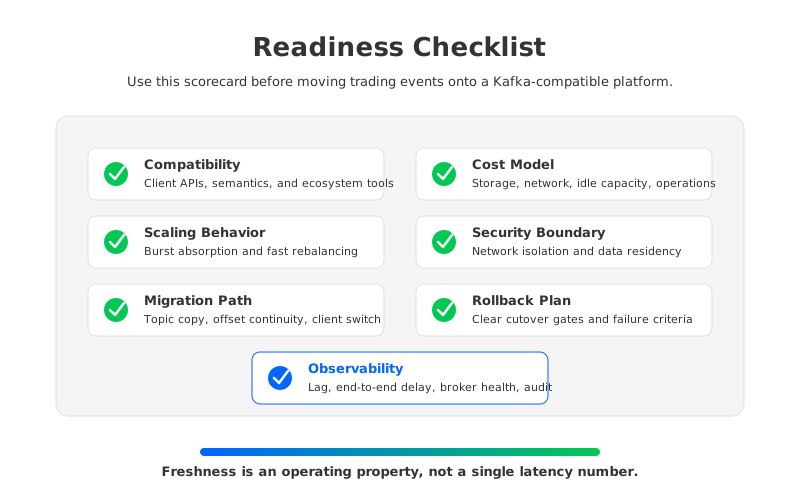
Use this scorecard during design review:
- Compatibility: Verify producer, consumer, admin, transaction, and offset behavior against the Kafka client versions you run. Also check Kafka Connect, stream processing frameworks, Schema Registry usage, monitoring tools, and security integrations.
- Freshness measurement: Track producer acknowledgement latency, broker health, consumer lag, connector lag, processing delay, and event-time skew. A single latency metric will hide too much.
- Cost model: Include compute, storage, replication traffic, cross-Availability Zone data transfer, private connectivity, observability, idle capacity, and operational labor. Avoid comparing only disk storage rates.
- Scaling behavior: Test scale-out, scale-in, leader movement, and partition reassignment under traffic. The question is not whether scaling exists, but whether it protects freshness during the trading window.
- Governance boundary: Confirm where data, metadata, logs, metrics, credentials, and control-plane actions live. Energy trading teams often need clear residency, audit, and separation-of-duty answers.
- Migration and rollback: Preserve offsets, ordering assumptions, client behavior, and cutover gates. A migration plan without rollback criteria is a hope, not an engineering plan.
This checklist also helps separate workload classes. A real-time bidding stream may require the strictest end-to-end delay SLO and dedicated operational controls. A compliance archive stream may prioritize retention, immutability, and lineage. A forecasting feature stream may care most about replay, backfill, and cost-effective historical reads. Putting all three behind one undifferentiated “Kafka latency” target makes the platform harder to operate.
5How AutoMQ changes the operating model
After the neutral evaluation, the architectural question becomes sharper: can the platform keep Kafka’s application contract while reducing the operational coupling between brokers and durable storage? AutoMQ approaches that question as a Kafka-compatible, cloud-native streaming platform built around Shared Storage architecture. The goal is not to ask trading applications to adopt a different event API. The goal is to keep Kafka protocol compatibility while changing what operators have to do when capacity, failure, and retention change.
In AutoMQ, brokers are stateless from the perspective of durable event storage. S3Stream replaces Kafka’s broker-local log storage layer with WAL storage plus S3-compatible object storage. The WAL (Write-Ahead Log) absorbs writes for low-latency durability and recovery, while object storage becomes the main shared storage layer. Because durable data is not permanently tied to a broker’s local disk, operations such as broker replacement, capacity changes, and partition reassignment can be handled as ownership and scheduling changes rather than bulk data movement.
That difference matters for data freshness because many freshness incidents are operational side effects. A cluster that needs long data movement before it can rebalance is harder to scale during a volatile market window. A cluster that couples retention growth to broker disk planning pushes teams toward conservative over-provisioning. A cluster that creates high replication traffic across failure domains can make multi-zone resilience a cost and capacity planning issue at the same time. Shared Storage architecture does not remove the need to engineer SLOs, but it gives the platform a different control surface.
AutoMQ’s deployment boundaries are also relevant for energy trading teams. AutoMQ BYOC is designed so the control plane and data plane run in the customer’s cloud account and VPC, while AutoMQ Software targets private data center deployments. That boundary can make architecture review easier for teams that need customer-controlled network, storage, and data residency models. It does not replace a compliance review, but it gives the review a concrete deployment shape instead of a vague managed-service boundary.
Migration still deserves its own workstream. AutoMQ commercial editions provide Kafka Linking for migration scenarios where byte-for-byte topic replication, offset consistency, and controlled traffic switching matter. Even with tooling, the team should inventory topic semantics, consumer groups, transaction usage, retention policies, ACLs, schemas, and client retry behavior before cutover. The operational promise of a target platform is only useful if the migration preserves the assumptions the trading applications already depend on.
6A practical readiness model
A platform is ready for energy trading events when it can answer three questions in measurable terms. What freshness target applies to each event class? What platform behavior protects that target during bursts, failures, and maintenance? What evidence shows the target still holds after migration? These questions sound basic, but they prevent teams from buying a generic streaming platform and discovering later that the hard part was operational coupling.
The readiness model can be lightweight. Start with a table that maps each event stream to its producer, partitioning key, ordering requirement, retention period, downstream consumers, maximum acceptable lag, replay expectation, and owner. Then run a platform test that includes at least one traffic burst, one consumer slowdown, one broker or node failure, one schema or processor deployment, and one migration rehearsal. The result should be a list of measured behaviors and operational actions, not a slide that says the platform is real time.
For teams evaluating AutoMQ, that same test should include the Shared Storage architecture assumptions: WAL type, object storage configuration, broker replacement behavior, Self-Balancing behavior, and observability coverage. The most valuable proof is not a single “low latency” number. It is seeing that the platform can keep consumer lag and end-to-end delay bounded while capacity changes and operational events happen around it.
7FAQ
7.1Is Kafka a good fit for energy trading events?
Kafka is a strong fit when multiple systems need durable, ordered, replayable event streams. It is less useful if the workload is a single request-response path with no need for replay, fan-out, or independent consumers. For energy trading, Kafka is often valuable because the same event may feed risk, settlement, monitoring, analytics, and audit workflows.
7.2What is the difference between latency and freshness?
Latency usually measures one part of the path, such as producer acknowledgement or broker response time. Freshness measures whether the consuming application sees the event in time for the business decision. A platform can have low broker latency while a downstream consumer is still late because of lag, backfill, connector delay, or processing bottlenecks.
7.3Does Tiered Storage solve freshness problems?
Tiered Storage helps with retention and historical data economics by moving older data to remote storage. It does not fully remove hot data from the broker-local operating model. If freshness problems come from bursty writes, hot partitions, broker failure recovery, or partition movement, teams should evaluate a broader architecture than Tiered Storage alone.
7.4Where should AutoMQ appear in an evaluation?
AutoMQ should appear after the team defines freshness targets, compatibility needs, governance boundaries, scaling behavior, and migration constraints. It is most relevant when the team wants Kafka-compatible streaming with Shared Storage architecture, stateless brokers, object-storage-backed durability, and customer-controlled deployment boundaries.
8Closing the loop
The search query energy trading events kafka starts as a tooling question, but the real decision is operational. Trading teams need fresh data when markets are noisy, when consumers fall behind, and when infrastructure changes are happening at the same time. If you are evaluating whether a Kafka-compatible Shared Storage architecture can simplify that operating model, try AutoMQ through the AutoMQ Cloud Console.
9References
- Apache Kafka documentation
- Apache Kafka Consumer API
- Apache Kafka transactions and semantics
- Apache Kafka KRaft documentation
- Apache Kafka Connect documentation
- AutoMQ Kafka compatibility documentation
- AutoMQ Shared Storage architecture
- AutoMQ WAL storage documentation
- AutoMQ Kafka Linking overview
- AutoMQ Continuous Self-Balancing
- AWS EC2 On-Demand Pricing
- AWS PrivateLink documentation


