
Table of Contents
Table of Contents
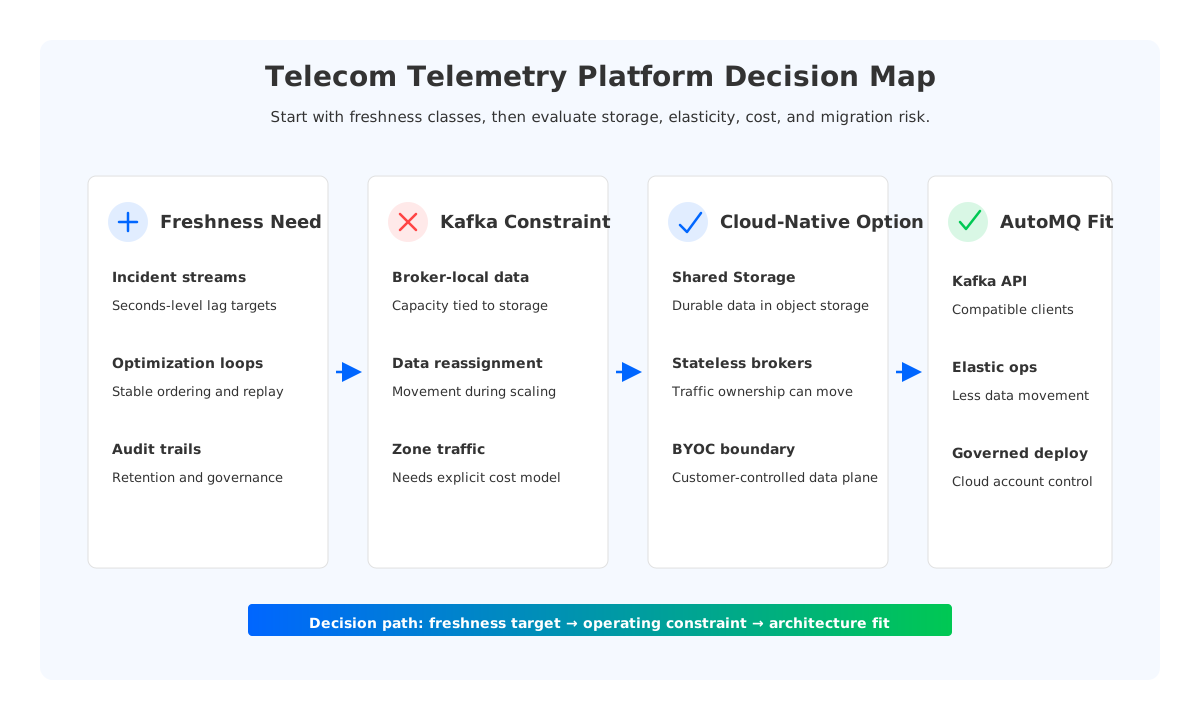
The phrase telecom network telemetry kafka usually appears after a team has already outgrown batch polling, but before it has agreed on what "fresh" should mean. Radio access events, core network counters, device logs, charging signals, and customer experience metrics do not all need the same latency target. The hard part is not deciding whether Kafka can move events. The hard part is deciding which telemetry streams must stay seconds behind reality, which ones can tolerate minutes of delay, and what the platform must do when traffic spikes, a zone fails, or an operations team needs to replay yesterday's incident.
That distinction matters because data freshness is an operating requirement, not a dashboard preference. A stale congestion metric can send an optimization loop toward the wrong cell site. A delayed alarm enrichment stream can make incident triage look normal until customers are already affected. For telecom platform teams, the useful question is not "Can Kafka handle telemetry?" It is "Which Kafka-compatible architecture keeps the right telemetry fresh without turning storage, network, and migration work into a permanent tax?"
1Why Teams Search for telecom network telemetry kafka
Telecom telemetry has a strange shape: it is wide, noisy, bursty, and full of uneven value. A short-lived network event may be critical for service assurance, while another stream with similar throughput may be useful only for hourly capacity reports. Teams reach for Apache Kafka because the model fits many of these requirements: producers write records to topics, consumers work through offsets, and consumer groups make it possible to scale processing across partitions. That gives platform teams a common transport for assurance, analytics, operations automation, and downstream data products.
The search becomes more specific once Kafka becomes the shared path for multiple operational loops. Service assurance teams want low lag and predictable replay. SRE teams want backpressure to be visible before it becomes an outage. Data engineering teams want governed topics, schema discipline, and connectors into analytical systems. These needs overlap, but treating them as one generic "real-time" requirement usually leads to overprovisioning in one place and underprotection in another.
A practical freshness model starts by classifying telemetry streams by decision speed. The categories below are not universal, but they force the right conversation:
| Telemetry class | Freshness expectation | Platform implication |
|---|---|---|
| Alarm correlation and incident enrichment | Seconds | Lag visibility, fast failover, and controlled replay matter more than long retention. |
| Network optimization loops | Seconds to minutes | Partitioning, ordering, and burst absorption must be designed together. |
| Customer experience analytics | Minutes | Fan-out, schema governance, and stable consumer group behavior become central. |
| Billing, compliance, and audit trails | Minutes to hours | Retention, immutability, access control, and recovery procedures dominate the design. |
The table makes one uncomfortable point clear: a single Kafka cluster can carry these streams, but a single operational policy rarely fits them all. Freshness is a contract between producers, brokers, storage, consumers, and the teams that own each loop. When that contract is vague, the platform team becomes the fallback owner for every missed service-level target.
2The Production Constraint Behind the Problem
Traditional Kafka is a Shared Nothing architecture. Each broker manages local persistent storage, partitions are placed on specific brokers, and replication copies partition data between leaders and followers for durability and availability. This model has served Kafka well because it keeps the commit log close to the broker that serves it. It also means that capacity, recovery, and data placement are tied together: when brokers change, data movement becomes part of the operation.
That coupling is what telecom telemetry exposes. A network event storm does not ask whether the cluster has spare disk on the right broker. It arrives where the producers send it. If one set of partitions becomes hot, the cluster may need partition reassignment, but reassignment in a local-disk design involves moving data as well as moving traffic ownership. If retention grows because teams need longer incident replay windows, local storage planning changes. If the deployment spans availability zones, broker-to-broker replication and client paths can create network traffic that must be understood before the bill arrives.
Kafka features reduce some pressure, but they do not remove the architectural trade-off. Tiered Storage can move older log segments to remote storage while retaining recent data locally. That helps with longer retention and historical reads, but it does not make the broker stateless because the active write path and recent log still depend on broker-local storage.
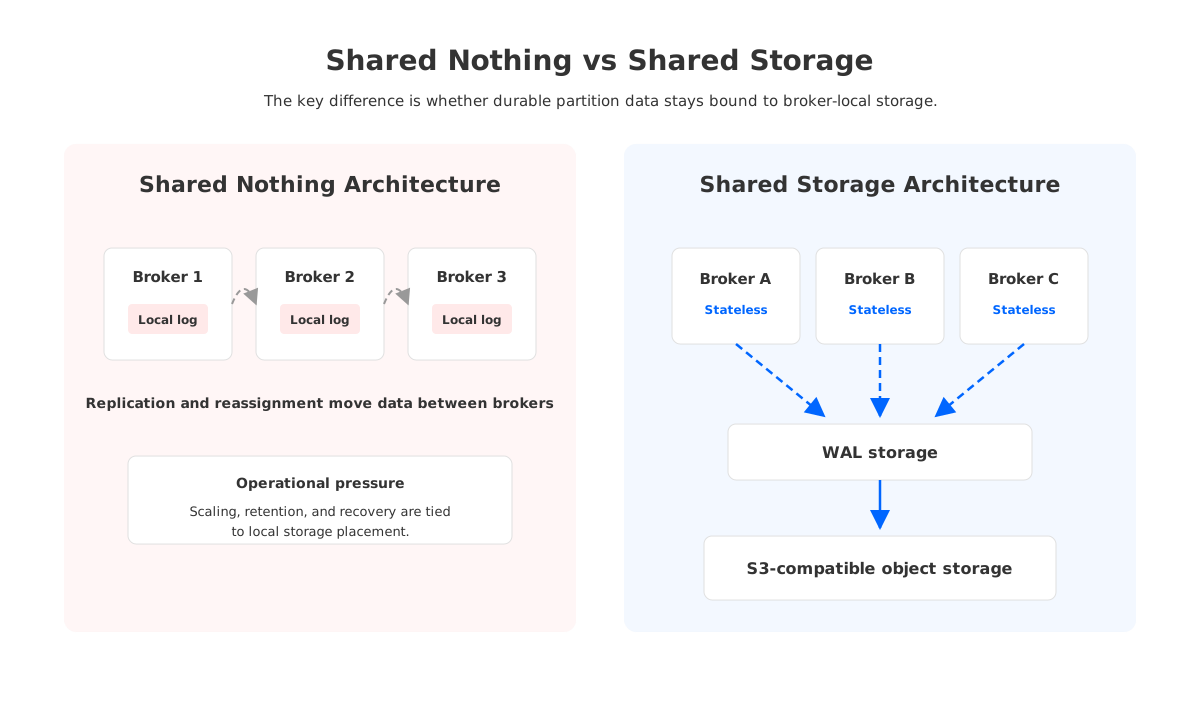
This is why telecom telemetry planning should separate freshness from raw throughput. Throughput tells you how much data moves through the platform. Freshness tells you how long the organization can tolerate wrong or incomplete operational state. A high-throughput topic with a relaxed freshness target can be managed differently from a lower-throughput incident stream that must stay close to real time during a failure. When these streams share infrastructure, the architecture must make priority, isolation, and recovery explicit.
3Architecture Options and Trade-Offs
There are several defensible ways to run telecom telemetry on Kafka-compatible infrastructure. The right answer depends on latency targets, cloud boundaries, operations maturity, and migration constraints. The mistake is pretending that the choice is only about broker count or instance size. Platform teams should compare architecture models by the operations they create under stress.
| Option | Where it fits | Trade-off to examine |
|---|---|---|
| Self-managed Kafka on local disks | Teams with strong Kafka operations expertise and strict control needs. | You own broker sizing, reassignment, storage planning, upgrades, and recovery drills. |
| Managed Kafka service | Teams that want less infrastructure ownership while staying close to standard Kafka behavior. | Service limits, networking model, elasticity behavior, and cost visibility need review. |
| Kafka with Tiered Storage | Teams with long retention or replay needs on standard Kafka. | Remote storage helps historical data, but active brokers still require local persistence. |
| Shared Storage architecture | Teams that want to decouple broker compute from durable storage. | You must validate latency, WAL design, object storage permissions, and migration procedures. |
The evaluation should begin with compatibility because telecom data platforms rarely start from a blank slate. Existing producers, consumers, stream processors, connectors, ACLs, and monitoring tools represent years of operational decisions. Kafka-compatible streaming means consumer group behavior, offsets, transactions, client versions, and tooling need to behave predictably enough that application teams do not become migration engineers.
Cost comes next, but not as a slogan. The meaningful question is which resources scale with telemetry volume, which scale with retention, and which are reserved for rare events. Local-disk Kafka often forces compute and storage to scale together. In cloud deployments, network paths also matter: cross-zone traffic, private connectivity, object storage requests, and data egress rules can change the cost profile.
Governance is the third pillar because fresh data that cannot be trusted creates faster mistakes. Topic ownership, schema policy, retention settings, access control, and audit logs should be part of the platform design. Telecom telemetry often crosses organizational boundaries: network operations, security, product analytics, and finance may all consume the same event family. Kafka's offset model lets each consumer group progress independently, but organizational ownership still has to decide who can create topics, change retention, reset offsets, or approve a replay after an incident.
Finally, recovery has to be tested as a workflow, not documented as a diagram. If a zone fails, which producers reconnect first? If consumers fall behind, who decides whether to scale processing, pause lower-priority topics, or replay from a known offset? These questions determine whether a freshness target survives real operations.
4Evaluation Checklist for Platform Teams
A useful checklist is short enough to run in a design review and specific enough to catch hidden ownership gaps. The point is not to crown one architecture. The point is to make every freshness promise traceable to a platform behavior.
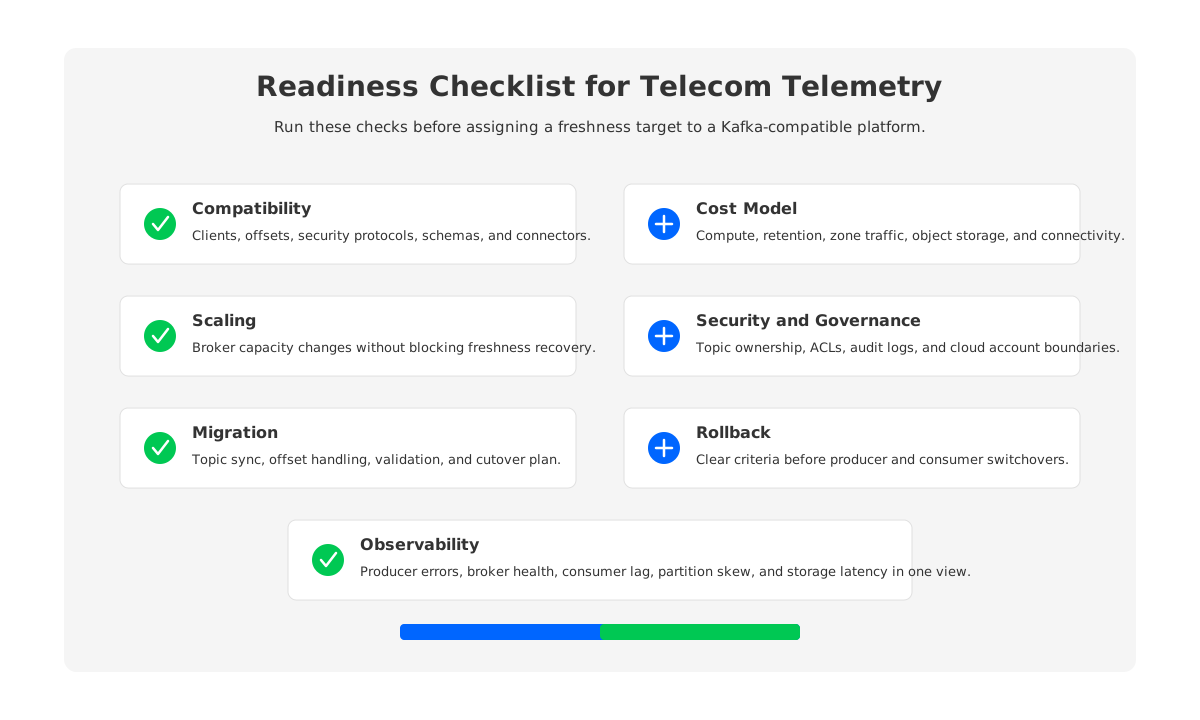
Use these checks before committing a telemetry platform design:
- Compatibility: List the Kafka client versions, security protocols, serializers, connector frameworks, and stream processors that must keep working. Include consumer group offset behavior and transaction usage, not only producer throughput.
- Freshness classes: Assign each telemetry domain a target lag range and a recovery priority. Incident enrichment and billing audit streams should not be governed by the same operating rule.
- Storage and retention: Separate hot operational reads from historical replay. Confirm whether retention growth requires more broker-local storage, remote object storage, or both.
- Network boundaries: Map producer, broker, consumer, object storage, and private connectivity paths across zones and VPCs. Validate cross-zone and private link pricing with current cloud provider documentation.
- Failure recovery: Run broker loss, zone degradation, consumer backlog, and bad deployment scenarios. Measure time to restore freshness, not only cluster availability.
- Migration and rollback: Define how topics, offsets, ACLs, schemas, and clients move. A migration plan without rollback criteria is only a deployment plan.
- Observability: Track producer error rates, broker health, consumer lag, partition skew, storage errors, and object storage latency in the same operational view.
This checklist turns freshness from a vague goal into a set of design constraints. It also reveals where team boundaries are too fuzzy. A platform team can provide the Kafka-compatible substrate, but application teams still own processing logic, data contracts, and replay semantics. The architecture should make that division easier to operate, not harder to remember.
5How AutoMQ Changes the Operating Model
Once the evaluation framework is clear, Shared Storage architecture becomes interesting for a specific reason: it changes which operations require data movement. AutoMQ is a Kafka-compatible, cloud-native streaming platform that keeps Kafka protocol semantics while replacing broker-local durable log storage with object-storage-backed S3Stream. Brokers handle Kafka requests, leadership, caching, and scheduling, while durable data is written through WAL storage and persisted in S3-compatible object storage.
For telecom telemetry, the operational shift is straightforward. If durable data is not bound to a broker's local disk, adding or replacing brokers is less about copying partition data and more about moving ownership and traffic. That does not make latency, cache behavior, or WAL configuration disappear; those still need engineering review. It does mean capacity planning can focus more directly on compute, network, and freshness classes rather than treating every storage change as a broker lifecycle event.
AutoMQ BYOC is relevant when data boundary control is part of the platform requirement. In this deployment model, the control plane and data plane run in the customer's cloud account and VPC, and customer message data stays in customer-owned infrastructure. That boundary matters for telecom teams that need to align telemetry handling with regional control, security review, and cloud account governance. AutoMQ Software serves private data center environments, while AutoMQ Open Source gives teams a way to evaluate the architecture with S3 WAL.
Migration is where compatibility becomes practical. AutoMQ's Kafka Linking capability is designed for Kafka-to-AutoMQ migration workflows, including topic data synchronization and consumer progress handling. Platform teams should still build a migration runbook around application cutover, security rules, schema ownership, and rollback criteria. The architecture can lower the amount of broker-local data movement after migration, but it cannot replace the organizational work of deciding when a telemetry stream is safe to switch.
6A Practical Readiness Scorecard
Before selecting a platform, give each candidate architecture a score from 1 to 5 across the dimensions below. A low score does not automatically disqualify an option. It tells you where extra runbooks, staffing, or managed services will be required.
| Dimension | What a 5 looks like |
|---|---|
| Freshness control | Each telemetry class has lag targets, priority rules, and tested recovery actions. |
| Kafka compatibility | Existing clients, offsets, security settings, and processing tools work with minimal change. |
| Elasticity | Broker capacity can change without long data movement windows blocking operations. |
| Cost transparency | Compute, storage, cross-zone traffic, private connectivity, and retention costs are modeled separately. |
| Governance | Topic ownership, schema policy, ACLs, retention, and audit requirements are explicit. |
| Migration safety | Topic sync, offset handling, cutover, validation, and rollback are rehearsed before production. |
7FAQ
7.1Is Kafka a good fit for telecom network telemetry?
Kafka is a strong fit when telemetry needs durable ingestion, replay, independent consumer groups, and integration with multiple processing systems. It is less useful as a generic answer if teams have not defined freshness targets, ownership rules, and recovery workflows for each telemetry class.
7.2What is the difference between throughput and data freshness?
Throughput measures how much data the platform can ingest or serve. Data freshness measures how far consumers and operational views are behind the real state of the network. A system can have high throughput and still fail a freshness target if consumers lag, partitions skew, or recovery takes too long.
7.3Does Tiered Storage solve telecom telemetry retention problems?
Tiered Storage can help extend retention by moving older log segments to remote storage, which is useful for replay and historical analysis. It does not by itself make active brokers stateless, so teams still need to plan for local storage, hot data, reassignment, and recovery behavior.
7.4Where should AutoMQ enter the evaluation?
AutoMQ should enter after the team has defined compatibility, freshness, cost, governance, and migration requirements. It is most relevant when Kafka-compatible behavior is required but broker-local storage and data movement are becoming operational constraints.
7.5What is a good next step for platform teams?
Pick one high-value telemetry domain, define its freshness target, list its producers and consumers, and run the readiness scorecard against your current platform. If broker-local storage, reassignment windows, or cross-zone traffic are limiting the design, evaluate a Shared Storage architecture with the same workload and failure cases.
If your team is evaluating a Kafka-compatible platform for telemetry, review AutoMQ's deployment model and start a focused architecture assessment through AutoMQ Cloud.
8References
- Apache Kafka Documentation
- Apache Kafka KIP-405: Kafka Tiered Storage
- AutoMQ Shared Storage Architecture
- AutoMQ WAL Storage
- AutoMQ Kafka Linking Overview
- AutoMQ Continuous Self-Balancing
- AutoMQ Table Topic
- Amazon EC2 On-Demand Pricing: Data Transfer
- Amazon S3 User Guide
- AWS Fault Isolation Boundaries: Availability Zones


