
Table of Contents
Table of Contents
Teams rarely search for data movement avoidance kafka because they want a nicer diagram. They search for it after a production system has made data movement visible: a broker replacement that took longer than the incident window, a partition reassignment that consumed the same network links used by customers, a migration plan that looked clean until offsets, retention, and rollback entered the room. The problem is not that Kafka moves data. Kafka is a distributed log, and replication is part of the bargain. The problem is that in many cloud deployments, the amount of operational work tied to moving data has become the reliability risk.
That risk appears in places that do not look related at first. Capacity planning becomes conservative because every new broker has to receive data before it is useful. Failover gets slower because storage ownership is attached to a broker. Cost governance gets noisy because replication and rebalancing create network traffic separate from application traffic. Migration teams discover that moving records is straightforward; preserving consumer position, delivery semantics, security boundaries, and rollback confidence is harder.
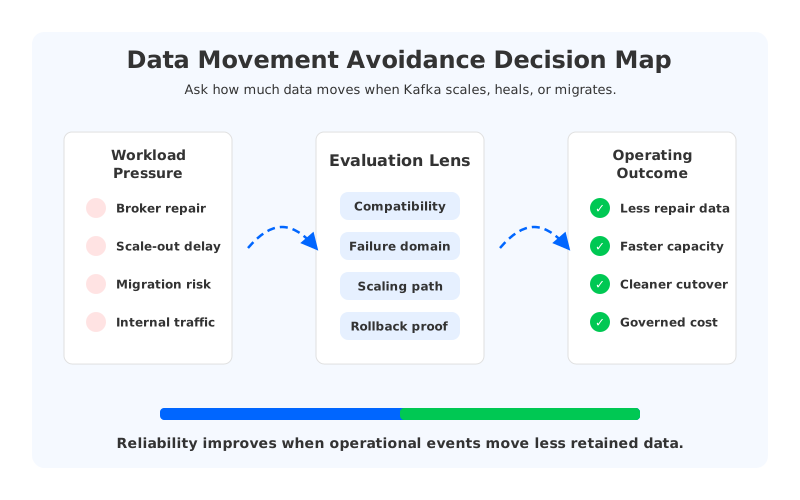
Data movement avoidance is a useful lens because it makes those failure modes discussable. Instead of asking whether a platform can move data quickly, platform teams can ask a sharper question: how much data has to move when the system scales, heals, upgrades, or migrates?
1Why teams search for data movement avoidance kafka
Kafka operators know that production reliability is often lost in maintenance paths rather than happy paths. A steady-state cluster can look healthy while carrying hidden operational debt. The debt appears when a broker is replaced, a disk fills up, a hot partition has to be moved, a rack or availability zone becomes impaired, or a migration deadline compresses what should have been a staged program into a weekend runbook.
Traditional Kafka gives operators strong primitives: partition replication, consumer groups, committed offsets, transactional producers, Kafka Connect, and rich client configuration. Those primitives are why Kafka became the default event backbone for many organizations. They also create a high bar for any Kafka-compatible replacement. A credible architecture cannot ask teams to give up the Kafka API or rewrite producers and consumers to reduce operational drag.
The search intent usually falls into four categories:
- Scaling without waiting for storage redistribution. The team wants new compute capacity to help immediately instead of waiting for partition reassignment and replica catch-up.
- Failure recovery without turning repair into another workload spike. The team wants broker replacement to be a control-plane action, not a large background copy job competing with production traffic.
- Migration without ambiguous rollback. The team wants to preserve offsets, topic semantics, ACLs, and application behavior while reducing the amount of state that must be copied under time pressure.
- Cost control without brittle placement rules. The team wants to avoid paying for internal movement that exists because of the storage model, not because the business produced or consumed more events.
The common thread is operational determinism. If a platform's most stressful events require moving a large fraction of retained data, reliability depends on the speed, scheduling, and isolation of those movements. If the platform can avoid most of that movement, the same team gets a smaller incident surface.
2The production constraint
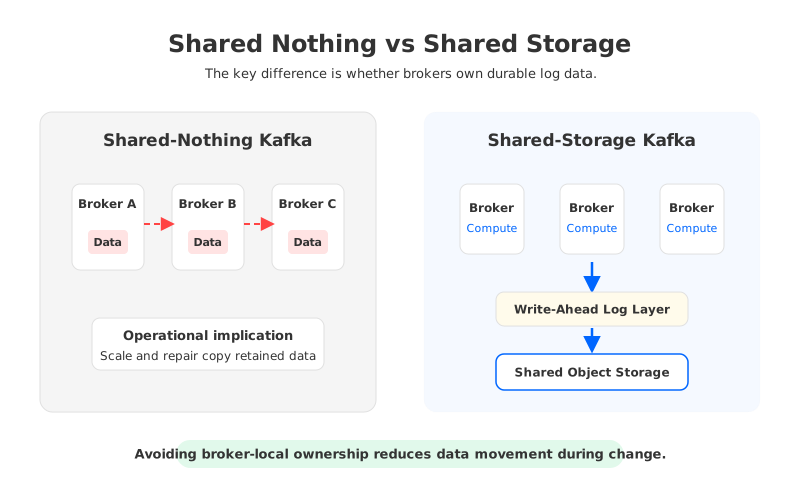
Kafka's original storage model is shared-nothing. Each broker owns local log segments for the partitions it hosts. Replication copies records from leaders to followers. Consumers read from partition replicas according to the cluster's configuration and client behavior. When a partition changes location, data has to be copied to the new owner before the cluster reaches the intended placement.
This design is coherent. It fits a world where brokers are stateful machines and local disks are the durable substrate. It also gives operators a direct mental model: if a partition lives on a broker, that broker has the data. The challenge is that cloud infrastructure changes the economics and the operational envelope. Compute, block storage, object storage, and cross-zone networking are separately metered and separately constrained. A design that was simple inside a private data center can create repeated data movement in a cloud region.
The pressure compounds in three loops. Replication copies production writes across brokers for durability. Balancing moves partitions when capacity, rack placement, or load distribution changes. Recovery turns failed brokers, replaced disks, and zone events into catch-up work. Each loop is reasonable by itself. Together they can turn maintenance into a second streaming workload that runs alongside the first.
This is why "faster rebalancing" is only a partial answer. Faster movement still consumes network, storage I/O, and operator attention. It still needs throttles, timing, and rollback planning. When retained data is large, even a well-run reassignment can create a long period where the cluster is technically healthy but operationally fragile.
3Architecture options
There are several ways to reduce the reliability impact of data movement. None is free, and the right answer depends on workload shape, retention, latency targets, compliance boundaries, and the team's tolerance for migration risk.
The first option is to operate traditional Kafka more carefully. Teams can use rack awareness, follower fetching where appropriate, partition reassignment throttles, better broker sizing, stricter topic governance, and tested runbooks. This often improves today's cluster without changing the platform contract. It does not remove the storage ownership model, but it can make planned movement safer.
The second option is tiered storage. Kafka tiered storage moves older log segments to remote storage while keeping the active log path on brokers. This can reduce local disk pressure and improve retention economics, especially when long retention is the main driver. It does not make brokers stateless. Hot data, leader placement, replica catch-up, and active partition ownership still matter, so tiered storage should be evaluated as retention optimization rather than complete data movement avoidance.
The third option is active replication across clusters. This is common for disaster recovery, regional isolation, data sharing, and migration. It can be the correct strategy when the target is a separate failure domain. It also introduces a second data movement plane. Operators now care about replication lag, offset translation or consumer cutover, schema and ACL consistency, network boundaries, and the exact point at which rollback stops being safe.
The fourth option is shared storage with stateless brokers. In this model, brokers serve the Kafka protocol and handle compute responsibilities, but durable log data is not owned by broker-local disks. Object storage or another shared durable layer becomes the system of record, while a write-ahead log path absorbs low-latency writes before data is organized for long-term storage. The reliability argument is direct: when brokers do not own durable data, replacing or scaling brokers requires far less data movement.
The decision is not "shared nothing bad, shared storage good." The question is whether the operational events that hurt your team are caused by broker-local data ownership. If your largest incidents are client misuse, schema evolution, or downstream backpressure, storage architecture will not solve them. If your largest incidents involve broker replacement, partition reassignment, storage expansion, cross-zone replication cost, or slow migration rehearsal, storage architecture deserves attention.
4Evaluation checklist for platform teams
A useful evaluation starts with the Kafka contract, not with vendor claims. Kafka is more than a wire protocol. It is the behavior that applications depend on: partition ordering, consumer group coordination, committed offsets, producer acknowledgments, transactions, log compaction, security configuration, connectors, metrics, and operational tooling. Reducing data movement while breaking these expectations usually transfers risk from infrastructure to applications, which is a bad trade.
Use the following scorecard to separate architecture benefit from migration wishful thinking.
| Evaluation area | Question to ask | Why it matters |
|---|---|---|
| Compatibility | Do existing clients, consumer groups, transactions, compaction, Connect jobs, and monitoring tools behave as expected? | The lowest-risk migration is one where applications do not become the test harness. |
| Movement during scaling | How much retained data must move before new capacity is useful? | Elasticity is only operationally useful when capacity arrives before the traffic spike has passed. |
| Movement during repair | What happens when a broker or node is replaced? | A repair path that copies large data volumes can extend the incident it is supposed to close. |
| Cost attribution | Can the team distinguish business traffic from internal replication, balancing, and recovery traffic? | Governance requires knowing whether spend is driven by user demand or architecture side effects. |
| Failure domains | Where does durable data live, and which component owns it during zone or node failure? | Recovery planning depends on whether data is tied to a broker, a zone, or a regional storage service. |
| Migration and rollback | Can the team test cutover, offset continuity, security mappings, and rollback before the final move? | A migration plan without rollback is an outage plan with nicer formatting. |
| Observability | Are movement, lag, catch-up, storage health, and client behavior visible in one operating view? | Teams cannot control what they cannot see during maintenance. |
This checklist also prevents a common evaluation mistake: over-weighting steady-state throughput. Throughput matters, but data movement avoidance is mostly about non-steady-state behavior. Similar produce and consume tests can hide very different behavior during expansion, broker replacement, and disaster recovery drills.
5How AutoMQ changes the operating model
Once the evaluation is framed around broker-local data ownership, AutoMQ becomes relevant as an architecture category rather than a product detour. AutoMQ is a Kafka-compatible cloud-native streaming platform that keeps the Kafka protocol and computation layer while moving durable storage into a shared-storage architecture backed by object storage. Brokers become stateless compute nodes for Kafka traffic instead of durable owners of partition data.
That change alters the operational model. Scaling brokers is primarily a compute action because the new broker does not need a large local copy of retained partitions before it can contribute. Repair is narrower because replacing a broker does not imply rebuilding its durable storage footprint. Storage and compute can be planned independently, which matters when throughput, fan-out, and retention grow at different rates.
AutoMQ's architecture also changes the cross-zone conversation. In shared-nothing Kafka, durability is commonly achieved by broker-to-broker replication across failure domains. In a shared-storage design, durable data is written through a storage layer that is not broker-local, so the platform can reduce the internal cross-zone replication patterns that often dominate cloud Kafka cost discussions. The exact financial result still depends on region, cloud provider pricing, read patterns, and deployment design, but the architectural source of the traffic is different.
The write path is the part engineers usually question first. Object storage is durable and cost-effective, but it is not a drop-in replacement for a broker's local append path. AutoMQ addresses this with a write-ahead log layer and S3Stream storage organization, so the system can preserve Kafka-compatible behavior while using object storage as the durable data foundation. The practical point for evaluators is not that every workload should use the same WAL backend. It is that latency, durability, and cost choices should be explicit architecture parameters rather than accidental consequences of broker disks.
Migration is where data movement avoidance becomes more than a scaling story. AutoMQ Linking is designed for Kafka-to-AutoMQ migration and replication scenarios where teams need controlled cutover. The operational goal is to test producer behavior, consumer progress, topic mappings, security configuration, and rollback conditions before the final switch. That does not eliminate migration work, but it changes the work from "copy everything and hope the window holds" to "prove each dependency before shrinking the final cutover."
6A practical readiness model
The best data movement avoidance project starts as an inventory exercise. List the events that force large internal movement: broker replacement, disk expansion, partition rebalancing, retention changes, cluster migration, disaster recovery drills, connector backfills, and cold reads. Rank them by frequency, blast radius, and operator confidence. This exposes whether the team has a tuning problem, a governance problem, or an architecture problem.
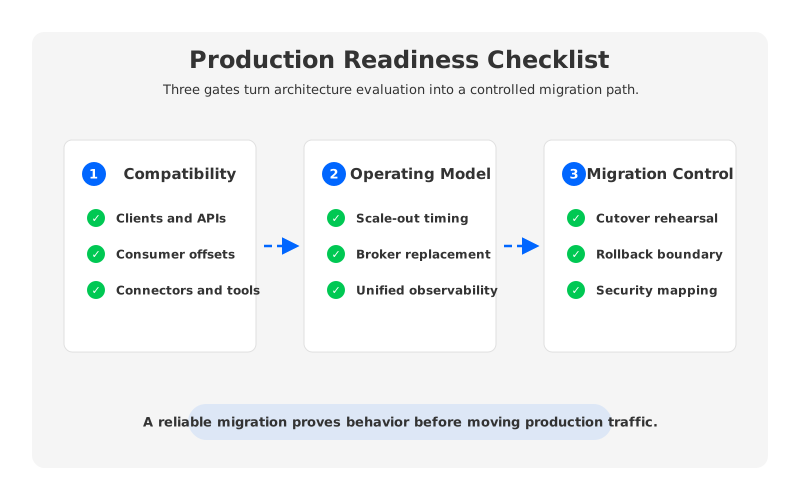
A good readiness review has three gates. The first gate is compatibility: prove that applications see the Kafka behavior they expect. The second gate is operating model: prove that scaling, repair, observability, and access control work in the target environment. The third gate is migration control: prove that the team can cut over and roll back with known offset, security, and data consistency boundaries. Skipping the first gate creates application risk. Skipping the second creates operations risk. Skipping the third creates business risk.
The most useful pilot is not a toy cluster. Choose a workload with enough retention and consumer fan-out to expose real movement costs, but not so much business criticality that every finding becomes an emergency. Run one broker replacement test, one scale-out test, one consumer group continuity test, one integration test, and one rollback rehearsal. Measure data moved, time to useful capacity, client latency impact, and manual coordination.
If your current Kafka reliability concerns are tied to data movement, evaluate the architecture before tuning another rebalancing window. The AutoMQ Diskless Engine overview is a good next step for understanding how stateless brokers and shared storage change the failure and scaling paths: Explore the AutoMQ Diskless Engine.
7References
- Apache Kafka documentation
- Apache Kafka consumer configuration reference
- Apache Kafka Connect documentation
- AutoMQ architecture overview
- AutoMQ stateless broker architecture
- AutoMQ Diskless Engine
- AWS EC2 network bandwidth documentation
8FAQ
8.1Is data movement avoidance the same as tiered storage?
No. Tiered storage can reduce local disk pressure by moving older log segments to remote storage, but it does not automatically make brokers stateless. Data movement avoidance is a broader reliability strategy that asks how much data must move during scaling, repair, failover, and migration.
8.2Does avoiding data movement mean replication is unnecessary?
No. Durable systems still need a durability model. The question is where durability lives and whether broker-to-broker copying is the main mechanism. Shared-storage architectures move that responsibility away from broker-local disks, which changes the operational paths for repair and scaling.
8.3What should I test before replacing an existing Kafka cluster?
Test client compatibility, consumer group behavior, transactional or idempotent producer paths if you use them, connector behavior, security mappings, observability, scale-out time, broker replacement, and rollback. A migration proof that only tests produce and consume throughput is incomplete.
8.4When is traditional Kafka still a reasonable choice?
Traditional Kafka remains reasonable when teams have strong operational maturity, predictable capacity, short retention, controlled growth, and few incidents tied to broker-local storage movement. The architecture pressure rises when retention, fan-out, cloud networking, and operational change frequency all grow together.


