
Table of Contents
Table of Contents
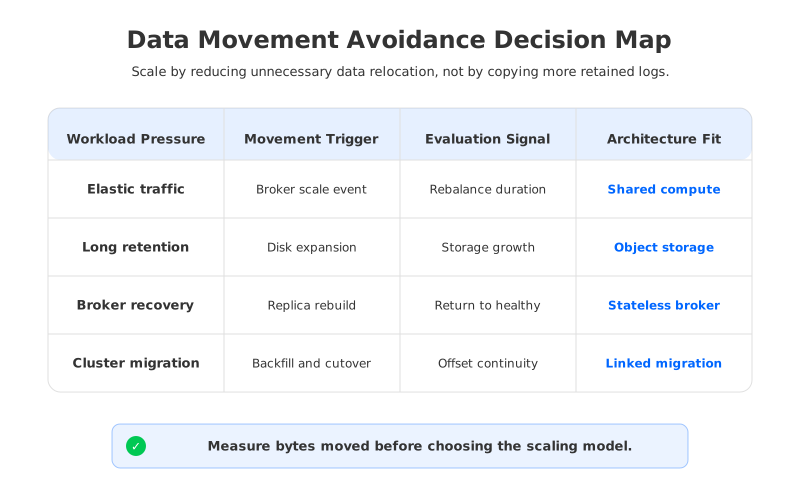
Teams usually search for data movement avoidance kafka after they have already accepted Kafka as critical infrastructure. The argument is no longer about whether event streaming matters. The harder question is why ordinary platform actions still move so much data: broker replacement, partition reassignment, retention expansion, zone failover, connector backfills, and migration rehearsals all become storage logistics problems. The cluster keeps serving applications, but the operations team spends its time asking which terabytes must move, where they will move, and what else they will disturb.
That is the wrong unit of scaling for many cloud workloads. In a cloud environment, durable storage, compute capacity, network paths, identity boundaries, and regional services are independently priced and independently operated. Kafka's traditional broker-local storage model compresses those dimensions into one broker fleet. When storage grows, brokers grow. When brokers change, data placement changes. When zones are used for availability, replication and client traffic can become line items on the bill.
Data movement avoidance is the discipline of making Kafka-compatible infrastructure scale by changing ownership and placement, not by copying more bytes between brokers. It does not mean data never moves. It means the architecture treats large data movement as a design smell unless the movement has direct user value: disaster recovery, compliance export, tier transition, analytical reuse, or an intentional migration. For platform teams, that shift is becoming as important as throughput tuning or partition count planning.
1Why teams search for data movement avoidance kafka
The search intent is practical because the pain appears during real production work. A broker fails and recovery is gated by replica catch-up. A topic's retention changes and disk planning returns to the roadmap. A consumer team asks for a long replay window and the platform team sees capacity and cross-zone transfer risk. A FinOps review asks why the streaming layer pays for block storage, server-side replication, and inter-zone movement for the same retained records.
Traditional Kafka made a reasonable historical trade-off. Brokers own partition logs, persist them to local disks, replicate them to other brokers, and serve reads from the same storage model. This design gives clear failure semantics and excellent sequential I/O when the cluster is sized well. The trouble starts when cloud elasticity asks the broker fleet to change faster than durable data can be relocated.
Several operating patterns expose the same constraint:
- Scaling out compute can require storage movement. Adding brokers increases serving capacity only after partition leadership, replicas, and local data placement catch up.
- Scaling retention can require broker expansion. Longer replay windows turn into disk reservations even when CPU and memory are not the bottleneck.
- Recovering from broker loss can create secondary load. Replica rebuilds, leadership changes, and client retries compete with production traffic at the moment the system has less headroom.
- Cross-zone availability can create unavoidable traffic. Replication and client topology both matter, so a highly available cluster can move data between zones even when applications are not directly asking for cross-zone exchange.
- Migrations can become double-write and backfill projects. Moving from one cluster to another requires data copy, offset continuity, access control parity, and rollback rules.
The common thread is not Kafka misconfiguration. It is that broker-local durable storage turns infrastructure changes into data relocation events. Once that is clear, the scaling primitive changes from "add more brokers and rebalance" to "avoid unnecessary data movement by changing where durable ownership lives."
2The storage constraint behind cloud Kafka
Kafka's storage model binds three responsibilities together: serving client requests, owning partition leadership, and holding durable log segments. That coupling is familiar, and it is one reason Kafka has been so successful. It also means that every broker has two identities. It is a compute node for producers and consumers, and it is a durable data owner for a subset of partitions. Cloud operations would prefer those identities to scale separately.
The cost side follows the same coupling. A platform team may see block volume charges, object storage charges, request charges, private connectivity charges, and inter-zone data transfer charges on different pages. Those costs are not independent if the architecture keeps copying retained records between broker-local stores. A pricing page can tell you the unit price, but it cannot tell you whether your architecture creates the traffic in the first place.
Tiered Storage reduces one important part of the problem. Apache Kafka's KIP-405 work lets older log segments move to remote storage, which helps with retention-heavy workloads and replay windows. But Tiered Storage keeps the hot path and broker ownership model intact. Brokers still coordinate local log segments, leaders still matter, and scaling compute is still related to data placement.
Diskless topics, represented by Apache Kafka KIP-1150, push the design further by making object storage the durable home for topic data in that topic mode. Whether a team evaluates upstream Kafka proposals, a managed Kafka service, or a Kafka-compatible shared-storage system, the architectural direction is similar: stop making every scale event copy durable records between brokers. The engineering details are where the real evaluation starts.
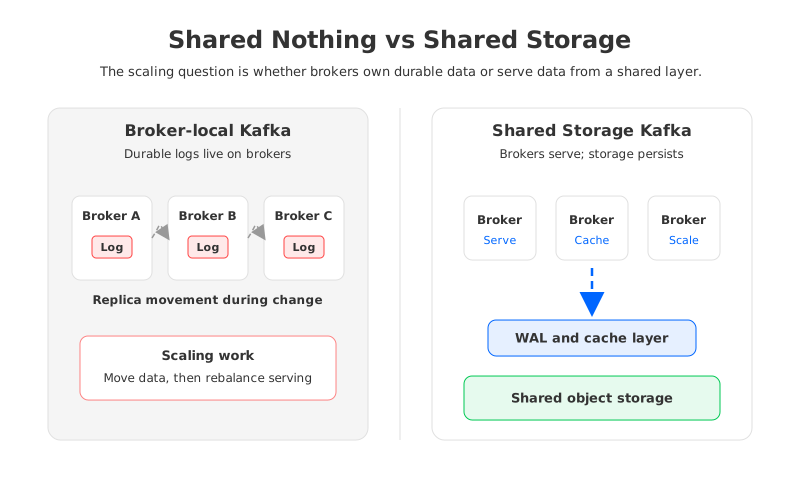
The picture matters because it changes the failure conversation. In broker-local Kafka, the cluster protects durability through replica placement and replica movement. In shared-storage Kafka, the serving layer can become more elastic because durable data lives below the broker fleet, usually with a write-ahead log, cache, and object storage backend. That does not make the system magically simpler. It moves the hard questions to WAL durability, cache efficiency, object storage behavior, metadata control, and observability.
3Architecture options: local disk, tiered storage, and shared storage
Platform teams should compare architecture families by operational consequence, not by product category. The useful question is what work the architecture removes from the steady-state operating model and what validation work it adds before production.
| Architecture | Data movement profile | What it improves | What still needs proof |
|---|---|---|---|
| Broker-local Kafka | Replicas and reassignments move durable logs between brokers. | Mature semantics, predictable local I/O, broad ecosystem familiarity. | Disk planning, rebalance windows, broker recovery, cross-zone traffic, and retained-data migration. |
| Kafka with Tiered Storage | Older segments can move to remote storage; hot data remains broker-local. | Longer retention without keeping all history on broker disks. | Remote-read latency, hot-tier sizing, cache behavior, compaction support, and operational maturity. |
| Kafka-compatible Shared Storage | Durable data lives outside broker-local disks; brokers serve and cache. | Independent compute and storage scaling, faster broker replacement, less broker-to-broker data copy. | WAL latency, object storage throttling, metadata recovery, cache cold starts, and migration safety. |
This table is intentionally neutral. Broker-local Kafka is still the right fit for some workloads, especially when the platform team values proven local-disk behavior and can manage capacity with stable growth. Tiered Storage is attractive when retention pressure is the main issue and the hot path should remain familiar. Shared Storage becomes compelling when the platform's main cost and risk come from moving data every time the cluster changes.
The boundary between these models is not only technical. It changes team responsibilities. A broker-local cluster asks Kafka operators to manage disk-heavy failure recovery. A tiered cluster asks operators to understand both local and remote read paths. A shared-storage cluster asks them to understand cloud storage, WAL behavior, and network topology as first-class Kafka concerns. None of those are free; the better model is the one that moves complexity to the layer your team can observe and control.
4Evaluation checklist for platform teams
A data movement avoidance review should resemble a production readiness review. The goal is not to pick the architecture with the boldest claim. The goal is to prove that fewer bytes move during the actions your team performs most often.
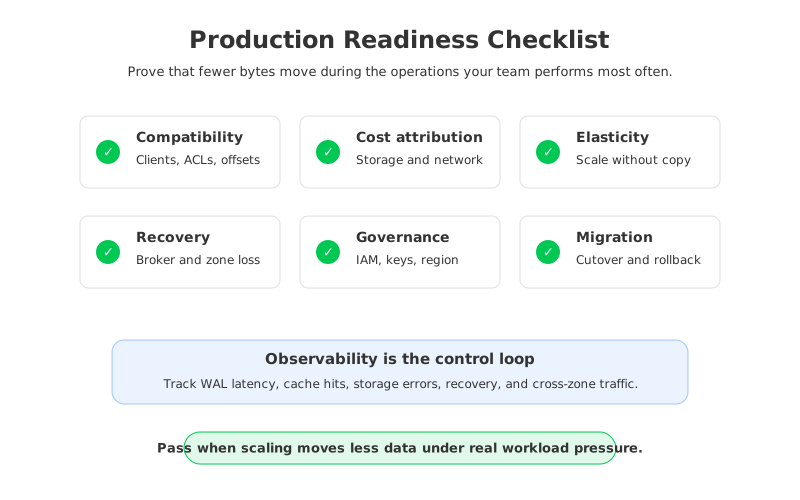
1. Compatibility. Start with the Kafka features your applications actually use: producer idempotence, transactions, consumer groups, offset commits, ACLs, quotas, log compaction, Kafka Connect, stream processors, and admin tooling. A Kafka-compatible platform should be tested against the real client versions and operational scripts already in use, not only against a protocol summary.
2. Cost attribution. Separate costs caused by user traffic from costs caused by the storage model. Producer writes, consumer reads, replica replication, partition movement, connector backfills, and migration copy streams should be measured separately where possible. This is how teams know whether an architecture reduces cost or moves it from disks to network, requests, or operational labor.
3. Elasticity. Test scale-out and scale-in with retained data already present. The interesting question is not whether a new broker process can start. It is whether the platform can add serving capacity without forcing a long data relocation cycle, and whether removing capacity creates predictable leadership and cache behavior.
4. Failure recovery. Exercise broker loss, zone loss, controller failover, object storage throttling, WAL pressure, cache cold start, and slow consumers. A data movement avoidance architecture should reduce recovery work tied to local data ownership, but it still needs a clear path back to a known-good state when the storage path is degraded.
5. Governance. Cloud-native storage changes the control surface. Buckets, IAM roles, encryption keys, VPC endpoints, PrivateLink-style connectivity, audit logs, and regional placement policies become part of the Kafka platform. Regulated teams should validate where data, credentials, logs, and control-plane access reside.
6. Migration and rollback. A successful migration preserves topic shape, offsets, producer behavior, consumer progress, ACLs, monitoring, and rollback options. If the target architecture avoids data movement during steady-state scaling but requires a risky cutover, the platform team has only moved the risk to the migration phase.
7. Observability. Kafka metrics are necessary but incomplete. Add WAL latency, cache hit rate, object storage request errors, remote read latency, throttling signals, recovery progress, and cross-zone traffic. If an SRE cannot explain a latency spike by following those metrics, the architecture is not ready for production.
5How AutoMQ changes the operating model
Once the evaluation shows that data movement is the scaling bottleneck, AutoMQ becomes relevant as a Kafka-compatible streaming platform built around Shared Storage architecture. The important point is not that AutoMQ uses object storage somewhere. The important point is that AutoMQ keeps the Kafka protocol surface while moving durable stream storage out of broker-local disks through S3Stream, WAL storage, object storage, and cache components.
That changes what an operator does during scaling. Brokers can be treated more like a serving layer, so adding or replacing broker capacity does not require the same kind of retained-log relocation that dominates broker-local Kafka operations. Partition leadership, request serving, scheduling, and cache behavior still matter, but durable data ownership is no longer trapped on an individual broker's local volume.
AutoMQ's WAL design also makes the latency question more concrete. Client writes are acknowledged after persistence in the WAL path, then data is uploaded to object storage according to the storage design. Different WAL choices have different latency, durability, and cloud infrastructure implications, so the evaluation should be workload-specific. A replay-heavy observability topic and a transaction-sensitive application event stream may both use Kafka APIs, but they should not be assigned the same write-path assumptions without measurement.
Cost evaluation changes because the architecture reduces broker-to-broker data movement as a default operating behavior. AutoMQ documentation describes deployment patterns for avoiding inter-zone traffic generated by production, consumption, and server-side replication under supported conditions. That claim should still be modeled against the customer's actual topology. Producers, consumers, broker placement, rack awareness, private networking, and cloud-provider pricing all influence the final bill.
Migration is the last place to be strict. AutoMQ Kafka Linking is designed to move data from Kafka-compatible sources while preserving partition counts, message offsets, and consumer progress, and it includes cutover mechanisms that can reduce disruption. A platform team should still rehearse producer switching, consumer validation, rollback, ACL parity, and monitoring before declaring the migration complete.
The broader lesson is that data movement avoidance is not a slogan. It is a measurable operating model. Count the bytes that move during scaling, recovery, retention expansion, and migration. Then choose the architecture that removes the most unnecessary movement without hiding new risk in the write path, governance model, or cutover plan.
If your team is evaluating Kafka scaling through this lens, start with one workload from each traffic class and measure the movement you can remove. For AutoMQ-specific validation, the AutoMQ architecture overview is a strong technical entry point for planning a proof of concept.
6References
- Apache Kafka documentation
- Apache Kafka documentation: Tiered Storage
- Apache Kafka KIP-405: Kafka Tiered Storage
- Apache Kafka KIP-1150: Diskless Topics
- AutoMQ overview
- AutoMQ compatibility with Apache Kafka
- AutoMQ S3Stream Shared Streaming Storage overview
- AutoMQ WAL Storage
- AutoMQ Kafka Linking overview
- AutoMQ inter-zone traffic broker configuration
- Amazon S3 data durability documentation
- AWS EC2 data transfer pricing
7FAQ
7.1What does data movement avoidance mean for Kafka?
It means designing Kafka-compatible infrastructure so routine operations do not require large retained logs to be copied between brokers. The goal is to reduce data movement during scaling, broker replacement, retention expansion, recovery, and migration while preserving Kafka semantics that applications rely on.
7.2Is data movement avoidance the same as Tiered Storage?
No. Tiered Storage can reduce local disk pressure by moving older segments to remote storage, but the hot path and broker-local ownership model remain important. Data movement avoidance is broader. It asks whether the architecture can scale compute, storage, and recovery without tying every change to broker-local durable data.
7.3Does shared storage remove all Kafka operational complexity?
No. It changes the complexity profile. Instead of spending most effort on broker disk ownership, partition data movement, and replica rebuilds, the team must validate WAL behavior, object storage access, cache efficiency, metadata recovery, and cloud governance controls.
7.4Which workloads benefit most?
Retention-heavy observability streams, audit logs, data lake ingestion, asynchronous application events, and replay-heavy pipelines are often strong candidates. Very latency-sensitive workloads need direct p99 latency and failure-mode testing before moving away from a broker-local hot path.
7.5Where does AutoMQ fit in this evaluation?
AutoMQ fits when a team wants Kafka compatibility with Shared Storage architecture, stateless brokers, object-storage-backed durability, WAL options, independent compute and storage scaling, and deployment boundaries that can be tested in the customer's cloud environment.


