
Table of Contents
Table of Contents
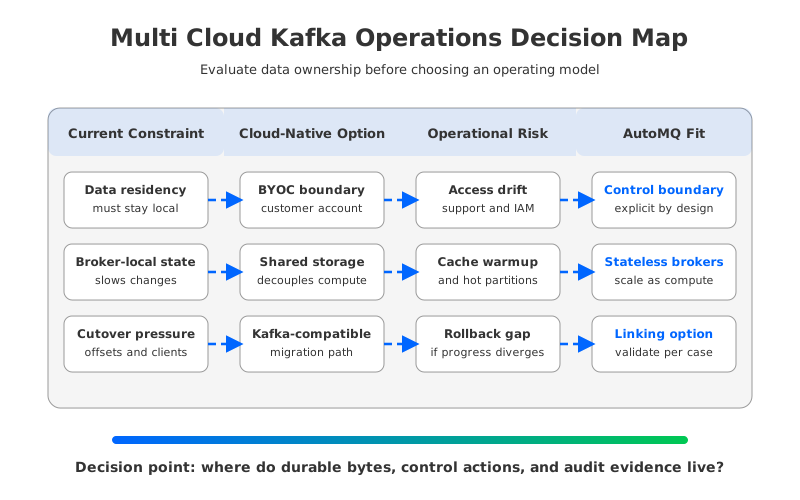
A search for multi cloud kafka operations usually starts after the architecture has already become political. One business unit runs on AWS, another has standardized on Azure, a data science team wants Google Cloud, and the security team is asking where Kafka data, keys, logs, and support access live. The Kafka question is no longer "can we run a cluster in more than one cloud?" The harder question is whether the platform team can make ownership, recovery, cost, and governance explicit enough for production.
That is why multi-cloud Kafka operations should not begin with a vendor checklist. It should begin with data ownership. Kafka is not a stateless API gateway. It carries retained records, consumer progress, connector offsets, transaction state, access policies, and operational evidence. If those responsibilities are spread across clouds without a clean boundary, the platform can look portable on a slide while becoming brittle during a migration, audit, or incident.
The useful framing is direct: choose the operating model whose failure modes your team can test. Compatibility, network design, security review, storage cost, and migration tooling all matter, but they matter because they decide who owns the durable bytes and who can safely operate around them.
1Why teams search for multi cloud kafka operations
Most teams do not wake up wanting another Kafka architecture. They search because an existing architecture stopped matching the organization. A regulated workload may require data to stay in a specific account or region. A merger may leave the company with several cloud standards. A platform group may need one Kafka-compatible interface for application teams while procurement, security, and FinOps want clearer ownership boundaries.
The search phrase is also vague because the pain is mixed. For an SRE, multi-cloud operations means runbooks, failover drills, broker replacement, and unified observability. For security, it means identity, encryption, data residency, private connectivity, and support access. For procurement, it means marketplace channels, contractual responsibility, and exit paths. For application teams, it means Kafka clients, offsets, transactions, and connector behavior that do not change every time the infrastructure boundary changes.
These groups often talk past each other. One group asks for managed operations, another asks for BYOC (Bring Your Own Cloud), and another asks for "Kafka compatibility" as if the phrase answers every risk. It does not. Apache Kafka's public documentation covers core client, consumer, transaction, KRaft, and Kafka Connect behavior, but an operating model still has to decide where that behavior runs and where durable state is stored. Multi-cloud Kafka becomes manageable when these questions are separated instead of collapsed into one product label.
2The production constraint behind the problem
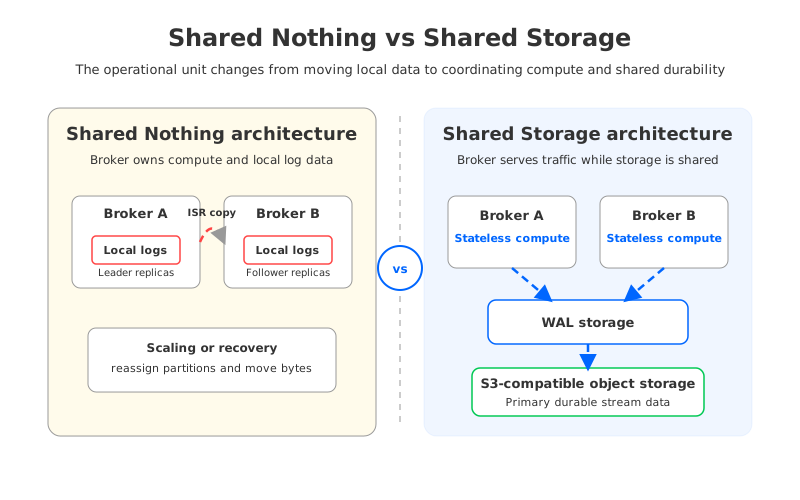
Traditional Kafka uses a Shared Nothing architecture. Each broker owns local log data for the partitions it serves, and durability is achieved through replication across leader and follower replicas in the ISR (In-Sync Replicas). The design is proven, and it remains a reasonable fit for many stable clusters. Its trade-off is that compute placement and durable data ownership are tightly coupled.
That coupling becomes more visible in multi-cloud operations. Scaling a broker fleet is not only adding compute. It can also mean moving partition replicas, watching disk watermarks, throttling reassignment traffic, and planning around hot partitions. Replacing a failed broker is not only restarting a process. The cluster must restore service while preserving local data durability and client behavior. Expanding retention is not only changing a configuration. It changes storage pressure, recovery windows, and the amount of state tied to each broker.
In one cloud and one team, those costs can be absorbed through discipline and automation. Across clouds, they become governance problems. Which team approves cross-Availability Zone networking? Which account owns disks or object storage? Which logs are available to support? Which system is authoritative when consumer progress differs between a source and target cluster? A multi-cloud design that cannot answer these questions before an outage is asking the incident commander to design the boundary under pressure.
Networking adds another layer. Cloud providers document separate pricing and behavior for private connectivity, endpoint services, and traffic across zones or services. A platform team does not need to memorize every line item to make a sound decision, but it must know which traffic paths are on the critical path and which ones scale with write throughput, replication, catch-up reads, or migration. In Kafka, hidden network paths can become a recurring cost and a recovery bottleneck.
3Architecture options and trade-offs
There are several defensible ways to operate Kafka across clouds. The mistake is treating them as maturity levels on a single ladder. They answer different ownership questions.
| Option | What it optimizes for | Ownership trade-off | When it fits |
|---|---|---|---|
| Self-managed Kafka per cloud | Maximum local control and full Kafka surface area | The platform team owns broker state, upgrades, capacity, security, and recovery in every cloud | Teams with deep Kafka operations experience and stable workload boundaries |
| Managed Kafka service | Reduced infrastructure operations | Data plane, control access, networking, and feature surface depend on provider boundaries | Teams that value operational offload over uniform multi-cloud control |
| BYOC Kafka-compatible platform | Customer-owned infrastructure boundary with vendor-supported operations | The customer still reviews cloud IAM, networking, telemetry, support access, and object storage | Regulated or procurement-sensitive teams that need data to stay in their environment |
| Shared Storage architecture | Less broker-local data ownership and more elastic compute | The storage layer, WAL, cache, and metadata model must be validated carefully | Teams whose pain comes from scaling, retention, reassignment, recovery, or cross-zone traffic |
| Replication between clusters | Local autonomy with controlled data movement | Offsets, ordering, lag, failover, and rollback need explicit tests | Teams with clear region or cloud separation and defined recovery objectives |
The table is not a ranking. A classic self-managed design can be the right answer when the workload is steady, the team has operational depth, and compliance prefers direct control. A managed service can be the right answer when the organization wants to outsource more infrastructure responsibility. A BYOC model can be attractive when security and procurement need customer-owned deployment boundaries. A shared-storage model deserves attention when broker-local data ownership is the reason scaling, recovery, and cost have become hard.
Tiered Storage deserves a separate note because it is often confused with shared storage. Apache Kafka Tiered Storage moves older log segments to remote storage while the broker still owns the active log path. That can reduce local retention pressure. It does not, by itself, make broker compute stateless for durable data ownership. Shared Storage architecture changes a deeper part of the operating model: brokers serve Kafka protocol traffic while durable stream data is externalized into a shared storage layer, usually with a write-ahead path and caching layer designed for streaming workloads.
4Evaluation checklist for platform teams
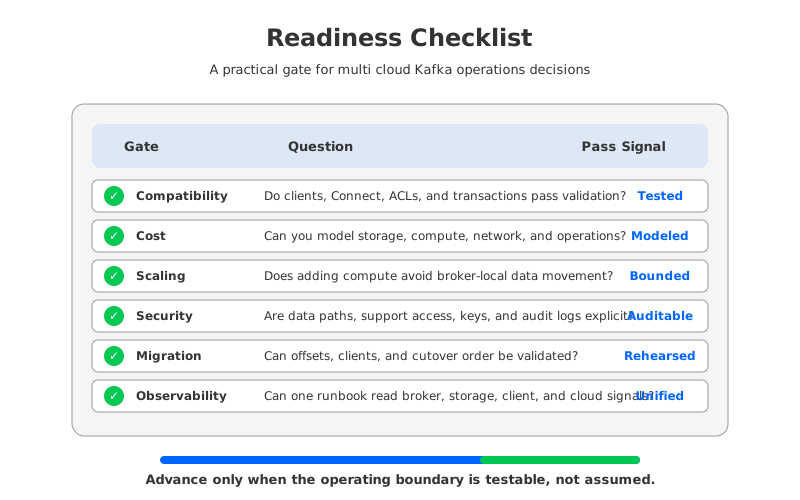
The right evaluation is not "which platform claims multi-cloud support?" It is "which platform makes the boundary testable?" A serious review should force every option through the same gates.
- Compatibility: Test the actual clients, AdminClient flows, Kafka Connect workers, Consumer group behavior, offsets, transactions, ACLs, and schema tooling that your applications use. Protocol compatibility matters most when it preserves existing automation and failure handling, not when it appears as a checkbox.
- Cost model: Separate compute, storage, network, operations, support, and migration capacity. Avoid blended estimates that hide the traffic path or storage tier responsible for the bill.
- Elasticity: Ask whether adding serving capacity requires moving retained data. If the answer is yes, scaling remains bounded by reassignment, throttling, and recovery windows.
- Governance: Identify where records, logs, metrics, object storage, keys, IAM policies, audit events, and support access live. A private endpoint protects a route; it does not automatically prove data ownership.
- Migration risk: Validate producer cutover, consumer progress, offset continuity, rollback, connector state, and backfill behavior before committing to a migration window.
- Observability: Make one runbook capable of reading broker metrics, client errors, storage health, network paths, and cloud events. Multi-cloud operations fail when each signal belongs to a different team and no one can assemble the timeline.
These checks expose the real decision. If the main pain is operational toil, a managed service may be enough. If the main pain is governance and procurement, a BYOC boundary may matter more than a large feature catalog. If the main pain is broker-local data movement, the architecture has to change beneath the Kafka API.
5How AutoMQ changes the operating model
After the neutral evaluation is complete, AutoMQ becomes relevant as a Kafka-compatible streaming platform built around Shared Storage architecture. It keeps Kafka protocol compatibility while replacing the traditional broker-local storage model with S3Stream, WAL (Write-Ahead Log) storage, S3-compatible object storage, and data caching. AutoMQ Brokers handle Kafka protocol processing, partition leadership, caching, and scheduling; durable stream data is not pinned to broker-local disks in the traditional model.
That change does not remove the need for engineering review. It moves the review to a more explicit place. The team must evaluate WAL type, object storage behavior, cache efficiency, metadata ownership, observability, and cloud resource permissions. The benefit is that broker scaling and replacement are less dominated by copying retained log data between brokers. Compute can be treated more like replaceable serving capacity, while durable data ownership is centered on shared storage.
For multi-cloud operations, the deployment boundary matters as much as the storage model. AutoMQ BYOC runs the control plane and data plane in the customer's own cloud account and VPC (Virtual Private Cloud). AutoMQ Software targets customer-managed private environments. In both cases, the useful point for security and procurement teams is not a slogan about control. It is a concrete review boundary: where the control plane runs, where the data plane runs, which cloud resources are used, how support access is authorized, and how operational telemetry is handled.
AutoMQ's architecture also changes how teams think about cross-zone traffic and migration. In a traditional Shared Nothing Kafka design, replication and reassignment can generate traffic patterns that grow with retained data and replica movement. In a Shared Storage architecture, the platform can reduce the amount of broker-to-broker data movement because storage is shared rather than tied to each broker's local disk. For migration scenarios, AutoMQ Kafka Linking provides a Kafka-compatible migration path that can preserve byte-level data and Consumer group progress under documented constraints. That capability still needs workload-specific validation, especially for authentication mode, topic selection, cutover order, and rollback planning.
The practical result is a different operating conversation. Instead of asking the platform team to make every broker stateful in every cloud and then automate around the complexity, the architecture asks which responsibilities should belong to compute, which should belong to shared storage, and which should remain explicit in the customer-controlled environment. That is a better fit for organizations where security, procurement, SRE, and application teams all need to approve the same streaming platform.
6A decision scorecard
Use this scorecard before choosing or replacing a multi-cloud Kafka operating model. Give each line a green, yellow, or red status. The goal is not to make every row green on the first pass; it is to find the rows that would become incident risk if ignored.
| Question | Green signal | Red signal |
|---|---|---|
| Where are durable records stored? | Account, region, storage service, and encryption controls are explicit | The team relies on contract language but cannot trace the data path |
| Who operates the data plane? | Responsibilities for scaling, patching, observability, and support access are documented | Operations depend on informal access or unclear escalation paths |
| What happens during scale-out? | Added capacity becomes useful without large retained-data movement | Scaling triggers long reassignment or recovery windows |
| What breaks during migration? | Producer, Consumer group, connector, offset, and rollback tests exist | The plan assumes client cutover will work because the protocol is compatible |
| How is cost reviewed? | Compute, storage, network, and migration capacity are modeled separately | The bill is reviewed after deployment as one blended platform number |
| Can the team exit? | Replication, export, rollback, and ownership transfer paths are rehearsed | The exit path depends on proprietary assumptions that have never been tested |
Back at the original search query, "multi cloud kafka operations" is too broad to be solved by a single feature list. The durable question is ownership. If your current Kafka model makes every cloud expansion, broker replacement, retention change, or migration a data movement project, evaluate whether a Kafka-compatible Shared Storage architecture belongs in the shortlist. To test that model in a customer-controlled environment, start with AutoMQ Cloud and run the scorecard against your own cloud, IAM, network, and migration constraints.
7FAQ
7.1Is multi-cloud Kafka the same as cross-cloud replication?
No. Cross-cloud replication is one tactic inside a broader operating model. Multi-cloud Kafka operations also include data ownership, client compatibility, private networking, IAM, observability, cost allocation, support access, migration, and rollback.
7.2Does BYOC automatically solve data ownership?
BYOC gives teams a clearer customer-owned deployment boundary, but it still needs review. Security teams should inspect control-plane placement, data-plane placement, object storage, IAM permissions, encryption, telemetry, and support access.
7.3Is Kafka Tiered Storage the same as Shared Storage architecture?
No. Tiered Storage offloads older log segments while preserving the broker-owned active log model. Shared Storage architecture changes durable data ownership so brokers are less tied to local persistent storage.
7.4What should platform teams test before choosing a Kafka-compatible platform?
Test real clients, AdminClient automation, Consumer group behavior, offsets, transactions, Kafka Connect, authentication, private networking, observability, migration, and rollback. Compatibility claims become useful only after the workload-specific path is proven.
8References
- Apache Kafka Documentation
- Apache Kafka KRaft Documentation
- Apache Kafka Connect Documentation
- Apache Kafka Transactions Documentation
- AutoMQ Architecture Overview
- AutoMQ Compatibility with Apache Kafka
- AutoMQ S3Stream Overview
- AutoMQ WAL Storage
- AutoMQ Kafka Linking Overview
- AutoMQ Zero Cross-AZ Traffic Overview
- AWS EC2 Network Bandwidth Documentation
- AWS PrivateLink Pricing


