
Table of Contents
Table of Contents
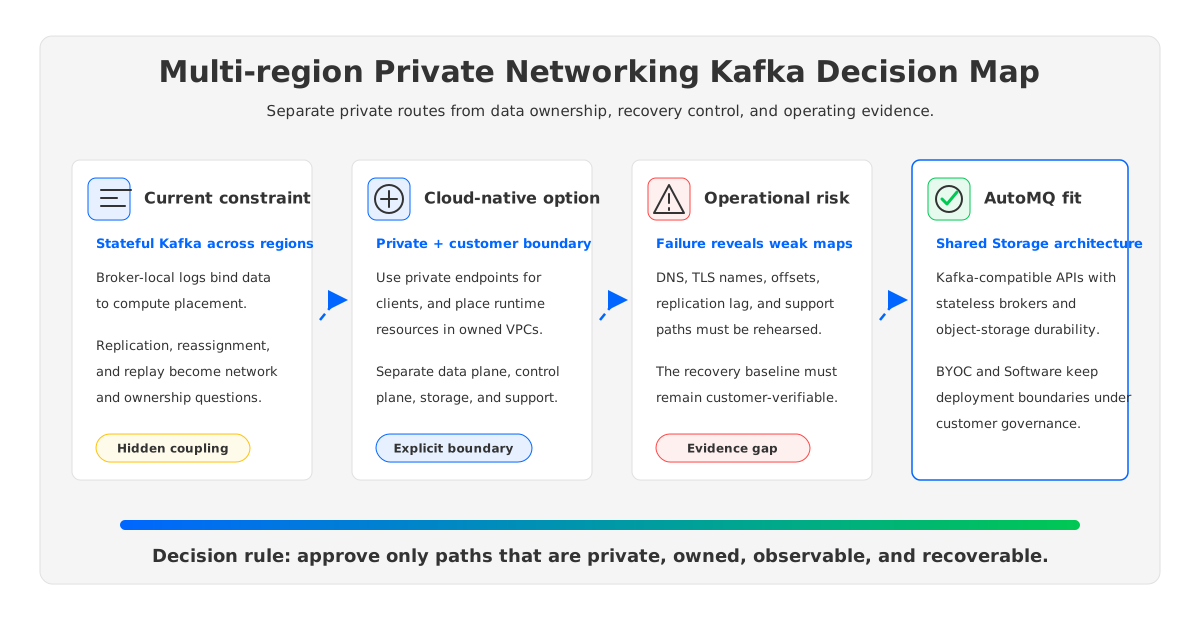
Teams search for multi region private networking kafka when the Kafka decision has become bigger than a private endpoint. The platform team may already know how to keep producer and consumer traffic off the public internet. The harder question is what happens when the same streaming platform spans two regions, two cloud accounts, several VPCs, and a recovery plan that security, finance, and application teams all have to trust. At that point, "private networking" is a set of ownership promises about where records live, who can move them, who can observe them, and which environment remains authoritative during failure.
That is why multi-region Kafka reviews often feel uncomfortable. Kafka is a commit log with offsets, consumer groups, transactions, monitoring streams, storage growth, and replay behavior. A design can pass a network diagram review and still fail the data ownership review if the durable log, replication path, or operational access path sits outside the intended boundary. The useful question is not "Is this Kafka endpoint private?" It is "Can we explain every data, control, storage, and recovery path when a region is unavailable?"
1Why teams search for multi region private networking kafka
The search usually begins after a team has outgrown the first private-network pattern. A single-region Kafka cluster inside one VPC is understandable: clients connect through private addresses, security groups restrict access, and the operations team can inspect cloud logs from one place. Multi-region changes the shape of the problem. Producers in one region may write to a local cluster while consumers in another region require a low-lag copy. A disaster recovery plan may require a warm standby region. A regulated workload may require that data stays in a specific country or cloud account, while a global application expects private access from multiple environments.
The first trade-off is locality versus consistency. Keeping clients close to a regional Kafka endpoint reduces network distance and avoids unnecessary cross-region dependencies, but it creates a replication and failover question. Sending all traffic to one primary region simplifies ordering and ownership, but it can make the platform more fragile during a regional incident. Active-active patterns can improve application locality, but they force teams to decide how topics, offsets, schemas, and conflict-sensitive workflows behave across regions. Kafka gives teams strong partition ordering and consumer group semantics within a cluster, but the multi-region architecture around Kafka has to define what "same stream" means across locations.
The second trade-off is private access versus private control. PrivateLink-style endpoints, private service access, peering, transit gateways, and VPNs can keep packets on private paths, but they do not automatically answer who owns the data plane. A provider-operated cluster reached through a private endpoint is different from a BYOC Kafka platform deployed inside the customer's account. Both may be valid. They give security reviewers different evidence: endpoint policies and service contracts in one case, customer-owned cloud resources, IAM roles, VPC flow logs, and storage buckets in the other.
2The production constraint behind the problem
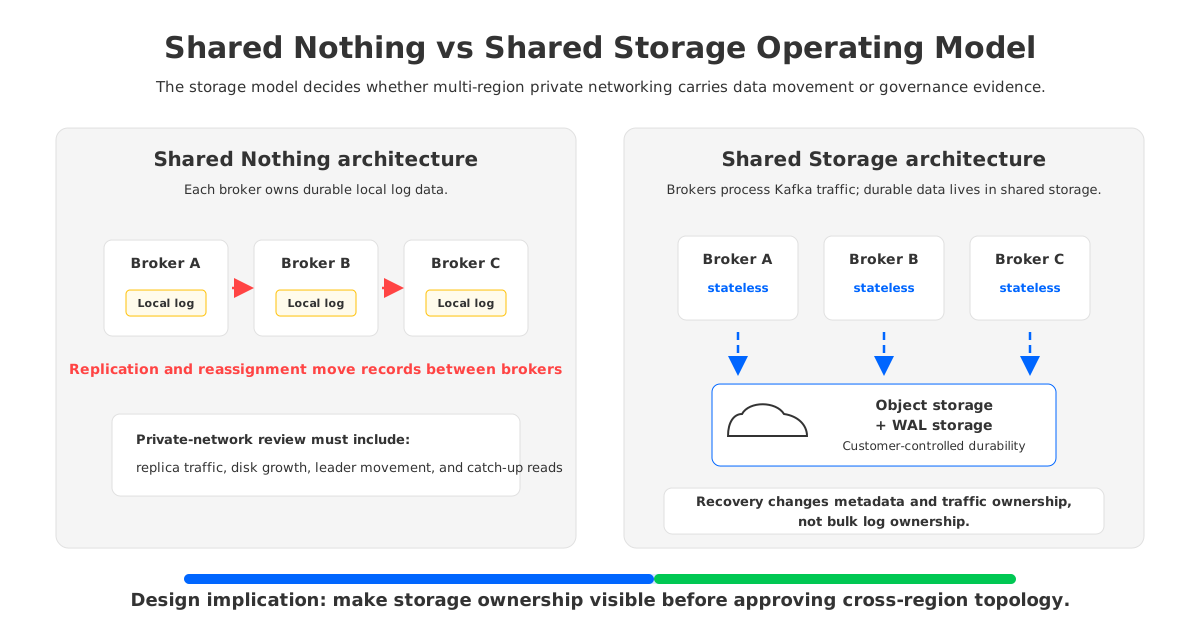
Traditional Kafka uses a Shared Nothing architecture. Each broker owns local log segments for the partitions it hosts, and replication across brokers provides durability and availability. That design is proven and well understood. It also means broker placement and storage ownership are tied together. When partitions move, leaders change, replicas catch up, or storage fills, the platform has to move or read data through broker-controlled paths. In a multi-region private-networking review, those paths become as important as the client listener.
This is where many diagrams understate the risk. They show producers, consumers, regional clusters, and private network links, but they hide the movement caused by broker-local storage. A broker replacement is not merely a compute event when the broker owns durable data. A recovery test is not complete when the standby endpoint accepts connections; it is complete when consumer groups can resume from expected offsets, applications know which region is authoritative, and operators can prove that replay data came from an approved storage boundary.
For platform teams, the production review should separate four questions:
- Where do Kafka records become durable? This includes local disks, WAL storage, object storage, backup buckets, and replicated topics.
- Which region owns the write decision? This affects producer routing, transactional behavior, ordering expectations, and failover procedures.
- Which private paths are required for recovery? Client access, replication, object storage access, monitoring export, support access, and administrative APIs may use different routes.
- What evidence proves the design during an incident? VPC flow logs, audit logs, Kafka metrics, consumer lag, offset checkpoints, endpoint policies, and IAM records all matter.
3Architecture options and trade-offs
Most teams compare three patterns. The first is self-managed Kafka in customer VPCs across regions. This maximizes visibility into network, storage, and identity resources. The cost is operational load: patching, scaling, partition balancing, disk capacity, replication tooling, and failover runbooks belong to the customer. This pattern works when the organization already has Kafka expertise and wants direct control more than managed operations.
The second pattern is a managed Kafka service with private connectivity. This can offload broker operations while giving applications private network paths. The trade-off is boundary clarity. The customer must understand where the service data plane runs, what data and metadata the provider can access, which private connectivity modes are supported per region, and how support access is approved and logged.
The third pattern is BYOC Kafka, where the platform runs inside the customer's cloud account or VPC while automation and lifecycle management are provided by the vendor. BYOC gives security and platform teams a cloud-native evidence model: IAM roles, KMS keys, object storage policies, VPC flow logs, private DNS, endpoint policies, and resource tags can all live in the customer's environment. The trade-off becomes whether software operations can be safely delegated inside the customer's boundary.
The storage model then decides whether BYOC is mostly a deployment label or a real operational change. With broker-local durable storage, multi-region private networking must still accommodate replica traffic, broker recovery, disk growth, and partition reassignment. With Shared Storage architecture, durable data can live in customer-controlled object storage while brokers act more like stateless compute. That does not remove Kafka semantics, and it does not remove the need for a recovery plan. It changes the operational unit of recovery from "move broker-owned data" toward "change metadata, ownership, and traffic routing against a shared durable store."
The following decision table is a better starting point than a vendor feature checklist:
| Requirement | What to verify | Architecture pressure |
|---|---|---|
| Regional data ownership | Which account, region, bucket, key, and logs hold durable records | Storage design matters more than endpoint design |
| Private client access | Bootstrap behavior, broker metadata, DNS, certificates, and endpoint policy | Kafka clients must be tested, not assumed |
| Failover readiness | Producer routing, consumer group offsets, replication lag, and rollback steps | Recovery evidence must be rehearsed |
| Cost control | Cross-region replication, cross-AZ traffic, endpoint processing, and storage reads | Network and storage bills follow data motion |
| Governance | Control plane permissions, support access, audit logs, and change approval | Ownership must be inspectable after deployment |
4Evaluation checklist for platform teams
A strong review starts with a packet walk and a record walk. The packet walk traces producer, consumer, admin, monitoring, object storage, and support routes across regions and accounts. The record walk traces where a Kafka record is acknowledged, retained, replicated, replayed, and deleted.
Use the checklist below before approving a multi-region private Kafka design:
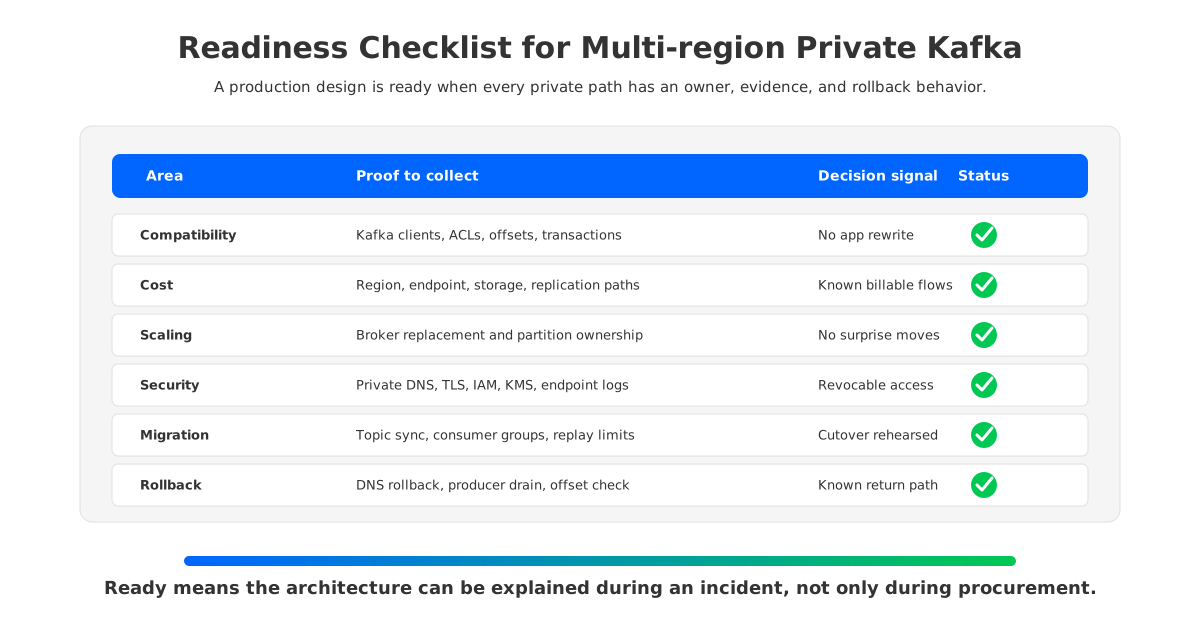
- Compatibility: Confirm that existing Kafka clients, authentication mechanisms, ACLs, offsets, consumer groups, transactions, Kafka Connect jobs, and operational tooling can work with the target platform. Apache Kafka documents these semantics in separate areas because they are not interchangeable details.
- Cost: Identify all billable data motion, including cross-region replication, cross-Availability Zone traffic, endpoint data processing, object storage reads, and catch-up replay. Avoid precision unless pricing is verified for the exact cloud, region, and service date.
- Elasticity: Ask what happens when brokers are added, removed, replaced, or isolated. In a broker-local design, scaling can create data movement. In a shared-storage design, scaling should be evaluated around leadership, metadata, cache warming, and traffic routing.
- Security: Define the owner of VPCs, private DNS zones, certificates, IAM roles, KMS keys, object storage policies, endpoint policies, logs, and support approval. A private route without revocable identity is not enough.
- Migration: Test topic creation, dual writes or replication, consumer group continuity, offset checks, schema compatibility, and cutover traffic. Multi-region migrations fail most often at the edges: DNS, client metadata, rate limits, and rollback timing.
- Rollback: Decide what makes the old region authoritative again. Rollback is not a feeling; it is a documented sequence for producer routing, consumer resume points, stale data handling, and monitoring alerts.
- Observability: Keep Kafka metrics, cloud network logs, object storage access logs, and platform audit logs correlated. During an incident, teams should not have to infer whether traffic used the intended private path.
This review prevents a worse outcome: a platform that is private on paper and ambiguous in production. The goal is to make the decision durable enough that the same architecture can survive a failover drill, an audit request, and a cost review.
5How AutoMQ changes the operating model
After the neutral evaluation, the architecture requirement becomes clearer: teams need Kafka-compatible streaming, private deployment boundaries, customer-controlled storage evidence, and an operating model that does not make broker-local data movement the center of every scaling or recovery event. This is where AutoMQ is relevant. AutoMQ is a Kafka-compatible cloud-native streaming platform that uses Shared Storage architecture, stateless brokers, WAL storage, and S3-compatible object storage to separate compute from durable storage.
In AutoMQ BYOC, the deployment boundary is designed for customer cloud environments. The control plane and data plane run in the customer's cloud account or VPC, so platform teams can align Kafka operations with existing IAM, VPC, KMS, object storage, monitoring, and approval processes. In AutoMQ Software, the same ownership principle applies to private data center environments. Those boundaries matter because multi-region private networking is often a governance discussion before it becomes a throughput discussion.
The storage layer is the deeper change. AutoMQ replaces Kafka's broker-local log storage with S3Stream, backed by WAL storage and object storage. The broker still speaks Kafka protocol to clients, but durable data is not permanently owned by a specific broker disk. In multi-region private-network terms, that gives teams a cleaner model: private Kafka listeners handle application access, WAL storage handles low-latency write durability, object storage provides the customer-governed durable repository, and stateless brokers can be replaced or scaled without treating every broker event as a bulk log migration.
This does not mean every multi-region design becomes automatic. Teams still need to choose regional topology, replication strategy, recovery objectives, private endpoint design, IAM boundaries, and operational procedures. AutoMQ changes the decision by reducing the coupling between broker compute and durable log ownership. That is the part traditional Kafka makes hard in the cloud: the data plane is private, but the data movement required to operate that data plane can become the real constraint.
6A practical decision framework
Once the tier is clear, platform teams can choose the operating model. Self-managed Kafka is reasonable when the organization wants maximum direct control and accepts the operational burden. Managed Kafka with private connectivity is reasonable when reduced operations matter more than customer-side data plane ownership. BYOC Kafka fits when the organization wants a managed operating experience while keeping runtime resources, storage, and network evidence inside its own cloud boundary. A Kafka-compatible Shared Storage architecture becomes relevant when scaling, retention, and recovery traffic are the pain points behind the private-network requirement.
The final review should produce one artifact: a multi-region ownership map. It should show client paths, broker or compute placement, durable storage, replication or linking path, control plane actions, observability export, support access, failover authority, and rollback authority. If the map cannot be drawn, the design is not ready. If it can be drawn and tested, procurement, security, and platform engineering can discuss trade-offs using the same facts.
When your Kafka review reaches that point, start with the question that opened this article: not "Can we make the endpoint private?" but "Can we own and prove the data boundary across regions?" If the answer points toward Kafka compatibility, customer-controlled deployment boundaries, and Shared Storage architecture, talk to the AutoMQ team with your regional topology, VPC design, recovery objectives, and governance requirements.
7FAQ
7.1Is multi-region private networking the same as disaster recovery for Kafka?
No. Multi-region private networking describes how Kafka clients, storage, replication, control, monitoring, and support paths stay inside approved private routes and ownership boundaries. Disaster recovery is one use case inside that design. A private network can still have weak recovery semantics if offsets, producer routing, and authoritative-region rules are not tested.
7.2Does BYOC Kafka remove the need for PrivateLink-style connectivity?
Not necessarily. BYOC changes where the runtime resources and storage live. PrivateLink-style connectivity and related private access mechanisms control how clients or services reach endpoints. Many production designs use both: BYOC for ownership boundaries and private connectivity for controlled access between VPCs, accounts, regions, or application environments.
7.3What should security teams ask first?
Ask where durable records live, which cloud account owns the storage and keys, which private paths carry client and replication traffic, who can operate the control plane, where logs are stored, and how support access is approved and revoked. Those answers should be backed by cloud policies and logs, not only architecture slides.
7.4Where does AutoMQ fit?
AutoMQ fits when teams want Kafka protocol compatibility, customer-controlled deployment boundaries through AutoMQ BYOC or AutoMQ Software, and a Shared Storage architecture that reduces broker-local data ownership. It should be evaluated alongside self-managed Kafka and managed Kafka with private connectivity based on workload risk, operating model, and governance requirements.
8References
- Apache Kafka documentation
- Apache Kafka documentation: geo-replication and cross-cluster data mirroring
- AWS PrivateLink documentation
- AutoMQ documentation: architecture overview
- AutoMQ documentation: compatibility with Apache Kafka
- AutoMQ documentation: S3Stream shared streaming storage
- AutoMQ documentation: prepare AWS VPC for BYOC
- AutoMQ documentation: migrate to AutoMQ


