
Table of Contents
Table of Contents
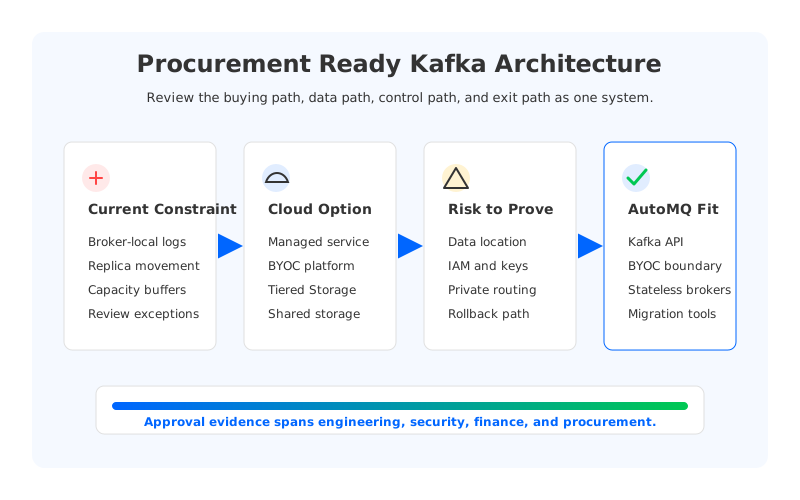
Teams usually search for procurement ready kafka architecture after the streaming platform has stopped being only an engineering decision. The Kafka cluster may already carry payment events, user activity, security telemetry, CDC streams, or AI feature updates. The harder question is whether the architecture can survive security, cloud-account, legal, budget, and migration review without turning every approval into a custom exception.
Procurement readiness is a technical property, not paperwork. Contracts, invoices, and approved vendors depend on where data lives, who can access infrastructure, which network paths are exposed, how usage scales, and how the company exits if the platform no longer fits. A Kafka architecture that looks clean in a benchmark can still fail procurement if the data plane boundary is vague or every scale event creates operational risk.
The useful frame is data ownership: which account stores the durable log, which team controls encryption and network routes, which system moves data during failure recovery, and which party can prove the boundary during an audit. A procurement-ready Kafka architecture makes those answers explicit before purchase, migration, or renewal.
1Why teams search for procurement ready kafka architecture
The search often starts with a familiar mismatch. Platform engineers want a Kafka-compatible service that reduces toil. Security teams want customer-controlled data paths, private networking, key ownership, and audit evidence. Finance wants predictable spend and fewer surprise capacity events. Procurement wants an approved buying path, clear service boundaries, and a contract that maps to the actual operating model.
Those goals collide when the architecture is described only as "managed Kafka," "self-managed Kafka," or "cloud-native Kafka." Those labels do not answer the questions that decide approval, because each one can hide a different data path and operating boundary. The review needs to ask more concrete questions.
- Data location: Are Kafka records, retained logs, snapshots, backups, and operational artifacts stored in the customer's account, the provider's account, or both?
- Control boundary: Which components can change cluster state, create infrastructure, read metadata, collect logs, or open support access?
- Network exposure: Do clients reach the service through private endpoints, VPC peering, public endpoints, or a mix of paths that need separate review?
- Cost behavior: Does growth require pre-provisioned broker storage, cross-Availability Zone replication traffic, remote storage requests, support fees, or marketplace commitments?
- Exit path: Can topics, offsets, consumer groups, ACLs, schemas, and connector state move without forcing a risky application cutover?
Procurement readiness means the platform can answer these questions in a format that security, finance, and engineering can all use. A small analytics team may accept a provider-owned data plane for speed. A regulated platform team may require the service to run inside its own cloud account. The architecture has to make the trade-off deliberate.
2The production constraint behind the problem
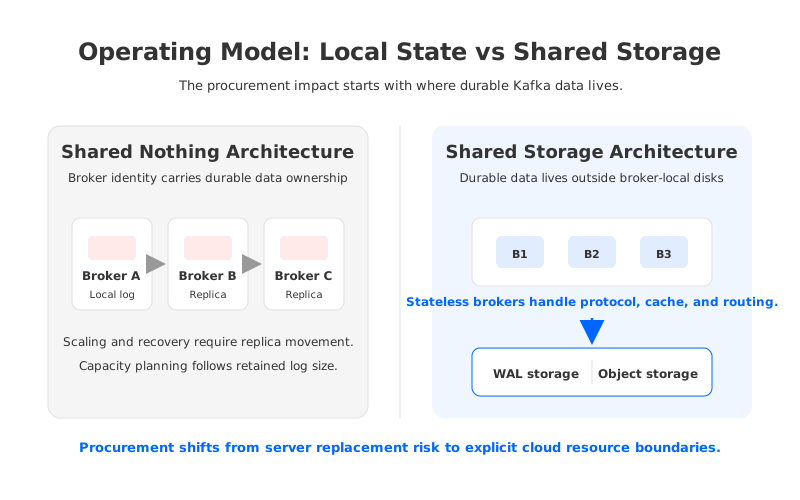
Traditional Apache Kafka uses a Shared Nothing architecture. Each broker owns local log segments for its assigned partitions, and durability is achieved through replicas coordinated by Kafka. This model is mature, well understood, and documented in the Apache Kafka project, including the mechanics of topics, partitions, Consumer groups, offsets, transactions, KRaft, and client behavior. It also makes broker identity and durable data placement tightly connected.
That connection matters during procurement because it turns platform operations into data operations. Adding brokers is not only adding compute; the cluster must decide which partitions move, how much data transfers, how replication catches up, and how client traffic is affected. Replacing a failed broker also means reasoning about local storage, replica health, under-replicated partitions, network headroom, and time to rebalance.
Cloud infrastructure amplifies this constraint. Local or block storage must be sized before traffic arrives. Multi-zone reliability often implies replica traffic across Availability Zones. Private connectivity, encryption, IAM, bucket policy, logging, and incident access must be reviewed separately from the Kafka protocol.
The procurement problem appears when those technical costs are hidden until late in the process. A team signs up for a service because the API is compatible, then discovers that data location, support access, networking, or migration controls do not match internal policy. Or a team keeps self-managing Kafka because it controls the environment, then discovers that staffing, capacity planning, and recovery drills are the real approval blockers. The decision should be made earlier, with architecture as the common language.
3Architecture options and trade-offs
There are several defensible Kafka operating models. The right choice depends on which boundary the organization is trying to optimize.
| Architecture option | What it optimizes | Procurement question it leaves open |
|---|---|---|
| Self-managed Apache Kafka | Maximum operational control and ecosystem familiarity | Can the team staff upgrades, failure drills, capacity planning, and migration safely? |
| Managed Kafka service | Faster adoption and outsourced operations | Where does the data plane run, and what data or metadata leaves the customer's boundary? |
| Kafka with Tiered Storage | Longer retention with less pressure on local disks | Does broker recovery and active-log operation still depend on broker-local state? |
| BYOC Kafka-compatible platform | Customer-owned infrastructure with provider-managed operations | Are IAM permissions, support access, telemetry, and upgrade actions clearly scoped? |
| Shared Storage architecture | Durable data externalized from broker-local disks | Does the write path, cache layer, and object storage design meet workload latency and recovery targets? |
This table is not a ranking. Self-managed Kafka can be the right answer when the company already has a strong Kafka SRE team and wants full control. A managed service can be right when speed matters more than account-level ownership. Tiered Storage can be useful when long retention is the main pressure. BYOC can be attractive when governance requires customer-owned infrastructure but the team still wants a managed operating experience.
Each model moves risk to a different owner. A provider-owned service can reduce operations but may require deeper review of data and metadata boundaries. A self-managed cluster gives control but keeps staffing and recovery risk inside the platform team. A Shared Storage architecture changes scaling and recovery, but still requires validation of WAL (Write-Ahead Log) storage, object storage behavior, cache warmup, monitoring, and failure handling.
Procurement-ready architecture does not hide these trade-offs behind a feature list. It states them plainly enough that each stakeholder can sign off on the part they own.
A Kafka platform is ready for procurement when the buying path, data path, control path, and exit path can be reviewed as one system.
4Evaluation checklist for platform teams
Start the evaluation with the Kafka contract. Existing clients, serializers, Consumer groups, offsets, transactions, Kafka Connect jobs, and monitoring tools are usually the reason the organization chose Kafka in the first place. If a proposed platform preserves the infrastructure boundary but breaks application behavior, procurement approval will not matter because the migration will stall.
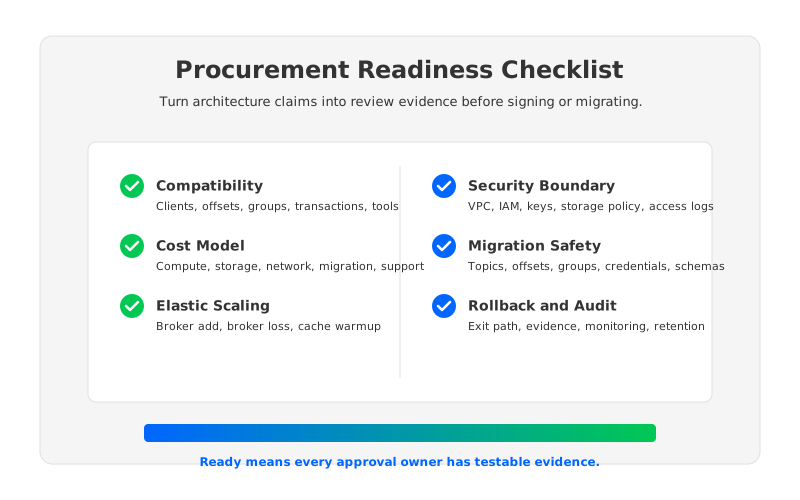
Then evaluate the operating boundary. The architecture review should create evidence that another team can inspect without reverse-engineering Kafka internals. The following checklist is a practical way to keep the review concrete:
- Compatibility: Test existing producers, consumers, admin tooling, ACLs, Consumer group behavior, offset commits, transactions if used, and connector workloads against the target platform.
- Data boundary: Identify the account, VPC (Virtual Private Cloud), bucket, encryption keys, backups, logs, metrics, and support-access procedures that touch Kafka records or operational data.
- Network boundary: Confirm whether clients use private connectivity, VPC routing, public endpoints, or marketplace-managed access paths. AWS PrivateLink-style controls are useful only when the rest of the data path is equally clear.
- Cost model: Separate compute, storage, network transfer, object storage operations, migration capacity, support, and marketplace charges. Do not reduce the review to a single broker price.
- Failure recovery: Simulate broker loss, zone impairment, storage throttling, controller failover, client retry storms, and consumer catch-up. Procurement risk includes incident risk.
- Migration and rollback: Prove how topics, offsets, Consumer groups, credentials, schemas, and producer cutover behave before production traffic moves.
- Observability and audit: Confirm which metrics, logs, audit events, and operational actions are available to the customer, and how long they are retained.
The checklist should produce a scorecard, not a yes-or-no answer. A team may accept a weaker exit path for a low-risk internal workload. It may demand stronger customer-owned boundaries for regulated event streams. The point is to make the exception visible before the contract is signed.
5How AutoMQ changes the operating model
After the neutral evaluation is complete, AutoMQ becomes relevant as a Kafka-compatible streaming platform built around Shared Storage architecture. It keeps the Kafka protocol and ecosystem contract while moving durable stream storage away from broker-local disks. AutoMQ Brokers handle protocol processing, partition leadership, caching, and scheduling, while S3Stream writes through WAL storage and S3-compatible object storage.
That architectural shift changes the procurement conversation. In a Shared Nothing architecture, broker operations and retained data are closely coupled. In AutoMQ's model, durable data is stored in shared object storage, and brokers are stateless with respect to persistent data ownership. Scaling, replacement, and reassignment can focus more on compute capacity, metadata ownership, routing, and cache behavior instead of bulk movement of broker-local logs.
AutoMQ BYOC is especially relevant when the buying requirement includes customer-controlled deployment boundaries. In AutoMQ BYOC, the control plane and data plane run in the customer's cloud account and VPC. Customer business data stays in the customer's environment, while the platform team can still use AutoMQ's control plane, Console, and managed operations model. AutoMQ Software targets customer-managed private environments where the same procurement logic applies inside a private data center.
The boundary is not magic. Security teams still need to review IAM permissions, object storage policy, encryption, support access, network routes, logs, metrics, and upgrade procedures. Platform teams still need to test workload latency, WAL type, cache behavior, client compatibility, and failure scenarios. The difference is that the architecture gives those teams native cloud control surfaces to inspect: buckets, VPC routes, keys, Kubernetes resources, telemetry exports, and audit policies.
Migration is another procurement issue that deserves early attention. AutoMQ commercial editions provide Kafka Linking for migrations that require byte-to-byte message synchronization, offset consistency, Consumer group progress synchronization, and producer cutover support. That matters because procurement teams often ask about exit and transition risk, but engineers are left to prove it later. A migration plan that includes offset behavior, rollback, and application cutover evidence is easier to approve than a plan that says "we will replicate later."
6A decision matrix for approval
Use the following matrix when the final decision crosses engineering, security, finance, and procurement. Each row should have an owner and evidence, not only a score.
| Review area | Strong signal | Weak signal |
|---|---|---|
| Kafka compatibility | Existing clients and tools pass workload tests | Only a simple produce-and-consume demo was run |
| Data ownership | Kafka records and durable logs remain in approved customer-controlled storage | Data, metadata, logs, and support access are described vaguely |
| Network control | Private routing and endpoint exposure are documented end to end | The service relies on broad public access or unclear peering |
| Cost predictability | Compute, storage, network, migration, and support are separated | One blended price hides traffic and retention behavior |
| Recovery behavior | Broker, zone, controller, and storage failure drills are documented | Recovery claims are accepted without tests |
| Migration safety | Topics, offsets, Consumer groups, and rollback are validated | Cutover depends on application downtime and manual coordination |
| Exit readiness | Data export, offset mapping, and client reconfiguration are known | The platform has no tested reverse path |
The matrix prevents a common failure mode: letting one team optimize its own concern while creating risk for another team. Engineering may choose a platform because it is easier to operate. Security may reject it because data paths are unclear. Procurement may approve it because the buying path is simple. Finance may later object because capacity or network behavior was never modeled. A procurement-ready Kafka architecture lets all four groups see the same system.
The next step is not to ask whether Kafka should be managed or self-managed. Ask where durable data lives, who controls the data plane, what changes during failure recovery, and how the organization exits cleanly. If those answers point toward Kafka compatibility with customer-owned cloud boundaries and a Shared Storage architecture, evaluate AutoMQ with your own workload, network, IAM, and migration constraints. Start with the AutoMQ GitHub project or review AutoMQ BYOC through the AutoMQ Cloud entry point.
7FAQ
7.1What is procurement ready kafka architecture?
It is a Kafka architecture that can be reviewed across engineering, security, finance, and procurement before purchase or migration. It should define Kafka compatibility, data ownership, control-plane access, data-plane location, private networking, cost behavior, observability, migration, rollback, and exit paths.
7.2Is BYOC Kafka always required for procurement readiness?
No. BYOC is useful when the organization needs customer-owned cloud infrastructure, VPC control, and clear data-plane boundaries. A provider-owned service can still be appropriate for lower-risk workloads if the organization accepts the data, metadata, and operational boundaries.
7.3Does Tiered Storage make Kafka brokers stateless?
Not by itself. Tiered Storage can move older log segments to remote storage, but the active log and broker lifecycle may still depend on broker-local responsibilities. Shared Storage architecture goes further by placing durable stream storage in a shared storage layer and making brokers stateless with respect to persistent data ownership.
7.4What should a procurement checklist include for Kafka-compatible streaming?
Include compatibility tests, data location, key ownership, network routes, IAM scope, support access, cost components, failure drills, migration steps, rollback behavior, monitoring, audit logs, and exit requirements. The checklist should produce evidence for each stakeholder, not only an engineering recommendation.
7.5How does AutoMQ fit this evaluation?
AutoMQ fits when a team wants Kafka compatibility, customer-controlled deployment boundaries, object-storage-backed durability, stateless brokers, and a clearer separation between compute operations and durable data ownership. AutoMQ BYOC is designed for customer cloud accounts, while AutoMQ Software targets customer-managed private environments.


