
Table of Contents
Table of Contents
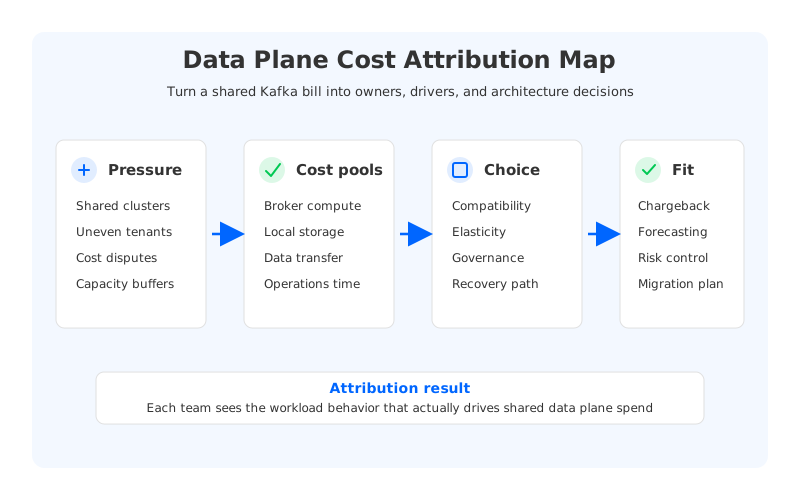
Kafka cost problems rarely arrive as a clean infrastructure ticket. They usually arrive as a finance question that the platform team cannot answer with confidence: which application drove the data transfer line item, which tenant forced the storage expansion, and why did a shared cluster need more brokers when aggregate traffic looked flat? The phrase data plane cost attribution kafka sounds narrow, but the search intent behind it is broad. Teams are trying to connect Kafka behavior to cloud cost, ownership, and architecture decisions without turning every application team into a Kafka operator.
The hard part is that a shared streaming platform is not billed in the same units that product teams understand. Product teams think in topics, tenants, event types, retention policies, consumer groups, SLAs, and data products. Cloud bills arrive as compute hours, storage, cross-zone transfer, private connectivity, load balancing, and support labor. Between those two views sits the Kafka data plane: brokers, partitions, replicas, network paths, local disks, controller metadata, clients, and operational workflows.
Cost attribution becomes credible only when it follows the data plane rather than the org chart. A team that writes 20 MiB/s with 7-day retention and three high-fanout consumers has a different cost profile from a team that writes the same volume with 24-hour retention and one downstream service. A tenant that creates many small topics can also produce operational cost through partition count, controller metadata pressure, alert noise, and rebalancing work. The goal is to make the cost model explain the platform's actual behavior.
1Why teams search for data plane cost attribution kafka
The search usually starts after a shared Kafka platform succeeds. Early on, a shared cluster is attractive because it centralizes expertise, avoids duplicated operations, and gives application teams a common streaming substrate. Over time, the same shared layer becomes a financial and governance boundary. Several teams now depend on it, but the cloud bill still lands in one infrastructure account.
That creates three recurring disputes. Finance wants a chargeback or showback model that maps cost to business owners. Platform engineering wants a model that does not require manual spreadsheet work every month. Application teams want a model that feels fair, charging for behavior they can control instead of mysterious broker-level side effects.
Kafka makes that line difficult because many expensive behaviors are indirect. A producer write becomes replicated broker traffic. Retention becomes local disk pressure and restore scope. A consumer group can create cross-zone reads depending on placement and routing. Connector pipelines add external traffic, task scheduling, failure handling, and dead-letter processing. A broker replacement can trigger data movement that is not owned by any single application team.
The attribution model therefore needs two layers. The first layer measures workload intent: bytes in, bytes out, retention, partitions, consumer fanout, replication policy, and latency target. The second layer measures platform conversion: how that intent turns into compute, storage, network transfer, capacity buffer, and human operations. Without the second layer, attribution becomes a traffic report. With it, attribution becomes an architecture evaluation tool.
2The cloud cost drivers behind the workload
Most teams begin with throughput because it is visible and easy to explain. Throughput matters, but it is not enough. A Kafka topic with steady writes can still create very different infrastructure cost depending on replication, retention, fanout, placement, and recovery requirements. The expensive part is often the multiplier around the byte, not the byte itself.
For a shared platform, a useful attribution model usually tracks these drivers:
- Write path intensity. Producer ingress drives broker CPU, network, page cache behavior, and replication work. Compression ratio and message size matter because they change the relationship between business events and stored bytes.
- Read fanout. Kafka's consumer group model lets many independent services read the same log, which is powerful, but every downstream read still consumes broker and network resources.
- Retention and replay. Longer retention expands the storage footprint and changes incident recovery behavior. A platform that promises replay as a product capability needs to price it as a product capability.
- Partition and metadata shape. Partition count, topic count, and consumer group count affect scheduling, controller metadata, balancing, and operational noise, even when byte volume looks modest.
- Network placement. In cloud deployments, the path between clients, brokers, storage, and availability zones can matter as much as the amount of data stored.
These drivers should not be reduced to one universal unit. A single "cost per GB" number hides the reason Kafka is expensive in the first place: streaming workloads have different ratios of write, read, retention, and recovery pressure. A platform team can still publish a compact showback dashboard, but the internal model needs enough detail to explain why two tenants with similar ingress create different data plane costs.
The cloud bill also includes services outside Kafka itself. Object storage pricing, block storage tiers, gateway endpoints, PrivateLink, load balancers, monitoring systems, and data transfer rules shape the final bill. Data plane attribution belongs in architecture review, not only FinOps reporting, because storage topology and network design lock in many cost drivers before finance sees the invoice.
3Storage, network, and compute trade-offs
Traditional Kafka deployments are built around a shared-nothing model: brokers own partitions, partitions live on broker-local disks, and replication protects the log across brokers. That model has strong historical reasons. It keeps hot data close to the broker process, uses sequential I/O well, and makes Kafka's log abstraction concrete. In a cloud environment, it also ties compute scaling, durable storage, data placement, and recovery work together.
This coupling is where attribution gets messy. If one tenant needs longer retention, the platform may need more storage-heavy brokers. If one topic becomes skewed, the platform may rebalance partitions and move data. If the cluster needs more compute headroom, the team may add brokers that also bring storage capacity. If a broker fails, recovery traffic appears as platform cost rather than tenant cost. Every one of these actions is technically valid, but the bill does not explain the cause.
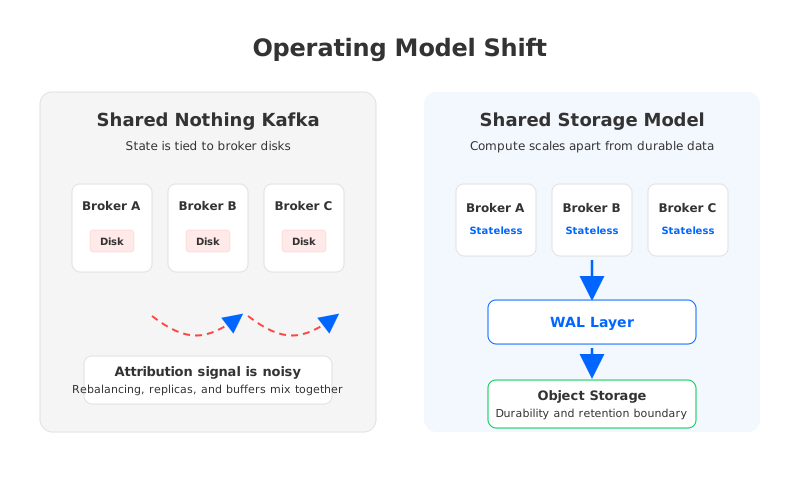
A cost attribution model should separate direct workload cost from platform conversion cost. Direct workload cost is the cost implied by the tenant's configuration and traffic: ingress, egress, retention, fanout, partitions, and service-level objectives. Platform conversion cost is the overhead introduced by the chosen architecture: replication traffic, rebalancing traffic, capacity buffers, recovery movement, local disk overprovisioning, and operational labor.
That distinction prevents a common mistake. Teams often try to charge every shared cost back to the tenant that happened to be active during a billing spike. In Kafka, a spike may come from a rebalance, broker replacement, consumer catch-up, connector retry storm, or cross-zone routing issue. A better model labels the spike as an architectural or operational conversion cost, then asks whether the platform design can reduce that conversion cost for everyone.
The practical evaluation looks like this:
| Question | Why it matters for attribution | What to measure |
|---|---|---|
| Can storage scale independently from brokers? | Separates retention ownership from compute headroom. | Stored bytes, retention windows, broker utilization. |
| Can compute scale without large data movement? | Reduces noisy platform conversion costs. | Rebalance volume, recovery duration, broker add/remove work. |
| Are network paths predictable? | Avoids hidden cross-zone or private connectivity charges. | Client placement, broker placement, read/write paths. |
| Are Kafka semantics preserved? | Keeps attribution from becoming a migration tax. | Client compatibility, offsets, transactions, ACLs, connector behavior. |
| Can ownership be expressed per tenant or workload? | Makes showback actionable. | Topic labels, account mapping, quotas, dashboards. |
The last row matters because attribution is governance. If a platform cannot reliably map topics and clients to owners, the most elegant cost formula will fail in production. Naming conventions, topic metadata, identity, quotas, and observability labels are part of the cost architecture.
4Evaluation checklist for FinOps and platform teams
A data plane cost attribution program should start with a neutral evaluation framework. The framework should work whether the team keeps its current Kafka deployment, adopts a managed Kafka-compatible service, or moves to a cloud-native architecture. The first decision is not vendor selection. The first decision is what level of cost truth the organization needs.
For internal showback, approximate allocation may be enough. The platform team can group topics by owner and report relative spend based on traffic and retention. Chargeback needs a higher bar because the numbers affect budgets: stable ownership metadata, documented formulas, exception handling, and a process for correcting allocations. Procurement also needs forecasts for growth, migration, and failure scenarios.
Use this readiness checklist before trusting the model:
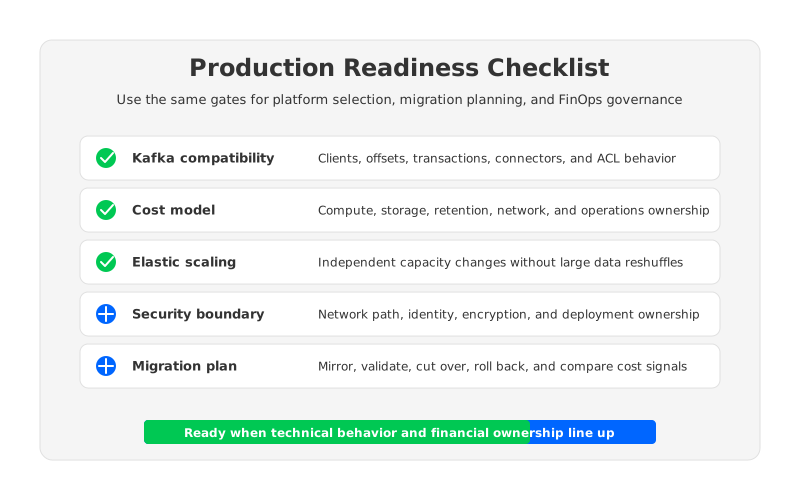
Run the checklist with real workload samples, not synthetic averages. Pick a high-throughput tenant, a high-retention tenant, a high-fanout tenant, and a noisy small-tenant case. If the model can explain those four, it is usually strong enough to guide platform decisions. If it only works for aggregate ingress, it will fail as soon as a team asks why its bill changed.
A scorecard keeps the discussion honest. Kafka-compatible platforms can differ significantly in storage architecture, data movement behavior, deployment boundaries, and network cost exposure. Some differences are feature differences; others are accounting differences. The evaluation should make those differences explicit:
- Compatibility gate. Verify client protocol behavior, consumer groups, offsets, transactions, ACLs, and Kafka Connect requirements before modeling cost savings.
- Cost gate. Split cost into compute, storage, data transfer, private connectivity, observability, and operations labor. Keep direct workload cost separate from platform conversion cost.
- Elasticity gate. Test whether capacity changes require data movement, partition reassignment, or broker-local storage expansion.
- Governance gate. Confirm that every topic, connector, principal, and workload can map to an owner and budget center.
- Recovery gate. Model broker failure, zone failure, restore, replay, and rollback. Incident behavior is part of cost attribution because recovery traffic and labor are real costs.
This is where many teams discover that cost attribution is a platform design review. If the architecture forces compute, storage, and recovery to move together, the attribution model will spend much of its time explaining overhead. If the architecture separates those responsibilities, the model can stay closer to workload intent.
5How AutoMQ changes the operating model
Once the evaluation framework is in place, AutoMQ fits into the discussion as a Kafka-compatible streaming system that separates compute from storage. AutoMQ keeps Kafka protocol compatibility as the application-facing contract, while its shared storage architecture moves durable log storage to object storage and treats brokers as stateless compute nodes. That changes the attribution model: retention is no longer primarily a broker-local disk planning problem, and compute scaling is no longer tied to moving large amounts of local partition data.
This does not make cost attribution disappear. It changes what the model has to explain. In a shared-nothing Kafka model, the platform team often has to explain replica movement, broker storage headroom, local disk expansion, and rebalancing side effects. In AutoMQ's model, the more relevant questions are workload bytes, object storage footprint, WAL design, broker compute, client traffic, and deployment boundary. Those are still engineering questions, but they map more directly to the behavior tenants understand.
AutoMQ's architecture is especially relevant when the organization wants shared platform economics without giving up customer-controlled deployment boundaries. In BYOC or software deployment models, the platform can remain inside the customer's cloud account or controlled environment while still using cloud-native storage primitives. That matters for teams evaluating data sovereignty, compliance, private networking, and procurement constraints. Cost attribution is easier to defend when the data plane boundary is clear.
Network cost is another reason the architecture matters. Cloud providers publish rules for object storage, gateway endpoints, private connectivity, and data transfer, and those rules vary by path. A Kafka architecture that creates unnecessary cross-zone broker traffic can turn replication and reads into a recurring bill line. AutoMQ's documented zero cross-AZ traffic approach is relevant here because it targets one of the hardest costs to explain in shared Kafka environments: money spent moving data inside the cloud network rather than delivering business events.
The migration question should be handled carefully. A Kafka-compatible API reduces application change, but migration still needs a plan for topic inventory, ACLs, consumer offsets, producer behavior, connector pipelines, validation windows, rollback, and observability. AutoMQ Linking and related migration workflows can be part of that plan, but the architectural decision should still pass the same readiness gates. Cost attribution after migration is only useful if the team can compare before and after behavior under the same workload labels.
If your current Kafka cost model cannot explain which tenants drive compute, storage, retention, and network spend, start with the attribution framework before changing platforms. Then evaluate whether the architecture makes those costs easier or harder to govern. For teams that want to test a Kafka-compatible shared storage model, the verified AutoMQ overview is a practical next step: review the AutoMQ architecture and deployment model.
6References
- Apache Kafka Documentation
- Kafka consumer configuration documentation
- Kafka Connect documentation
- AutoMQ architecture overview
- AutoMQ WAL storage documentation
- AutoMQ zero cross-AZ traffic documentation
- AutoMQ migration documentation
- AWS S3 pricing
- AWS gateway endpoints for Amazon S3
7FAQ
7.1What is data plane cost attribution for Kafka?
Data plane cost attribution maps Kafka workload behavior to infrastructure spend. Instead of allocating a shared cluster bill evenly across teams, it connects cost to drivers such as ingress, egress, retention, consumer fanout, partitions, replication, network path, and recovery behavior.
7.2Is throughput enough for Kafka chargeback?
Throughput is a useful starting point, but it is not enough for chargeback. Two tenants with the same ingress can create different costs if one has longer retention, more consumers, more partitions, or less predictable network placement. A defensible model also includes storage, network, elasticity, and operational conversion cost.
7.3How does shared storage affect Kafka cost attribution?
Shared storage can make attribution clearer by separating durable data from broker-local compute. Retention can be modeled closer to stored bytes and object storage policy, while broker compute can be modeled closer to active workload demand. The exact result still depends on the implementation, WAL design, network path, and deployment model.
7.4Should FinOps own Kafka cost attribution?
FinOps should help define reporting, budget ownership, and governance rules, but Kafka platform teams need to own the technical model. The platform team understands partitioning, replication, consumer groups, connectors, rebalancing, and recovery behavior. The strongest programs combine both views.
7.5What should teams validate before migrating for cost reasons?
Validate compatibility, migration mechanics, rollback, observability, and a before-and-after cost baseline. A lower projected bill is not enough if the team cannot preserve client behavior, offsets, access control, connector pipelines, and recovery procedures. Cost attribution should continue during the migration so the organization can prove which architectural changes changed the bill.


