
Table of Contents
Table of Contents
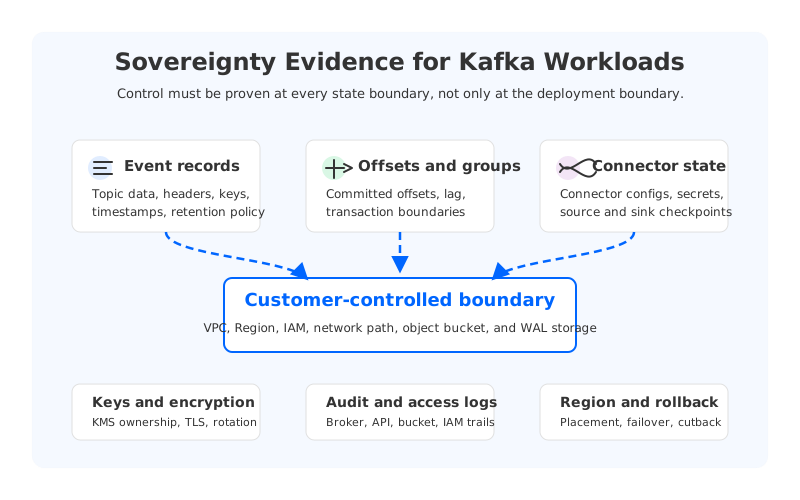
Searches for data sovereignty architecture kafka usually start with a legal or procurement question, but the answer lives in the streaming architecture. A Kafka platform holds event records, committed offsets, consumer group state, transaction markers, connector configuration, source and sink checkpoints, access logs, encryption context, and migration history. If a sovereignty review stops at "the cluster runs in our account," it misses the state that determines whether a workload can be audited, recovered, migrated, or rolled back under customer control.
The hard part is that Kafka turns data location into an operational property. A topic can be assigned to a region, while the offset migration path is unclear. Records can be encrypted, while connector secrets sit in a different control plane. Object storage can be customer-owned, while the write-ahead recovery path still needs a separate durability and key-management review. Data sovereignty architecture for Kafka is therefore less about a label and more about evidence: where every durable state boundary is, who controls it, how it is logged, and whether the workload can keep running during change.
1The Sovereignty Unit Is the Kafka Workload, Not the Cluster
The first mistake is treating the Kafka cluster as the unit of control. That works for inventory, but it is too coarse for governance. A real streaming workload has producers writing records, consumers advancing offsets, stream processors maintaining their own progress, and connectors bridging databases, warehouses, object storage, and SaaS applications. Each piece creates state that can decide whether a regulated process is reproducible.
For Kafka, the sovereignty unit is better defined as the workload envelope: topic data, metadata, identities, progress, integration state, and operational evidence around a specific business stream. A payments authorization topic has different evidence requirements from an IoT telemetry stream, and a CDC connector has different rollback pressure from a stateless analytics consumer. Filing all of them under "Kafka cluster is in region X" makes the audit story thin where it needs to be precise.
Streaming systems are copied, replayed, and reprocessed. Retention settings make old records available for later reads, consumer groups let applications resume from committed offsets, and Kafka Connect preserves source positions. Sovereignty evidence must cover both data at rest and data in motion through time.
2What Must Be Proven for Kafka Data Sovereignty
A practical review starts by naming the durable state surfaces. Not every item contains business payloads, but every item can affect access, resume position, or migration evidence.
| Evidence surface | Kafka-specific question | What to collect |
|---|---|---|
| Event records | Where do topic keys, values, headers, timestamps, and retained records live? | Topic placement, retention policy, storage bucket or volume, encryption configuration |
| Offsets and groups | Can each consumer resume from a known position after migration or rollback? | Consumer group offset exports, lag snapshots, cutover records, transaction-state handling |
| Connector state | Do source and sink positions stay within the approved boundary? | Connector configs, secret ownership, source offsets, sink checkpoints, worker logs |
| WAL and object storage | Which storage layer acknowledges writes, and which layer holds long-term stream objects? | WAL type, bucket, region, credentials, recovery path, object lifecycle settings |
| Keys and identity | Who owns encryption keys and service identities? | KMS key policy, rotation process, IAM roles, TLS and mTLS configuration |
| Audit logs | Can access and operational changes be reconstructed? | Broker logs, control plane audit logs, object storage access logs, cloud API trails |
| Migration and rollback | Can the workload move without losing record order or offset continuity? | Source baseline, topic-copy proof, consumer switchover logs, rollback runbook |
The table shows why generic BYOC language is not enough. A BYOC deployment boundary can be correct while the workload proof is incomplete. If a connector checkpoint sits outside the approved region, or if cutover cannot prove offset continuity, the workload still has a sovereignty gap.
3Shared Nothing Kafka Makes Sovereignty Operationally Expensive
Traditional Kafka follows a Shared Nothing architecture. Each Broker owns local persistent storage, and partitions are replicated across Brokers for durability. In data centers, this model was a reasonable match for the infrastructure. On cloud infrastructure, it creates a tighter coupling between data placement, broker placement, and recovery mechanics.
That coupling shows up during operations that touch capacity or fault domains. Scaling can require partition reassignment, and reassignment can mean moving persistent data between Brokers. Changing the region or Availability Zone design can become a storage migration. Retention growth turns into disk provisioning, and a failed Broker raises questions about replica catch-up, disk state, and network transfer before the workload is healthy again.
For sovereignty reviews, this creates two uncomfortable effects. The evidence changes whenever the storage topology changes, and the rollback path can be entangled with local disk state. A team can write a region-control policy, but if recovery requires reconstructing broker-local partition data, the policy becomes hard to test under pressure.
Tiered Storage improves part of the retention story by moving older data to object storage, but it does not remove local storage from the hot path. Recent records still sit on broker-attached storage before they age into the remote tier. That distinction matters because the hot path is where write acknowledgment, recovery, consumer lag, and cutover behavior are most sensitive.
4The WAL and Object Storage Boundary Is the Real Design Question
For cloud-native streaming, the useful question is: where is the first durable write, and where does the long-term stream live? That boundary determines which infrastructure must be owned, encrypted, logged, and tested.
In a shared-storage design, Brokers handle Kafka protocol work and request processing, while durable stream data is written through a storage layer that is not tied to broker-local disks. The WAL (Write-Ahead Log) provides the durable acknowledgment and recovery buffer. S3-compatible object storage holds the primary stream objects for retention and catch-up reads. The key point is not that every byte goes straight to object storage on the hot path. The key point is that persistent state is no longer owned by a specific Broker's local disk.
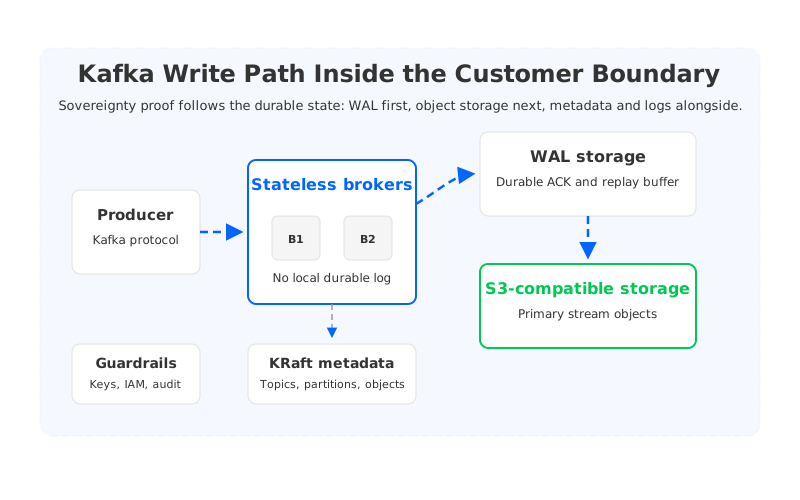
This boundary gives platform teams a sharper review model. The WAL must be inside the approved account, region, network, and key boundary because it is where acknowledged writes can be recovered. The object storage bucket must be inside the same governance story because it is the long-term source of retained records. KRaft metadata and object metadata also belong in the audit trail because they explain how a logical Kafka Partition maps to physical storage.
AutoMQ is a Kafka-compatible streaming platform built around this Shared Storage architecture. It keeps the Kafka protocol and ecosystem surface while replacing broker-local persistent storage with S3Stream, WAL storage, and S3-compatible object storage. In AutoMQ BYOC, the control plane and data plane run in the customer's environment, so the durable data path can be reviewed through the customer's cloud account, VPC, storage, and key-management controls.
5Encryption and Key Ownership Need Workload Context
Encryption claims are often stated too broadly. "Data is encrypted at rest and in transit" is necessary, but Kafka workloads need more detail. Records may be encrypted by the client, the broker storage layer, object storage, or a combination of controls. Connector secrets may use a different secret manager, and audit logs may have their own retention and encryption policy.
The key-ownership question is more important than the cipher name. Who can administer the key? Who can rotate it? Which principals can decrypt stored objects or read WAL storage? Are connector workers allowed to access source credentials across regions? Are TLS certificates issued under the customer's process, and are private endpoints or VPC paths used where the policy requires them? A Kafka platform can pass a generic encryption checklist and still fail the workload-specific ownership test.
For regulated streaming pipelines, separate application-level encryption from infrastructure-level encryption. Application-level encryption can protect selected payload fields even if infrastructure operators can read storage objects. Infrastructure-level encryption provides broad storage protection and auditability through cloud services such as KMS and object storage logs. Many teams need both, but they serve different evidence needs.
6Audit Logs Must Explain Operations, Not Just Access
Kafka sovereignty is not proven by access logs alone. Access logs show who touched an API or storage object. Operations logs explain why the system changed shape. For streaming, both matter because operational changes can alter data flow without directly reading payloads.
Consider a production cutover. A platform engineer may change bootstrap endpoints, promote a mirror topic, alter ACLs, rotate a connector secret, or update a consumer group mapping. Those steps are not equivalent to reading business records, but each can determine where records are written and where consumers resume.
The minimum evidence set should include Kafka authorization events, topic and ACL changes, connector lifecycle events, bucket access logs, key-management events, and cloud control-plane API calls. Cloud audit services such as AWS CloudTrail can record account-level API activity, while Kafka and AutoMQ runtime logs provide workload-level context. The useful audit question is whether a reviewer can follow a record, an offset, and a control action through the same incident timeline.
7Region Control Is a Runtime Discipline
Region control sounds static until the workload is under stress. A team may pin a cluster to one cloud region, but consumers, connectors, observability pipelines, and disaster recovery paths can pull state across boundaries. Long retention makes this visible because historical records may be read by a different consumer group long after they were written.
The architecture should define allowed regions for each state type. Event records and WAL storage belong in the approved data region. Connector workers should run close to their sources and sinks, using private network paths where required. Metrics and logs should be classified so customer business data, operational telemetry, and control metadata are not mixed together.
Shared storage can reduce operational friction here. Because persistent stream data is not tied to a Broker's local disk, changing compute capacity does not require the same kind of partition data movement that traditional Kafka often demands. Region placement still requires planning, but capacity changes become less likely to disturb the evidence map.
8Migration and Rollback Are Part of Sovereignty
Many sovereignty reviews focus on the target state and underinvest in the path to reach it. That is risky for Kafka because migration is not a file copy. A streaming migration must preserve partition order, keep offsets meaningful, and control when producers and consumers switch. If rollback is not tested, the organization owns the data but does not fully control the workload.
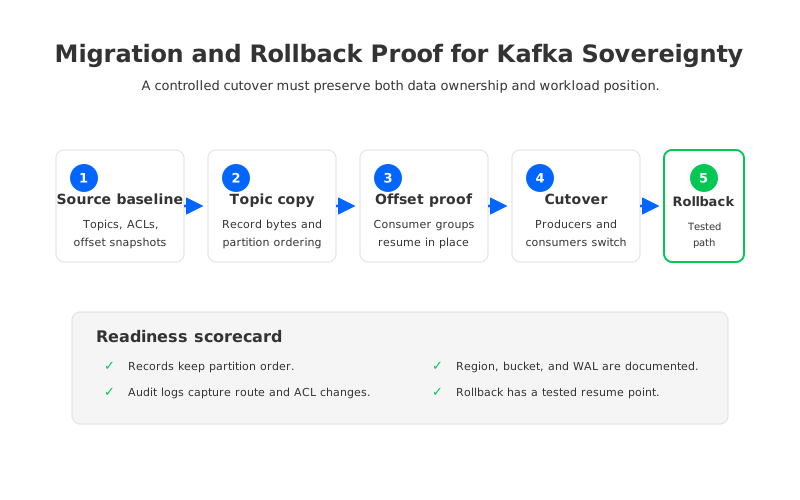
A useful migration proof has four layers: source baseline, data-copy evidence, cutover evidence, and rollback evidence. Capture topics, partitions, ACLs, retention, committed offsets, and connector state before synchronization. Then verify that copied records keep partition order, producers and consumers move under a controlled sequence, lag is observed, and the team knows where consumers resume if the target path is paused or reversed.
AutoMQ commercial editions provide Kafka Linking for migration scenarios that need byte-to-byte topic synchronization and offset consistency from Kafka-compatible source clusters. The feature is relevant because it turns migration proof into a workload-level artifact rather than an after-the-fact explanation. Whatever migration tool you choose, do not sign off until records, offsets, identities, connector state, and rollback have all been tested.
9A Decision Framework for Platform Teams
Evaluate Kafka sovereignty across state boundaries instead of vendor categories. A self-managed cluster can have weak evidence if offsets and connector state are unmanaged. A managed deployment can have strong evidence if the data plane, storage, keys, logs, and migration paths are demonstrably under customer control.
Use these questions before selecting or approving a platform:
- Can we identify where every acknowledged record is durable before and after it is flushed to long-term storage?
- Can we prove where committed offsets, consumer group progress, transaction state, and connector checkpoints live?
- Can we show that encryption keys, IAM roles, certificates, and secret stores are owned or governed by the customer?
- Can we reconstruct topic changes, ACL changes, migration actions, bucket access, and key usage from audit logs?
- Can we move a workload and roll it back while preserving record ordering and consumer resume points?
- Can we change compute capacity without forcing broad data movement that invalidates the evidence map?
These questions shift the conversation from "is this BYOC?" to "can this workload be governed?" That test connects legal intent to the mechanics of Kafka.
10Where AutoMQ Fits in the Evaluation
AutoMQ fits when the desired operating model is Kafka-compatible streaming with customer-controlled deployment boundaries and shared storage. Its architecture separates compute from storage, uses stateless brokers, writes through WAL storage for durable acknowledgment, and stores persistent stream data in S3-compatible object storage. For teams evaluating data sovereignty architecture for Kafka, the durable data boundary can be tied to customer-owned storage, region controls, and key-management policies rather than broker-local disks.
That fit is strongest when the workload also needs elastic capacity, long retention, cloud object storage economics, or migration without application changes. It is less about replacing governance work and more about making that work observable.
If your team is reviewing Kafka sovereignty for a production migration, build the evidence map before the platform decision. Validate the write path, storage boundary, key policy, audit trail, region placement, and rollback procedure against the workload that matters most. To see how AutoMQ BYOC handles customer-controlled Kafka-compatible deployments, start with the AutoMQ BYOC console.
11References
- Apache Kafka documentation: concepts, offsets, consumer groups, and configuration
- Apache Kafka documentation: Kafka Connect
- Apache Kafka documentation: KRaft
- AutoMQ documentation: Architecture overview
- AutoMQ documentation: WAL storage in S3Stream
- AutoMQ documentation: Migration overview and Kafka Linking
- AWS documentation: Using server-side encryption with AWS KMS keys in Amazon S3
- AWS documentation: AWS CloudTrail user guide
12FAQ
12.1Is BYOC the same as data sovereignty for Kafka?
No. BYOC is a deployment boundary. Kafka sovereignty also needs workload evidence: where records, offsets, connector state, WAL storage, object storage, keys, audit logs, and migration state live.
12.2Why are offsets part of sovereignty?
Offsets decide where consumers resume. If migration or rollback loses offset continuity, the team may reprocess records, skip records, or fail to explain which events were consumed.
12.3Does object storage automatically solve Kafka sovereignty?
No. Object storage helps because it provides a durable, customer-owned storage boundary with native encryption and audit controls. The architecture still needs a clear WAL design, metadata governance, access policy, connector-state handling, and rollback.
12.4What should be tested before a regulated Kafka migration?
Test topic synchronization, partition ordering, consumer group resume points, connector checkpoints, ACL migration, key access, audit logs, and rollback.


