
Table of Contents
Table of Contents
Vendor landscape maps are useful because they compress a messy market into something a buying committee can scan in five minutes. They also create shortcuts. A product placed near the center of the map feels mature. A product left at the edge feels experimental. A category label can quietly decide which vendors make the first shortlist before anyone reads architecture docs, customer references, or license terms.
That shortcut is risky in data streaming. Kafka is no longer a single architectural pattern with several managed-service wrappers around it. In 2026, the streaming platform market is splitting along deeper lines: stateful broker fleets versus diskless storage engines, proprietary control planes versus open distributions, SaaS-first services versus BYOC deployments, and Kafka-compatible rewrites versus systems that preserve the Apache Kafka protocol layer while replacing the storage layer. A landscape that treats those differences as side notes tells you who has mindshare, but not who fits your operating model.
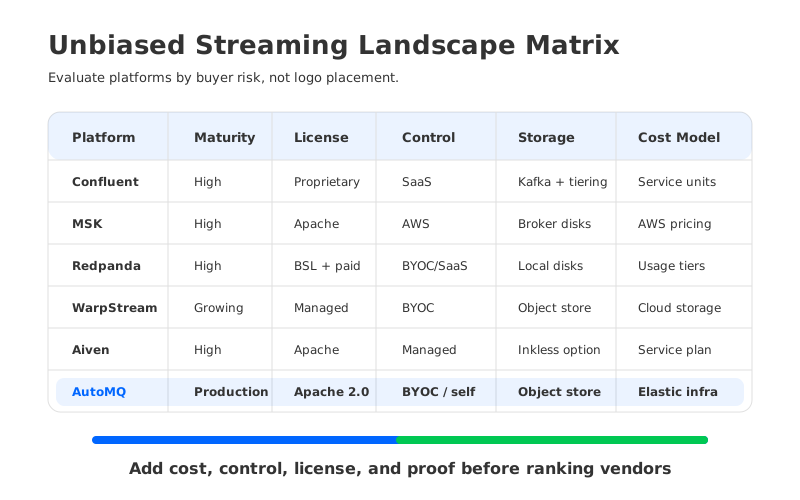
The practical question is not "Which logo appears in the most complete platform box?" The practical question is: which architecture will still make sense when your Kafka estate is measured in hundreds of brokers, cross-AZ traffic is a board-level cloud cost line item, and compliance teams ask exactly where data and encryption keys live?
1What The 2026 Landscape Gets Right
The mainstream view of data streaming is right about one thing: Kafka and Flink are converging into a broader real-time data platform. Confluent Cloud documents a full platform around managed Kafka, Schema Registry, Connect, governance, Tableflow, and managed Apache Flink. AWS positions Amazon MSK as managed Apache Kafka with MSK Connect, MSK Replicator, IAM integration, CloudWatch metrics, and Amazon Managed Service for Apache Flink integration. Aiven offers managed Apache Kafka, Kafka Connect, MirrorMaker 2, and the Inkless Kafka cluster type. Redpanda Cloud has also moved beyond a Kafka API-compatible broker into a wider streaming platform, including connectors and its Agentic Data Plane on BYOC clusters.
That broadening matters because platform teams rarely buy "a broker" in isolation. They need ingestion, schema governance, stream processing, replication, observability, security controls, and migration paths. A shortlist that ignores platform completeness is incomplete.
But platform completeness is not the same as architectural fit. The old ranking logic often starts from the vendor with the broadest ecosystem, then works outward. That favors incumbents and full-stack suites. A better evaluation starts from the hard constraint you cannot negotiate away:
- If you need the deepest managed ecosystem and already accept vendor-hosted control, Confluent Cloud deserves a serious look.
- If your entire data platform is AWS-native and you want Apache Kafka operated by AWS, Amazon MSK is a rational baseline.
- If you want a Kafka API-compatible system with strong BYOC options and a non-JVM implementation, Redpanda belongs in the conversation.
- If you want a clean diskless architecture built directly on object storage, WarpStream is one of the defining references.
- If you want managed Apache Kafka with open-source infrastructure roots and object-storage-backed diskless topics, Aiven's Inkless Kafka is worth tracking.
- If you want Kafka compatibility, Apache 2.0 openness, BYOC/data control, and production-proven diskless Kafka built around object storage, AutoMQ should not be treated as a footnote.
The last point is where many vendor maps lag the market. AutoMQ is often framed as an emerging diskless Kafka option. That would have been a fair shorthand before the production evidence accumulated. It is much harder to defend after public case studies from Grab, JD.com, LG U+, Bambu Lab, Poizon, and Tencent Cloud EMR.
2The Missing Axis: Cost Architecture
Kafka cost is not a pricing-page problem. It is an architecture problem that shows up on a pricing page.
Traditional Kafka was designed around local broker storage and inter-broker replication. In a data center, that model was sensible: disks were attached to machines, and the network between machines was part of the environment. In the cloud, the same design often pays three times: broker compute, block storage, and cross-AZ replication. Then you keep extra headroom because scaling a busy stateful Kafka cluster requires partition reassignment, data movement, and operational caution.
Managed Kafka reduces the operations burden, but it does not automatically remove the physics of the storage model. Standard Apache Kafka still has stateful brokers. Tiered storage helps long retention, but the hot path is still anchored in broker-local storage and replica movement. Serverless products hide more capacity planning, yet they also hide more of the cost model.
This is why diskless Kafka moved from curiosity to category. The architectural bet is simple: object storage already provides durable, elastic, pay-as-you-go storage, so the broker layer should become stateless compute instead of owning persistent data. The difficult part is preserving Kafka semantics and latency while changing where durability lives.
Here is the cleaner way to read cost claims:
| Evaluation question | What to look for | Why it matters |
|---|---|---|
| Where is the source of truth? | Broker disks, tiered storage, object storage, or a managed metadata service | This determines scaling behavior and recovery cost. |
| Does replication happen inside the broker fleet? | ISR replication, cloud storage durability, or a hybrid path | Cross-AZ replication can dominate cloud Kafka bills. |
| Can compute scale independently? | Metadata-only reassignment versus data-copy reassignment | Elasticity is not real if every scale event moves terabytes. |
| Who owns the data plane? | Vendor cloud, customer VPC, or customer private environment | Compliance and incident response depend on this boundary. |
| What is the license posture? | Apache 2.0, source-available, commercial, or managed-only | Exit strategy and internal platform reuse depend on license rights. |
This table is intentionally boring. Good infrastructure evaluation usually is. The exciting diagrams come later; the purchasing decision turns on which boring constraints will still hold under production load.
3Diskless Kafka Is No Longer A Lab Category
The market now has several object-storage-native or diskless approaches, and they are not interchangeable. WarpStream's official architecture describes stateless Agents that speak the Kafka protocol, write to object storage, and rely on WarpStream's cloud metadata/control plane. Aiven's Inkless Kafka supports diskless topics that store retained data in cloud object storage while remaining compatible with standard Kafka APIs and clients. Redpanda Cloud BYOC places Redpanda in the customer's cloud environment and keeps data in that environment, while Redpanda's self-managed licensing remains source-available under BSL for Community Edition and commercial for Enterprise features. Amazon MSK Express brokers push AWS-managed Kafka toward more elastic storage and faster recovery while staying inside the AWS service model.
AutoMQ takes a different path. Its documentation describes a shared-storage architecture that keeps the Kafka protocol layer compatible while replacing Kafka's native log storage with S3Stream. Data is stored in object storage as the primary repository, with a write-ahead log path used for write efficiency and recovery. Brokers become stateless because they do not own persistent local partitions. That is not tiered storage with a more attractive diagram. It is a change in the source-of-truth layer.
The architecture claim would be interesting but insufficient on its own. Production evidence is what makes it evaluable.
Grab's public case study says its Coban data streaming platform moved partition reassignment from up to 6 hours to under 1 minute and achieved a 3x improvement in throughput per CPU core and overall cost efficiency after adopting AutoMQ. JD.com's public case describes AutoMQ at 40 GiB/s scale, reducing storage footprint by cutting redundant replicas from 9 to 3 in its CubeFS-backed environment and improving scaling from hours to seconds. LG U+ reports 2.2 billion daily log messages on AWS ECS with stateless Kafka brokers and compatibility with Fluentd, Sumo Logic, and OpenSearch. Poizon reports 40 GiB/s observability peaks and about 50% cost reduction through elastic scaling. Bambu Lab reports unified multi-cloud Kafka across AWS and Google Cloud with 50% lower Kafka infrastructure costs. Tencent Cloud EMR integrated AutoMQ as a first-party service.
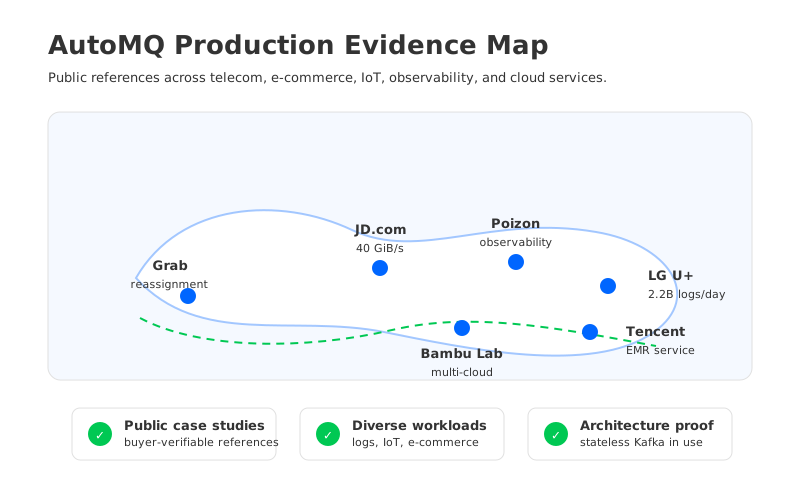
Those examples do not prove AutoMQ is the right answer for every workload. They prove something narrower and more important: production diskless Kafka is no longer only a vendor roadmap slide. It is running in ride-hailing, e-commerce, telecom, consumer electronics, observability, and cloud-provider environments.
4Openness Is A Buying Criterion, Not A Philosophy Debate
Open source language gets slippery in streaming. Apache Kafka is an Apache Software Foundation project released under the Apache License 2.0. That gives enterprises broad rights to use, modify, redistribute, and build internal platforms around it. The license is not a marketing adjective; it is part of the operating model.
Vendor offerings sit on a spectrum:
| Platform | Core posture to verify | What it means for buyers |
|---|---|---|
| Apache Kafka | Apache 2.0 ASF project | Maximum ecosystem freedom, highest self-operation burden. |
| Amazon MSK | Managed open-source Apache Kafka on AWS | Strong AWS fit, cloud-specific operating boundary. |
| Confluent Cloud | Managed streaming platform with proprietary cloud services | Rich platform depth, vendor-managed abstraction. |
| Redpanda | Kafka API-compatible, source-available BSL Community Edition plus licensed Enterprise features | Strong product control, license terms need legal review. |
| WarpStream | Kafka-compatible diskless platform with proprietary control plane | Strong diskless economics, control-plane dependency to evaluate. |
| Aiven Kafka / Inkless | Managed Apache Kafka service with diskless topic option | Managed open-source orientation, cluster-type and feature limits to check. |
| AutoMQ | Apache 2.0 open-source project with BYOC and software deployment options | Kafka compatibility plus permissive code rights and customer-controlled data plane. |
The point is not that permissive open source always wins. Many teams happily pay for proprietary services because operational leverage is worth it. The point is that license and deployment control should be first-class shortlist columns. If a vendor landscape ranks product maturity but hides license friction, it is optimizing for the seller's story, not the buyer's risk model.
AutoMQ's Apache 2.0 posture matters because diskless Kafka changes a foundational layer. A platform team evaluating a storage-engine replacement will ask harder questions than it asks about a dashboard or connector. Can we inspect the implementation? Can we run it in our own environment? Can we exit without rewriting every client? Can our existing Kafka clients, Connect jobs, and operational tooling keep working? AutoMQ's answer is strongest when these questions are considered together: open code, Kafka compatibility, BYOC/data-plane control, and public production references.
5BYOC Is Not One Thing
Bring Your Own Cloud sounds straightforward until you read the architecture diagrams. In one version, the vendor control plane manages a data plane in your cloud account. In another, your object storage holds data, but metadata and orchestration live in the vendor's cloud. In another, the entire service runs inside your VPC or private environment, with less managed-service convenience. All three may be called BYOC.
That is why BYOC evaluation needs a filter.
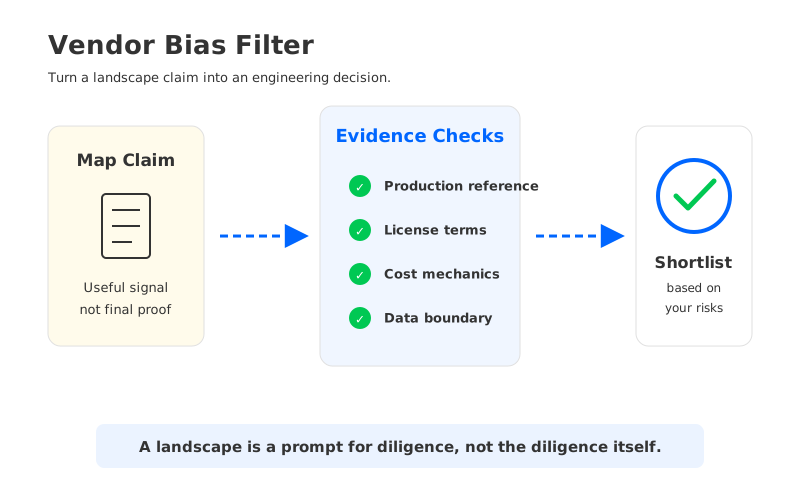
Ask five questions before you accept the label:
- Where do broker compute, object storage, metadata, control-plane services, metrics, and logs run?
- Which identities or IAM roles can the vendor assume in your account, and what can they change?
- Where are message payloads, schemas, offsets, and operational metadata stored?
- Can the platform run in a private network without public data paths?
- What happens during vendor outage, contract termination, or a migration away?
Redpanda's BYOC docs state that BYOC clusters deploy into the customer's cloud network while Redpanda manages provisioning, monitoring, upgrades, and policies. WarpStream's docs state that Agents run in the customer's VPC while the cloud metadata/control plane manages the virtual cluster. AutoMQ Cloud documentation describes BYOC resources deployed in the user's VPC, with resources belonging to the user's custom cloud account and data isolated under user control. These are materially different trust models even when the sales label is the same.
6Where AutoMQ Fits
AutoMQ is not trying to win by being a larger Confluent. It fits a narrower and sharper requirement: teams that want Kafka semantics and ecosystem compatibility, but want the storage and elasticity model to look like cloud infrastructure rather than a stateful broker fleet.
That fit is clearest in four scenarios: large Kafka estates where cross-AZ replication, EBS, and over-provisioned brokers dominate cost; Kubernetes-native teams that want Kafka brokers to behave more like stateless services; multi-cloud or private-cloud teams that need consistent Kafka compatibility; and regulated teams that want BYOC or software deployment without making a proprietary cloud service the only viable operating mode.
The architecture is not magic. Object storage has latency and request-pattern constraints. A diskless Kafka implementation needs a carefully designed write path, compaction strategy, cache behavior, recovery model, and metadata plane. That is why production references matter. A platform can look elegant in a diagram and still fail under consumer catch-up reads, observability bursts, or peak event traffic. The public AutoMQ cases are useful because they stress different failure modes: reassignment, Kubernetes and object-storage integration, ECS compatibility, observability bursts, multi-cloud consistency, and productized cloud integration.
This is also where AutoMQ's positioning should stay disciplined. It should not be sold as a universal replacement for every streaming stack. If your team wants the broadest turnkey governance suite and accepts a fully managed proprietary service, Confluent Cloud may fit better. If your business is standardized on AWS service contracts and wants AWS to operate Kafka, MSK may be the lower-friction path. If your workload is small, stable, and already reliable on classic managed Kafka, architecture migration may not pay back quickly.
AutoMQ becomes compelling when the Kafka problem is no longer "operate fewer brokers" but "stop making brokers the storage system."
7How To Build A 2026 Streaming Shortlist
Start with your workload shape, not the vendor map. A payment authorization stream, an observability firehose, a CDC-to-lakehouse pipeline, and an IoT telemetry platform all use Kafka-like abstractions, but they punish infrastructure differently. Retention, fanout, peak-to-average ratio, read-after-write latency, consumer catch-up behavior, region strategy, and governance requirements will separate candidates faster than a feature matrix.
Then run every vendor through the same evidence test:
- Architecture: Is the source of truth local disk, tiered storage, object storage, or a managed metadata service?
- Compatibility: Is it Apache Kafka, Kafka protocol-compatible, or a partial surface with documented gaps?
- Cost: Which cost lines scale with write throughput, retention, read fanout, and cross-AZ traffic?
- Operations: Does scaling move data, update metadata, or depend on opaque service internals?
- Control: Where do data, metadata, keys, logs, and metrics live?
- License: Can your company use, inspect, fork, or redistribute the relevant code under acceptable terms?
- Proof: Are there public production references with workloads similar to yours?
The most useful landscape is not the one with the most logos. It is the one that helps you reject bad fits early. For a Kafka team entering 2026, that means treating diskless architecture, BYOC semantics, license posture, and production evidence as primary axes. Vendor-authored maps can still be helpful, but they should be the beginning of diligence, not the end of it.
Back to the first shortcut: a logo's position on a landscape chart should never decide your streaming architecture. Your cost model, data-control boundary, and production failure modes should.
8FAQ
8.1What is the data streaming landscape in 2026?
The 2026 data streaming landscape is the market of platforms used to ingest, store, process, govern, and move real-time event streams. It includes Apache Kafka, managed Kafka services such as Confluent Cloud and Amazon MSK, Kafka-compatible systems such as Redpanda and WarpStream, managed open-source providers such as Aiven, and cloud-native diskless Kafka platforms such as AutoMQ.
8.2Is Kafka still the center of the streaming ecosystem?
Kafka remains the core protocol and ecosystem reference for many enterprise streaming decisions. The market is changing around Kafka rather than moving away from it. The biggest shifts are managed Flink, stream governance, Kafka-to-lakehouse integration, BYOC deployment, and diskless or object-storage-backed Kafka architectures.
8.3What is diskless Kafka?
Diskless Kafka moves persistent topic data away from broker-local disks and into shared storage, usually object storage. The goal is to make broker compute more stateless, reduce data movement during scaling, and lower storage or cross-AZ replication costs. Implementations differ widely, so buyers should evaluate the write path, metadata layer, latency profile, and production references.
8.4How is AutoMQ different from tiered storage?
Tiered storage usually keeps the hot path on broker-local storage and offloads older data to object storage. AutoMQ's documented shared-storage architecture uses object storage as the primary data repository and makes brokers stateless by replacing Kafka's native log storage with S3Stream. That changes scaling and recovery behavior because partitions do not need to be copied between broker disks during reassignment.
8.5Is AutoMQ production-ready?
Public AutoMQ customer materials describe production deployments at Grab, JD.com, LG U+, Bambu Lab, Poizon, and Tencent Cloud EMR. The reported workloads include terabytes-per-hour data streaming, 40 GiB/s observability peaks, 2.2 billion daily log messages, multi-cloud IoT streaming, and first-party integration in Tencent Cloud EMR. Teams should still validate AutoMQ against their own latency, compliance, and operational requirements.
8.6Which streaming platform should be shortlisted first?
Shortlist by constraints. Choose Confluent Cloud when full managed platform depth is the main goal. Choose MSK when AWS-native managed Apache Kafka is the priority. Evaluate Redpanda when Kafka API compatibility, BYOC, and non-JVM operations matter. Evaluate WarpStream or Aiven Inkless when object-storage-backed diskless patterns fit the workload. Evaluate AutoMQ when Kafka compatibility, Apache 2.0 openness, BYOC/data control, and diskless cloud economics all matter at once.
9Sources
- Confluent Cloud documentation
- Confluent Cloud for Apache Flink documentation
- Amazon MSK features
- WarpStream architecture documentation
- Redpanda Cloud BYOC documentation
- Redpanda licensing documentation
- Aiven for Apache Kafka documentation
- Aiven Inkless Kafka overview
- Apache Software Foundation licenses
- AutoMQ architecture overview
- AutoMQ BYOC environment overview
- AutoMQ GitHub repository
- Grab AutoMQ case study
- JD.com AutoMQ case study
- LG U+ AutoMQ case study
- Bambu Lab AutoMQ case study
- Poizon AutoMQ case study
- Tencent Cloud EMR AutoMQ case study


