
Table of Contents
Table of Contents
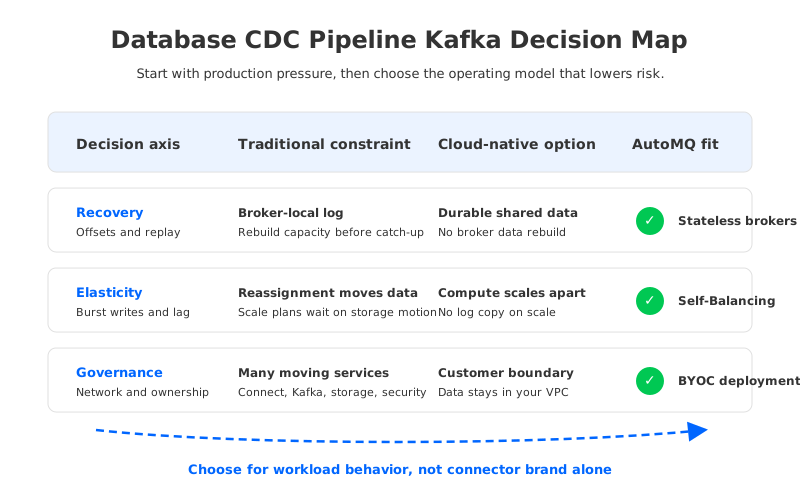
Searches for database cdc pipeline kafka usually start after a team has already built the first version. The connector is reading a database transaction log, Kafka is receiving row-level changes, and downstream systems are consuming topics. Then production adds the harder questions: who owns replay, how much retention is enough, what happens when a connector stalls, and whether the Kafka layer can scale without turning every recovery event into a storage operation.
The phrase looks like a tooling query, but the real problem is architectural. A database CDC pipeline has at least three stateful surfaces: the source database log, the connector state and schema history, and the Kafka commit log that downstream consumers treat as the durable handoff point. If any one of those surfaces drifts from the others, the pipeline can keep running while quietly losing the operational properties that made CDC attractive in the first place. The platform decision is therefore not "which connector can read MySQL or PostgreSQL?" It is "which Kafka-compatible operating model keeps change streams recoverable when the workload stops behaving like a demo?"
1Why Teams Search for database cdc pipeline kafka
Database Change Data Capture (CDC) is appealing because it lets teams turn committed database changes into event streams without polling tables or scheduling nightly export jobs. Tools such as Debezium commonly run through Kafka Connect, tail database logs, and publish change events into Kafka topics. Apache Kafka then becomes the shared buffer between source systems, stream processors, operational services, lakehouse ingestion, search indexes, and analytics consumers.
That separation is useful, but it also creates a new platform boundary. The database team cares about log retention and source load. The data integration team cares about connector tasks, schema evolution, and dead-letter handling. The Kafka team cares about partitions, consumer groups, offsets, storage growth, replication, and broker failures. A CDC pipeline crosses all of those teams, so production readiness depends on more than connector configuration.
Three pressures usually bring the architecture question to the surface:
- Replay becomes a product requirement. Downstream teams ask for backfills, reprocessing, or late consumer onboarding, which increases Kafka retention and changes storage economics.
- Write bursts are not evenly distributed. A database migration, bulk update, or high-traffic business event can push more changes through a small set of topics than normal traffic planning expected.
- Recovery has to preserve ordering and offsets. Consumer groups depend on offsets, and platform teams need a cutover plan that does not force every consumer to rediscover its position.
At this point, Kafka compatibility matters because the ecosystem is the reason the pipeline exists. Existing producers, consumers, Kafka Connect workers, stream processors, and operations tooling should not need a rewrite because the underlying streaming platform changes. Compatibility, however, is the entry ticket. It does not answer whether the platform can absorb retention growth, replay traffic, and multi-Availability Zone (AZ) failure recovery at an acceptable operating cost.
2The Production Constraint Behind the Problem
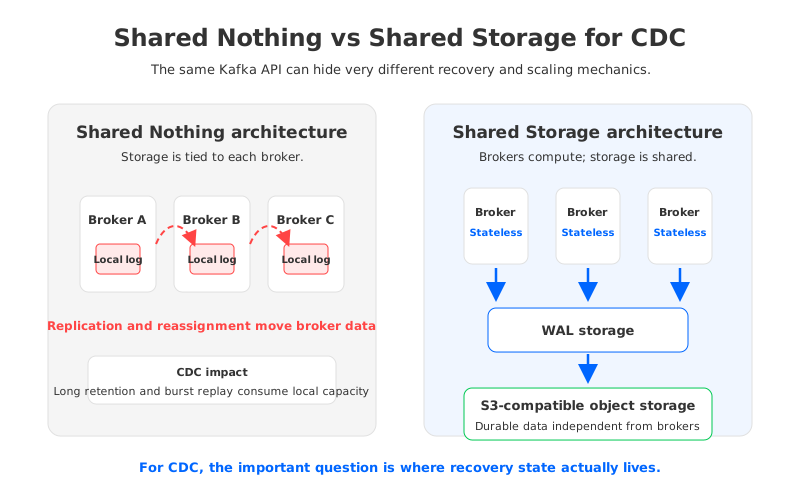
Traditional Kafka uses a Shared Nothing architecture. Each broker owns local storage for the partitions it hosts, and durability is achieved through replication between brokers. This model is proven and well understood, and for many workloads it remains a practical choice. Its constraint in cloud CDC environments is that data placement, broker lifecycle, capacity planning, and recovery are tightly coupled.
CDC workloads amplify that coupling because they are both write-sensitive and replay-sensitive. The write path must keep up with database change volume, and the read path must support consumers that may lag, restart, or backfill. Longer retention increases the amount of data tied to broker-local storage. Partition reassignment can become a data movement exercise. Scaling out is no longer only about adding compute; it may also mean redistributing large logs before the new capacity is useful.
Tiered Storage changes part of this equation by moving older Kafka log segments to remote storage while keeping the active log on broker-attached storage. That is a meaningful improvement for long retention, especially when cold data dominates the cost profile. It does not fully remove broker-local storage from the operating model, because active segments and recovery mechanics still depend on the primary storage layer. For CDC teams, the distinction matters: the difficult moments are often the hot path moments, not only the historical replay moments.
The production constraint can be summarized this way:
| Decision area | What CDC needs | What can go wrong |
|---|---|---|
| Source capture | Read committed changes without overloading the database | Database log retention expires before the connector catches up |
| Kafka durability | Preserve ordered change events for consumers and replay | Broker storage fills or reassignment becomes a data-copy operation |
| Consumer recovery | Let teams resume from known offsets | Cutover or rollback changes offsets without a mapping plan |
| Governance | Keep data paths, credentials, and audit controls clear | Connector operations become an unowned shared service |
The table is deliberately platform-neutral. A strong CDC architecture starts by making these failure modes explicit. Once the failure modes are visible, the streaming platform can be evaluated on the work it removes from the recovery path.
3Architecture Options and Trade-Offs
Most production teams end up comparing four broad options. Self-managed Kafka gives maximum control, but the platform team owns broker sizing, upgrades, storage, rebalancing, Kafka Connect operations, and incident response. A managed Kafka service reduces some infrastructure work, but teams still need to understand how networking, storage, connector management, and migration boundaries behave. A managed CDC product can simplify source capture, yet it may introduce a separate control plane, pricing model, or data movement boundary. A Kafka-compatible cloud-native platform tries to keep the Kafka API while changing the storage and operations model underneath.
The right answer depends on the constraint you are optimizing. If the pipeline is small, predictable, and owned by one team, self-managed Kafka plus Debezium and Kafka Connect can be a reasonable path. If the organization has many sources, many consumers, strict network boundaries, and unpredictable replay needs, the storage and scaling model deserves more attention than the connector catalog. The connector gets data into the stream; the platform keeps the stream usable during failure, growth, and migration.
A practical evaluation should separate API compatibility from operational compatibility. API compatibility asks whether existing Kafka clients, Kafka Connect connectors, serializers, Schema Registry usage, and consumer group behavior continue to work. Operational compatibility asks whether the team can keep its runbooks, observability, access controls, network design, and rollback procedures simple enough to trust under pressure.
There is a subtle trap here. CDC projects often treat Kafka as a neutral pipe, then discover that the pipe is the system of record for every downstream consumer. The more teams depend on the stream, the less acceptable it becomes to manage Kafka storage as an implementation detail. Storage placement controls replay, recovery, scaling, and cost. That is why architecture belongs in the first production review, not in the post-incident review.
4Evaluation Checklist for Platform Teams
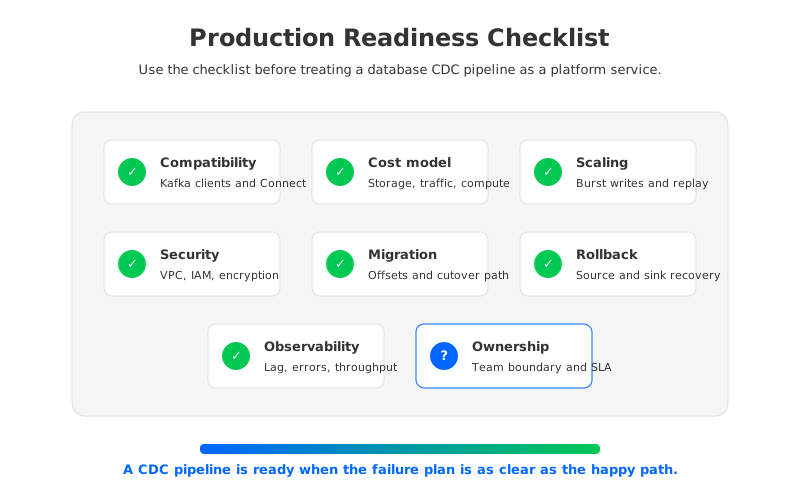
Before choosing a platform for a database CDC pipeline Kafka architecture, run the evaluation against the behavior you need in production. A checklist is more useful than a generic feature matrix because it forces the team to name the owner, failure mode, and rollback path for each decision.
Use these questions as the first pass:
- Compatibility: Can the platform run existing Kafka clients, Kafka Connect workloads, serializers, consumer groups, and monitoring integrations without application changes?
- Durability and recovery: Where does durable stream data live, and what has to move when a broker fails, scales, or is replaced?
- Retention and replay: Can the platform support the required retention window without turning every backfill into a broker capacity event?
- Network boundary: Do database changes, connector traffic, Kafka traffic, and object storage access stay inside the intended VPC or private network?
- Migration: Can the team preserve topic names, offsets, schema behavior, and rollback options during cutover?
- Operations ownership: Who patches connector workers, manages credentials, responds to lag, and validates end-to-end freshness?
The strongest signal is not a yes/no answer to each question. It is whether the answers are owned by the same team that will be paged when the pipeline stalls. A CDC platform that looks clean in an architecture diagram can still fail organizationally if database log retention belongs to one team, Kafka retention belongs to another, and connector error handling belongs to nobody.
5How AutoMQ Changes the Operating Model
Once the neutral framework is clear, AutoMQ becomes relevant as a Kafka-compatible streaming platform with a Shared Storage architecture. It keeps Kafka protocol and API compatibility as the surface that applications see, while moving persistent stream data away from broker-local disks and into S3-compatible object storage through S3Stream and WAL (Write-Ahead Log) storage.
That architectural shift changes the CDC operating model in a specific way: brokers become primarily compute nodes rather than long-lived homes for partition data. In traditional Kafka, a broker replacement or partition reassignment is closely tied to the data that lives on broker storage. In AutoMQ, durable data is stored in shared object storage, and WAL storage acts as a low-latency durability layer for fresh writes and recovery. The platform can change broker ownership and balance traffic without treating every operation as a large data copy.
For database CDC pipelines, this matters in several places. Write bursts can be handled by scaling compute capacity without pre-provisioning broker disks for every possible replay scenario. Long retention can be mapped to object storage economics instead of broker-local storage expansion. Recovery planning can focus on connector state, database log availability, and consumer offsets rather than also waiting for large broker-local logs to move. The result is not that CDC becomes effortless. The result is that fewer production tasks are blocked by where Kafka data happens to sit.
AutoMQ BYOC is also relevant for teams that treat data movement boundaries as a governance requirement. In BYOC (Bring Your Own Cloud), the control plane and data plane run in the customer's cloud account and VPC, so CDC traffic and stored stream data can remain inside customer-controlled infrastructure. AutoMQ Managed Connector adds a managed Kafka Connect operating layer in that environment, which can reduce the burden of deploying and operating connector workers while keeping the Kafka-compatible architecture intact.
This does not remove the need for careful CDC design. Teams still need source database log retention, schema evolution rules, connector restart policy, dead-letter handling, consumer lag alerts, and a tested migration plan. AutoMQ's role is narrower and more concrete: it changes the storage and broker lifecycle assumptions under the Kafka-compatible layer, so platform teams can design CDC around shared durability, stateless brokers, and cloud-native scaling instead of broker-local storage motion.
6Migration and Readiness Scorecard
The safest migration plan treats CDC as a state alignment problem, not a traffic switch. First, inventory every topic, connector, schema dependency, consumer group, retention policy, and downstream SLA. Then decide which state must be identical after cutover and which state can be rebuilt. Offsets, schema history, and source log position deserve special attention because they define whether consumers can resume cleanly.
A readiness scorecard should include five gates:
- Source gate: The database log retention window is longer than the expected connector outage and backfill time.
- Connector gate: Connector configuration, secrets, schema history, and task restart behavior are reproducible.
- Kafka gate: Topics, partition counts, retention settings, ACLs, and consumer groups are mapped before cutover.
- Validation gate: Freshness, duplicate handling, ordering assumptions, and row-count reconciliation are measured.
- Rollback gate: The team knows when to roll back, how to stop writes, and how to prevent consumers from reading mixed streams.
This scorecard is intentionally boring. Production CDC rewards boring preparation. The more exciting the platform promise sounds, the more important it is to test the unglamorous parts: stalled connectors, expired source logs, consumer replay, schema incompatibility, and partial cutover.
The search query was database cdc pipeline kafka, but the decision is not about a single pipeline. It is about whether change streams can become a shared production substrate without forcing every future incident to rediscover the same storage, offset, and ownership questions. If you want to evaluate a Kafka-compatible platform for CDC with Shared Storage architecture, BYOC deployment boundaries, and managed connector operations, start with AutoMQ Cloud.
7FAQ
7.1Is Kafka required for database CDC pipelines?
No. CDC can be delivered through several architectures, including direct replication tools and managed data integration platforms. Kafka is useful when multiple teams need a durable stream, independent consumers, replay, stream processing, or a Kafka-compatible ecosystem boundary.
7.2What is the biggest production risk in CDC pipelines?
The biggest risk is usually state drift between the source database log, connector state, Kafka offsets, and downstream consumers. When those states are not aligned, a pipeline can recover technically but still produce duplicates, gaps, or consumer confusion.
7.3Does Tiered Storage solve CDC retention cost?
Tiered Storage can reduce pressure from historical data by offloading older log segments to remote storage. It does not fully remove broker-local storage from the active log and recovery model, so teams should still evaluate hot-path writes, broker replacement, and scaling behavior.
7.4Where does AutoMQ fit in a CDC architecture?
AutoMQ fits at the Kafka-compatible streaming platform layer. It can run Kafka-compatible clients and ecosystem tools while using Shared Storage architecture, stateless brokers, and object-storage-backed durability to change the operating model for retention, scaling, and recovery.
7.5Should the connector platform and Kafka platform be owned by the same team?
Not always, but the ownership boundary must be explicit. At minimum, one runbook should connect database log retention, connector lag, Kafka topic retention, consumer group recovery, and rollback decisions.
8References
- Apache Kafka documentation
- Apache Kafka Connect documentation
- Apache Kafka message delivery semantics and transactions
- Apache Kafka KRaft documentation
- Apache Kafka Tiered Storage documentation
- Debezium documentation
- AutoMQ architecture overview
- AutoMQ compatibility with Apache Kafka
- AutoMQ S3Stream WAL storage
- AutoMQ Managed Connector documentation
- AutoMQ Table Topic configuration


