
Table of Contents
Table of Contents
Debezium Kafka projects rarely begin as platform architecture projects. They start with a practical request: stream database changes into Kafka so downstream systems can react without polling tables, copying nightly batches, or wiring every service directly to a production database. A team deploys Kafka Connect, runs a Debezium connector, creates topics for changed rows, and proves that change data capture can move application state into analytics, search, caches, lakehouse tables, or event-driven services.
The architecture becomes harder when that first pipeline becomes a dependency. A delayed connector can make inventory stale. A lost schema history topic can turn recovery into a database incident. A snapshot can compete with OLTP traffic. A Kafka retention setting that was fine for one table can become expensive when hundreds of tables emit updates all day. At that point, Debezium is no longer only a connector choice. It is part of a CDC platform that needs capacity planning, recovery design, and storage economics.
The right question is not whether Debezium works with Kafka. It does, and it is widely used for that reason. The sharper question is whether the surrounding Kafka, Connect, schema, retention, and recovery architecture can keep up after CDC becomes production-critical.
1Why CDC Pipelines Become Production-Critical
CDC feels lightweight because it avoids the obvious pain of batch extraction. Debezium reads database transaction logs or equivalent change streams and emits structured change events. Consumers can then build projections, update search indexes, feed stream processors, or land data into analytical systems with lower freshness delay.
That pattern changes the ownership model. The source database team still owns permissions, log retention, and schema changes. The data platform team owns Kafka Connect, connector configuration, internal Connect topics, Kafka topics, serialization, and replay. Application teams own the consumers that rely on those records. A CDC incident can cross all three groups before anyone agrees where the failure lives.
Three forces usually turn a Debezium Kafka pipeline into shared infrastructure:
- More tables become sources, which multiplies topics, schemas, and connector tasks.
- More consumers depend on the same changes, which raises the value of replay and retention.
- More operational events overlap, including snapshots, database failovers, connector restarts, consumer lag, and broker maintenance.
When CDC becomes central to order processing, fraud detection, user personalization, or operational analytics, these stop being separate issues and become one architecture problem.
2The Debezium-Kafka Architecture Components
A Debezium Kafka architecture has more moving parts than the phrase "CDC to Kafka" suggests. The source database exposes a change stream. The Debezium connector reads it and maintains position. Kafka Connect runs connector tasks and stores state in Kafka. Kafka topics hold table-level change events, schema history, connector offsets, and task status. Consumers read those topics and commit their own offsets.
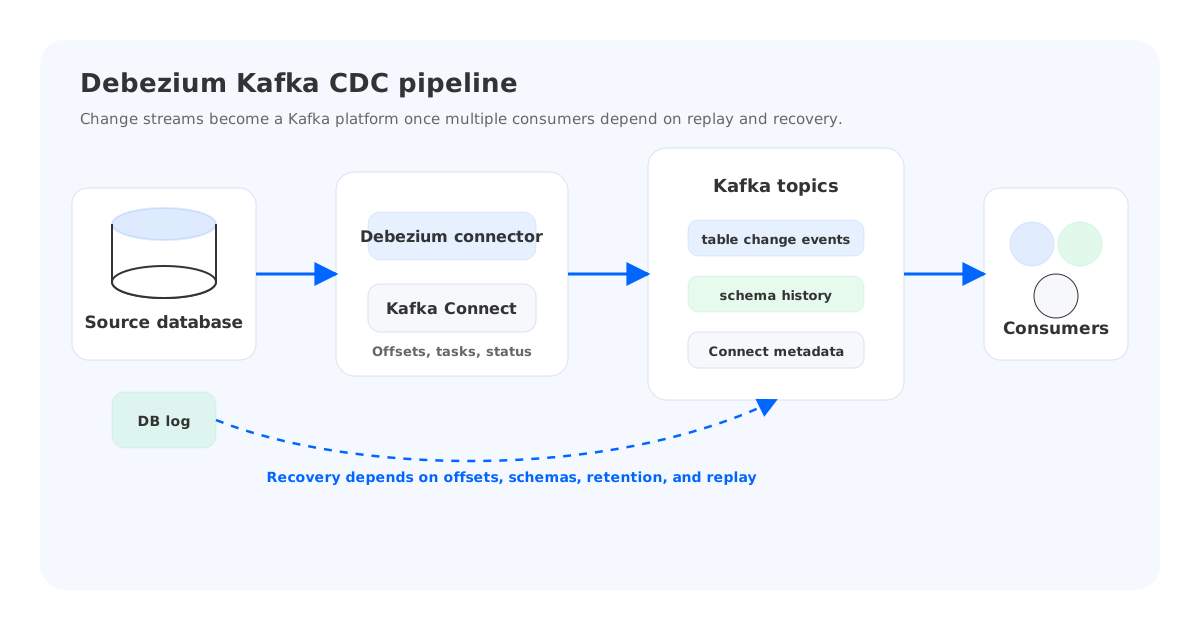
The high-level flow is straightforward:
- The database records committed changes in a transaction log or equivalent change stream.
- Debezium performs an initial snapshot when needed, then streams changes from a recorded log position.
- Kafka Connect runs the connector, coordinates tasks, and stores connector offsets and status.
- Kafka stores CDC events in table-oriented topics, plus internal topics for Connect and Debezium metadata.
- Consumers process change events and rely on Kafka retention when they need replay.
The details matter during recovery. Debezium connectors maintain offsets so they can resume from a known position after restart. Some connectors also use schema history topics to interpret historical records after DDL changes. Kafka Connect depends on internal topics for connector configs, offsets, and status. If these topics are misconfigured, under-replicated, deleted, or placed on an unstable Kafka cluster, the connector may be healthy in code but unable to restart cleanly.
Topic naming also becomes architecture. Debezium commonly emits table changes into table-specific topics, which makes consumer routing and replay easier but increases topic count. Topic count drives operational load through partition planning, ACLs, monitoring, retention policy, and broker metadata.
3Lag, Snapshots, Schema Changes, and Recovery Risks
CDC lag is not the same as ordinary producer lag. A producer application can often buffer or retry. A Debezium connector is tied to the source database log. If the connector falls behind long enough for the database to remove required log segments, the recovery path may move from "restart the connector" to "resnapshot affected data." That is a very different operational event.
Initial snapshots deserve special attention. A snapshot reads existing table data so the CDC stream starts from a consistent baseline. It also reads source tables, writes many records to Kafka, and can temporarily increase broker throughput, storage growth, and downstream consumer lag. Incremental snapshots can reduce disruption, but they still need planning around database load, connector task capacity, and topic retention.
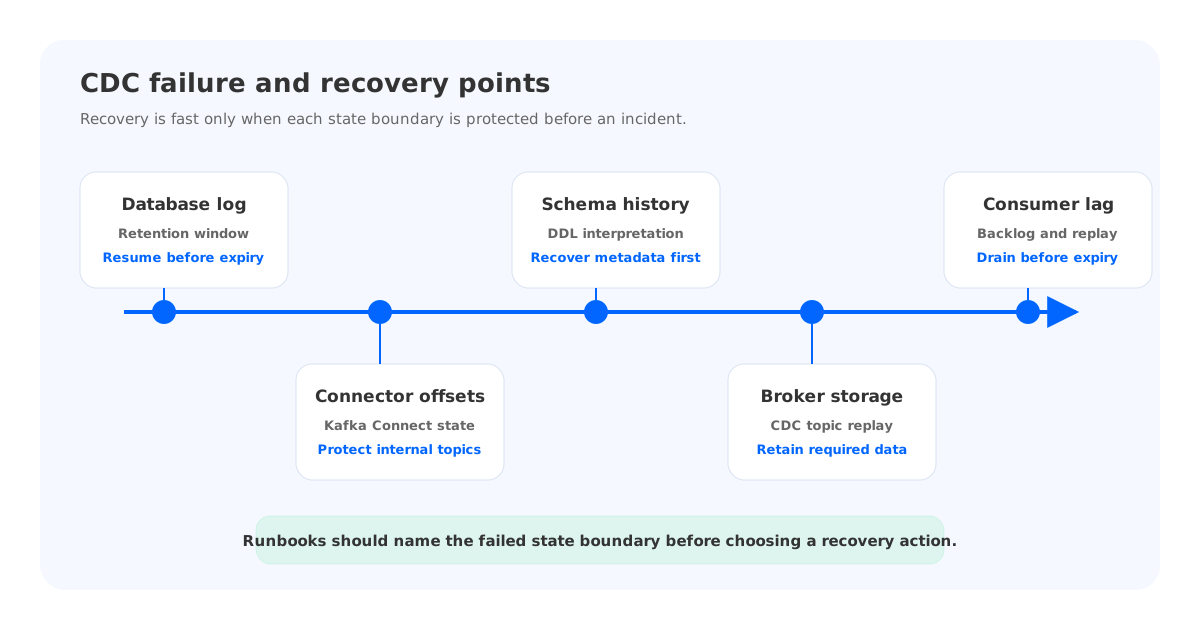
The most common recovery risks sit at five points:
- Database log retention: The connector must resume before the needed log position disappears from the source system.
- Connector offsets: Offset loss or corruption can force a restart strategy decision instead of a routine resume.
- Schema history: Consumers and connectors need enough schema context to interpret changes across DDL evolution.
- Broker storage: Kafka must retain CDC data and internal metadata long enough for consumers and connectors to recover.
- Consumer backlog: Slow consumers can turn a connector recovery into a full replay and catch-up event.
The operational mistake is treating these as independent knobs. Increasing Kafka retention helps consumers replay, but it does not preserve source database logs. Increasing database log retention helps Debezium resume, but it does not protect Kafka Connect internal topics. Adding Connect workers helps only if task execution is the bottleneck.
A practical CDC runbook should describe recovery by failure point. If a connector crashes and the database log position is still available, resume from offsets. If the schema history topic is missing, decide whether it can be reconstructed safely before restarting. If Kafka no longer has data required for replay, treat it as a data recovery problem, not a consumer tuning exercise.
4Retention and Storage Cost in CDC Workloads
CDC topics can look small per record but large in aggregate. A database with frequent updates emits row state, metadata, transaction information, and serialized schemas depending on configuration. Deletes and tombstones may be needed for compaction semantics. Multiple consumers may ask for longer retention because replay is the safest way to rebuild derived state.
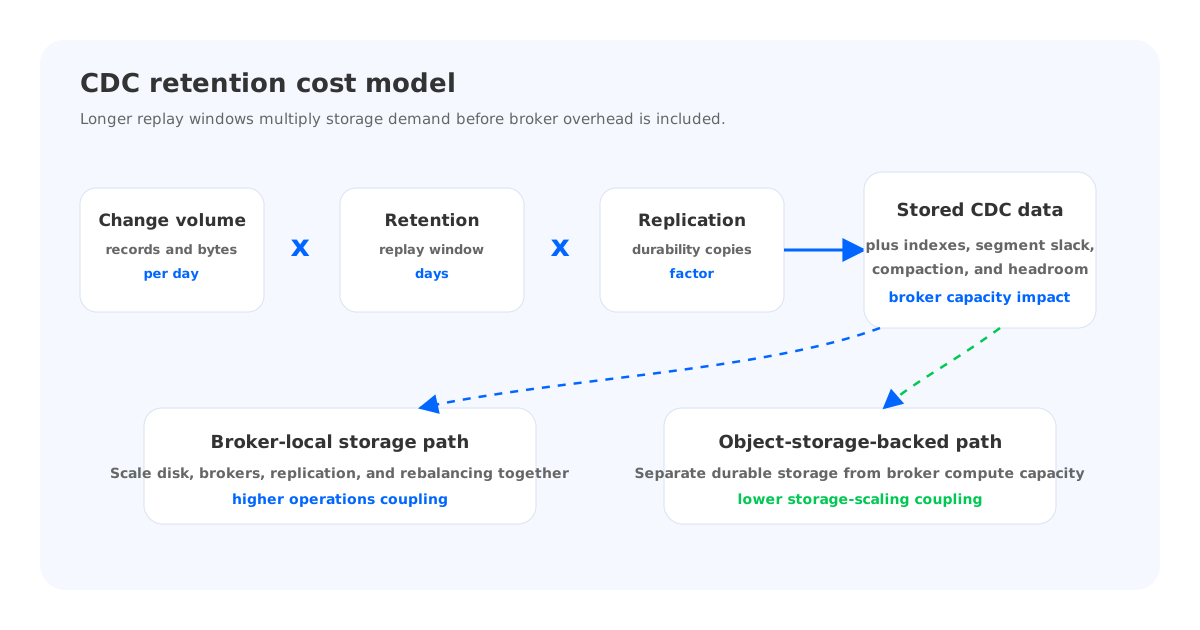
Kafka retention cost is a function of change volume, retention duration, replication factor, and storage implementation. In a conventional self-managed Kafka cluster, durable data is stored on broker-local disks and replicated across brokers. A rough planning model is:
stored data = daily change volume x retention days x replication factor
That formula omits filesystem overhead, indexes, segment slack, compaction behavior, compression ratio, cross-zone transfer, and over-provisioned broker capacity. It still shows why CDC growth creates a different cost profile from short-lived event streams.
Consider what happens when a team keeps extending retention. One consumer team wants replay for lake ingestion. Another wants enough history to rebuild a search index. A compliance-adjacent workflow asks for longer auditability, even if Kafka is not the final system of record. Each request may be reasonable. Together, they turn Kafka from a transport layer into a replay store for database history.
This is where self-managed Kafka and Connect start to feel misaligned with CDC growth. Brokers need enough local disk for retained records, network for replication, CPU for compression and fetches, and headroom for snapshots and catch-up reads. Scaling storage often means adding brokers or disks even when compute is not the bottleneck. Rebalancing partitions then moves data across the cluster during an already sensitive period.
5Managed CDC vs Kafka-Compatible Platform Modernization
Teams usually consider three paths after CDC becomes expensive to operate: managed CDC, managed Kafka Connect, or modernization of the Kafka platform beneath Debezium. They solve different problems.
Managed CDC services reduce connector operations. They can abstract source setup, task orchestration, retry behavior, and destination wiring. That is valuable when the main pain is connector lifecycle management. The tradeoff is control: teams may need to verify connector feature coverage, schema handling, network placement, security model, destination flexibility, and replay semantics.
Managed Kafka Connect keeps the Kafka-native integration model but reduces worker management. The team still designs CDC topics, consumer behavior, Kafka retention, and recovery. This path is useful when Debezium remains the right connector framework but platform engineers want fewer moving parts around worker deployment, plugin isolation, and task scheduling.
Kafka-compatible platform modernization addresses the storage and scaling layer. The team keeps the Kafka API, Kafka clients, Kafka Connect patterns, and Debezium architecture, but changes the infrastructure beneath Kafka so CDC retention and bursty workloads are less tied to broker-local disk expansion.
| Decision area | Managed CDC | Managed Kafka Connect | Kafka-compatible platform modernization |
|---|---|---|---|
| Connector operations | Lower | Lower | Similar unless paired with managed Connect |
| Kafka API control | Varies by service | Preserved | Preserved |
| CDC topic retention design | Often abstracted | Still owned by platform | Still owned, with different storage economics |
| Consumer replay model | Varies | Kafka-native | Kafka-native |
| Main problem solved | Connector burden | Worker and task management | Broker storage, scaling, and recovery cost |
The decision depends on where the pain sits. If the team cannot keep connector tasks healthy, manage the connector layer. If the team can run Debezium but Kafka retention, rebalancing, and storage growth are the limiting factors, the Kafka layer deserves attention.
6Where AutoMQ Fits for CDC on Kafka
AutoMQ fits the third path: Kafka-compatible platform modernization for teams that want to keep Kafka semantics while changing the storage architecture that makes CDC retention and scaling painful. AutoMQ is a Kafka-compatible streaming platform built around storage-compute separation and object storage. That means existing Kafka-oriented applications, clients, and ecosystem tools can remain relevant while broker-local disk is no longer the primary durable storage boundary.
For Debezium Kafka pipelines, the value is not that AutoMQ replaces Debezium. Debezium still captures database changes, and Kafka Connect or a managed Connect layer still runs connector tasks. The value is that CDC topics, replay windows, and catch-up traffic can sit on a Kafka-compatible platform designed around shared object storage and stateless brokers.
This matters in three CDC scenarios. Longer retention becomes less coupled to local disk sizing. Bursty events such as snapshots or backfills can be handled with more elastic broker capacity. Broker recovery and scaling no longer need to revolve around moving large amounts of partition data between local disks.
AutoMQ BYOC also offers managed Kafka Connect, which can be relevant when the team wants connector workers to run in its own network environment while reducing deployment and task-management burden. For database-adjacent workloads, network placement and data control often matter as much as convenience, because CDC connectors need access to systems such as RDS, Redis, and private services.
The architectural takeaway is simple: Debezium success creates Kafka requirements. Once CDC becomes a shared production platform, the bottleneck may no longer be the connector. It may be the retention, replay, and scaling model underneath Kafka. At that point, evaluating a Kafka-compatible object-storage-backed platform is a practical modernization path, not a detour from CDC.
7How to Design the Next CDC Architecture Review
Before changing tools, map the current pipeline by failure and cost domain. Start with the source database: log retention, connector permissions, snapshot policy, failover behavior, and schema changes. Then inspect Kafka Connect: worker mode, internal topic replication, plugin lifecycle, task parallelism, offset storage, and restart process. Then inspect Kafka: topic count, partition count, retention policy, compaction settings, storage growth, replication factor, broker utilization, and catch-up reads.
The review should produce decisions, not only diagrams:
- Which topics must be replayable, and for how long?
- Which consumers can rebuild from another source, and which depend on Kafka replay?
- Which connector offsets and schema history topics are protected as critical metadata?
- Which snapshots are allowed during business hours?
- Which scaling events require broker data movement today?
- Which parts of the platform should be managed, and which must remain under direct control?
This framing keeps CDC architecture honest. It avoids blaming Debezium for broker storage economics, blaming Kafka for database log retention, or blaming consumers for connector offset loss. It also gives platform teams a clean way to decide whether they need managed CDC, managed Connect, a Kafka-compatible platform change, or a phased combination.
8References
- Debezium source connector documentation
- Debezium PostgreSQL connector snapshots, streaming, offsets, and failure behavior
- Apache Kafka documentation
- Apache Kafka topic configuration documentation
- Apache Kafka Connect documentation
- AutoMQ architecture overview
- AutoMQ compatibility with Apache Kafka
- AutoMQ managed Kafka Connect overview
9FAQ
9.1Is Debezium a replacement for Kafka Connect?
No. Debezium provides CDC connectors, while Kafka Connect is the framework that runs connectors, coordinates tasks, and stores connector metadata in Kafka. Many Debezium Kafka deployments use Kafka Connect distributed mode so connector tasks can be managed across workers.
9.2Why does Debezium Kafka lag matter more than ordinary producer lag?
Debezium lag is tied to the source database change stream. If the connector falls behind long enough for required database log segments to disappear, the team may need a snapshot or other recovery process instead of a routine restart.
9.3Should CDC topics use compaction or time-based retention?
It depends on the consumer model. Compaction helps consumers read the latest state by key, while time-based retention supports change-history replay. Review delete handling, tombstones, and rebuild requirements before changing topic policy.
9.4When should a team consider managed CDC?
Managed CDC is worth considering when connector setup, source permissions, retry behavior, and operational ownership are the main pain points. Teams should still verify schema handling, replay semantics, network placement, and destination flexibility.
9.5When does AutoMQ become relevant to a Debezium Kafka architecture?
AutoMQ becomes relevant when the team wants to keep Kafka-compatible CDC pipelines but reduce the storage, scaling, and recovery burden created by broker-local disks. It is especially relevant when CDC retention windows, snapshots, and replay traffic are driving Kafka cost or operational risk.


