
Table of Contents
Table of Contents
Teams searching for event driven copilot kafka are usually not asking whether a chatbot can call an API. They are asking how to make a copilot react to the business as it changes: a customer opens a ticket, a payment fails, a deployment emits an error, a policy changes, a user abandons a workflow, or an agent tool produces a risky output. The copilot may look conversational at the edge, but the production problem underneath is a real-time data platform problem.
Kafka is a natural place to start because the semantics match the workload. Topics carry streams of business events, partitions preserve ordering where ordering matters, offsets give consumers a replay position, and Consumer groups let multiple services process the same feed independently. That is why the search phrase often includes both the application layer and the infrastructure layer. The harder question is whether the Kafka operating model can keep up when the copilot becomes a production system rather than a demo.
The useful design target is not "AI on Kafka" in the abstract. It is an Apache Kafka-compatible event backbone that can keep context fresh, survive bursty agent traffic, respect data boundaries, and migrate without forcing every application team to relearn the messaging layer.
1Why teams search for event driven copilot kafka
An event-driven copilot depends on signals that expire quickly. A support copilot needs the latest account state before suggesting a resolution. A developer copilot needs fresh incident telemetry before proposing a rollback. A revenue operations copilot needs current opportunity, usage, and billing events before recommending a next action. If those signals arrive through a nightly batch job, the copilot may produce a polished answer that is already stale.
Event streams solve the freshness side of the problem by making operational state observable as it changes. Producers write events once, and different consumers can build specialized views: retrieval indexes, feature stores, policy engines, alerting services, audit sinks, and human review queues. Kafka's offset model is especially important because AI systems often need replay. A team may need to rebuild an embedding index, re-run an evaluation job, reconstruct an agent decision, or test a safer routing policy against historical traffic.
The search also reflects a platform ownership question. Application teams want to ship copilots, but platform teams own the durability, retention, scaling, compliance, and migration surface. Once the copilot reads from the stream, streaming incidents become user-facing AI incidents. A delayed consumer is no longer a dashboard gap; it can change what the copilot says or does.
2The production constraint behind the problem
The first constraint is latency of context, not only message latency. A produce request may be fast, but the copilot still sees stale context if downstream consumers cannot keep up, if replay takes too long, or if a batch enrichment path is treated as the source of truth. The architecture needs to protect the whole loop: event capture, stream processing, state materialization, retrieval, policy evaluation, and audit.
The second constraint is elasticity. Copilot workloads are uneven. A product launch, abuse campaign, incident, synthetic evaluation run, or marketing event can create sharp traffic swings. Traditional Kafka can scale, but in a Shared Nothing architecture the broker owns local durable data. Capacity changes are therefore entangled with partition placement, retained log segments, replica movement, and disk provisioning. The platform can handle that with enough operational skill, but it often leads to conservative overprovisioning because adding capacity at the moment of pressure is harder than adding compute.
The third constraint is governance. Copilot events can contain prompts, tool inputs, customer identifiers, model outputs, policy decisions, and human feedback. That data may need to remain inside a specific cloud account, VPC, region, or data center. The streaming layer therefore has to fit the security model, not the other way around. A design that looks elegant in an architecture diagram can fail review if the data path crosses a boundary the business cannot accept.
These constraints interact. Freshness pushes teams toward event streaming. Elasticity determines whether streaming can absorb bursts without long manual intervention. Governance determines where the platform can run and who controls the data. Evaluating any Kafka-compatible platform for copilots means keeping all three in the same conversation.
3Architecture options and trade-offs
The baseline option is self-managed Apache Kafka. It gives teams deep control and broad ecosystem compatibility. The official Apache Kafka documentation remains the right reference for core behaviors such as consumers, offsets, transactions, Kafka Connect, KRaft metadata, and Tiered Storage. For teams with strong Kafka operations experience, self-management can be a rational choice because every layer is inspectable and tunable.
That control has a cost. Platform teams own broker sizing, storage provisioning, multi-AZ topology, upgrades, partition reassignment, failure drills, and client tuning. Those tasks are not paperwork; they shape whether a copilot sees fresh context during a burst. When durable data is bound to broker-local storage, scaling decisions become storage decisions. Adding brokers is not only adding request-handling capacity. It may also mean redistributing partitions and moving retained data across the cluster.
Managed Kafka services reduce some operational work, and they can be useful when the primary goal is a standard Kafka API with less infrastructure management. The key question is where the managed service boundary sits. If the service still exposes the same local-storage operating model, the platform team may still need to plan around storage-heavy scale events, long retention, cross-AZ traffic, and recovery behavior. If governance requires customer-controlled network, IAM, encryption, and storage boundaries, the managed model needs a careful data-path review.
Tiered Storage deserves a fair place in the evaluation. It can move older log segments to remote storage while keeping recent data local, which helps long retention and replay economics. It does not make brokers stateless. Hot data, leader placement, and broker recovery still matter because the recent write path remains tied to the broker fleet. For copilot workloads, Tiered Storage can help with history, but it does not remove the need to reason about burst handling, hot partitions, and the operational cost of scaling.
The deeper architectural difference is Shared Nothing architecture versus Shared Storage architecture. In Shared Nothing architecture, each broker manages local durable data and coordinates replication with other brokers. In Shared Storage architecture, durable data lives in shared object storage, while brokers focus on protocol handling, leadership, caching, and scheduling. The difference is not a marketing label; it changes what happens during scale-out, scale-in, failure recovery, and migration.
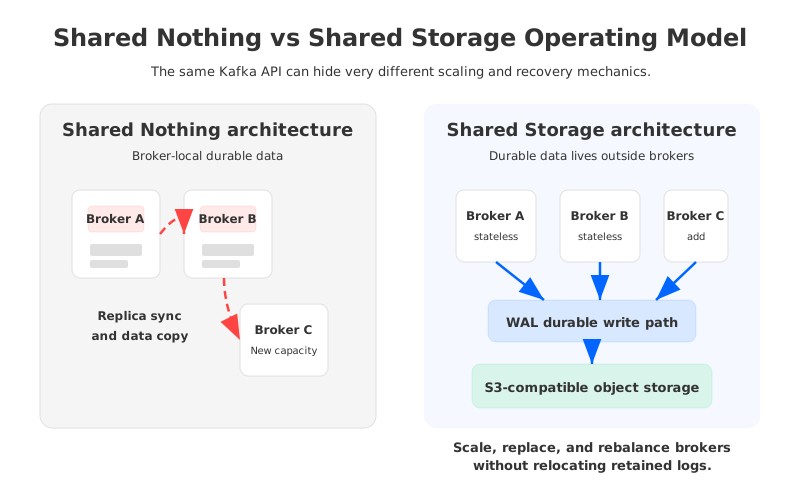
No option removes trade-offs. Shared Storage architecture still needs a durable write path that can acknowledge records safely, a cache strategy for hot reads, and a catch-up path for replay. The point is to evaluate the operating model directly. Does adding capacity require copying retained logs, or can brokers be added as compute? Does recovery depend on rebuilding local disks, or can ownership move to another broker? Does the platform preserve Kafka client behavior while changing the storage layer underneath?
4Evaluation checklist for platform teams
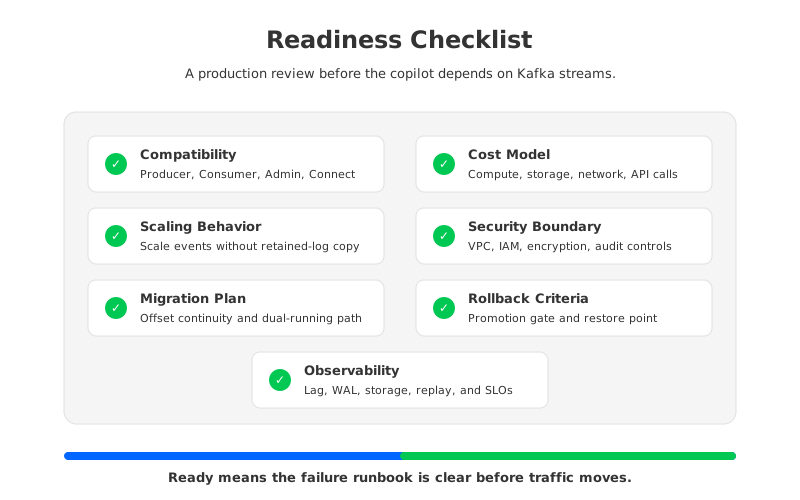
The most useful review starts with failure modes rather than feature names. Imagine the copilot receives a sudden tool-call burst, a consumer falls behind, a broker fails, a security team asks for proof of data residency, and a migration has to roll back. If the runbook depends on long data movement, unclear offset behavior, or a batch copy that trails the stream, the architecture is carrying risk that will surface under production pressure.
Use the matrix below to keep the review grounded:
| Evaluation area | What to verify | Why it matters for copilots |
|---|---|---|
| Kafka compatibility | Producer, Consumer, Admin, Connect, schema, auth, and client behavior | Existing applications and tools should move without a rewrite. |
| Freshness and replay | Consumer lag, offset continuity, replay windows, and state rebuild paths | Copilots need current context plus auditable history. |
| Elasticity | Broker scale-out, scale-in, partition reassignment, and rebalance behavior | Bursty agent traffic should not force permanent overprovisioning. |
| Cost model | Compute, storage, inter-AZ traffic, object storage operations, and retention | Copilot context grows fast when every prompt, tool call, and decision is retained. |
| Governance | VPC, IAM, encryption, audit logs, data residency, and control-plane boundary | AI telemetry can include sensitive user and business context. |
| Migration and rollback | Offset consistency, dual-running, cutover gates, and rollback criteria | A streaming migration should not corrupt downstream copilot decisions. |
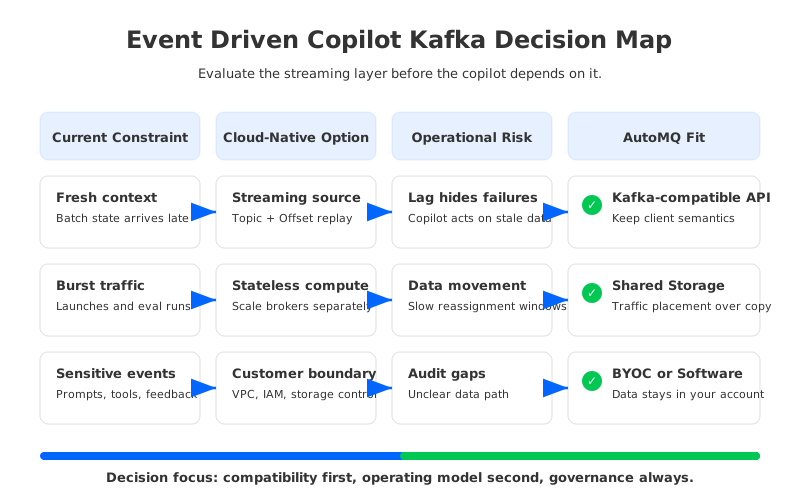
This matrix also prevents a common shortcut: treating Kafka API compatibility as the whole decision. Compatibility is necessary because it protects existing producers, consumers, stream processors, connectors, and operational tooling. It is not sufficient because a platform can accept Kafka clients while still imposing a scaling and recovery model that does not fit AI workloads. The proof is in the runbook: how many steps are required to add capacity, isolate a hot workload, recover a failed broker, retain more history, or replay a month of events into a new evaluator?
5How AutoMQ changes the operating model
After the neutral evaluation, the architecture requirement becomes clearer: keep Kafka semantics where applications depend on them, but reduce the amount of durable state tied to any single broker. AutoMQ is a Kafka-compatible streaming platform built around that idea. It keeps the Kafka API and ecosystem surface while replacing broker-local log storage with S3Stream and Shared Storage architecture.
In AutoMQ, brokers are stateless brokers in the storage sense: they handle Kafka protocol requests, leadership, caching, and scheduling, while durable stream data is placed in S3-compatible object storage. A WAL (Write-Ahead Log) layer provides the durable write path, and object storage becomes the main storage layer for retained data. That separation changes day-to-day operations. Scaling the broker fleet becomes less dependent on relocating retained logs. Recovery focuses on moving ownership and traffic rather than rebuilding local broker disks.
For event-driven copilots, that matters in four places. Freshness benefits when the platform can absorb bursts without making every capacity change a data migration. Replay benefits when retained history sits in shared storage rather than being scattered across broker disks. Governance benefits when AutoMQ BYOC or AutoMQ Software keeps control plane, data plane, and customer data inside the customer's cloud account or private environment. Migration benefits when Kafka-compatible clients can keep their familiar semantics while the platform team changes the storage and operating model underneath.
AutoMQ also provides features that map to production rollout concerns. Kafka Linking is designed for migration workflows that need byte-level message copying, offset continuity, and controlled cutover. Self-Balancing helps redistribute traffic as workloads shift. Table Topic can stream Kafka data into Apache Iceberg tables for analytical use cases when teams want copilot events to feed both operational systems and lakehouse analysis. These features are not a substitute for architecture review, but they reduce the number of custom runbooks a platform team has to build around the streaming layer.
The main design discipline is to test the same scenarios you fear in production. Create a high-cardinality copilot event topic. Run multiple Consumer groups: one for retrieval indexing, one for policy evaluation, one for audit, and one for analytics export. Force a lagging consumer to replay. Add and remove brokers. Validate that client authentication, schema handling, metrics, logs, and alerting remain usable. Then run the migration and rollback procedure before the copilot becomes a dependency for user-facing decisions.
6FAQ
6.1Is Kafka a good fit for event-driven copilots?
Kafka is a strong fit when the copilot depends on ordered, replayable, real-time business events. It is less useful if the system only needs occasional batch refreshes or if every action can be answered from a single transactional database.
6.2What is the biggest Kafka design risk for copilot workloads?
The biggest risk is treating the copilot as an application feature while leaving the streaming layer as an afterthought. Once the copilot depends on fresh events, consumer lag, replay speed, scaling behavior, and data governance become part of the AI system's reliability model.
6.3Does Tiered Storage solve the scaling problem?
Tiered Storage can help with long retention by moving older segments to remote storage, but it does not make brokers stateless. Teams still need to evaluate hot data, leader placement, broker recovery, and partition movement.
6.4Where should AutoMQ appear in an evaluation?
AutoMQ should appear after the team has defined requirements for compatibility, freshness, elasticity, governance, migration, and rollback. It is an architectural option for teams that want Kafka-compatible semantics with a shared-storage operating model.
7References
- Apache Kafka Documentation
- Apache Kafka KIP-500: Replace ZooKeeper with a Self-Managed Metadata Quorum
- Apache Kafka KIP-405: Kafka Tiered Storage
- AutoMQ Architecture Overview
- AutoMQ Compatibility with Apache Kafka
- AutoMQ WAL Storage
- AutoMQ Kafka Linking Migration Overview
- AutoMQ Zero Cross-AZ Traffic Overview
If your copilot roadmap is forcing Kafka to become both a real-time context bus and a governance boundary, evaluate the operating model before traffic moves. To review AutoMQ for a Kafka-compatible, customer-controlled deployment, start from AutoMQ Cloud.


